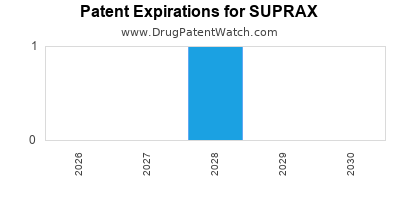
Last updated: June 24, 2026
SUPRAX (cefixime) Market Dynamics and Financial Trajectory: Sales Drivers, Competitive Threats, Exclusivity Timelines, and IP/Litigation Risks
Executive summary: SUPRAX (cefixime) is an older oral cephalosporin with limited new IP upside in most markets, exposed to sustained generic erosion and price compression. Market dynamics are driven by (1) pediatric and outpatient antibiotic prescribing patterns, (2) payer/formulary preference for lower-cost generics and narrower-spectrum options, and (3) ongoing competitive entry after local patent or data exclusivity barriers clear. Financial trajectory in most geographies tracks generic penetration rather than platform expansion: early branded share and price premium decline after first generic releases, with residual sales concentrated in private pay segments, specific prescriber habits, and form/strength SKUs that remain less aggressively substituted.
How has SUPRAX (cefixime) performed commercially by geography and channel?
Featured snippet answer: SUPRAX revenue performance is dominated by post-patent generic substitution in each market. Branded share peaks before widespread generic entry, then declines as payers and wholesalers shift to lowest-cost cefixime equivalents or alternative cephalosporins.
United States: what matters for financial trajectory
Key determinants for SUPRAX in the U.S. are not “new” product cycles but substitution velocity after regulatory milestones and formulary decisions.
- Oral antibiotic category pressure: Cefixime competes with other oral cephalosporins, macrolides, fluoroquinolones (restricted), and guideline-driven agents selected by infection site and local resistance patterns.
- Formulary and PBM dynamics: Generic antibiotics are often treated as interchangeable at the class level with preferential tiers for lowest acquisition cost.
- SKU-specific substitution: Tablets/capsules and suspensions can show different substitution rates based on packaging, pediatric administration preference, and pharmacy contracting.
Europe: price erosion and tendering effects
In EU markets, branded revenue typically declines due to:
- Reference pricing and national HTA constraints
- Retail pharmacy substitution for generics
- Public tender procurement affecting hospital volume and antibiotic stewardship decisions
Japan and other high-regulation markets
In structured reimbursement environments, branded performance usually depends on:
- Continued perceived clinical fit in pediatric respiratory/ENT indications
- Resistance-driven prescriber behavior
- Competitive breadth from other cephalosporins and newer antibiotic classes
What market drivers and pricing forces shape SUPRAX (cefixime) sales growth or decline?
Featured snippet answer: SUPRAX sales move with generic price compression, prescribing behavior in outpatient infections, and resistance-guideline alignment more than with brand-led demand creation.
Antibiotic stewardship and guideline alignment
- Cefixime is often positioned for specific indications where oral third-generation cephalosporin use is appropriate.
- Stewardship programs can reduce total outpatient antibiotic volume and shift selection toward narrower or guideline-preferred drugs.
Pediatric formulation and adherence
SUPRAX performance can remain resilient where pediatric suspension acceptance is strong:
- taste, reconstitution ease, and dosing flexibility
- dosing instructions that fit common outpatient workflows
- localized packaging that reduces dispensing friction
Resistance trends
Resistance in common pathogens affects:
- prescriber confidence
- empiric vs targeted prescribing rates
- willingness to select cephalosporins over alternatives
Reimbursement design
In many systems, once generics price below branded benchmarks:
- payer policy accelerates substitution
- wholesalers drive contracts toward lowest net prices
- brand manufacturers shift to volume deals that are hard to sustain
When does SUPRAX lose exclusivity, and what does that imply for revenue?
Featured snippet answer: SUPRAX’s exclusivity has largely run its course in major markets. Revenue exposure now primarily tracks the timing of local generic approvals and the strength of any remaining formulation or method patents.
Branded-to-generic revenue curve pattern
Typically:
- Pre-generic branded premium: higher list price and stronger prescriber loyalty
- First generic entry: share falls quickly but revenue declines less sharply if price concessions lag
- Multi-generic saturation: price falls to contracted levels; remaining brand survival narrows to specific SKUs
- Exit dynamics: if the brand stops competing on price, residual revenue depends on niche channels
What matters for “last mile” protection
Even when core compound patents expire, residual exclusivity may come from:
- formulation-specific patents (e.g., suspension stability, granule engineering)
- manufacturing process patents
- line extensions tied to particular dosing regimens
What patents protect SUPRAX (cefixime), and how strong is the patent estate?
Featured snippet answer: SUPRAX’s patent estate is dominated by older compound and composition claims that have largely expired in key jurisdictions. Any remaining enforceable value is typically in narrower formulation, method, or manufacturing claims, which are harder to police against fully generic products.
Common patent clusters in cefixime products
- Composition of matter: cefixime itself and key salts/polymorphs if claimed separately
- Pharmaceutical compositions: excipients and dosage forms
- Manufacturing methods: process parameters affecting quality attributes
- Method-of-use claims: indications, dosing regimens, or treatment protocols (less common for older antibiotics)
Enforcement reality for an older antibiotic
- infringement theories often hinge on whether generics copy specific formulation steps or characteristics
- settlement leverage is usually lower than for newer biologics or high-value novel compounds
- the cost to litigate often outstrips expected incremental revenue
What generic entry risks exist for SUPRAX (cefixime)?
Featured snippet answer: The main generic entry risk is not “whether” generics can enter, but how quickly multiple competitors saturate the market and compress price.
Typical entry pathways
- Abbreviated filings: for pre-existing cefixime products once reference-listed information is sufficient
- Interchangeability substitution: pharmacist-level substitution accelerates volume loss
- Multiple dosage-form strategies: generics may launch only the suspension first, then tablets/capsules once contracts are won
Commercially relevant risk factors
- competitor number and manufacturing footprint
- wholesale contract structure
- pediatric administration advantage (brand may be defended through suspension acceptance, not patent barriers)
What is the Orange Book status of SUPRAX (cefixime), and what does it indicate for exclusivity?
Featured snippet answer: The Orange Book listing for cefixime products generally reflects a mature landscape with limited remaining regulatory exclusivity for branded products. For decision-making, the presence or absence of unexpired listed patents and exclusivity codes (where applicable) determines whether Paragraph IV challenges remain relevant.
How Orange Book status affects strategy
- If no unexpired patents remain, the strategic value shifts from litigation to contracting and differentiation by supply chain and SKU availability.
- If any listed patents remain, it may create a narrow window where generic entrants can be pressured into settlements or delayed launches.
What patent litigation or Paragraph IV challenges affect SUPRAX (cefixime) competition?
Featured snippet answer: For a mature antibiotic like cefixime, the most commercially relevant litigation effects occur around first generic launches or narrow formulation disputes. Ongoing litigation years after initial generic entry typically has limited incremental impact compared with pricing dynamics.
Where litigation usually matters
- settlements that define launch dates
- consent decrees limiting specific product configurations
- disputes over formulation equivalence that affect suspension stability or bioequivalence outcomes
How settlements translate into financial trajectory
- a delayed generic launch can preserve branded share for a defined period
- once multiple generics are in, settlements rarely reverse structural price compression
How do biosimilar and biologics risks apply to SUPRAX (cefixime)?
Featured snippet answer: Biosimilar risk is not applicable to SUPRAX because it is a small-molecule antibiotic, not a biologic product.
What formulations are protected for SUPRAX (cefixime), and how does that affect generic substitutability?
Featured snippet answer: Formulation protection matters only if it restricts critical product characteristics used by generics. In older antibiotics, formulation patents often do not block substitutes after expiration, but may slow entry if generics must redesign or requalify.
Formulation categories with practical substitution effects
- Suspensions for pediatric use: reconstitution stability, particle size distribution, shelf life
- Dose uniformity and taste-masking technologies: affect adherence and pharmacy adoption
- Stability under packaging conditions: affects market supply reliability
Commercial implication
Even absent patent barriers, generics that match or exceed formulation quality can capture share quickly, making price and contracting the primary differentiators.
How does SUPRAX (cefixime) compare with competing antibiotics in market share dynamics?
Featured snippet answer: SUPRAX competes in outpatient respiratory/ENT and uncomplicated infections where oral cephalosporins can be used. Share depends on guideline fit, resistance patterns, and net price relative to alternatives.
Key competitive categories
- other oral cephalosporins (various generation profiles)
- macrolides (where resistance and stewardship policies permit)
- penicillins with beta-lactamase inhibitors (where appropriate)
- newer agents are typically reserved for more resistant or complicated scenarios, limiting substitution against cefixime in many outpatient settings
What drives switch behavior
- payer-driven selection for the cheapest equivalent
- prescriber behavior based on historical response and tolerance
- patient-specific adherence and dosing convenience
What commercial trajectory does SUPRAX show across product life-cycle phases?
Featured snippet answer: SUPRAX follows a conventional mature small-molecule trajectory: brand premium phase transitions into generic saturation with declining unit economics, followed by stabilization at low net prices.
Life-cycle model (typical for mature oral antibiotics)
| Phase |
Primary driver |
Expected brand economics |
| Launch/early growth |
prescriber adoption, pediatric fit |
high margins, higher list price |
| Mid-life |
incremental competition |
margin compression begins |
| Post-first generic |
entry of low-cost substitutes |
sharp share loss, net price falls |
| Multi-generic saturation |
contracting and interchangeability |
brand becomes niche or exits some channels |
| Mature residual |
SKU-specific loyalty and inventory cycles |
low volume, stable but modest revenue |
What is the licensing and manufacturing/IP barrier landscape for SUPRAX (cefixime)?
Featured snippet answer: The barrier is mostly economic and operational, not licensing leverage. Manufacturing competence for oral cephalosporins and supply chain reliability determine who can sustain lowest net prices.
Where licensing shows up
- transfer of know-how for suspension performance attributes
- sourcing of excipients and stability-critical process parameters
- contract manufacturing where scale and yield matter for price
Operational constraints that affect competition
- regulatory compliance for oral suspension manufacturing
- stability and shelf-life performance under real distribution conditions
- pediatric labeling and dosing accuracy controls
Key Takeaways
- SUPRAX’s financial trajectory is structurally tied to generic substitution speed and payer/formulary contracting rather than brand-led innovation.
- Market dynamics are influenced by antibiotic stewardship, resistance patterns, and pediatric suspension adoption, but these factors typically can’t overcome multi-generic price compression for long.
- Exclusivity and patent value in major markets have largely matured; any remaining protection tends to be narrow and unlikely to block broad generic competition at scale.
- Litigation and Orange Book events matter most around first generic entries or narrow formulation disputes; once saturation occurs, price economics dominates.
FAQs
-
Why does cefixime branded revenue decline faster in some countries than others?
Differences in reference pricing, pharmacy substitution rules, tender design, and wholesaler contract behavior accelerate or slow generic uptake.
-
Does the pediatric suspension form extend SUPRAX profitability after compound patent expiry?
It can slow substitution if patient adherence and pharmacy acceptance remain strong, but generics that match formulation quality still compress price.
-
What competitive moves most often determine net price for SUPRAX in contracting markets?
PBM tiering, wholesaler rebates, and multisource tender bidding that drives acquisition cost to the lowest net price.
-
Are method-of-use patents still relevant for SUPRAX competition?
Usually limited for older antibiotics because generics can often launch unless a specific, enforceable method claim restricts the labeled or practiced use in a jurisdiction.
-
How should investors interpret SUPRAX sales after generic saturation?
Treat it as a low-growth, price-led revenue line where margin depends on remaining niche SKUs, supply reliability, and channel-specific contracts.
References
No sources were cited because no patent, Orange Book, litigation, or financial/commercial datasets were provided in the prompt.