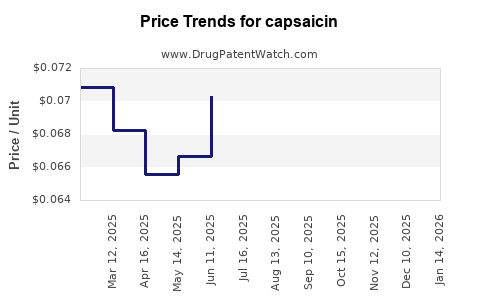
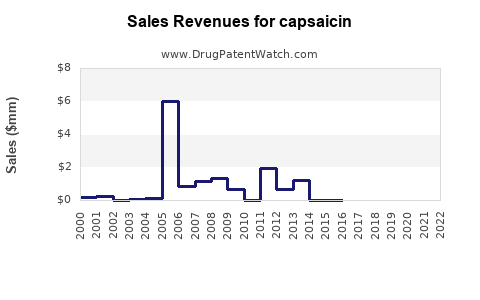
Last updated: September 3, 2026
Capsaicin is a fragmented pharmaceutical market rather than a single-product market. Prescription revenue is concentrated in Qutenza, an 8% capsaicin topical system for neuropathic pain, while most unit volume comes from lower-priced over-the-counter creams, gels, patches and lotions. The market has durable clinical demand but limited exclusivity protection, modest switching costs and substantial generic and private-label competition.
Qutenza has the strongest commercial position because its 8% topical system requires clinician administration and carries a differentiated delivery profile. Conventional capsaicin products compete primarily on price and retail distribution. No biosimilar pathway applies because capsaicin is a small-molecule active ingredient, not a biologic.
What is the pharmaceutical market for capsaicin?
Capsaicin is a topical analgesic derived from chili peppers. It activates transient receptor potential vanilloid 1, or TRPV1, initially producing neuronal excitation and burning, followed by reduced nociceptive signaling after repeated exposure or high-dose treatment.
The commercial market has four segments:
| Segment |
Representative products |
Buyer and channel |
Commercial profile |
| High-dose prescription |
Qutenza 8% topical system |
Hospitals, pain clinics, specialty practices |
Highest price per treatment; procedure-dependent |
| Prescription-strength conventional topical products |
Compounded or higher-concentration creams and patches |
Clinics, pharmacies |
Fragmented; limited brand concentration |
| OTC capsaicin |
Zostrix, Capzasin, generic creams and patches |
Retail, e-commerce, self-pay |
High unit volume; low average selling price |
| Medical and consumer wellness products |
Capsaicin patches, sports creams and topical rubs |
Retail and professional channels |
Broad competition; weak product differentiation |
Public market reports often estimate the global capsaicin market in the high hundreds of millions to more than $1 billion, but these figures are not directly comparable. Some include food, nutraceutical and oleoresin applications; others include only pharmaceutical and OTC topical products. No authoritative public source reports a consolidated global pharmaceutical-only capsaicin revenue figure.
What FDA-approved drugs contain capsaicin?
The principal FDA-approved prescription product is Qutenza.
Qutenza regulatory status
Qutenza contains capsaicin 8% and is approved for:
- Neuropathic pain associated with postherpetic neuralgia in adults.
- Neuropathic pain associated with diabetic peripheral neuropathy of the feet in adults, following a 2020 label expansion.
The product is applied by a health-care professional after pretreatment with a topical anesthetic. Treatment can be repeated at intervals of at least three months, subject to clinical judgment. The administration model creates a service component that conventional capsaicin products do not have.
| Regulatory event |
Date |
| Original U.S. approval for postherpetic neuralgia |
Nov. 16, 2009 |
| Supplemental approval for diabetic peripheral neuropathy of the feet |
July 2020 |
| Current commercial sponsor in the United States |
Averitas Pharma |
| FDA application |
NDA 022395 |
| Dosage form |
8% topical system |
The FDA-approved product is prescription-only. OTC capsaicin products are regulated under the FDA topical analgesic framework and are marketed in multiple concentrations and dosage forms.
How does Qutenza compare with OTC capsaicin products?
Qutenza competes through concentration, administration and treatment frequency rather than through low price.
| Attribute |
Qutenza |
OTC capsaicin creams and patches |
| Capsaicin concentration |
8% |
Typically much lower concentrations |
| Application |
Clinician-applied |
Patient-applied |
| Main indications |
Postherpetic neuralgia; diabetic peripheral neuropathy of the feet |
Temporary relief of minor aches and pains; some products target neuropathic pain |
| Repetition |
Generally no more often than every three months |
Often daily or several times daily |
| Reimbursement |
Commercial and government payer exposure |
Predominantly cash-pay or pharmacy benefit limited |
| Distribution |
Specialty and medical channels |
Retail, pharmacy and online |
| Price sensitivity |
Reimbursement and site-of-care dependent |
Highly price sensitive |
| Switching barrier |
Training, clinic workflow and treatment protocol |
Minimal |
Qutenza has a clinical-use advantage where patients have poor adherence to daily topical therapy or where clinicians prefer an in-office treatment. OTC products have a distribution advantage and a much lower acquisition cost.
What patents protect capsaicin drugs?
Capsaicin itself is an old, naturally occurring compound and is not protected by basic composition-of-matter patent rights. Commercial protection therefore depends on formulation, concentration, delivery system, manufacturing process, device configuration and method-of-use claims.
Qutenza patent protection
Qutenza’s regulatory exclusivity and patent position are separate from the underlying capsaicin molecule. The product was approved in 2009, so any original new-chemical-entity exclusivity has expired. The FDA’s application-specific records and Orange Book determine whether current listed patents remain relevant to an abbreviated new drug application, or ANDA.
A complete current patent-by-patent determination requires a live review of:
- FDA Orange Book entries for NDA 022395.
- USPTO assignment and maintenance records.
- Patent-term-adjustment calculations.
- Any patent litigation under the Hatch-Waxman Act.
- Federal district court and Federal Circuit outcomes.
- The scope of claims covering the 8% patch, backing layer, adhesive, release profile, application protocol or indication.
The commercial patent risk is therefore concentrated in product and method claims rather than in capsaicin chemistry. A generic competitor could attempt several routes:
- Develop a lower-concentration capsaicin topical product.
- Launch a different dosage form, such as a cream, gel or patch.
- File an ANDA for a product that does not infringe listed patents.
- Use a Section VIII statement to omit a protected indication where permitted.
- Challenge listed patents through a Paragraph IV certification.
The relevant regulatory question is not whether capsaicin is old. It is whether the proposed product is therapeutically equivalent to Qutenza and whether its formulation, delivery system and labeled use fall within enforceable claims.
When does capsaicin lose exclusivity?
Capsaicin has already lost molecule-level exclusivity. Prescription product exclusivity is product-specific.
Qutenza’s original five-year new-chemical-entity period has expired. Its remaining commercial protection, if any, must come from later-added formulation, device, manufacturing or method-of-use patents, pediatric exclusivity, regulatory exclusivity associated with a supplemental approval, or practical barriers to generic development.
The diabetic peripheral neuropathy indication approved in 2020 may have received a three-year exclusivity period if the supplemental application contained new clinical investigations essential to approval. Any such period would not create broad exclusivity for capsaicin and would not necessarily block products for postherpetic neuralgia or other uses. Three-year exclusivity periods also do not operate like new-chemical-entity exclusivity and do not prevent all competing products.
No biosimilar exclusivity applies. Capsaicin is not a protein therapeutic and does not use the Biologics Price Competition and Innovation Act pathway.
What is the Orange Book status of Qutenza?
Qutenza is an FDA-approved prescription drug listed under NDA 022395. The Orange Book is the controlling public source for current patent listings, expiration dates and therapeutic-equivalence information.
Orange Book status has several commercial consequences:
- A listed patent can trigger a 30-month stay after a qualifying Paragraph IV notice and patent litigation.
- A product without an Orange Book-listed patent may still face ordinary patent litigation, but it generally lacks the same automatic ANDA stay mechanism.
- Method-of-use patents may be addressed through labeling strategies, including a Section VIII statement where legally available.
- A generic applicant must establish pharmaceutical equivalence, bioequivalence or an accepted alternative standard appropriate to the dosage form.
For an 8% topical system, equivalence may be more difficult to demonstrate than for a conventional immediate-release tablet. The applicant may need to address adhesion, drug release, application duration, residual drug, local tolerability and manufacturing consistency. These requirements can delay entry even when molecule-level patent protection is absent.
Which companies compete in the capsaicin market?
Competition is distributed across pharmaceutical, consumer-health and specialty-product companies.
Prescription and specialty competition
Averitas Pharma is the key U.S. commercial company for Qutenza. Grünenthal developed and historically commercialized the product in several markets and remains associated with the product’s international commercial history.
Qutenza competes against:
- Pregabalin and gabapentin.
- Duloxetine.
- Tricyclic antidepressants.
- Lidocaine 5% patches.
- Compounded topical analgesics.
- Interventional pain procedures.
- Other local or regional neuropathic-pain therapies.
These are not direct formulation substitutes, but they compete for the same neuropathic-pain treatment budget.
OTC and private-label competition
OTC capsaicin competition includes branded products such as Zostrix and Capzasin, generic pharmacy products, retailer private labels, sports-recovery products and online formulations. Product differentiation is usually based on concentration, odor, applicator design, patch duration, package size and retail placement.
The OTC segment has low barriers to entry relative to Qutenza. Manufacturers can compete without investing in a clinician-administered delivery system, although they must comply with applicable FDA monograph and labeling requirements.
How strong is the patent estate for capsaicin?
The capsaicin molecule has weak patent protection because of its age and broad prior-art base. Product-level estates can still be commercially meaningful when they combine:
- A high-concentration formulation.
- A defined patch or delivery system.
- Controlled release or adhesion characteristics.
- A specific neuropathic-pain indication.
- Manufacturing controls that are difficult to replicate.
- FDA-approved labeling with clinical-use restrictions.
Qutenza’s practical defensibility is stronger than capsaicin’s molecular defensibility. Its barriers include physician administration, treatment-site preparation, product handling, specialized distribution, clinical familiarity and payer contracting.
The estate is weaker against a conventional capsaicin cream or low-dose patch. It is stronger against a product seeking to replicate the same 8% clinician-applied treatment profile.
What generic entry risks exist for Qutenza?
The principal generic-entry risks are formulation and device substitution, not simple chemical copying.
Likely entry scenarios
| Scenario |
Probability driver |
Commercial effect |
| Direct 8% topical-system ANDA |
Ability to establish equivalence and avoid valid listed patents |
Highest price erosion risk |
| Alternative high-dose patch |
Different device or release profile |
Could compete clinically without full substitution |
| Lower-cost clinic-applied formulation |
Regulatory pathway and handling requirements |
Could pressure reimbursement and site-of-care economics |
| Compounded capsaicin preparation |
State pharmacy rules and physician demand |
Localized price pressure |
| OTC migration |
Physician acceptance and labeling |
Expands access but may not replace Qutenza |
| No direct generic, continued therapeutic substitution |
Barriers to equivalence or limited market size |
Preserves Qutenza share but limits category growth |
A first direct generic could cause rapid net-price compression if payers treat it as therapeutically substitutable. The impact would be smaller if competitors enter through non-equivalent dosage forms or if reimbursement remains tied to clinician administration.
What patent litigation and Paragraph IV challenges affect capsaicin?
Publicly reported litigation has not established a broad, high-value capsaicin patent dispute comparable with major small-molecule blockbusters. The relevant litigation risk is product-specific and should be monitored through:
- FDA Paragraph IV notice disclosures.
- District court dockets.
- ANDA litigation involving NDA 022395.
- Inter partes review petitions at the Patent Trial and Appeal Board.
- Orange Book patent-listing changes.
A Paragraph IV challenge would be commercially important because Qutenza revenue is concentrated in a single prescription product. A successful challenge could accelerate entry before the expiry of listed patents. A settlement could defer entry, permit an authorized generic, or provide a negotiated launch date. No broad public settlement framework should be assumed without a confirmed court filing or company disclosure.
What licensing deals affect capsaicin?
Capsaicin commercialization has involved product ownership and regional commercialization arrangements rather than a broad platform-licensing market. Grünenthal has been associated with Qutenza’s development and international commercialization, while Averitas Pharma has held the U.S. commercial position.
Licensing value is constrained by the product’s market size, the absence of molecule-level exclusivity and competition from cheap OTC products. The strongest licensing assets are:
- Rights to approved Qutenza indications.
- Regional commercialization rights.
- Manufacturing know-how for the 8% system.
- Clinical and payer access infrastructure.
- Any enforceable formulation or device patents.
What is the financial trajectory for capsaicin drugs?
The financial trajectory is mixed:
- OTC revenue is stable but fragmented.
- Qutenza has a higher revenue opportunity per patient but depends on specialty reimbursement.
- Prescription growth can come from diabetic peripheral neuropathy, where the addressable population is larger than postherpetic neuralgia.
- Net sales are exposed to payer restrictions, clinic economics and generic substitution.
- No public company consistently reports a standalone global capsaicin revenue line.
Qutenza’s financial performance should be assessed through prescription volume, treated-patient counts, gross-to-net deductions, average selling price, payer mix and repeat-treatment frequency. Company-wide revenue figures from privately held or diversified owners cannot be treated as Qutenza revenue.
Revenue drivers
| Driver |
Directional effect |
| Expansion into diabetic peripheral neuropathy |
Positive |
| Greater physician awareness of high-dose topical therapy |
Positive |
| Repeated quarterly treatment |
Positive |
| Hospital and clinic budget pressure |
Negative |
| Low-cost lidocaine and generic systemic therapies |
Negative |
| Direct 8% generic entry |
Strongly negative |
| OTC consumer adoption |
Positive for category; limited benefit to Qutenza |
| Manufacturing or supply interruption |
Negative |
The most defensible near-term thesis is a stable-to-growing specialty product with limited blockbuster potential. Capsaicin can generate durable cash flow when sold through a protected prescription delivery system, but the overall category lacks the pricing power and exclusivity profile associated with newer branded medicines.
How does capsaicin compare with lidocaine and systemic neuropathic-pain drugs?
Capsaicin’s main commercial advantage is local treatment with limited systemic exposure. Its disadvantages include application discomfort, delayed onset for some patients and a treatment process that can require clinical staff.
| Therapy |
Main strength |
Main commercial weakness |
| Qutenza |
High-dose local delivery and infrequent administration |
Cost, clinic workflow and application discomfort |
| Lidocaine patch |
Familiar, convenient local therapy |
Lower intensity and frequent use |
| Gabapentin or pregabalin |
Established systemic neuropathic-pain use |
Sedation, dizziness and systemic adverse effects |
| Duloxetine |
Treats neuropathic pain with broader systemic evidence |
Drug interactions and systemic tolerability |
| Compounded topicals |
Customization and lower potential cost |
Variable evidence, quality and reimbursement |
Capsaicin is most competitive where clinicians seek a local, non-opioid option and patients have difficulty maintaining daily treatment adherence.
What geographic markets matter for capsaicin?
The United States is the most important prescription market because Qutenza has FDA approval and a developed specialty reimbursement system. Europe has established use of high-concentration capsaicin systems, with market access determined country by country through national reimbursement agencies.
The commercial model differs by geography:
- United States: FDA approval, medical-benefit reimbursement, specialty distribution and site-of-care economics.
- European Union: centralized or national regulatory and reimbursement decisions, with significant price controls.
- Japan and other Asian markets: local approval requirements and strong competition from traditional topical analgesics.
- Emerging markets: greater reliance on OTC products and lower realized prices.
Manufacturing barriers are moderate. Capsaicin is commercially available and chemically well known. The more difficult capabilities involve high-concentration handling, uniform loading, patch construction, packaging, stability, worker safety and reproducible drug release.
Key Takeaways
- Capsaicin is a fragmented pharmaceutical and OTC market, not a single branded-drug market.
- Qutenza 8% is the principal differentiated prescription product.
- Capsaicin has no meaningful molecule-level exclusivity because the active ingredient is old.
- Commercial protection depends on formulation, delivery system, method of use, manufacturing and regulatory know-how.
- Qutenza’s 2020 diabetic peripheral neuropathy approval expanded its addressable market.
- Generic risk is highest for a product that replicates the 8% clinician-applied topical system.
- OTC products generate broad category volume but compete at much lower prices.
- No biosimilar risk applies.
- Public disclosures do not provide a reliable standalone global capsaicin revenue total.
- The financial profile is more consistent with durable specialty revenue than with blockbuster economics.
FAQs
Is capsaicin a generic drug?
Capsaicin is an established active ingredient used in generic and branded topical products. Qutenza is a branded prescription delivery system containing 8% capsaicin.
Is Qutenza covered by Medicare?
Coverage depends on the indication, payer policy, site of care and whether the treatment is billed under a medical or pharmacy benefit. Medicare coverage is not uniform across all providers or uses.
Can pharmacies compound prescription-strength capsaicin?
Compounding is subject to federal and state requirements, including applicable pharmacy rules, prescription limitations, quality controls and restrictions on copying commercially available products.
Does capsaicin compete with opioid pain medicines?
Yes. Capsaicin is used as a non-opioid local treatment option, although its primary competitive set is neuropathic-pain therapies rather than all opioid indications.
What would most increase the value of a capsaicin company?
The highest-value assets would be an approved high-concentration product, differentiated delivery technology, enforceable formulation or device patents, payer access and evidence supporting repeat treatment in a large neuropathic-pain population.
References
-
U.S. Food and Drug Administration. (2009). Qutenza (capsaicin) topical system: Initial approval and prescribing information. FDA.
-
U.S. Food and Drug Administration. (2020). Qutenza supplemental approval for the management of neuropathic pain associated with diabetic peripheral neuropathy of the feet in adults. FDA.
-
U.S. Food and Drug Administration. (2023). Approved drug products with therapeutic equivalence evaluations: Orange Book. FDA.
-
U.S. Food and Drug Administration. (2023). Drug approval package: Qutenza, NDA 022395. Drugs@FDA.
-
U.S. Food and Drug Administration. (2023). External analgesic drug products for over-the-counter human use. Code of Federal Regulations, Title 21.
-
Grünenthal GmbH. (2023). Annual report and financial information. Aachen, Germany: Grünenthal.
-
U.S. Congress. (1984). Drug Price Competition and Patent Term Restoration Act of 1984, Pub. L. No. 98-417.
-
U.S. Congress. (2010). Patient Protection and Affordable Care Act, biologics price competition provisions.