Last updated: September 7, 2026
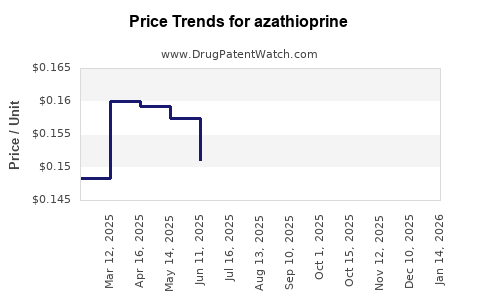
Azathioprine is a mature, low-cost immunosuppressant with limited commercial growth potential. Its market is driven by chronic use in transplant medicine, rheumatoid arthritis, inflammatory bowel disease, autoimmune disorders, and selected dermatologic and rheumatologic conditions. Generic competition has eliminated brand-level pricing power, while supply continuity, manufacturing quality, and hospital contracting determine commercial performance.
The original Imuran and Azasan franchises have lost meaningful exclusivity. Azathioprine has no biosimilar pathway because it is a synthetic small molecule, and generic entry has been established for decades. Financial value now resides in manufacturing scale, reliable supply, portfolio breadth, channel access, and niche formulations rather than patent exclusivity.
What is azathioprine used for and how large is its clinical market?
Azathioprine is an immunosuppressive purine antimetabolite. It is converted in vivo to 6-mercaptopurine metabolites that interfere with purine synthesis and lymphocyte proliferation.
The U.S. FDA-approved uses are narrower than current clinical practice. The approved label covers:
- Adjunctive prevention of rejection in renal homotransplantation.
- Management of severe rheumatoid arthritis in patients who have failed other therapies.
Physicians also use azathioprine in inflammatory bowel disease, including Crohn's disease and ulcerative colitis, autoimmune hepatitis, systemic lupus erythematosus, myasthenia gravis, vasculitis, dermatologic autoimmune disease, and other immune-mediated conditions. Many of these uses are off-label in the United States but supported by specialty guidelines and long clinical experience.
Core demand drivers
| Demand driver |
Market effect |
| Renal transplantation |
Creates chronic, protocol-driven demand |
| Inflammatory bowel disease |
Supports long-duration maintenance use, although biologics have reduced use in some patients |
| Rheumatoid arthritis |
Historical indication; methotrexate and biologic therapies limit demand |
| Autoimmune hepatitis |
Preserves a specialist-led maintenance market |
| Pregnancy and breastfeeding considerations |
Can support use where clinicians seek established pregnancy experience, subject to current clinical guidance |
| Low cost |
Maintains use in price-sensitive health systems |
| Therapeutic familiarity |
Supports continued prescribing despite newer alternatives |
Azathioprine demand is relatively defensive because many patients remain on treatment for years. Volume is more stable than revenue. New-patient growth is constrained by competition from biologics, targeted synthetic drugs, mycophenolate, methotrexate, tacrolimus, and corticosteroid-sparing alternatives.
How does azathioprine compare with competing immunosuppressants?
Azathioprine competes across several therapeutic segments rather than against a single replacement product.
| Drug or class |
Main competitive relationship |
Commercial effect on azathioprine |
| Mycophenolate mofetil and mycophenolic acid |
Major transplant alternatives |
Reduces first-line transplant use in many protocols |
| Tacrolimus and cyclosporine |
Calcineurin inhibitors used in transplant regimens |
Usually complementary rather than direct substitutes |
| Methotrexate |
Rheumatoid arthritis and autoimmune disease |
Limits use in rheumatology |
| Biologic TNF inhibitors |
Inflammatory bowel disease and rheumatoid arthritis |
Captures patients requiring higher-efficacy therapy |
| Vedolizumab and ustekinumab |
Inflammatory bowel disease |
Reduces reliance on thiopurine monotherapy |
| JAK inhibitors |
Autoimmune and inflammatory diseases |
Competes for patients with moderate-to-severe disease |
| 6-mercaptopurine |
Closely related thiopurine |
Alternative in inflammatory bowel disease and oncology |
| Mycophenolate |
Autoimmune and transplant use |
Gains preference in several specialty protocols |
Azathioprine remains relevant where low acquisition cost, oral administration, long-term clinician experience, and steroid-sparing treatment are priorities. Its competitive position is weaker in diseases where rapid induction of remission or high efficacy is required.
What is the FDA regulatory status of azathioprine?
Azathioprine is an FDA-approved small-molecule prescription drug available in oral tablets and injectable presentations. U.S. marketed products include generic azathioprine tablets and historical branded products such as Imuran and Azasan.
The FDA labeling identifies clinically important risks, including:
- Bone-marrow suppression.
- Leukopenia, thrombocytopenia, and anemia.
- Hepatotoxicity.
- Serious infection.
- Increased risk of malignancy with chronic immunosuppression.
- Interaction with allopurinol and febuxostat.
- Increased toxicity in some patients with reduced TPMT or NUDT15 activity.
TPMT and NUDT15 testing can inform risk management, although testing does not eliminate the need for blood-count and liver-function monitoring. These safety requirements create clinical friction but also support continued use in specialist settings where monitoring systems are established.
FDA milestone timeline
| Period |
Event |
| 1950s |
Azathioprine developed as a thiopurine immunosuppressant related to 6-mercaptopurine |
| 1960s |
U.S. regulatory approval of the original Imuran product |
| 1980s-1990s |
Expanded generic availability and broad clinical adoption |
| 2000s |
Oral generic products became standard in many markets |
| 2010s |
Increased emphasis on TPMT and later NUDT15-related toxicity risk |
| Current market |
Mature generic market with low unit prices and multiple suppliers |
The original approval and product history are documented in FDA labeling and Drugs@FDA records. Current regulatory status depends on the specific manufacturer, strength, dosage form, and market authorization.
What patents protect azathioprine, and when did exclusivity expire?
Azathioprine is an old active pharmaceutical ingredient. The original composition-of-matter and early product rights expired many years ago. The commercial market is not protected by a live foundational patent covering azathioprine itself.
Patent and exclusivity position
| Protection category |
Current commercial relevance |
| Original compound patent |
Expired |
| Original Imuran product rights |
Expired |
| New-drug exclusivity |
Expired |
| Generic tablet products |
Long-established |
| Formulation patents |
No widely recognized blocking formulation estate for standard tablets |
| Method-of-use patents |
No broad, commercially dominant method-of-use barrier |
| Manufacturing patents |
Potentially relevant to individual suppliers, but not a market-wide barrier |
| Orphan exclusivity |
Not a central feature of the current azathioprine market |
| Biosimilar exclusivity |
Not applicable to a synthetic small molecule |
The Orange Book is relevant for identifying current listed patents and exclusivity for approved products. Azathioprine's mature generic status means the commercial analysis is primarily one of abbreviated new drug application competition, manufacturing compliance, and supply continuity rather than Paragraph IV litigation.
What is the Orange Book status of azathioprine?
Azathioprine products have historically been listed in the Orange Book under approved brand and generic product records. The key commercial point is that standard azathioprine tablets are established multisource products with no apparent active patent barrier preventing ordinary generic competition.
An abbreviated new drug applicant generally relies on the reference listed drug's safety and efficacy findings and must demonstrate pharmaceutical equivalence and bioequivalence. The applicant may need to address any listed patents or exclusivity associated with the relevant reference product, but the legacy azathioprine market does not present the type of late-life Orange Book patent thicket seen with newer specialty drugs.
Orange Book status can differ by dosage form, manufacturer, and reference product. The FDA's Approved Drug Products with Therapeutic Equivalence Evaluations remains the controlling source for current therapeutic-equivalence codes and listed patent information. [1]
Are there Paragraph IV challenges or azathioprine patent lawsuits?
Paragraph IV litigation is not a major current feature of the azathioprine market. The principal generic competition was established long ago, and the commercial value of challenging a remaining azathioprine patent would be limited because:
- The active ingredient is old.
- Standard tablets are commoditized.
- Multiple generic suppliers already compete.
- Average selling prices are low.
- A litigation victory would not create durable market exclusivity unless a meaningful formulation or use patent remained enforceable.
No major current patent dispute is central to the U.S. azathioprine market based on the established generic product history and the absence of a recognized blocking patent estate. Litigation risk is more likely to arise from product liability, manufacturing compliance, recalls, or supply contracts than from core composition patents.
Settlement agreements and authorized generics
Settlement agreements are not a material value driver for ordinary azathioprine tablets. Authorized-generic strategies could occur as part of a broader legacy portfolio, but they would not create the launch dynamics associated with a first generic to market. Competition is already distributed among established manufacturers.
What formulations are protected by azathioprine patents?
The principal commercial dosage forms are oral tablets, commonly including 25 mg, 50 mg, and 100 mg strengths, depending on the manufacturer and country. Injectable azathioprine has also been marketed for clinical settings where oral administration is not appropriate.
Standard tablet formulations have low differentiation. Potential technical barriers can include:
- Tablet stability.
- Content uniformity at low doses.
- Dissolution and bioequivalence.
- Packaging against moisture and light.
- Control of impurities and degradation products.
- Sterile manufacturing for injectable products.
- Scale-up and process validation.
These are manufacturing and regulatory barriers rather than strong exclusivity barriers. A supplier may have proprietary processes or internal know-how, but such know-how generally does not prevent competitors from producing an equivalent product.
How strong is the azathioprine patent estate?
The patent estate is weak from a branded-product perspective and moderate only at the operational level.
| Patent-strength factor |
Assessment |
| Composition-of-matter protection |
Exhausted |
| Product exclusivity |
Exhausted |
| Standard tablet protection |
Weak |
| Method-of-use protection |
Fragmented and commercially limited |
| Manufacturing know-how |
Potentially useful but supplier-specific |
| Regulatory barriers |
Moderate because of quality and bioequivalence requirements |
| Supply-chain barriers |
More important than patents |
| Litigation leverage |
Low |
A generic manufacturer cannot rely on patent protection to support premium pricing. The stronger commercial defenses are supplier qualification, reliable active pharmaceutical ingredient sourcing, regulatory history, inventory, and distribution relationships.
What are the main generic entry and supply risks?
Generic entry is no longer a future event. It is the existing market structure. The main risks are operational:
- API shortages or dependence on a limited number of qualified suppliers.
- Manufacturing-site observations or FDA warning letters.
- Product recalls caused by impurities, dissolution failures, or labeling errors.
- Hospital formulary switching.
- Price erosion when additional suppliers enter.
- Discontinuation of low-volume strengths.
- Wholesaler consolidation.
- Foreign manufacturing disruptions.
- Demand spikes caused by shortages of competing immunosuppressants.
Azathioprine is not generally considered a high-growth product, but it can become commercially important during shortages of mycophenolate, methotrexate, or other immunosuppressants. That effect is episodic and does not normally support sustained pricing expansion.
What is the financial trajectory for azathioprine?
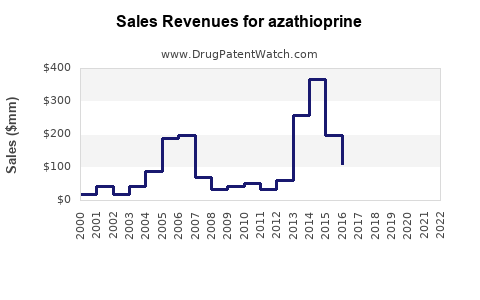
Azathioprine's financial trajectory follows the standard lifecycle of a mature generic:
| Phase |
Financial characteristics |
| Branded launch |
Premium pricing and concentrated revenue |
| Early generic entry |
Rapid price erosion and volume redistribution |
| Mature generic period |
Low unit prices, stable demand, thin margins |
| Current market |
Portfolio economics driven by scale, supply reliability, and channel access |
Public companies generally do not report azathioprine revenue separately. Sales are usually grouped within broader generic pharmaceuticals, hospital products, or specialty portfolios. As a result, a precise global azathioprine market size or manufacturer revenue ranking cannot be derived reliably from public company filings alone.
Revenue characteristics
Azathioprine has:
- Low average selling prices.
- High generic substitution.
- Limited promotional spending.
- Low likelihood of premium reimbursement.
- Stable but fragmented demand.
- Limited opportunity for lifecycle management.
- Greater margin sensitivity to manufacturing cost than to clinical demand.
Revenue growth, where it occurs, is more likely to result from unit-volume gains, geographic expansion, supply shortages, contract wins, or acquisition of a generic portfolio than from price increases.
For manufacturers, the product can still be attractive when produced on an existing oral-solid-dose line. Incremental contribution margins may be positive if the company has qualified API supply and sufficient plant utilization. The economics are less attractive for a new entrant that must build dedicated regulatory, pharmacovigilance, and distribution infrastructure for azathioprine alone.
Which companies are competing in azathioprine?
The market has included large generic manufacturers and regional suppliers. Depending on country and year, marketed products may be associated with companies such as:
- Teva Pharmaceuticals.
- Sandoz.
- Viatris and legacy Mylan operations.
- Hikma Pharmaceuticals.
- Sun Pharmaceutical Industries.
- Cipla.
- Accord Healthcare.
- Zydus Lifesciences.
- Regional hospital and generic suppliers.
The active supplier set changes over time because manufacturers discontinue low-margin products, transfer marketing authorizations, or consolidate portfolios. A company’s presence in one country does not establish current supply in another.
The competitive landscape is therefore best evaluated by:
- Current FDA product listings.
- National marketing authorization databases.
- Recent shortage notices.
- Wholesale availability.
- Manufacturer discontinuation announcements.
- Hospital contract participation.
How does azathioprine compare with mycophenolate and biologic therapies financially?
Azathioprine has much lower revenue per patient than newer immunosuppressive therapies. Mycophenolate products have also experienced generic price erosion, but their transplant and autoimmune use remains commercially significant. Biologics and targeted therapies generate far higher revenue per treated patient because of complex manufacturing, clinical differentiation, and residual exclusivity.
| Product category |
Relative price per patient |
Patent position |
Market growth |
| Azathioprine |
Low |
Expired |
Flat to declining in many segments |
| Generic mycophenolate |
Low to moderate |
Mostly expired or fragmented |
Stable in transplant |
| Branded biologics |
High |
Product-specific exclusivity |
Growth in selected diseases |
| Targeted synthetic drugs |
Moderate to high |
Active or recently expired rights |
Competitive growth |
| Tacrolimus products |
Low to moderate |
Generic, with formulation differences |
Stable transplant demand |
Azathioprine retains a role where clinical familiarity and low cost outweigh the efficacy advantages of newer agents. It does not compete effectively on revenue intensity.
Does azathioprine have biosimilar risk?
No. Azathioprine is a chemically synthesized small molecule, so biosimilar regulation does not apply. Its competitive risk comes from generic equivalents and therapeutic substitution.
The closest commercial substitutes are generic small molecules and branded biologics used in the same diseases. Biologics can reduce azathioprine use by moving patients toward higher-efficacy therapies, but they do not create a direct biosimilar threat to azathioprine.
What generic launch scenarios exist for azathioprine?
Because generic entry is established, the relevant scenarios concern supplier behavior rather than first entry.
Base case
Stable chronic demand, low pricing, and modest supplier turnover. Manufacturers retain the product as part of a broader generic portfolio.
Downside case
Price erosion, API inflation, regulatory remediation, or low utilization leads one or more suppliers to discontinue selected strengths. Market supply becomes more concentrated.
Upside case
A competitor exits, a shortage develops, or a distributor awards a supply contract. Remaining manufacturers gain temporary volume and improved capacity utilization.
Strategic case
A manufacturer uses azathioprine to complete an immunosuppressive portfolio that includes mycophenolate, tacrolimus, prednisone, or related hospital products. The product's value is then measured by portfolio access and account retention rather than standalone margin.
What is the geographic coverage of azathioprine?
Azathioprine is marketed internationally, although brand names, strengths, formulations, and approved indications vary. Imuran remains a recognized historical brand in several markets. Generic azathioprine is available in the United States, Europe, the United Kingdom, Canada, Australia, and many emerging markets, subject to national registration and supply conditions.
Geographic revenue is affected by:
- Public procurement and tender pricing.
- National generic-substitution rules.
- Transplant-center protocols.
- Availability of competing immunosuppressants.
- Local API and finished-dose manufacturing.
- Import controls.
- Pharmacovigilance and labeling requirements.
Emerging markets can offer volume growth but generally provide lower pricing and greater procurement sensitivity. Developed markets offer stronger reimbursement systems but more intense generic competition.
Key Takeaways
- Azathioprine is a mature generic immunosuppressant with stable clinical demand and limited revenue growth.
- The original compound, brand, and regulatory exclusivity rights have expired.
- Standard azathioprine tablets do not have a commercially meaningful patent barrier.
- Paragraph IV litigation and settlement activity are not central to the current market.
- Biosimilar risk is not applicable because azathioprine is a synthetic small molecule.
- The main competitors are mycophenolate, tacrolimus, methotrexate, 6-mercaptopurine, biologics, and targeted therapies.
- Financial performance depends on manufacturing scale, API supply, hospital contracts, and distribution.
- Revenue is rarely reported separately by public companies.
- Supply disruption and manufacturer exits are more important risks than patent expiry.
- The best commercial rationale is portfolio inclusion, not standalone premium pricing.
FAQs
Is azathioprine still commercially profitable?
It can be profitable when produced at scale on an established oral-solid-dose platform. Standalone economics are weak because prices are low and generic substitution is extensive.
Does azathioprine have an exclusivity date?
The original exclusivity period expired decades ago. Current products rely on generic approval rather than active market exclusivity.
Can a company obtain a new patent for an azathioprine formulation?
A company could pursue a patent for a genuinely novel formulation, manufacturing process, or delivery system. Such a patent would need to satisfy novelty, non-obviousness, and other applicable requirements. It would not restore exclusivity to ordinary azathioprine tablets.
Why do hospitals continue to purchase azathioprine?
Hospitals and transplant centers purchase it because it is familiar, orally available, inexpensive, and suitable for selected chronic immunosuppressive regimens.
Is azathioprine exposed to future price increases?
Large sustained price increases are unlikely in a fully generic market. Temporary price increases can occur after supplier exits, shortages, API disruptions, or hospital-contract changes.
References
- U.S. Food and Drug Administration. (2024). Approved drug products with therapeutic equivalence evaluations: Orange Book. https://www.fda.gov/drugsatfda
- U.S. Food and Drug Administration. (n.d.). Azathioprine prescribing information. DailyMed. https://dailymed.nlm.nih.gov/
- U.S. Food and Drug Administration. (n.d.). Drugs@FDA: FDA-approved drugs. https://www.accessdata.fda.gov/scripts/cder/daf/
- U.S. Food and Drug Administration. (2024). Generic drugs: Questions and answers. https://www.fda.gov/drugs/questions-answers-generic-drugs
- European Medicines Agency. (n.d.). Azathioprine-containing medicinal products and product information. https://www.ema.europa.eu/
- U.S. Food and Drug Administration. (2024). Drug shortages and discontinuations. https://www.accessdata.fda.gov/scripts/drugshortages/