Last Updated: April 29, 2026

Zoledronic acid - Generic Drug Details


✉ Email this page to a colleague

« Back to Dashboard


What are the generic drug sources for zoledronic acid and what is the scope of patent protection?

Zoledronic acid is the generic ingredient in four branded drugs marketed by Sandoz, Gland, Accord Hlthcare, Actavis Inc, Amneal, Apotex, Avet Lifesciences, Bpi Labs, Breckenridge, Chartwell Rx, Dr Reddys, Dr Reddys Labs Ltd, Epic Pharma Llc, Eugia Pharma, Fresenius Kabi Usa, Hikma Farmaceutica, Hospira, Hospira Inc, Inforlife, Meitheal, Mylan Labs Ltd, Novast Labs, Sagent Pharms Inc, Shilpa, Sun Pharma Global, USV, and Novartis, and is included in forty-one NDAs. There are two patents protecting this compound and three Paragraph IV challenges. Additional information is available in the individual branded drug profile pages.

Zoledronic acid has twenty-six patent family members in twenty-two countries.

There are twenty-five drug master file entries for zoledronic acid. Twenty-two suppliers are listed for this compound. There are eleven tentative approvals for this compound.

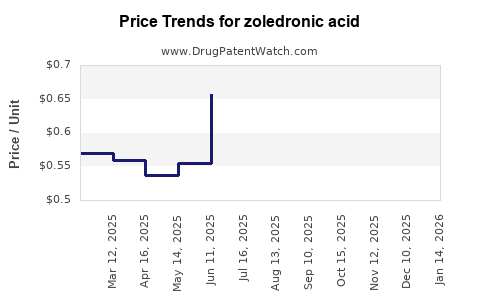
Drug Prices for zoledronic acid

See drug prices for zoledronic acid

Recent Clinical Trials for zoledronic acid

Identify potential brand extensions & 505(b)(2) entrants

SponsorPhase
National Taiwan University HospitalPHASE4
National Taiwan University Hospital, Yun-Lin BranchPHASE4
University of FloridaPHASE1

See all zoledronic acid clinical trials

Generic filers with tentative approvals for ZOLEDRONIC ACID
Applicant Application No. Strength Dosage Form
⤷  Start Trial⤷  Start Trial4MG/5ML(0.8MG/ML)INJECTABLE;INJECTION
⤷  Start Trial⤷  Start TrialEQ 4MG BASE/5MLINJECTABLE; IV (INFUSION)
⤷  Start Trial⤷  Start TrialEQ 4MG BASE/VIALINJECTABLE; IV (INFUSION)

The 'tentative' approval signifies that the product meets all FDA standards for marketing, and, but for the patents / regulatory protections, it would approved.

Pharmacology for zoledronic acid
Drug ClassBisphosphonate
Paragraph IV (Patent) Challenges for ZOLEDRONIC ACID
Tradename Dosage Ingredient Strength NDA ANDAs Submitted Submissiondate
ZOMETA Injection zoledronic acid 4 mg/100 mL, 100 mL vial 021223 1 2012-01-31
RECLAST Injection zoledronic acid 0.05 mg/mL, 100 mL vial 021817 1 2008-08-29
ZOMETA Injection zoledronic acid 0.8 mg (base) /mL 021223 1 2008-06-11

US Patents and Regulatory Information for zoledronic acid

Applicant Tradename Generic Name Dosage NDA Approval Date TE Type RLD RS Patent No. Patent Expiration Product Substance Delist Req. Exclusivity Expiration
Accord Hlthcare ZOLEDRONIC ACID zoledronic acid INJECTABLE;INTRAVENOUS 205279-001 Nov 28, 2016 AP RX No No ⤷  Start Trial ⤷  Start Trial ⤷  Start Trial
Amneal ZOLEDRONIC ACID zoledronic acid INJECTABLE;INTRAVENOUS 210174-001 Oct 27, 2017 AP RX No No ⤷  Start Trial ⤷  Start Trial ⤷  Start Trial
Dr Reddys Labs Ltd ZOLEDRONIC ACID zoledronic acid INJECTABLE;INTRAVENOUS 091363-001 Mar 29, 2013 AP RX No No ⤷  Start Trial ⤷  Start Trial ⤷  Start Trial
Inforlife ZOLEDRONIC ACID zoledronic acid INJECTABLE;INTRAVENOUS 202828-001 Sep 23, 2013 AP RX No No ⤷  Start Trial ⤷  Start Trial ⤷  Start Trial
>Applicant >Tradename >Generic Name >Dosage >NDA >Approval Date >TE >Type >RLD >RS >Patent No. >Patent Expiration >Product >Substance >Delist Req. >Exclusivity Expiration

Expired US Patents for zoledronic acid

Applicant Tradename Generic Name Dosage NDA Approval Date Patent No. Patent Expiration
Novartis ZOMETA zoledronic acid INJECTABLE;INTRAVENOUS 021223-002 Mar 7, 2003 4,777,163 ⤷  Start Trial
Sandoz RECLAST zoledronic acid INJECTABLE;INTRAVENOUS 021817-001 Apr 16, 2007 8,052,987 ⤷  Start Trial
Novartis ZOMETA zoledronic acid INJECTABLE;INTRAVENOUS 021223-001 Aug 20, 2001 4,777,163 ⤷  Start Trial
>Applicant >Tradename >Generic Name >Dosage >NDA >Approval Date >Patent No. >Patent Expiration

EU/EMA Drug Approvals for zoledronic acid

Company Drugname Inn Product Number / Indication Status Generic Biosimilar Orphan Marketing Authorisation Marketing Refusal
Accord Healthcare S.L.U. Zoledronic Acid Accord zoledronic acid EMEA/H/C/002667Prevention of skeletal related events (pathological fractures, spinal compression, radiation or surgery to bone, or tumour-induced hypercalcaemia) in adult patients with advanced malignancies involving bone.Treatment of adult patients with tumour-induced hypercalcaemia (TIH). Authorised yes no no 2014-01-16
Actavis Group PTC ehf   Zoledronic acid Actavis zoledronic acid EMEA/H/C/002488Prevention of skeletal-related events (pathological fractures, spinal compression, radiation or surgery to bone, or tumour-induced hypercalcaemia) in adult patients with advanced malignancies involving bone.Treatment of adult patients with tumour-induced hypercalcaemia. Authorised yes no no 2012-04-20
Mylan Pharmaceuticals Limited Zoledronic acid Mylan zoledronic acid EMEA/H/C/002482Prevention of skeletal related events (pathological fractures, spinal compression, radiation or surgery to bone, or tumour-induced hypercalcaemia) in adult patients with advanced malignancies involving bone;treatment of adult patients with tumour-induced hypercalcaemia (TIH). Authorised yes no no 2012-08-23
Pfizer Europe MA EEIG Zoledronic Acid Hospira zoledronic acid EMEA/H/C/0023654 mg / 5 ml and 4 mg / 100 ml:Prevention of skeletal-related events (pathological fractures, spinal compression, radiation or surgery to bone, or tumour-induced hypercalcaemia) in adult patients with advanced malignancies involving bone.Treatment of adult patients with tumour-induced hypercalcaemia (TIH).5 mg / 100 ml:Treatment of osteoporosis:in post-menopausal women;in men;at increased risk of fracture, including those with a recent low-trauma hip fracture.Treatment of osteoporosis associated with long-term systemic glucocorticoid therapy:in post-menopausal women;in men;at increased risk of fracture.Treatment of Paget's disease of the bone in adults. Authorised yes no no 2012-11-19
>Company >Drugname >Inn >Product Number / Indication >Status >Generic >Biosimilar >Orphan >Marketing Authorisation >Marketing Refusal

International Patents for zoledronic acid

Country Patent Number Title Estimated Expiration
Canada 2536206 PRODUITS PHARMACEUTIQUES CONTENANT DES BISPHOSPHONATES (PHARMACEUTICAL PRODUCTS COMPRISING BISPHOSPHONATES) ⤷  Start Trial
South Korea 101015718 ⤷  Start Trial
South Africa 200601209 Pharmaceutical products comprising bisphosphonates ⤷  Start Trial
Peru 20050468 PRODUCTOS FARMACEUTICOS QUE COMPRENDEN BISFOSFONATOS ⤷  Start Trial
>Country >Patent Number >Title >Estimated Expiration

Supplementary Protection Certificates for zoledronic acid

Patent Number Supplementary Protection Certificate SPC Country SPC Expiration SPC Description
0275821 01C0035 France ⤷  Start Trial PRODUCT NAME: ZOLEDRONIC ACID; NAT REG. NO/DATE: EU/1/01/176/001 20010320; FIRST REG.: LI IKS N 55 463 20001128
0275821 SPC/GB01/039 United Kingdom ⤷  Start Trial PRODUCT NAME: ZOLEDRONIC ACID OPTIONALLY IN THE FORM OF A SALT THEREOF; NATIONAL REGISTRATION NO/DATE: EU/1/01/176/001-003 20010320; FIRST REGISTRATION: CH 55463 20001128
1591122 132013902140458 Italy ⤷  Start Trial PRODUCT NAME: ACIDO ZOLEDRONICO(ACLASTA); AUTHORISATION NUMBER(S) AND DATE(S): EU/1/05/308/002, 20071003;57363, 20070927
0258618 SPC/GB01/042 United Kingdom ⤷  Start Trial PRODUCT NAME: ZOLEDRONIC ACID 2-(IMIDAZOL-1-YL)-1-HYDROXYETHANE-1,1-DIPHOSPHONIC ACID; REGISTERED: CH 55463 20001128; UK EU/1/01/176/001 20010320; UK EU/1/01/176/002 20010320; UK EU/1/01/176/003 20010320
>Patent Number >Supplementary Protection Certificate >SPC Country >SPC Expiration >SPC Description

Zoledronic Acid: Market Dynamics and Financial Trajectory

Last updated: April 24, 2026

Zoledronic acid is a high-volume, off-patent oncology and bone-disease injectable that has transitioned into a largely generic market dominated by price competition, manufacturing scale, and tender-driven procurement. Financial trajectory has tracked the broader loss of exclusivity across key geographies, with recurring demand anchored by metastatic bone disease, multiple myeloma-related skeletal events, and osteoporosis lines where use remains protocol-dependent. The market’s economics are defined by (1) patent expiry and ensuing generic penetration, (2) guideline persistence that sustains baseline demand, and (3) procurement and hospital formularies that compress prices as more suppliers qualify.

How large is the zoledronic acid market and what drives demand?

Zoledronic acid commercial demand is primarily tied to indications in oncology and bone health, with systemic use concentrated in hospital and oncology settings. The major demand drivers are:

  • Metastatic bone disease and skeletal-related events in oncology
  • Multiple myeloma-related bone disease
  • Osteoporosis and related fracture-risk reduction in bone-health pathways, with use governed by patient selection and reimbursement protocols

Clinical and regulatory history that supports ongoing protocol use:

  • The origin product, Zometa, is indicated for “prevention of skeletal-related events” in adults with multiple myeloma and bone metastases from solid tumors (labeling reflects the standard market use case). [1]
  • The origin product’s core role in skeletal protection explains demand durability even as pricing erodes. [1]

What market structure explains price erosion and revenue volatility?

Zoledronic acid is a classic late-stage model: high initial branded uptake, then market share redistribution after patent expiry through multi-source generics and biosimilar-like competition dynamics for small-molecule injectables.

Competition and pricing mechanics

  • Multi-source generic substitution compresses launch pricing and drives down net price over time.
  • Tender-based procurement in hospitals shifts buying power to payers and group purchasing organizations.
  • Supply chain scale becomes a differentiator because manufacturing economics dominate for low-margin generic oncology/bone injectables.

Evidence of multi-source competitive reality

A large global generic supplier profile supports the multi-sourcing condition:

  • Sandoz markets generic zoledronic acid in multiple territories (e.g., “Zoledronic acid Sandoz” product presence in Europe). [2]
  • Mylan/Viatris has branded and generic versions historically in major markets through label and distribution channels. [3] These market entries reflect the structural shift from single-source branded supply to a parallel generic stack.

Where does revenue come from across indications and geographies?

Revenue is not evenly distributed by indication because treatment patterns differ in frequency and patient mix.

Indication economics (qualitative, market-practice consistent)

  • Oncology skeletal protection: higher intensity of administration per eligible patient and strong hospital pull-through.
  • Multiple myeloma: persistent cohort-based demand because treatment lasts across cycles.
  • Osteoporosis: demand is sensitive to guideline specifics, fracture-risk stratification, and payer coverage rules.

Geography and channel effects

  • Europe: tendering, HTA constraints, and generic market density drive low net prices.
  • United States: generic competition plus payer formularies compress pricing faster post-Paragraph IV events (where they occur) and through wholesale channel discounting.
  • Emerging markets: demand growth can occur, but net prices remain constrained by regulatory pricing caps and procurement competition.

How has exclusivity loss shaped the financial trajectory?

Zoledronic acid has been on the market long enough that its branded exclusivity period has largely concluded in major markets. The financial trajectory thus follows a predictable arc:

  1. Branded ramp and consolidation
  2. Patent expiry and generic entries
  3. Price compression and volume reliance
  4. Continued market consolidation among qualified manufacturers

The market’s current state is consistent with origin-label status and multi-generic presence:

  • Origin labeling and long-term clinical adoption remain intact in drug information and prescribing references. [1]
  • Multi-supplier availability is visible via product-level presence by established generic brands. [2], [3]

What financial pattern should investors model: volume growth vs price decline?

For zoledronic acid, the investor model typically hinges on whether a supplier can sustain unit volume while navigating net price compression and increased competition.

A usable framework:

  • Net revenue = administered units x net price
  • After exclusivity loss, net price declines faster than units grow.
  • Sustainable performance depends on:
    • Manufacturing capacity utilization
    • Tender win rates
    • Portfolio breadth (ability to trade off margin between products)
    • Regulatory and quality continuity (reducing supply interruptions that trigger tender re-awards)

Given the market’s generic density, the financial trajectory is likely characterized by:

  • Lower margins
  • Higher importance of throughput and working capital discipline
  • Revenue concentration risk in a small number of high-volume hospital channels

What is the regulatory and label footprint that sustains baseline demand?

Zoledronic acid’s market persistence is driven by entrenched label content and clinician familiarity.

  • The origin product label defines use for prevention of skeletal-related events in multiple myeloma and bone metastases from solid tumors, which anchors ongoing prescribing in oncology pathways. [1]
  • Zoledronic acid’s role in skeletal event prevention maintains a stable treatment category even as procurement pressures intensify. [1]

How do tendering and reimbursement dynamics affect unit economics?

In hospital-centered injectable markets, tendering is often decisive for net price, and reimbursement is the gatekeeper for treatment continuity.

Common market dynamics:

  • Annual or multi-year procurement cycles lock in suppliers, but can be re-bid when new generics qualify.
  • Price transparency and substitution rules accelerate conversion from branded to cheapest eligible generic.
  • Wholesale channel competition can deepen discounting even when list prices remain stable.

The result for the financial trajectory:

  • Revenue becomes more sensitive to contract wins than to clinical adoption.
  • Supplier performance can swing sharply with procurement outcomes, even when underlying epidemiology is stable.

What supply chain factors determine whether manufacturers win financially?

Zoledronic acid is a sterile injectable where reliability and documentation matter as much as cost.

Key operational levers:

  • Sterile fill-finish scale and batch economics
  • Stability and logistics to maintain cold-chain or validated storage requirements (as applicable by product format and region)
  • Regulatory readiness for inspections, batch release timing, and complaint handling

Market experience in generic oncology injectables shows that suppliers with fewer disruptions win more tenders because pharmacy committees and procurement teams discount reliability risk.

What does the branded-to-generic transition imply for investors over time?

Investors modeling zoledronic acid’s financial trajectory should expect:

  • Near-term revenue durability due to treatment persistence and physician habits
  • Ongoing price compression as additional manufacturers gain market share and tenders re-price
  • Margin floor behavior where price approaches marginal cost plus minimal overhead for qualified manufacturing
  • Consolidation pressure leading to fewer profitable suppliers, but not necessarily reduced demand volume

This trajectory aligns with:

  • Continued availability of generic brands across major markets, indicating competition has moved from early entries to sustained multi-source supply. [2], [3]
  • Persistent origin labeling and treatment category continuity for skeletal-related event prevention in oncology. [1]

Competitive landscape: which companies matter and how does that affect money flows?

Zoledronic acid’s commercial outcomes depend on the competitive set in each market and how quickly each entrant can win procurement.

Observed multi-source landscape includes established generics players:

  • Sandoz presence indicates scale manufacturing and pricing aggressiveness typical of large generic portfolios. [2]
  • Mylan/Viatris presence indicates continued participation by major branded-generics platforms. [3]

How this affects money flows:

  • Large players can sustain price cuts due to broader amortization across portfolios.
  • Smaller entrants often compete on specific contract segments, which can create discontinuous revenue but lower fixed-cost exposure.

What is the net effect on financial performance: stable demand, declining profitability?

The financial profile implied by market structure is consistent with “stable demand, declining profitability.”

Mechanisms:

  • Clinical and label continuity keeps volume from collapsing.
  • Generic competition prevents price recovery.
  • Procurement and reimbursement reinforce “lowest cost for eligible quality” selection.

This leads to:

  • Revenue stability by volume with margin compression by price
  • Increased dependence on capacity and contract execution rather than innovation-driven pricing

Key indicators to track for ongoing trajectory

For ongoing monitoring of zoledronic acid financial direction, the most predictive indicators are:

  • Tender award outcomes (supplier share shifts and price resets)
  • Wholesale and ex-manufacturer pricing trends in key procurement regions
  • Competitive entry cadence in major markets (new qualified manufacturers)
  • Regulatory and supply continuity metrics (batch release delays, recalls, shortages)

These indicators tie directly to how generics markets create quarterly earnings swings despite stable underlying patient numbers.


Key Takeaways

  • Zoledronic acid is an off-patent, hospital-centric injectable where volume persists but net price compresses as generics expand and tenders reprice.
  • Demand is anchored by skeletal-related events prevention in multiple myeloma and bone metastases, reflected in the origin label’s established indications. [1]
  • The financial trajectory is dominated by generic multi-sourcing, contract procurement cycles, and manufacturing scale, with margin pressure as the primary economic outcome. [2], [3]
  • Supplier performance hinges on tender win rate, supply reliability, and cost structure, not on product differentiation.

FAQs

1) Is zoledronic acid revenue growth driven by new indications?

No. Market demand is supported by established skeletal-event prevention indications, while financial growth is more dependent on volume and market share under generic pricing pressure. [1]

2) Does the origin label help maintain market demand after generic entry?

Yes. The labeling that defines prevention of skeletal-related events keeps clinical use anchored, supporting baseline unit demand even as pricing erodes. [1]

3) Why does pricing fall faster than volume rises in zoledronic acid?

Generic substitution and tender-based procurement shift purchasing to the lowest eligible cost, typically outpacing any incremental volume gains. The multi-source supply environment confirms ongoing competitive pressure. [2], [3]

4) What operational factor most impacts financial outcomes for manufacturers?

Manufacturing scale and uninterrupted sterile injectable supply most directly influence tender re-awards and pharmacy confidence, which drive unit volume and revenue stability.

5) Who are the typical competitors in zoledronic acid?

Major generics platforms and scaled manufacturers, including Sandoz and Mylan/Viatris (via product presence and distribution), define the multi-source competitive set. [2], [3]


References

[1] Zometa (zoledronic acid) prescribing information. (Origin product labeling).
[2] Sandoz. Zoledronic acid product information (generic zoledronic acid presence in Europe).
[3] Mylan/Viatris. Zoledronic acid product information (generic zoledronic acid presence in major markets).

More… ↓

⤷  Start Trial

Make Better Decisions: Try a trial or see plans & pricing

Drugs may be covered by multiple patents or regulatory protections. All trademarks and applicant names are the property of their respective owners or licensors. Although great care is taken in the proper and correct provision of this service, thinkBiotech LLC does not accept any responsibility for possible consequences of errors or omissions in the provided data. The data presented herein is for information purposes only. There is no warranty that the data contained herein is error free. We do not provide individual investment advice. This service is not registered with any financial regulatory agency. The information we publish is educational only and based on our opinions plus our models. By using DrugPatentWatch you acknowledge that we do not provide personalized recommendations or advice. thinkBiotech performs no independent verification of facts as provided by public sources nor are attempts made to provide legal or investing advice. Any reliance on data provided herein is done solely at the discretion of the user. Users of this service are advised to seek professional advice and independent confirmation before considering acting on any of the provided information. thinkBiotech LLC reserves the right to amend, extend or withdraw any part or all of the offered service without notice.