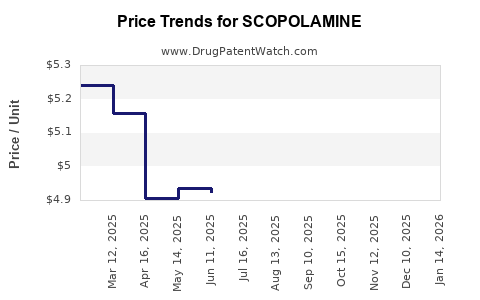
Last updated: September 8, 2026
Scopolamine is a mature anticholinergic drug with limited patent protection, established generic competition, and demand concentrated in transdermal patches for motion sickness and postoperative nausea and vomiting. The commercial market is stable rather than innovation-driven. Revenue depends on patch supply, generic pricing, hospital utilization, travel activity, and manufacturing reliability.
The branded product, Transderm Scop, no longer has meaningful basic-molecule exclusivity. The primary commercial risks are generic price erosion, supply interruptions, regulatory compliance costs, and substitution by alternative antiemetic therapies. Scopolamine has no biosimilar exposure because it is a small-molecule drug.
What is scopolamine used for and how large is the addressable market?
Scopolamine, also called hyoscine, is a muscarinic acetylcholine receptor antagonist. In the United States, the best-known product is the transdermal system used to prevent nausea and vomiting associated with motion sickness and postoperative recovery.
The principal commercial indications are:
| Segment |
Product role |
Commercial characteristics |
| Motion sickness |
Prevention of nausea and vomiting |
Consumer and prescription demand; linked to travel activity |
| Postoperative nausea and vomiting |
Perioperative prevention |
Institutional and hospital demand |
| Off-label antiemetic use |
Selected palliative-care and clinical applications |
Fragmented demand; limited branded economics |
| Oral or injectable scopolamine |
Limited or regional use |
Less important to the U.S. commercial market than the patch |
The transdermal patch releases scopolamine over approximately 72 hours. The delivery system is commercially important because it provides sustained exposure and differentiates the product from short-acting oral antiemetics.[1]
Market demand is influenced by:
- Air, cruise, and recreational travel.
- Elective surgical volumes.
- Hospital protocols for postoperative nausea and vomiting.
- Availability of ondansetron, promethazine, dimenhydrinate, meclizine, and other antiemetics.
- Seasonal travel patterns.
- Generic patch supply and wholesaler inventory.
Public companies generally do not report scopolamine revenue as a separate line item. Financial analysis therefore relies on prescription volume, product availability, generic approvals, pricing data, and broader antiemetic-market trends rather than audited scopolamine sales.
What is the FDA regulatory status of scopolamine?
The FDA approved Transderm Scop under NDA 017874. The product is a prescription transdermal system containing 1.5 mg of scopolamine, with delivery of approximately 1 mg over three days according to the prescribing information.[1]
The product has a long-established regulatory history:
| Regulatory attribute |
Status |
| Active ingredient |
Scopolamine |
| Dosage form |
Transdermal patch |
| U.S. reference product |
Transderm Scop |
| NDA |
017874 |
| Primary U.S. uses |
Motion sickness; postoperative nausea and vomiting |
| Regulatory pathway for competitors |
ANDA, subject to reference-product requirements |
| Biologic status |
Not applicable |
| Prescription status |
Prescription drug |
The FDA labeling identifies important anticholinergic risks, including blurred vision, mydriasis, urinary retention, confusion, dry mouth, and angle-closure glaucoma risk. These safety considerations limit use in certain patient groups and can affect prescribing relative to alternatives.[1]
Scopolamine also has controlled-substance implications in some jurisdictions because of abuse and diversion concerns associated with the broader hyoscine class, although the transdermal prescription product is not commercially positioned as a controlled substance in the same way as opioid or stimulant products.
When does scopolamine lose exclusivity?
Scopolamine lost practical market exclusivity decades ago. The active ingredient is an old small molecule, and the original Transderm Scop approval dates to the late 1970s. Any original composition-of-matter protection has expired.
The economic exclusivity timeline is therefore:
| Exclusivity type |
Current position |
| Compound patent |
Expired |
| Original formulation protection |
Expired or commercially irrelevant |
| Original NDA exclusivity |
Expired |
| Current orphan exclusivity |
None identified |
| Pediatric exclusivity |
No material current protection identified |
| Biosimilar exclusivity |
Not applicable |
| Generic competition |
Established |
The commercial question is not when scopolamine first lost exclusivity. It is whether the patch remains difficult enough to manufacture to support pricing above a commodity generic. Transdermal products can have greater technical complexity than immediate-release tablets because performance depends on adhesive systems, drug loading, membrane or matrix design, release kinetics, packaging, and skin adhesion.
That complexity can slow generic entry, but it does not recreate the economic power of a live compound patent.
What patents protect scopolamine products?
No active U.S. patent is generally recognized as providing meaningful broad exclusivity over scopolamine itself. The potential patent categories are narrower:
Transdermal formulation patents
These can cover:
- Adhesive composition.
- Drug-in-adhesive matrix design.
- Release-rate control.
- Scopolamine stability.
- Backing layers and liners.
- Patch dimensions and drug loading.
- Packaging that limits evaporation or degradation.
Any surviving formulation patent would need to claim a commercially important patch characteristic and withstand invalidity and non-infringement challenges. For a product approved in the 1970s, the most important original formulation patents would ordinarily have expired.
Manufacturing patents
Manufacturing protection may involve:
- Purification of scopolamine.
- Salt or stereochemical control.
- Adhesive coating.
- Lamination and die-cutting.
- Continuous manufacturing.
- Stability-preserving packaging.
These rights can create operational barriers but usually do not block an ANDA if the generic applicant uses a non-infringing process.
Method-of-use patents
Potential method-of-use claims could address:
- Prevention of motion-sickness symptoms.
- Prevention of postoperative nausea and vomiting.
- Use in particular surgical populations.
- Dosing or timing before travel or surgery.
Because these uses are long established, broad method-of-use exclusivity is unlikely. Any remaining method-of-use patent would need to cover a narrower patient group, dosing schedule, or clinical setting.
What is the Orange Book status of Transderm Scop?
The Orange Book is the key U.S. source for listed patents and regulatory exclusivity tied to approved drug products. Transderm Scop is listed as an FDA-approved reference product, while generic applicants can rely on the reference product through the ANDA pathway.[2]
The practical Orange Book position is characterized by:
- An old reference NDA.
- No meaningful current compound patent barrier.
- Generic approval through bioequivalence and product-quality requirements.
- Potential historical or limited patent entries that do not create long-term market exclusivity.
A current patent-by-patent Orange Book conclusion requires a live FDA Orange Book record and current patent listing review. A broad assertion that Transderm Scop has no listed patents should not substitute for that review because patent listings can change through regulatory submissions.
How many generic scopolamine products compete in the United States?
The United States has generic scopolamine transdermal competition. The FDA approved a generic scopolamine transdermal system from Amneal Pharmaceuticals in 2019, according to the company’s public announcement.[3]
Generic competition has several effects:
- It reduces the reference product’s ability to maintain premium pricing.
- It shifts purchasing power to wholesalers, hospitals, and pharmacy benefit managers.
- It increases the importance of supply reliability.
- It makes patch quality and availability more important than brand recognition.
- It creates periodic price increases when manufacturing capacity contracts.
The generic market is not necessarily a large-volume commodity market. Transdermal manufacturing requires specialized equipment and quality controls, which can leave the market with fewer effective suppliers than the number of approved products suggests.
Which companies manufacture or market scopolamine?
Commercial participation has changed over time. The reference product originated with Ciba-Geigy and became associated with Novartis through corporate succession. Generic competition has included Amneal and other manufacturers or distributors depending on market period and national jurisdiction.[3]
Relevant company categories include:
| Company type |
Role in the market |
| Reference-product holder |
Maintains Transderm Scop NDA and brand distribution |
| Generic drug manufacturers |
Manufacture ANDA-approved patches |
| Contract manufacturers |
Produce transdermal systems for sponsors |
| Wholesalers |
Manage inventory and pharmacy distribution |
| Hospital suppliers |
Provide perioperative products |
| International licensees |
Commercialize scopolamine products outside the United States |
Publicly disclosed licensing transactions focused specifically on scopolamine are limited. The product’s mature status makes ordinary supply, distribution, and contract-manufacturing arrangements more commercially relevant than high-value discovery licenses.
How strong is the scopolamine patent estate?
The scopolamine patent estate is weak as a blocking estate and moderate as a manufacturing and quality-control barrier.
| Estate component |
Strength |
Reason |
| Active ingredient |
Low |
Old molecule; no meaningful composition exclusivity |
| Core indication |
Low |
Long-established therapeutic uses |
| Transdermal delivery |
Low to moderate |
Technical complexity, but historical patents are aged |
| Manufacturing process |
Moderate |
Specialized equipment and process know-how may limit entrants |
| Packaging and stability |
Low to moderate |
Can support quality differentiation but rarely blocks all competitors |
| Trade secrets |
Moderate |
Process parameters and scale-up knowledge may matter |
| Regulatory know-how |
Moderate |
Transdermal ANDA development requires product-specific expertise |
The most defensible commercial advantages are likely to be manufacturing consistency, adhesive performance, regulatory compliance, and supply continuity rather than patent exclusivity.
What generic entry risks exist for Transderm Scop?
Generic entry risk is high because:
- The compound is mature.
- The primary clinical uses are established.
- The regulatory pathway is an ANDA.
- The product has a long history of use.
- The reference product has limited ability to use new indication patents to block substitution.
- At least one generic entrant has already received FDA approval.[3]
Generic entry does not guarantee immediate full substitution. Patches can encounter:
- Manufacturing deviations.
- Adhesion failures.
- Stability problems.
- Product complaints.
- Wholesaler shortages.
- Hospital formulary preferences.
- State substitution rules.
- Reimbursement differences.
The market can therefore experience both long-term price erosion and short-term price spikes during shortages.
What patent litigation and Paragraph IV challenges affect scopolamine?
A Paragraph IV certification allows an ANDA applicant to assert that a listed patent is invalid, unenforceable, or not infringed. For a mature product such as scopolamine, a Paragraph IV dispute would most likely concern a formulation, delivery-system, or method-of-use patent rather than the active ingredient.
No major current U.S. Paragraph IV litigation is generally associated with the original scopolamine compound. The principal litigation risk is historical or product-specific:
- A brand company may sue after receiving a Paragraph IV notice.
- A 30-month stay can delay FDA approval if statutory conditions are met.
- A generic applicant may design around a listed patch or indication claim.
- Litigation may end through a license, launch-at-risk decision, or settlement.
The absence of a prominent current patent dispute supports the conclusion that scopolamine is primarily a supply and pricing market rather than a patent litigation market.
Does scopolamine face biosimilar risk?
No. Scopolamine is a chemically synthesized small molecule, not a biologic. Competitors file ANDAs rather than abbreviated applications under the biosimilar pathway.
The relevant competitive threats are:
- Generic scopolamine patches.
- Alternative antiemetic drugs.
- Non-pharmacologic motion-sickness products.
- Different transdermal delivery systems.
- Hospital protocols favoring ondansetron or other agents.
Biosimilar substitution, interchangeability, and biologic reference-product exclusivity do not apply.
How does scopolamine compare with competing antiemetic drugs?
| Product |
Main advantage |
Main limitation |
Commercial effect |
| Scopolamine patch |
Three-day transdermal delivery |
Anticholinergic adverse effects; delayed onset |
Defensible niche in motion sickness and perioperative use |
| Ondansetron |
Familiar, broad hospital use |
Shorter duration; QT and constipation concerns |
Strong institutional competitor |
| Meclizine |
Widely recognized for motion sickness |
Sedation and oral dosing |
Consumer substitute |
| Dimenhydrinate |
Low cost and broad availability |
Sedation and repeated dosing |
Commodity competitor |
| Promethazine |
Multiple formulations |
Sedation and safety concerns |
Used selectively |
| Granisetron |
Long-acting antiemetic option |
Different clinical positioning and cost |
Competes in perioperative settings |
Scopolamine’s commercial differentiation is convenience. Its disadvantages are anticholinergic side effects and the risk that clinicians prefer more familiar antiemetics in hospital protocols.
What is the financial trajectory for scopolamine?
Scopolamine revenue is likely to follow a mature-product trajectory:
Near-term
Revenue remains supported by established prescribing, recurring travel-related demand, and perioperative use. Price growth is constrained by generic substitution, but shortages or reduced manufacturing capacity can create temporary price increases.
Medium-term
The market is likely to experience low or negative nominal growth in the branded segment. Generic share should expand where supply is reliable. Total market value will depend more on unit volume and product mix than on new indications.
Long-term
The product should remain commercially viable because the transdermal route solves a practical dosing problem. The market is unlikely to become a high-growth pharmaceutical category without a new formulation, an expanded indication, or a proprietary delivery platform.
Financial exposure is distributed across several participants:
| Participant |
Primary economic risk |
| Brand holder |
Volume loss and price erosion |
| Generic manufacturer |
Low margins, manufacturing interruptions, remediation costs |
| Contract manufacturer |
Customer concentration and quality-system obligations |
| Wholesaler |
Inventory volatility and shortage-driven working capital |
| Hospitals |
Substitution costs and perioperative supply risk |
| Payers |
Generic savings offset by shortage-related price increases |
Because manufacturers do not generally disclose scopolamine revenue separately, investor analysis should avoid treating broad antiemetic-market estimates as company-specific scopolamine sales.
What licensing deals and commercial partnerships matter?
No major recent licensing transaction has publicly redefined the scopolamine market. The commercial structure is more likely to involve:
- ANDA commercialization agreements.
- Contract manufacturing.
- Regional distribution rights.
- Private-label supply.
- Hospital purchasing contracts.
- Wholesale distribution arrangements.
The absence of a large discovery or platform deal is consistent with scopolamine’s mature status. Value is concentrated in reliable manufacturing, regulatory maintenance, and distribution access.
What generic launch scenarios are most likely?
Scenario 1: Stable multi-supplier market
Several suppliers remain active. Prices continue to decline gradually, while the reference brand retains a smaller premium segment.
Scenario 2: Supplier consolidation
One or more manufacturers exit because of low margins or quality costs. Remaining suppliers gain pricing leverage, and periodic shortages emerge.
Scenario 3: Brand erosion
Generic availability improves and payer substitution becomes more aggressive. The branded product loses volume without a compensating price increase.
Scenario 4: Formulation innovation
A new long-acting, lower-side-effect, or easier-to-apply product gains share. This would shift value from the legacy patch toward delivery technology rather than revive the old patent estate.
What geographic markets offer the strongest opportunity?
The United States remains the most structured market because of FDA approval, Orange Book substitution, and a large generic distribution system. Other markets vary by prescription status, travel patterns, reimbursement, and availability of oral antiemetics.
Potentially attractive regions have:
- High cruise, air-travel, or recreational tourism.
- Significant elective surgery volume.
- Established transdermal manufacturing.
- Weak generic penetration.
- Limited access to alternative antiemetics.
International commercialization is constrained by different regulatory classifications and branded names. Scopolamine may be marketed as hyoscine or under regional trade names, creating additional trademark and regulatory complexity.
Key Takeaways
- Scopolamine is a mature small-molecule market with no meaningful compound-patent protection.
- Transderm Scop remains the best-known U.S. product, but generic competition is established.
- The FDA approved an Amneal generic scopolamine transdermal system in 2019.
- The commercial moat is manufacturing execution, not patent exclusivity.
- Transdermal formulation, adhesive, packaging, and process know-how can still affect market entry.
- Biosimilar risk does not apply.
- Financial growth is likely to be limited, with revenue shaped by generic pricing, travel demand, surgery volumes, and supply reliability.
- The principal investment risk is supplier concentration and shortage volatility rather than patent expiry.
- Public company filings generally do not isolate scopolamine revenue, limiting precise product-level valuation.
FAQs About Scopolamine Market and Patent Exclusivity
Is Transderm Scop still patent protected?
The original scopolamine compound and early transdermal technology are too old to provide meaningful current market exclusivity. Any remaining patent issue would likely involve a narrow formulation, manufacturing, or method-of-use claim.
Can generic scopolamine patches substitute automatically for Transderm Scop?
Substitution depends on FDA therapeutic-equivalence ratings, state law, payer rules, and pharmacy practice. An approved therapeutically equivalent generic is generally positioned for substitution, subject to applicable requirements.
Is scopolamine a high-growth pharmaceutical market?
No. It is a mature specialty generic market. Growth is more likely to come from unit demand, travel recovery, perioperative volume, or new delivery systems than from price expansion.
What is the biggest barrier to entering the scopolamine patch market?
The principal barrier is reliable transdermal manufacturing. Adhesion, drug release, stability, packaging, scale-up, and quality control can be more difficult than developing a conventional oral generic.
Could a new scopolamine formulation regain market exclusivity?
A genuinely novel formulation could obtain patents and regulatory exclusivity if it satisfies applicable requirements. Any new exclusivity would attach to the new delivery system or clinical use, not to the old scopolamine molecule itself.
References
- U.S. Food and Drug Administration. (2024). Transderm Scop: Scopolamine transdermal system prescribing information.
- U.S. Food and Drug Administration. (2024). Approved drug products with therapeutic equivalence evaluations: Orange Book.
- Amneal Pharmaceuticals, Inc. (2019). Amneal announces FDA approval of generic Transderm Scop, scopolamine transdermal system.
- U.S. Food and Drug Administration. (2024). Drugs@FDA: FDA-approved drug products.
- U.S. Food and Drug Administration. (2024). Approved drug product label and product-specific guidance for scopolamine transdermal systems.