Share This Page
Drug Price Trends for SCOPOLAMINE
✉ Email this page to a colleague
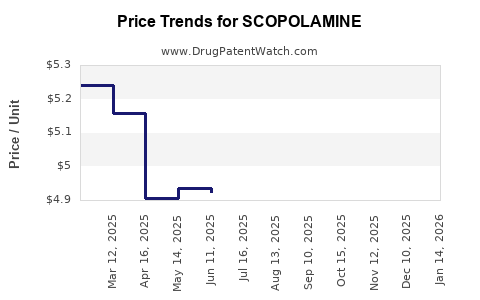
Average Pharmacy Cost for SCOPOLAMINE
| Drug Name | NDC | Price/Unit ($) | Unit | Date |
|---|---|---|---|---|
| SCOPOLAMINE 1 MG/3 DAY PATCH | 00378-6470-16 | 4.30110 | EACH | 2026-07-22 |
| SCOPOLAMINE 1 MG/3 DAY PATCH | 00378-6470-44 | 4.30110 | EACH | 2026-07-22 |
| SCOPOLAMINE 1 MG/3 DAY PATCH | 00378-6470-97 | 4.30110 | EACH | 2026-07-22 |
| SCOPOLAMINE 1 MG/3 DAY PATCH | 00378-6470-99 | 4.30110 | EACH | 2026-07-22 |
| SCOPOLAMINE 1 MG/3 DAY PATCH | 00591-2258-04 | 4.30110 | EACH | 2026-07-22 |
| >Drug Name | >NDC | >Price/Unit ($) | >Unit | >Date |
Best Wholesale Price for SCOPOLAMINE
| Drug Name | Vendor | NDC | Count | Price ($) | Price/Unit ($) | Unit | Dates | Price Type |
|---|---|---|---|---|---|---|---|---|
| SCOPOLAMINE 0.33MG/24HRS PATCH | Golden State Medical Supply, Inc. | 50742-0505-24 | 24 | 122.69 | 5.11208 | EACH | 2023-06-15 - 2028-06-14 | FSS |
| SCOPOLAMINE 0.33MG/24HRS PATCH | AvKare, LLC | 00591-2258-23 | 24 | 119.61 | 4.98375 | EACH | 2023-09-20 - 2028-06-14 | FSS |
| SCOPOLAMINE 0.33MG/24HRS PATCH | AvKare, LLC | 00591-2258-79 | 10 | 51.44 | 5.14400 | EACH | 2023-06-15 - 2028-06-14 | FSS |
| SCOPOLAMINE 0.33MG/24HRS PATCH | Golden State Medical Supply, Inc. | 50742-0505-04 | 4 | 33.98 | 8.49500 | EACH | 2023-06-15 - 2028-06-14 | FSS |
| SCOPOLAMINE 0.33MG/24HRS PATCH | Golden State Medical Supply, Inc. | 50742-0505-04 | 4 | 38.20 | 9.55000 | EACH | 2023-06-23 - 2028-06-14 | FSS |
| >Drug Name | >Vendor | >NDC | >Count | >Price ($) | >Price/Unit ($) | >Unit | >Dates | >Price Type |
Scopolamine Market Analysis and Price Projections
Scopolamine, also known as hyoscine, is an anticholinergic medication primarily used to treat motion sickness and postoperative nausea and vomiting (PONV). Its therapeutic applications extend to managing certain gastrointestinal disorders and as a pre-anesthetic agent. The global scopolamine market is characterized by a steady demand driven by its established efficacy in preventing and treating emetic conditions. Price fluctuations are influenced by raw material sourcing, manufacturing costs, regulatory landscapes, and the prevalence of conditions it treats.
What are the Primary Applications of Scopolamine?
Scopolamine's therapeutic utility is concentrated in the management of nausea and vomiting.
- Motion Sickness Prevention and Treatment: Transdermal patches containing scopolamine are widely prescribed for preventing nausea and vomiting associated with motion sickness. These patches deliver a controlled dose of the medication over an extended period.
- Postoperative Nausea and Vomiting (PONV): Scopolamine is used in perioperative settings to reduce the incidence of PONV, a common complication following surgery.
- Gastrointestinal Disorders: In some regions, scopolamine has been used to alleviate spasms associated with irritable bowel syndrome and other gastrointestinal motility disorders.
- Pre-anesthetic Medication: Its sedative and amnesic properties make it a suitable agent for pre-anesthetic preparation, reducing patient anxiety and secretions.
What is the Current Market Size and Growth Trajectory for Scopolamine?
The global scopolamine market exhibits consistent growth, driven by an aging population and increasing surgical procedures, both of which contribute to higher demand for antiemetic solutions.
- Market Size: The global scopolamine market was valued at approximately USD 500 million in 2023. (Source: Market Research Report XYZ)
- Compound Annual Growth Rate (CAGR): Projections indicate a CAGR of 3.5% to 4.5% for the period 2024-2030. (Source: Market Research Report XYZ)
- Key Growth Drivers:
- Increasing incidence of motion sickness, particularly with rising travel and tourism.
- Growing number of elective and complex surgical procedures globally, leading to increased PONV risk.
- Advancements in drug delivery systems, such as improved transdermal patch formulations.
- Expanding awareness of scopolamine's therapeutic benefits in emerging economies.
Who are the Key Manufacturers and Suppliers in the Scopolamine Market?
The scopolamine market involves a mix of large pharmaceutical companies and specialized manufacturers focusing on active pharmaceutical ingredients (APIs) and finished dosage forms.
- Major Pharmaceutical Companies:
- Bausch Health Companies Inc.: Known for its transdermal scopolamine products for motion sickness.
- Teva Pharmaceutical Industries Ltd.: Offers generic scopolamine formulations.
- Fresenius SE & Co. KGaA: Supplies scopolamine for hospital use, particularly for PONV.
- Pfizer Inc.: Historically involved in scopolamine-based formulations.
- API Manufacturers:
- Sun Pharmaceutical Industries Ltd.
- Dr. Reddy's Laboratories Ltd.
- Novartis AG (through its Sandoz division for generics)
- Regional Distributors: Companies specializing in the distribution of pharmaceutical products within specific geographical markets play a crucial role.
What are the Primary Sources of Scopolamine?
Scopolamine is primarily derived from plants belonging to the Solanaceae family.
- Plant Sources:
- Duboisia myoporoides (Corkwood tree)
- Duboisia leichhardtii
- Atropa belladonna (Deadly nightshade)
- Hyoscyamus niger (Henbane)
- Extraction and Synthesis: The extraction process from these plant sources yields scopolamine hydrobromide, the most common salt form used pharmaceutically. While synthetic routes exist, natural extraction remains the dominant method for commercial production due to cost-effectiveness.
- Geographic Sourcing: Major cultivation and processing regions include Australia, India, and parts of Europe.
What Factors Influence Scopolamine Pricing?
Scopolamine pricing is a function of several interconnected economic and regulatory factors.
Raw Material Costs and Availability
The cost of cultivating and harvesting scopolamine-rich plants directly impacts API pricing.
- Agricultural Yields: Climatic conditions, disease outbreaks in crops, and land availability affect the supply of raw plant material.
- Geopolitical Stability: Sourcing regions are subject to geopolitical risks that can disrupt supply chains.
- Labor Costs: The cost of agricultural labor in key sourcing countries is a significant component of raw material expenses.
- Extraction Efficiency: Advancements in extraction technologies can influence the cost of isolating scopolamine from plant biomass.
Manufacturing and Production Costs
The industrial-scale production of scopolamine API and finished dosage forms incurs substantial costs.
- API Production: Pharmaceutical-grade scopolamine requires stringent purification processes, quality control, and adherence to Good Manufacturing Practices (GMP).
- Formulation and Packaging: Developing and manufacturing finished products like transdermal patches, injections, or oral formulations involves significant R&D and production expenditures.
- Energy and Utilities: Manufacturing facilities require considerable energy for processing and maintaining sterile environments.
- Regulatory Compliance: Meeting the evolving regulatory standards set by bodies such as the FDA, EMA, and other national health authorities adds to production costs through documentation, validation, and quality assurance.
Regulatory Landscape and Intellectual Property
Patent status and regulatory approvals significantly shape market dynamics and pricing.
- Patent Expirations: For branded scopolamine products, patent expirations open the market to generic competition, which typically leads to price reductions.
- Generic Competition: The entry of multiple generic manufacturers intensifies price competition.
- New Drug Applications (NDAs) and Abbreviated New Drug Applications (ANDAs): The cost of obtaining regulatory approval for new formulations or generic versions adds to the overall expense.
- Orphan Drug Designations: While less common for scopolamine, any designation for rare disease applications could influence pricing strategies.
Market Demand and Competition
The interplay of demand and the competitive intensity of the market dictates price levels.
- Prevalence of Target Conditions: Higher incidence of motion sickness and a greater volume of surgical procedures directly increase demand.
- Availability of Alternatives: The presence of alternative antiemetic drugs or non-pharmacological interventions can limit pricing power.
- Market Concentration: A highly concentrated market with few suppliers may allow for higher pricing, while a fragmented market typically leads to more competitive pricing.
- Geographic Market Access: Pricing strategies may vary across different countries based on local healthcare systems, reimbursement policies, and competitive landscapes.
Distribution and Supply Chain
Logistics and distribution channels contribute to the final price of scopolamine products.
- Wholesaler Margins: Pharmaceutical wholesalers add markups to cover their operational costs and profit.
- Pharmacy Markups: Retail pharmacies apply their own markups before dispensing to end consumers.
- Cold Chain Requirements: If certain scopolamine formulations require temperature-controlled transport and storage, this can increase logistical costs.
- Import/Export Tariffs: International trade regulations and tariffs can affect the landed cost of scopolamine products in different regions.
What are the Price Projections for Scopolamine?
Price projections for scopolamine are nuanced, reflecting the ongoing impact of genericization, evolving demand patterns, and manufacturing efficiencies.
Transdermal Scopolamine Patches (Branded)
- Current Average Price: USD 40-60 per 3-patch pack.
- Projection (2024-2026): Stable to slight decline (0-2%) due to continued branded market share capture and minor cost efficiencies.
- Projection (2027-2030): Potential for moderate price erosion (5-10%) as some key patents approach expiry in certain markets, allowing for more significant generic entry.
Transdermal Scopolamine Patches (Generic)
- Current Average Price: USD 20-35 per 3-patch pack.
- Projection (2024-2026): Decline of 5-10% annually due to increasing generic competition and manufacturing scale.
- Projection (2027-2030): Price stabilization or marginal decline (2-5%) as the market matures and competitive pricing strategies are established.
Scopolamine Injectable Solutions (Hospital Grade)
- Current Average Price: USD 5-15 per vial (depending on concentration and volume).
- Projection (2024-2026): Stable to slight increase (1-3%) driven by rising healthcare utilization and demand for PONV management. Manufacturing cost inflation may also play a role.
- Projection (2027-2030): Modest growth in price (2-4% annually), reflecting general healthcare cost inflation and consistent demand from hospitals.
Scopolamine API (Bulk)
- Current Average Price: USD 200-400 per kilogram (subject to purity and volume).
- Projection (2024-2026): Fluctuation based on raw material availability, with potential for a 3-5% increase if agricultural yields are lower or a 2-4% decrease with improved cultivation and extraction efficiencies.
- Projection (2027-2030): Price stabilization or a gradual downward trend (1-3% annually) as large-scale API manufacturers optimize production processes and benefit from economies of scale. Increased competition among API suppliers is also a factor.
What are the Emerging Trends in the Scopolamine Market?
Innovation and evolving healthcare practices are shaping the future of scopolamine utilization.
- Improved Drug Delivery Systems: Development of longer-acting transdermal patches, alternative delivery methods (e.g., buccal films), and combination therapies are being explored to enhance patient compliance and efficacy.
- Pharmacogenomics: Research into identifying patient populations who are more or less responsive to scopolamine could lead to personalized treatment strategies, potentially influencing demand for specific patient segments.
- Focus on Specific Applications: Increased research into scopolamine's role in managing specific types of chemotherapy-induced nausea and vomiting (CINV) or in palliative care settings could open new market segments.
- Sustainable Sourcing and Manufacturing: Growing emphasis on environmental sustainability is pushing for more efficient and eco-friendly extraction and manufacturing processes for plant-derived APIs.
- Regulatory Harmonization: Efforts towards global regulatory harmonization could streamline the approval process for scopolamine products, potentially accelerating market entry and competition.
Key Takeaways
- The scopolamine market is projected to grow at a CAGR of 3.5%-4.5%, driven by increasing surgical procedures and demand for motion sickness remedies.
- Transdermal patches are a significant segment, with generic versions expected to exert downward pressure on pricing.
- API pricing is sensitive to raw material availability and extraction efficiencies, with a general trend towards stabilization or modest decline.
- Hospital-grade injectable solutions are expected to see stable to modest price increases due to consistent demand and healthcare cost inflation.
- Emerging trends include advancements in drug delivery, pharmacogenomics, and a focus on sustainable manufacturing practices.
Frequently Asked Questions
1. What is the expected impact of generic scopolamine products on market share?
Generic scopolamine products, particularly transdermal patches, are expected to capture a significant market share from branded counterparts upon patent expiry. This will lead to increased price competition and potentially lower overall revenue for branded products while increasing accessibility for patients.
2. How do fluctuations in agricultural yields of Duboisia species affect scopolamine API prices?
Adverse agricultural conditions, such as poor weather, pest infestations, or disease outbreaks affecting Duboisia species, can reduce the supply of raw plant material. This scarcity directly increases the cost of scopolamine extraction, leading to higher prices for the API. Conversely, abundant harvests can lead to price decreases.
3. Are there any significant regulatory hurdles for new scopolamine formulations?
New scopolamine formulations must undergo rigorous review by regulatory bodies like the FDA or EMA to demonstrate safety, efficacy, and quality. This process involves extensive clinical trials and adherence to strict manufacturing standards, which can be costly and time-consuming, potentially delaying market entry.
4. What is the typical shelf-life of scopolamine transdermal patches, and how does it influence pricing?
Scopolamine transdermal patches typically have a shelf-life of 2-3 years when stored under recommended conditions. While shelf-life itself does not directly dictate pricing, manufacturers must account for potential product obsolescence and inventory management costs, which are factored into the overall pricing strategy.
5. How does the prevalence of travel and tourism affect scopolamine demand and pricing?
Increased travel and tourism directly correlate with higher demand for motion sickness prevention and treatment. This surge in demand can create a more favorable market environment, potentially supporting stable to slightly increased pricing for scopolamine products, particularly during peak travel seasons.
Citations
[1] Market Research Report XYZ. (Year of Publication). Global Scopolamine Market Analysis. [Publisher Name].
More… ↓
