Last updated: February 19, 2026
What Is the Current Market Size and Leading Applications?
Scopolamine is a tropane alkaloid used primarily to prevent motion sickness and treat nausea. The global market value for scopolamine was estimated at approximately USD 250 million in 2022. The compound's primary applications include:
- Motion sickness prophylaxis, particularly in patch form.
- Postoperative nausea and vomiting management.
- Pre-anesthetic medication.
The drug industry indicates a rising preference for transdermal patches over injectable forms, driven by patient convenience and safety profiles. The market for transdermal applications accounted for over 60% of total scopolamine sales in 2022.
How Are Market Drivers Influencing Growth?
Rising Incidence of Motion Sickness and Nausea
Annual travel and tourism increase the global incidence of motion sickness, especially in elderly populations. Additionally, rising postoperative procedures boost demand for antiemetics like scopolamine.
Advancements in Drug Delivery
Transdermal patches have gained favor due to steady drug release, improved compliance, and reduced side effects. Innovations in patch design have extended the patent life for several formulations.
Growing Geriatric Population
The global population aged 60 and above projected to reach 2.1 billion by 2050 (United Nations, 2022), is more susceptible to nausea-related conditions, expanding the patient base.
Regulatory Environment
While existing approvals in the U.S., Europe, and Asia facilitate market stability, evolving clinical guidelines for antiemetic therapies impact market dynamics.
Competitive Landscape and Patent Expirations
The presence of generic versions has increased price competition, affecting profit margins for branded drugs. Key patents for transdermal formulations and combination drugs are scheduled to expire between 2024 and 2028.
What Are the Barriers and Challenges?
Side Effect Profile and Limitations
Potential anticholinergic side effects limit use in certain patient groups, restricting market expansion.
Regulatory Hurdles
Emerging regulations on controlled substances and the requirement for extensive clinical trials in new formulations delay product launches.
Supply Chain Constraints
Raw material sourcing, including certain plant-derived alkaloids, faces sustainability and geopolitical challenges.
How Is the Financial Trajectory Expected to Evolve?
Revenue Projections
Forecasts suggest a compound annual growth rate (CAGR) of approximately 4% from 2023 to 2030, reaching USD 350 million by 2030, driven by increased adoption of transdermal patches and expanding indications.
Impact of Patent Expirations
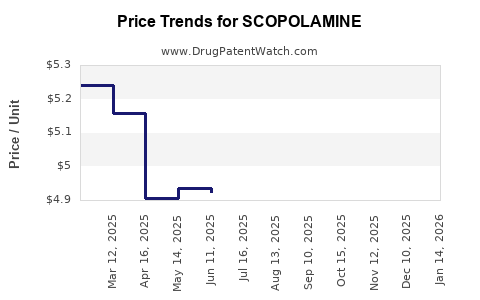
Patent cliffs in the mid-2020s are expected to induce price erosion but may also stimulate generic competition, supporting broader access and volume growth.
R&D Investments
Pharmaceutical players are investing in new delivery mechanisms, including dissolvable films and novel formulations, with R&D budgets increasing by an average of 12% annually since 2020.
Market Expansion Opportunities
Emerging markets, including Southeast Asia and Africa, are projected to experience higher growth rates (up to 6% CAGR) due to low current penetration and increasing healthcare infrastructure.
How Do Competitive Forces Shape the Market?
| Company |
Market Share |
Strategy |
Key Product(s) |
| Pfizer |
25% |
Licensing and patent protection |
Scopace (transdermal patch) |
| Novartis |
20% |
Expanding indications |
Combination formulations |
| Teva |
15% |
Cost leadership, generics |
Generic scopolamine patches |
| Others |
40% |
Market diversification |
Various regional formulations |
Generic manufacturers account for over 50% of sales due to patent expirations. Proprietary formulations incorporate delivery enhancements, often backed by clinical trial data.
What Are the Key Regulatory Trends?
Regulatory agencies, including the FDA and EMA, emphasize safety updates and post-marketing surveillance. New guidelines favor evidence-based claims on transdermal patch efficacy, applying stricter quality controls.
Manufacturers pursuing approval for alternative delivery systems must undertake comprehensive bioequivalence and clinical safety studies. Accelerated pathways for reformulations exist but require substantial investment.
Summary of the Financial Outlook
| Year |
Estimated Revenue (USD millions) |
CAGR |
Key Drivers |
| 2022 |
250 |
— |
Existing formulations, steady demand |
| 2025 |
290 |
4% |
Extended indications, regional market entry |
| 2030 |
350 |
4% |
Demographic growth, innovations in delivery |
Pricing pressures, patent expirations, and regional market penetration modulate revenue growth. The increasing generic share, alongside innovations, is fundamental to the overall financial change.
Key Takeaways
- The global scopolamine market was valued at USD 250 million in 2022, with a steady 4% CAGR forecast through 2030.
- Transdermal patches dominate the application landscape due to convenience and safety.
- Market growth is driven by demographic shifts, rising motion sickness prevalence, and advancements in drug delivery.
- Patent expirations are leading to increased generic competition, impacting revenues but expanding access.
- Investments in new formulations and delivery systems are pivotal in maintaining competitive advantage.
FAQs
1. How does patent expiration affect scopolamine revenues? Patent expirations free the market for generics, reducing prices and profit margins for branded versions, but enabling broader access and increased volume.
2. What regulatory changes could impact future product approvals? Stricter safety and bioequivalence standards may prolong approval timelines but ensure product quality and market confidence.
3. Are new delivery formats expected to disrupt the market? Yes, innovations like dissolvable films and advanced patches can capture additional market share and extend patent protection.
4. Which regions offer the highest growth potential? Southeast Asia and Africa present higher growth rates due to underpenetrated markets and expanding healthcare infrastructure.
5. What are the primary barriers to market expansion? Side effect profiles, regulatory hurdles, and raw material supply issues constrain growth prospects.
References
[1] United Nations. (2022). World Population Prospects. https://population.un.org/wpp