Last updated: April 24, 2026
Market Dynamics and Financial Trajectory for PROPYLTHIOURACIL (PTU)
Summary: Propylthiouracil (PTU) is an off-patent, widely marketed thyroid drug that operates in a crowded generic market with low pricing power and limited scope for incremental revenue growth. Commercial performance is driven by (1) clinical guideline positioning versus methimazole for Graves’ disease and thyrotoxicosis, (2) safety-related prescribing shifts, (3) pharmacy-level generic substitution economics, and (4) periodic supply or regulatory disruptions that can temporarily move price and demand.
What market does PTU actually serve?
PTU is used for thyroid-related indications tied to hyperthyroidism/thyrotoxicosis, most notably:
- Graves’ disease (antithyroid drug management)
- Thyroid storm / severe thyrotoxicosis (often in acute hospital settings)
- Situations where methimazole is not preferred based on clinical guidance and patient factors
Market structure: PTU competes primarily against methimazole and other standard antithyroid regimens, with distribution dominated by generic formulations and interchangeable supply. The product’s economic profile is therefore characteristic of a mature specialty-leaning commodity:
- High competitive intensity from low-cost generics
- Limited differentiation on formulation (typical for older small molecules)
- Pricing pressure from payer formularies and generic substitution
Regulatory and safety influence on prescribing: PTU has a known safety profile that has historically influenced guideline preference and clinician behavior, which directly affects demand allocation between PTU and methimazole. The U.S. FDA has communicated risks including severe liver injury for PTU and has issued guidance that has supported reduced long-term use in favor of methimazole for many patients. FDA communications are central to real-world prescribing patterns and payer decisions. [1]
How do guideline and safety dynamics move PTU demand?
Demand for PTU moves with two forces: clinical positioning and risk-benefit framing.
1) Guideline-driven substitution toward methimazole
In many settings, clinicians treat methimazole as the default antithyroid option, with PTU reserved for narrower patient populations or specific circumstances. This translates into structural headwinds for PTU volume growth.
A key U.S. guidance marker is FDA direction discouraging PTU use for most patients except where alternatives are not appropriate. FDA specifically indicates:
- PTU is not preferred for initial therapy in most non-pregnant patients due to risk of liver injury
- For pregnancy, PTU may be used during certain trimesters depending on risk considerations, with methimazole generally favored later in pregnancy
These FDA messages shift prescriber behavior and payer coverage decisions, limiting the addressable market size for PTU. [1]
2) Acute-care demand is real but episodic
PTU can see hospital-driven demand for acute management scenarios such as severe thyrotoxicosis or thyroid storm, where antithyroid medication selection and timing matter. That can stabilize baseline consumption, but it does not create sustained price premiums in a generic market.
3) Safety events can create short-term pricing/distribution effects
When supply tightens or when specific strengths/forms face disruption, pharmacies and wholesalers may reduce substitution speed, temporarily raising realized prices. In mature generics, these effects tend to be tactical and short-lived unless there is a systemic supply issue.
What does PTU’s competitive landscape look like financially?
PTU’s competitive landscape is structurally generic. The financial trajectory is shaped less by brand-specific factors and more by generic supply and competitive pricing behavior.
Pricing power is capped by interchangeability
Because PTU is not protected by meaningful patent exclusivity in most markets, pricing is dominated by:
- Generic tendering and wholesaler contracting
- Pharmacy reimbursement formulas
- Formulary placement relative to methimazole
Competition comes from “good enough” drug economics
In generic small molecules, competition typically reduces realized prices to a narrow band unless:
- A subset of SKUs is constrained
- A regulatory action limits certain suppliers
- A formulation/strength is temporarily unavailable
FDA oversight and product availability can move the market, but they do not typically rebuild long-term pricing power. [1]
What is the financial trajectory: growth, decline, or stability?
Directionally: stability with downward bias. PTU operates in a mature generic segment where:
- Volume growth depends on absolute incidence of hyperthyroidism cases and the fraction allocated to PTU rather than methimazole
- Pricing declines over time due to generic competition
- Safety guidance caps long-run expansion of the PTU share of use
The strongest evidence of trajectory comes from FDA safety communications that have historically shifted initial choice away from PTU for many patients. That reduces the pool of new prescriptions and supports gradual share decline unless compensated by acute use. [1]
Revenue mechanics in a generic market
PTU revenue is effectively the product of:
- Prescriptions (or inpatient dosing days)
- Realized net price after rebates and contracting dynamics
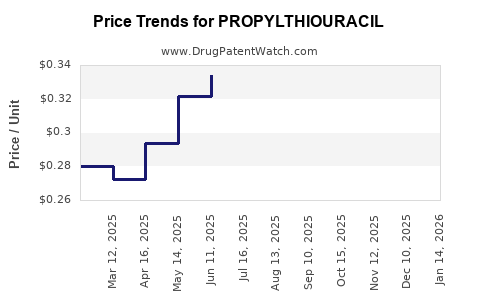
With methimazole as primary alternative, PTU’s realized net price typically trends toward the lower end of the generics market. As competitors enter, the net price often drifts down faster than volume can offset.
What are the key drivers of realized net sales for PTU?
Demand-side drivers
- Prescribing share vs methimazole
- FDA safety direction influences prescriber and payer choice. [1]
- Pregnancy use pattern
- PTU usage in pregnancy has trimester-dependent nuance per guidance, affecting seasonal and demographic demand. [1]
- Acute-care protocols
- Thyroid storm and severe thyrotoxicosis protocols generate intermittent hospital demand.
Supply-side drivers
- Generic manufacturer count and capacity
- More entrants reduce pricing; capacity constraints temporarily raise price.
- Regulatory/quality actions
- FDA actions that affect specific manufacturers can temporarily tighten supply. [1]
Contracting and payer effects
- Formulary placement
- If methimazole is preferred, PTU sees lower utilization management.
- State and federal substitution frameworks
- Generic substitution norms compress pricing.
Are there meaningful revenue upside levers for PTU holders?
In a mature generic segment, upside usually comes from operational and commercial rather than scientific drivers:
- Winning share through supply reliability and contract execution
- Improving service-level performance and reducing backorders that cost market access
- Targeting specific patient subsets where PTU remains guideline-supported
- Avoiding product disruptions that force switches away from PTU during shortages
However, the structural demand limitation from safety-guided preference versus methimazole limits sustained upside. [1]
Key market dynamics snapshot
| Factor |
Expected impact on PTU |
Mechanism |
| FDA safety communications |
Downward pressure on share |
Restricts PTU preference in many settings |
| Guideline preference for methimazole |
Downward pressure on new prescriptions |
Payer and clinician substitution |
| Acute-care use (thyroid storm/severe cases) |
Stabilizes baseline |
Hospital protocols create episodic demand |
| Generic competition |
Limits pricing power |
Interchangeability drives net price compression |
| Supply interruptions |
Short-term price volatility |
Wholesaler/retailer substitution slower under constraint |
[1]
What does “financial trajectory” look like by time horizon?
Near term (quarters)
- Net sales fluctuate with generic contracting and supply tightness.
- Share remains sensitive to local formularies and inpatient protocol adherence to safety guidance.
Medium term (1 to 3 years)
- Pricing continues to face generic erosion unless supply disruptions raise realized prices.
- Demand remains capped by the safety-guided positioning versus methimazole.
Long term (3 to 7 years)
- PTU likely exhibits a mature-generic plateau or slow decline in utilization share unless clinical guidance materially changes or supply/quality issues alter market structure. FDA safety direction is a persistent governing factor. [1]
Regulatory signals that matter commercially
The most commercially relevant regulatory signal for PTU is the FDA’s risk communication around severe liver injury and the resulting prescribing guidance that de-emphasizes PTU for most patients. These messages shape:
- Patient selection
- Prescriber behavior
- Payer preference and utilization management
That is the principal structural driver of PTU market dynamics. [1]
Key Takeaways
- PTU’s market is mature and generic, with pricing power constrained by interchangeability and contracting economics.
- Safety-related guidance shifts prescribing toward methimazole, which caps PTU share growth.
- Acute-care use stabilizes demand but does not create sustained volume expansion sufficient to offset generic price pressure.
- Realized net sales track a mix of guideline-driven share, inpatient protocols, and supply reliability.
FAQs
1) Why does PTU face weaker long-run share than methimazole?
Because FDA safety communications have reduced PTU’s preferred status for many patients, shifting prescribing toward methimazole. [1]
2) What patient setting still supports PTU use?
PTU use persists in specific clinical scenarios where alternatives are not appropriate, with pregnancy use handled through trimester-dependent guidance. [1]
3) Does PTU benefit from generic substitution economics?
Generic substitution generally compresses pricing and limits net price gains. It can increase volume but usually not enough to overcome competitive pricing pressure.
4) Can shortages improve PTU financial performance?
Temporary shortages can raise realized pricing due to constrained supply, but the effect is typically short-lived in a multi-manufacturer generic market unless supply disruptions are sustained.
5) What is the dominant commercial lever for PTU manufacturers?
Supply reliability and formulary access execution, since clinical differentiation is limited and demand share is governed by safety-guided prescribing behavior. [1]
References
[1] U.S. Food and Drug Administration. (2010). Propylthiouracil and severe liver injury: FDA warning and drug safety communication. FDA. https://www.fda.gov/