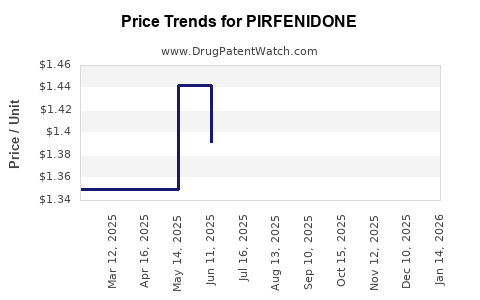
Last updated: August 12, 2026
Pirfenidone is a mature antifibrotic drug used primarily for idiopathic pulmonary fibrosis (IPF). Roche’s Esbriet established the commercial market, but the product has entered a post-exclusivity phase marked by generic competition, declining branded sales and continued demand from a large chronic-treatment population. Roche reported approximately CHF 1 billion in annual Esbriet sales at the product’s peak, followed by a sustained decline through 2023. The main commercial risks are generic price erosion, competition from Boehringer Ingelheim’s nintedanib and limited opportunity to extend exclusivity through new formulations.
What is pirfenidone and which diseases does it treat?
Pirfenidone is an oral small-molecule antifibrotic. Its principal approved use is slowing the decline of pulmonary function in adults with mild-to-moderate IPF.
The U.S. product is marketed as Esbriet by Genentech, a Roche company. Standard treatment requires a gradual dose escalation followed by a maintenance dose of 801 mg three times daily, generally delivered through 267 mg capsules or tablets. The treatment burden is significant because patients take nine 267 mg-equivalent units per day at maintenance dosing.
Key characteristics include:
| Attribute |
Pirfenidone |
| Active ingredient |
Pirfenidone |
| Brand |
Esbriet |
| Primary indication |
Idiopathic pulmonary fibrosis |
| U.S. sponsor |
Genentech, Inc. |
| Global parent |
Roche |
| Dosage form |
Oral capsules and tablets |
| U.S. approval |
October 15, 2014 |
| Regulatory designation |
Orphan drug |
| Main competing product |
Ofev, nintedanib |
| Biosimilar exposure |
None; pirfenidone is a synthetic small molecule |
| Primary commercial risk |
Generic substitution and price compression |
The FDA approved Esbriet under the accelerated approval framework after clinical studies showed a reduction in the decline of forced vital capacity, a key measure of lung function. The FDA later converted the approval to traditional approval following confirmatory evidence. [1]
How large is the pirfenidone market?
The global market is concentrated in IPF and is largely controlled by two branded antifibrotic products: pirfenidone and nintedanib. Market size depends on whether calculations use manufacturer sales, ex-U.S. prices, retail prescriptions or estimated patient treatment volume.
Roche’s reported Esbriet sales provide the clearest public measure of the branded market’s financial trajectory:
| Year |
Roche Esbriet sales |
Trend |
| 2019 |
Approximately CHF 1.0 billion |
Peak commercial period |
| 2020 |
Approximately CHF 1.0 billion |
Stable at peak levels |
| 2021 |
Approximately CHF 0.9 billion |
Early erosion |
| 2022 |
Approximately CHF 0.7 billion |
Accelerated decline |
| 2023 |
Approximately CHF 0.6 billion |
Continued generic pressure |
Amounts are based on Roche annual reporting and are presented in Swiss francs as reported by the company. [2-5]
The decline reflects several factors:
- Generic pirfenidone entered the U.S. market after loss of regulatory exclusivity and patent challenges.
- International markets have lower net prices and earlier generic substitution.
- Nintedanib has remained a strong alternative for newly diagnosed and previously untreated patients.
- IPF treatment discontinuation remains material because of gastrointestinal adverse events, photosensitivity and disease progression.
- Roche has had limited ability to create a differentiated follow-on product around pirfenidone.
The underlying disease market remains commercially relevant even as branded revenue declines. IPF is a chronic, progressive disease with a substantial treatment duration for surviving patients. Growth in diagnosis, specialist referral and use of antifibrotic therapy can support prescription volume while average selling prices fall.
When did pirfenidone lose market exclusivity?
Pirfenidone’s principal U.S. regulatory exclusivity periods have expired.
| Exclusivity right |
Approximate status |
| New chemical entity exclusivity |
Expired after the five-year period following the 2014 approval |
| Orphan-drug exclusivity |
Expired after the seven-year period following approval |
| Generic access |
Began following FDA ANDA approvals and patent resolution |
| Current market position |
Post-exclusivity, generic-exposed |
The U.S. orphan-drug period protected the approved IPF indication for seven years. It did not create permanent protection for the molecule, nor did it prevent all future approvals involving pirfenidone. The five-year new chemical entity period also ended before the current generic market phase. [1,6]
In Europe and other developed markets, the timing of generic competition has varied by country because national patent rights, supplementary protection certificates, regulatory exclusivity and local litigation outcomes differ.
What patents protect pirfenidone?
Pirfenidone’s original molecule protection is no longer the central barrier to competition. The remaining patent estate has focused on methods of treatment, dosing, administration and other use-related claims rather than a broad, unexpired composition-of-matter monopoly.
Publicly identified U.S. Esbriet patent records have included:
| Patent |
General subject matter |
Commercial relevance |
| U.S. Patent No. 7,566,729 |
Pirfenidone treatment methods |
Historical method-of-use protection |
| U.S. Patent No. 8,609,709 |
Treatment of fibrotic disease |
Relevant to generic certification and litigation |
| U.S. Patent No. 8,846,096 |
IPF treatment methods |
Listed use-related protection |
| U.S. Patent No. 9,403,871 |
Additional pirfenidone treatment claims |
Later-expiring method claims |
The FDA Orange Book is the controlling public source for current listed patents and exclusivity codes. Patent listing status can change as patents expire, are delisted, are disclaimed or are affected by litigation. [7]
What formulations are protected by pirfenidone patents?
Esbriet’s core commercial formulation is an immediate-release oral dosage form. The main product value has not come from a highly differentiated delivery system such as a long-acting injectable, inhaled formulation or targeted-release technology.
Potential formulation strategies include:
- Lower-pill-burden tablets
- Modified-release oral products
- Gastrointestinal-tolerability improvements
- Combination therapy with another antifibrotic
- Pediatric or non-IPF fibrosis applications
- Dose packs supporting treatment initiation and escalation
These strategies have limited commercial impact unless they receive a separate regulatory approval, obtain enforceable patent protection and achieve meaningful reimbursement differentiation. Generic immediate-release products can compete effectively when the clinical label and dosing instructions remain substantially similar.
What is the Orange Book status of Esbriet?
Esbriet has been listed in the FDA Orange Book with patents directed principally to methods of use and treatment. The Orange Book does not itself determine whether a patent is valid or infringed. It identifies patents that an NDA holder has submitted for approved products and that affect ANDA certification.
For a generic pirfenidone applicant, the relevant pathways are:
- Paragraph I certification if no patent information is listed.
- Paragraph II certification if the listed patent has expired.
- Paragraph III certification if the applicant will wait for patent expiry.
- Paragraph IV certification if the applicant asserts that the patent is invalid, unenforceable or not infringed.
- A section viii statement if the applicant omits a patented method from its labeling.
Because IPF is the primary approved use, skinny-label strategies can be commercially constrained. A generic applicant must avoid infringing listed method claims while retaining a label that supports lawful prescription and reimbursement.
Which companies are challenging or competing with Esbriet?
The competitive field has three groups: generic pirfenidone manufacturers, nintedanib, and investigational antifibrotic developers.
Generic pirfenidone manufacturers
FDA-approved generic pirfenidone products have been associated with manufacturers including Cipla, Torrent Pharmaceuticals and other ANDA sponsors. Competition varies by strength, dosage form, supplier and distribution channel. Generic availability has reduced the achievable price for pirfenidone in the United States and has weakened Roche’s ability to retain volume through brand loyalty alone.
Nintedanib
Boehringer Ingelheim markets nintedanib as Ofev. It is approved for IPF and other chronic fibrosing interstitial lung diseases, including progressive fibrosing phenotypes. Ofev has remained a major competitor because physicians often choose between the two drugs based on tolerability, comorbidities, patient preference and payer rules.
| Factor |
Pirfenidone |
Nintedanib |
| Brand |
Esbriet |
Ofev |
| Manufacturer |
Roche/Genentech |
Boehringer Ingelheim |
| Dosage |
Three-times-daily oral dosing |
Twice-daily oral dosing |
| Main tolerability issues |
Nausea, dyspepsia, photosensitivity, fatigue |
Diarrhea, nausea, liver-enzyme elevations |
| Generic exposure |
Yes |
More limited, depending on jurisdiction |
| Market position |
Mature and declining branded product |
Strong branded competitor |
| Biosimilar risk |
None |
None |
What patent litigation affects pirfenidone?
Pirfenidone litigation has centered on ANDA applicants challenging method-of-use patents covering treatment of IPF and fibrotic lung disease. Paragraph IV certifications can trigger litigation under the Hatch-Waxman framework and may create an automatic 30-month stay of FDA approval, subject to statutory conditions. [8]
The commercial significance of these cases is narrower than for a drug protected by a composition patent. Method-of-use claims may be avoided through label carving, may be vulnerable to invalidity arguments or may expire before producing a durable market block.
The relevant litigation questions are:
- Whether a generic label induces infringement of a listed method patent.
- Whether the asserted claims are valid and adequately supported.
- Whether the patent claims treatment parameters that are unavoidable in routine IPF prescribing.
- Whether a settlement permits an agreed generic launch date.
- Whether the applicant launches at risk after litigation or patent expiration.
Public patent records should be evaluated patent by patent. The existence of a listed patent does not establish that generic entry will be prevented through the full listed term.
Are there pirfenidone settlement agreements?
Pirfenidone settlements may establish confidential or semi-public launch dates, but settlement economics and licensing terms are not uniformly disclosed. Where an ANDA dispute is resolved, the key commercial terms are usually:
- Authorized generic rights
- Agreed entry date
- Royalty or supply arrangements
- Restrictions on formulation or indication
- Allocation of litigation risk
- Treatment of later generic applicants
A settlement that permits entry before the nominal expiry of a method patent can materially accelerate revenue erosion. Conversely, a settlement that preserves a later entry date can support residual Esbriet sales, although competing ANDA approvals can still change market structure.
What is the FDA regulatory status of pirfenidone?
Esbriet is FDA-approved for adults with mild-to-moderate IPF. FDA-approved generics have the same active ingredient, strength and route of administration as the reference product, subject to ANDA requirements.
Important regulatory characteristics include:
- Oral administration
- Dose escalation during the first two weeks
- Maintenance dosing at 801 mg three times daily
- Liver-function monitoring
- Dose modification for adverse reactions and drug interactions
- Food-related administration requirements to reduce tolerability problems
Pirfenidone does not have biosimilar competition because it is a synthetic small molecule, not a biologic. The relevant competitive pathway is ANDA-based generic approval.
How strong is the pirfenidone patent estate?
The estate is commercially weak compared with a product protected by an unexpired composition patent or a proprietary delivery platform.
Strengths
- Multiple method-of-use patents
- Regulatory history supporting treatment of IPF
- Established brand and physician familiarity
- Chronic use and recurring prescriptions
- Potential barriers around label design and induced infringement
Weaknesses
- Core molecular protection has expired
- Regulatory exclusivity has expired
- Generic substitution is legally and technically straightforward
- Limited formulation differentiation
- Method patents face validity, scope and non-infringement challenges
- Nintedanib provides an established branded alternative
The estate can delay or shape generic entry, but it is unlikely to restore monopoly pricing. Its economic value is defensive rather than expansionary.
What generic launch scenarios exist for pirfenidone?
Scenario 1: Broad generic substitution
Multiple suppliers obtain approval and compete on price. Pharmacies and payers shift patients from Esbriet to generic pirfenidone. Roche retains a declining premium segment based on physician preference, patient support and supply reliability.
Scenario 2: Limited supplier competition
Only a small number of manufacturers launch, allowing higher generic prices and slower erosion. Roche retains more residual share, particularly in commercial insurance and specialty-pharmacy channels.
Scenario 3: Formulation-led segmentation
A generic or branded follow-on product reduces pill burden or improves tolerability. The product captures patients who are unable to maintain standard dosing, but reimbursement depends on demonstrated clinical and economic value.
Scenario 4: International price compression
Low-cost suppliers expand across Europe, Asia and other regulated markets. Local tendering and reference pricing reduce net prices faster than prescription volume declines.
The most likely long-term outcome is continued volume retention with lower revenue per treated patient.
How does pirfenidone compare with competing antifibrotic drugs?
Pirfenidone’s principal advantage is established use, broad physician experience and generic availability. Its disadvantages are three-times-daily administration and photosensitivity-related counseling.
Nintedanib has twice-daily dosing and a broader chronic fibrosing interstitial lung disease label, but diarrhea and hepatic monitoring can limit persistence. The two products are not fully interchangeable from a clinical or payer perspective. Treatment choice is influenced by adverse-event profile, disease phenotype, comorbidities and local reimbursement.
The arrival of generics can increase antifibrotic treatment access by reducing cost. It can also shift prescribing away from nintedanib where payers impose step therapy or favor the lowest-cost clinically appropriate option.
What revenue exposure does pirfenidone create for Roche?
Esbriet is no longer a growth driver for Roche. At peak sales near CHF 1 billion, the product was commercially important within Roche’s pharmaceutical portfolio. By 2023, reported sales had fallen to roughly CHF 0.6 billion. The revenue decline affects:
- Roche’s respiratory franchise
- Genentech’s U.S. specialty-pharmacy operations
- Gross margin, because branded small-molecule revenue is replaced by lower-priced generic volume
- Portfolio valuation of late-life products
- Incentives to develop or acquire replacement assets in pulmonary fibrosis
The product remains cash-generative, but its strategic value is primarily residual cash flow and franchise maintenance rather than market expansion.
What manufacturing and intellectual-property barriers remain?
Manufacturing pirfenidone is less difficult than manufacturing a biologic, but commercial supply still requires:
- Active pharmaceutical ingredient qualification
- Control of impurities and degradation products
- Demonstration of bioequivalence
- Stable tablet or capsule production
- Packaging that supports photosensitivity-related handling requirements
- Consistent supply for specialty pharmacies and hospitals
The main barriers are regulatory execution, formulation equivalence, patent certification and commercial scale. They are not comparable to the manufacturing barriers associated with monoclonal antibodies, cell therapies or complex inhaled products.
What is the geographic outlook for pirfenidone?
The United States remains the highest-value market, but generic competition has the greatest effect on branded revenue. Europe has a mature IPF treatment market with substantial price variation between countries. Japan and other Asian markets remain important because of high clinical recognition of IPF and country-specific licensing and reimbursement systems.
Geographic value depends on:
- Local patent expiry
- National reimbursement
- Generic substitution rules
- Hospital and specialty-pharmacy procurement
- Diagnosis rates
- Use of nintedanib
- Availability of local manufacturers
Emerging markets can expand treated volume while producing lower net revenue per patient. This creates a volume-growth, price-decline profile for generic pirfenidone.
Key Takeaways
- Pirfenidone is a mature oral antifibrotic primarily used for IPF.
- Esbriet sales peaked near CHF 1 billion and declined to roughly CHF 0.6 billion by 2023.
- U.S. regulatory exclusivity has expired, and generic pirfenidone is approved.
- Remaining patents are primarily method-of-use patents, not broad molecule patents.
- Generic competition is the dominant driver of future price erosion.
- Nintedanib remains the principal branded competitor.
- Pirfenidone has no biosimilar risk because it is a synthetic small molecule.
- Roche’s remaining revenue is defensible through brand, supply and patient-support advantages, but the product is not a growth asset.
- The patent estate can influence launch timing but is unlikely to support long-term monopoly pricing.
- Market growth will depend more on diagnosis and treatment penetration than on branded price expansion.
FAQs
Does pirfenidone have orphan-drug exclusivity today?
No. The seven-year U.S. orphan-drug exclusivity period associated with the 2014 approval has expired.
Can generic pirfenidone be substituted automatically for Esbriet?
Substitution depends on state law, payer policy, dosage form, pharmacy rules and the specific FDA-approved product. FDA approval establishes therapeutic equivalence standards, but automatic substitution is governed through applicable regulatory and pharmacy frameworks.
Is pirfenidone more effective than nintedanib?
Neither drug has a universal efficacy advantage across all IPF patients. Treatment selection generally depends on tolerability, dosing preference, comorbidities, liver function, disease phenotype and reimbursement.
Does a pirfenidone generic need to conduct new Phase 3 trials?
No. An ANDA applicant generally relies on the reference product’s safety and efficacy findings and must establish pharmaceutical equivalence and bioequivalence, subject to applicable patent and labeling requirements.
Could a new pirfenidone formulation regain premium pricing?
A new formulation would need a clinically meaningful advantage, enforceable intellectual-property protection and favorable reimbursement. Reduced dosing frequency or improved tolerability would provide the strongest potential basis for differentiation.
References
- U.S. Food and Drug Administration. (2014). FDA approves Esbriet to treat idiopathic pulmonary fibrosis. https://www.fda.gov
- Roche Holding AG. (2020). Annual report 2019. https://www.roche.com/investors/annual-report
- Roche Holding AG. (2021). Annual report 2020. https://www.roche.com/investors/annual-report
- Roche Holding AG. (2022). Annual report 2021. https://www.roche.com/investors/annual-report
- Roche Holding AG. (2024). Annual report 2023. https://www.roche.com/investors/annual-report
- U.S. Food and Drug Administration. (2024). Orange Book: Approved drug products with therapeutic equivalence evaluations. https://www.accessdata.fda.gov/scripts/cder/ob/
- U.S. Patent and Trademark Office. (2024). Patent Center. https://patentcenter.uspto.gov
- U.S. Food and Drug Administration. (2024). Hatch-Waxman amendments and abbreviated new drug applications. https://www.fda.gov/drugs/drug-approval-process-generic-drugs/abbreviated-new-drug-application-anda