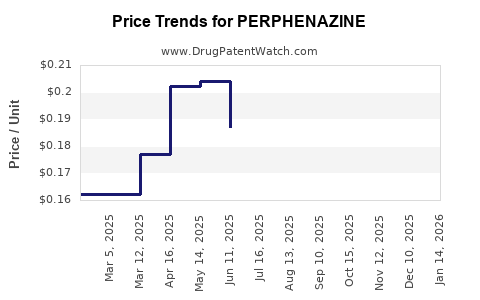
Last updated: September 3, 2026
Perphenazine is a mature, low-cost generic antipsychotic with limited commercial growth potential. Its U.S. brand, Trilafon, is no longer the primary market product, and generic tablets are supplied by multiple manufacturers. The drug has no meaningful remaining regulatory exclusivity, no material biosimilar risk, and limited patent protection. Financial performance depends on continued institutional demand, generic manufacturing economics, and supply reliability rather than innovation or premium pricing.
What is the current market position of perphenazine?
Perphenazine is a first-generation, or typical, antipsychotic in the phenothiazine class. In the United States, it is approved for schizophrenia and for severe nausea and vomiting in adults. It is available primarily as generic tablets in 2 mg, 4 mg, 8 mg, and 16 mg strengths.[1]
| Market factor |
Current assessment |
| Brand product |
Trilafon, historically marketed by Schering-Plough |
| Current commercial form |
Generic oral tablets |
| Main U.S. indications |
Schizophrenia; severe nausea and vomiting |
| Therapeutic class |
First-generation antipsychotic |
| Controlled-substance status |
Not scheduled under the U.S. Controlled Substances Act |
| Regulatory exclusivity |
Expired |
| U.S. patent position |
No commercially important active Orange Book protection identified |
| Biosimilar exposure |
None; perphenazine is a small-molecule drug |
| Pricing power |
Low |
| Market growth |
Mature to declining, with limited volume upside |
| Primary commercial risks |
Generic price erosion, supply interruptions, adverse-effect concerns, and substitution by newer antipsychotics |
Perphenazine competes with other low-cost typical antipsychotics, including haloperidol, fluphenazine, chlorpromazine, and trifluoperazine. It also competes indirectly with atypical antipsychotics such as risperidone, olanzapine, quetiapine, aripiprazole, and ziprasidone.
The drug retains clinical relevance in selected patients, especially where cost, prior treatment response, or formulary policy favors an established generic. Its market is unlikely to expand materially because newer antipsychotics generally have stronger prescribing momentum and broader use across psychiatric indications.
When did perphenazine lose exclusivity?
Perphenazine lost meaningful U.S. market exclusivity decades ago. The original product was approved in the 1950s, and generic versions have been marketed for many years. Current products are approved through abbreviated new drug applications rather than through a protected new-drug commercialization strategy.[1][2]
The practical exclusivity timeline is:
| Event |
Approximate timing |
Commercial effect |
| Original U.S. approval |
1950s |
Established the reference product |
| Brand commercialization as Trilafon |
Mid-20th century |
Created the historical branded market |
| Generic entry |
Decades ago |
Removed durable brand pricing power |
| Patent and regulatory exclusivity expiration |
Long expired |
Enabled multiple generic suppliers |
| Current market |
Generic-dominated |
Pricing controlled by formularies, wholesalers, and supply |
The original composition-of-matter and product protection associated with a drug approved in the 1950s would not support current commercial exclusivity. Any historical patents would have expired by the present period under the U.S. patent term framework.
What is the Orange Book status of perphenazine?
Perphenazine does not have a commercially significant Orange Book patent estate supporting current market exclusivity. The FDA Orange Book identifies patents and regulatory exclusivity associated with approved reference products, but mature generic products such as perphenazine generally have no remaining patent-based barrier to ANDA competition.[2]
The reference product history is more important than any current patent position. Trilafon established the original regulatory benchmark, but the commercial market has shifted to generic perphenazine tablets.
What patent rights protect perphenazine formulations?
No material U.S. formulation patent protection is apparent for the standard perphenazine tablet market. The commercially relevant products are conventional immediate-release tablets rather than proprietary extended-release systems, transdermal products, depot injections, or complex drug-device combinations.
Potentially relevant intellectual-property categories include:
- Tablet composition and excipient combinations
- Manufacturing processes
- Packaging and stability systems
- Clinical-use claims
- Foreign-country formulations or process rights
These categories are unlikely to create a meaningful U.S. barrier because generic manufacturers can market conventional tablets after the core drug rights have expired. Manufacturing know-how may still affect cost and quality, but it does not generally create exclusion equivalent to an active composition patent.
How strong is the perphenazine patent estate?
The patent estate is weak from a commercial-protection perspective.
| Patent-estate criterion |
Assessment |
| Active composition patent |
None expected |
| Active Orange Book patent |
No material protection identified |
| New chemical entity exclusivity |
Expired |
| Pediatric exclusivity |
None of commercial relevance |
| Formulation exclusivity |
No important U.S. barrier identified |
| Method-of-use exclusivity |
No material current protection identified |
| Freedom to develop generic tablets |
Broad |
| Ability to support premium pricing |
Minimal |
Generic applicants ordinarily face a low intellectual-property burden when developing standard perphenazine tablets. The principal development requirements are bioequivalence, manufacturing compliance, product quality, and reliable supply.
What is the FDA regulatory status of perphenazine?
Perphenazine remains an FDA-approved prescription drug in generic tablet form. The FDA-approved labeling includes a boxed warning concerning increased mortality in elderly patients with dementia-related psychosis. The drug is not approved for that use.[1]
The label also warns about tardive dyskinesia, neuroleptic malignant syndrome, extrapyramidal symptoms, orthostatic hypotension, sedation, and other phenothiazine-associated adverse effects. These safety issues affect prescribing decisions and contribute to substitution by newer antipsychotics.
Perphenazine is available as an oral tablet. There is no comparable current U.S. commercial franchise based on a long-acting injectable, inhaled product, or other differentiated delivery system.
What drives perphenazine demand?
Demand is shaped by four factors: clinical substitution, generic affordability, institutional prescribing, and supply availability.
Clinical substitution
Atypical antipsychotics have displaced many first-generation agents in routine outpatient prescribing. Physicians often favor newer drugs because of broader indications, lower perceived risk of movement disorders, or established use in bipolar disorder and adjunctive depression treatment.
Perphenazine can remain attractive when:
- A patient previously responded to the drug
- A low acquisition cost is important
- A health system maintains a typical-antipsychotic formulary option
- A clinician seeks an alternative to higher-cost atypical therapy
- Nausea and vomiting treatment is required and the product is available
Generic affordability
Perphenazine has little ability to sustain premium pricing. Pharmacies, pharmacy benefit managers, hospitals, and wholesalers can substitute among approved manufacturers. The low unit price limits revenue per prescription but supports continued use in cost-sensitive channels.
Institutional demand
Psychiatric hospitals, correctional-health systems, long-term-care facilities, and public-sector formularies may provide more stable demand than branded outpatient markets. These buyers are price-sensitive and may purchase through institutional contracts or wholesaler inventories.
Supply availability
For mature generics, market share can shift rapidly when a manufacturer experiences manufacturing problems, raw-material shortages, quality actions, or commercial discontinuation. A small number of active suppliers can create temporary price increases without changing the long-term market structure.
What is the financial trajectory for perphenazine?
Perphenazine is unlikely to generate material standalone revenue for a large pharmaceutical company. Public companies generally report sales at the portfolio, business-unit, or therapeutic-area level rather than disclosing revenue for an individual low-cost generic.
| Financial metric |
Assessment |
| Public standalone revenue |
Generally not disclosed |
| Revenue growth potential |
Low |
| Gross-margin potential |
Low to moderate, depending on supply position |
| Pricing trend |
Long-term downward pressure |
| Volume trend |
Mature, stable to declining |
| Capital requirements |
Low for established tablet manufacturers |
| Commercial upside |
Mostly tied to supply shortages or portfolio optimization |
| Major value driver |
Manufacturing efficiency and reliable availability |
The financial model is a volume business. Profitability depends on production scale, active pharmaceutical ingredient procurement, plant utilization, regulatory compliance, and distribution efficiency. A supplier with a dependable facility and limited competition may achieve attractive short-term margins, but these margins are vulnerable to new entrants and contracting pressure.
Perphenazine is unlikely to support a high-value licensing transaction based solely on the molecule. Any transaction would more likely involve a broader generic portfolio, geographic rights, manufacturing capacity, or a product bundle.
Which companies manufacture or market perphenazine?
U.S. generic availability has historically included products from multiple manufacturers and labelers, including large generic companies and specialty suppliers. The active manufacturer set can change as companies discontinue low-volume products or transfer ANDAs.
DailyMed records identify current product labeling and labeler information, while FDA drug databases provide the regulatory status of approved products.[1][3] Manufacturer-level commercial share and net pricing are not generally disclosed in public company filings.
The competitive structure is fragmented:
- Large generic companies may retain the product as part of a broad hospital or psychiatric portfolio.
- Smaller suppliers may enter when manufacturing economics are favorable.
- Wholesalers and pharmacy chains can switch suppliers based on price and availability.
- Contract manufacturers may produce the tablets for a separate labeler.
Are there Paragraph IV challenges involving perphenazine?
Paragraph IV litigation is not a significant current feature of the perphenazine market. The drug’s core patent protection expired long ago, and generic entry has already occurred. New ANDA filings would not normally face a meaningful Orange Book patent challenge for the standard tablet product.
Any historical ANDA litigation would have little effect on present competition unless it involved a still-relevant formulation or manufacturing patent. No such patent barrier is commercially apparent for conventional perphenazine tablets.
What litigation and settlement agreements affect perphenazine?
No material current U.S. litigation or settlement structure is associated with perphenazine’s standard generic market. The drug is not in the commercial position of a recently launched branded medicine facing an organized wave of Paragraph IV cases.
Potential legal exposure is more likely to arise from:
- Product liability claims involving tardive dyskinesia or other adverse effects
- Manufacturing and quality disputes
- Regulatory enforcement
- Contract disputes over supply or distribution
- Foreign-market patent or trademark matters
These issues could affect individual companies but are unlikely to change the market-wide competitive structure.
Does perphenazine face biosimilar risk?
Perphenazine faces no biosimilar risk because it is a chemically synthesized small molecule. Its competitive threat is generic substitution, not biosimilar entry.
The relevant FDA pathway is the ANDA pathway under section 505(j) of the Federal Food, Drug, and Cosmetic Act. Generic applicants must demonstrate pharmaceutical equivalence and bioequivalence to the reference product. The product does not require the biologics license application and biosimilar framework used for monoclonal antibodies, recombinant proteins, or other biologics.
What geographic markets offer commercial opportunity?
The United States is a mature generic market. Growth opportunities are more likely to come from geographic expansion than from U.S. innovation.
| Region |
Commercial assessment |
| United States |
Mature, low-priced, generic-dominated |
| Europe |
Established use, country-specific reimbursement and regulatory requirements |
| Canada |
Mature generic market with provincial pricing controls |
| Latin America |
Demand may persist through public-sector and private generic channels |
| Asia-Pacific |
Potential volume opportunity, but local registration and price competition are significant |
| Emerging markets |
Access may be supported by low cost, although quality and distribution standards vary |
International opportunities depend on local approvals, reference-product requirements, pharmacovigilance rules, trademark rights, and procurement systems. A company with existing regional distribution can add perphenazine more efficiently than a new entrant building a standalone franchise.
What generic launch scenarios exist for perphenazine?
Three scenarios are commercially plausible.
Base case: stable generic maintenance
Existing suppliers continue offering tablets at low prices. Demand remains stable in institutional and selected outpatient settings. Revenue declines gradually as prescribing shifts toward newer agents.
Supply-constrained case: temporary price improvement
One or more manufacturers exits or experiences a production interruption. Remaining suppliers gain volume and may achieve temporary pricing improvement. The effect is usually reversible once supply returns.
Portfolio-rationalization case: reduced availability
Manufacturers discontinue the product because of low margins, compliance costs, or insufficient volume. Availability becomes more dependent on a small number of suppliers. This can create shortage risk without creating durable product value.
How does perphenazine compare with competing antipsychotics?
| Drug |
Class |
Generic status |
Commercial position |
| Perphenazine |
Typical antipsychotic |
Generic |
Mature, low-cost, limited growth |
| Haloperidol |
Typical antipsychotic |
Generic |
Broad institutional use and multiple dosage forms |
| Fluphenazine |
Typical antipsychotic |
Generic |
Oral and long-acting injectable relevance |
| Chlorpromazine |
Typical antipsychotic |
Generic |
Older product with broad historical use |
| Risperidone |
Atypical antipsychotic |
Generic |
Larger market and broader indications |
| Olanzapine |
Atypical antipsychotic |
Generic |
High-volume psychiatric product |
| Aripiprazole |
Atypical antipsychotic |
Generic |
Strong historical commercial franchise and multiple formulations |
Perphenazine’s main disadvantage is limited differentiation. Its main advantage is cost and established clinical familiarity. It lacks the formulation breadth and indication coverage that support larger revenue pools for some competing antipsychotics.
Key Takeaways
- Perphenazine is a mature generic antipsychotic with no meaningful remaining U.S. regulatory exclusivity.
- The historical brand, Trilafon, no longer controls the commercial market.
- Standard perphenazine tablets have little apparent patent protection and face minimal Paragraph IV litigation risk.
- The drug is not exposed to biosimilar competition.
- Revenue is generally not disclosed on a standalone basis and is likely modest relative to modern antipsychotic franchises.
- Market value depends on manufacturing cost, supply reliability, institutional demand, and portfolio economics.
- Long-term prescribing pressure comes from atypical antipsychotics and concerns associated with first-generation agents.
- The most likely financial outcomes are stable low-margin maintenance, temporary supply-driven pricing, or gradual portfolio withdrawal.
FAQs
Is perphenazine still being manufactured?
Yes. Generic perphenazine tablets remain listed in U.S. drug-labeling and regulatory databases, although the active manufacturer and product availability can change over time.[1][3]
Is perphenazine more profitable than newer antipsychotics?
Generally no. Newer antipsychotics historically supported larger revenues through patent protection, broader indications, and differentiated formulations. Perphenazine competes mainly on low cost.
Can a company obtain a new patent for perphenazine?
A company could seek patent protection for a genuinely novel formulation, delivery system, manufacturing process, or use. A patent on the old active ingredient itself would not be available because the molecule is long established.
Is perphenazine used in long-term-care facilities?
It may be used in institutional and long-term-care settings, subject to clinical judgment, facility formularies, patient-specific risks, and applicable regulatory requirements. Its use is constrained by movement-disorder and dementia-related psychosis warnings.[1]
Does perphenazine have a branded generic opportunity?
A branded-generic strategy could create limited commercial value through reliable supply, packaging, distribution, or institutional contracting. It would not recreate the exclusivity or pricing power of a protected innovative product.
References
- U.S. Food and Drug Administration. (2019). Perphenazine tablets: Prescribing information. FDA.
- U.S. Food and Drug Administration. (2024). Approved drug products with therapeutic equivalence evaluations, 44th edition. FDA.
- National Library of Medicine. (2024). DailyMed: Perphenazine tablet labeling. U.S. National Library of Medicine.