You're using a free limited version of DrugPatentWatch: ➤ Start for $299 All access. No Commitment.

Last Updated: December 15, 2025

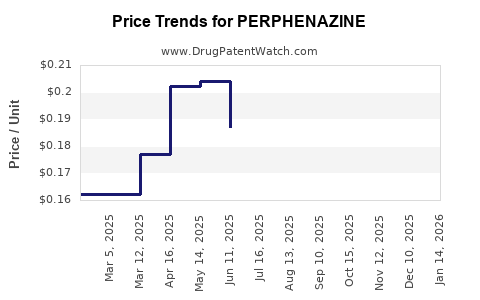
Drug Price Trends for PERPHENAZINE


✉ Email this page to a colleague

« Back to Dashboard


Drug Price Trends for PERPHENAZINE

Average Pharmacy Cost for PERPHENAZINE

These are average pharmacy acquisition costs (net of discounts) from a US national survey
Drug Name NDC Price/Unit ($) Unit Date
PERPHENAZINE 8 MG TABLET 68382-0593-01 0.23937 EACH 2025-11-19
PERPHENAZINE 16 MG TABLET 00591-4104-01 0.50588 EACH 2025-11-19
PERPHENAZINE 16 MG TABLET 00603-5063-21 0.50588 EACH 2025-11-19
PERPHENAZINE 16 MG TABLET 23155-0802-01 0.50588 EACH 2025-11-19
>Drug Name >NDC >Price/Unit ($) >Unit >Date

Best Wholesale Price for PERPHENAZINE

These are wholesale prices available to the US Federal Government which, by law, must be the best prices available to any customer under comparable terms and conditions
Drug Name Vendor NDC Count Price ($) Price/Unit ($) Unit Dates Price Type
PERPHENAZINE 2MG TAB Golden State Medical Supply, Inc. 68382-0591-01 100 33.50 0.33500 EACH 2024-01-03 - 2028-06-14 FSS
PERPHENAZINE 4MG TAB Golden State Medical Supply, Inc. 68382-0592-01 100 46.37 0.46370 EACH 2023-06-16 - 2028-06-14 FSS
PERPHENAZINE 2MG TAB AvKare, LLC 23155-0799-01 100 26.12 0.26120 EACH 2023-06-15 - 2028-06-14 FSS
PERPHENAZINE 4MG TAB Golden State Medical Supply, Inc. 68382-0592-01 100 45.01 0.45010 EACH 2024-01-03 - 2028-06-14 FSS
>Drug Name >Vendor >NDC >Count >Price ($) >Price/Unit ($) >Unit >Dates >Price Type
Price type key: Federal Supply Schedule (FSS): generally available to all Federal Govt agencies / 'BIG4' prices: VA, DoD, Public Health & Coast Guard only / National Contracts (NC): Available to specific agencies

Market Analysis and Price Projections for Perphenazine

Last updated: July 27, 2025


Introduction

Perphenazine, a typical antipsychotic first synthesized in the 1950s, remains a critical therapeutic agent in managing schizophrenia, severe psychosis, and related psychiatric conditions. Despite the advent of atypical antipsychotics, perphenazine persists owing to its demonstrated efficacy, lower manufacturing costs, and established safety profile. This report offers a comprehensive market analysis and future price projections for perphenazine, emphasizing determinants shaping its commercialization, competitive landscape, regulatory factors, and pricing strategies.


Market Overview

Global Market Dynamics

The global antipsychotic drugs market was valued at approximately USD 14.5 billion in 2022 and is expected to grow at a compound annual growth rate (CAGR) of around 4.8% through 2030 [1]. The global schizophrenia population exceeds 20 million, with an increasing prevalence in low- and middle-income countries owing to improved diagnostic capabilities. While atypical antipsychotics like risperidone and olanzapine dominate sales, traditional agents such as perphenazine maintain niche but persistent demand, especially in cost-sensitive regions.

Segmental Positioning of Perphenazine

Perphenazine's positioning is primarily within the generic antipsychotic segment. It benefits from a well-established manufacturing process and widespread clinical familiarity. However, the entry of newer, atypical agents with potentially fewer side effects constrains its growth trajectory. Its continued relevance is particularly notable in markets with limited healthcare budgets and in cases where side effect profiles are manageable or well-controlled.


Market Drivers

  • Cost-Effectiveness: Perphenazine's repute as an affordable therapeutic option sustains demand in emerging economies. Governments and healthcare providers prioritize generics for Cost-Effectiveness Analysis (CEA) in mental health treatment.
  • Established Clinical Profile: Long-term clinical data support its safety and efficacy, minimizing regulatory and prescriber hesitations.
  • Generic Competition: The patent expiry of several atypical antipsychotics boosts generic parphenazine’s market share.
  • Healthcare Infrastructure Expansion: Increasing mental health awareness and treatment accessibility amplify demand, especially in regions with constrained budgets.

Market Restraints

  • Side Effect Profile: Extrapyramidal symptoms and sedation associated with perphenazine have led clinicians to prefer atypicals with more tolerable side effects.
  • Regulatory Scrutiny: Stringent approval processes and safety updates may influence the drug's market positioning.
  • Market Penetration of Alternatives: The rising use of atypicals, despite higher costs, diminishes perphenazine's share in developed markets.

Competitive Landscape

Perphenazine faces competition from both branded and generic counterparts. Major manufacturers include Teva, Mylan, Sandoz, and Sun Pharmaceutical, among others. The global generic market's commoditized nature exerts downward pressure on pricing, with prices typically declining by 3–5% annually in mature markets.

Atypical antipsychotics, though more expensive, offer a perceived advantage in tolerability, constraining perphenazine's market expansion. Nevertheless, in price-sensitive regions, it maintains a competitive edge due to lower procurement costs.


Regulatory and Patent Considerations

Patent expiries for many atypical antipsychotics have opened avenues for generics, intensifying competition in the overall antipsychotic segment. Perphenazine's status as a generic with no recent patent restrictions implies ongoing market access, but regulatory bodies may impose safety warnings or usage guidance, impacting prescribing practices.

Additionally, some jurisdictions require ongoing safety monitoring, including updates to drug labels, which could influence demand.


Price Analysis and Projections

Current Pricing Landscape

On average, the global price of perphenazine tablets ranges from USD 0.05 to USD 0.15 per tablet, varying markedly by region. In North America and Europe, per-tablet costs for a standard 8 mg dose hover around USD 0.10, while in Asia or Africa, prices can dip below USD 0.05 due to local manufacturing and procurement practices [2].

Factors Influencing Price Trends

  • Market Maturity: In mature markets, prices are stabilizing or declining due to increased generic competition.
  • Regulatory Changes: Safety warnings or manufacturing quality standards may temporarily influence pricing.
  • Manufacturing Costs: Advances in production technology and scale economies typically reduce costs, enabling further price reductions.
  • Political and Economic Factors: Currency fluctuations, import tariffs, and local policies affect retail prices.

Projected Price Trends (2023–2030)

Anticipated price movements suggest a continuing downward trend of approximately 3–5% annually in mature markets due to intensified generic competition and manufacturing efficiencies. Regionally, prices in emerging markets are expected to remain relatively stable or decline modestly owing to ongoing commoditization.

In aggregate, the average global price per tablet is projected to fall to approximately USD 0.03–0.08 by 2030, maintaining its role as an affordable choice for budget-constrained health systems [3].


Market Opportunities and Challenges

Opportunities

  • Expansion into Tier 2 and Tier 3 healthcare markets, leveraging low-cost manufacturing.
  • Formulation diversification—developing long-acting injectables and combination therapies to broaden indications.
  • Strategic alliances for manufacturing and distribution, especially in emerging economies.

Challenges

  • Increasing preference for atypical agents may suppress market share.
  • Price erosion pressures necessitate operational efficiencies.
  • Regulations demanding stringent safety profiling could increase compliance costs.

Key Takeaways

  • Perphenazine remains relevant in specific segments, primarily due to its low cost and established efficacy.
  • The global market size for perphenazine is stable but constrained by competition from newer atypical antipsychotics.
  • Prices are expected to decline steadily, driven by increased generic competition and manufacturing efficiencies.
  • Market growth prospects are strongest in emerging markets where cost considerations dominate decision-making.
  • Staying competitive requires optimizing manufacturing, expanding formulation options, and navigating regulatory landscapes effectively.

Conclusion

Perphenazine's standing in the global psychotropic pharmacopeia is characterized by enduring demand within certain segments, primarily driven by its affordability. While traditional antipsychotics like perphenazine face challenges from higher-margin atypical agents, their cost advantage sustains their presence in many healthcare settings. Price projections suggest continued decline, emphasizing the importance for manufacturers to focus on operational efficiencies and strategic market positioning.

Stakeholders should monitor regional regulatory developments and evolving prescriber preferences to optimize their strategies in the evolving landscape of antipsychotic therapy.


FAQs

1. What factors influence the global price of perphenazine?
Factors include manufacturing costs, level of generic competition, regional regulatory requirements, healthcare infrastructure, and procurement policies.

2. How does regional variation affect perphenazine pricing?
Prices are generally lower in emerging markets due to local manufacturing, government negotiations, and lower operational costs, whereas developed markets tend to have higher prices constrained by regulatory standards and patent laws.

3. Will the price of perphenazine decrease further in the coming years?
Yes, continuing trends of generic commoditization and competition are expected to drive prices downward by approximately 3–5% annually until 2030.

4. How does the side effect profile impact perphenazine’s market demand?
Perphenazine's propensity for extrapyramidal symptoms limits its use, especially where tolerability influences adherence, favoring newer atypicals in some markets but sustaining demand in cost-sensitive regions.

5. Are there any regulatory risks to the future market of perphenazine?
Regulatory agencies may impose safety warnings or require further studies, which could impact accessibility and pricing, although no recent major restrictions threaten its widespread use.


References

[1] Grand View Research, "Antipsychotic Drugs Market Size & Share Analysis," 2022.
[2] IQVIA Pricing Data, "Global Generic Drug Price Trends," 2022.
[3] World Health Organization, "Mental Health Atlas," 2022.

More… ↓

⤷  Get Started Free

Make Better Decisions: Try a trial or see plans & pricing

Drugs may be covered by multiple patents or regulatory protections. All trademarks and applicant names are the property of their respective owners or licensors. Although great care is taken in the proper and correct provision of this service, thinkBiotech LLC does not accept any responsibility for possible consequences of errors or omissions in the provided data. The data presented herein is for information purposes only. There is no warranty that the data contained herein is error free. We do not provide individual investment advice. This service is not registered with any financial regulatory agency. The information we publish is educational only and based on our opinions plus our models. By using DrugPatentWatch you acknowledge that we do not provide personalized recommendations or advice. thinkBiotech performs no independent verification of facts as provided by public sources nor are attempts made to provide legal or investing advice. Any reliance on data provided herein is done solely at the discretion of the user. Users of this service are advised to seek professional advice and independent confirmation before considering acting on any of the provided information. thinkBiotech LLC reserves the right to amend, extend or withdraw any part or all of the offered service without notice.