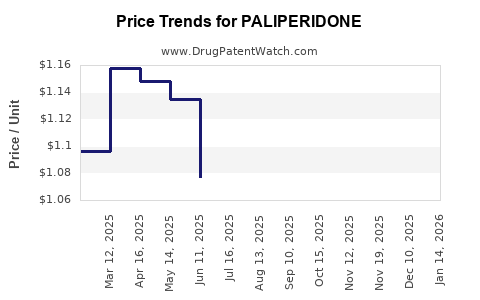
Last updated: September 7, 2026
Paliperidone is a mature antipsychotic franchise with an expanding long-acting injectable market. Johnson & Johnson markets oral paliperidone as Invega and injectable paliperidone palmitate as Invega Sustenna, Invega Trinza, and Invega Hafyera. The franchise has shifted from oral tablets toward monthly, three-month, and six-month injections, extending commercial durability despite generic oral competition.
The principal commercial risk is not biosimilar substitution. Paliperidone is a small-molecule drug, so the relevant threats are abbreviated new drug applications, patent challenges, payer pressure, competing long-acting injectables, and conversion from branded to generic therapy.
What products contain paliperidone?
Paliperidone is the major active metabolite of risperidone. It is approved primarily for schizophrenia and schizoaffective disorder.
| Product |
Active ingredient |
Dosage form |
FDA approval |
Administration |
| Invega |
Paliperidone extended-release |
Oral tablet |
2006 |
Once daily |
| Invega Sustenna |
Paliperidone palmitate |
Long-acting injectable suspension |
2009 |
Once monthly |
| Invega Trinza |
Paliperidone palmitate |
Long-acting injectable suspension |
2015 |
Once every three months |
| Invega Hafyera |
Paliperidone palmitate |
Long-acting injectable suspension |
2021 |
Once every six months |
Invega Sustenna is indicated for schizophrenia and schizoaffective disorder. Trinza is used in patients adequately treated with Sustenna for at least four months. Hafyera is used in patients adequately treated with Sustenna or Trinza for the required stabilization period.[1-4]
The injectable products use paliperidone palmitate, a poorly water-soluble ester designed for gradual release after intramuscular injection. The formulation supports a longer dosing interval than oral paliperidone and creates manufacturing and formulation barriers that are more difficult to replicate than a conventional tablet.
How large is the paliperidone market?
The global paliperidone franchise generates several billion dollars annually, with most revenue coming from long-acting injectable products.
Johnson & Johnson reports Invega sales as a product-family category within Innovative Medicine. Public filings do not consistently separate Sustenna, Trinza, Hafyera, and oral Invega in all reporting periods. Reported annual franchise sales have increased from roughly $3 billion in the early 2020s to more than $4 billion in subsequent periods, driven by higher penetration of long-acting formulations and patient conversions from monthly to longer-interval injections.[5]
| Market driver |
Effect on paliperidone |
| Long-acting injectable adoption |
Supports revenue growth and treatment persistence |
| Trinza conversion |
Increases revenue per stabilized patient and reduces monthly administration burden |
| Hafyera conversion |
Extends the franchise into six-month dosing |
| Oral generic competition |
Compresses Invega tablet pricing |
| Payer utilization controls |
Limits net price and influences site-of-care economics |
| Competing LAIs |
Creates pressure from aripiprazole and risperidone products |
| Patent settlements |
Can delay injectable generic entry beyond basic regulatory exclusivity |
The franchise has a favorable product mix. Oral Invega is exposed to generic substitution, while the injectable products retain stronger pricing and switching barriers. Treatment initiation, injection-site logistics, prior authorization, and patient stabilization requirements reduce immediate substitution rates.
What is the financial trajectory for paliperidone?
Paliperidone revenue has followed a lifecycle-extension model rather than a conventional single-product trajectory. Oral Invega reached maturity after generic entry, while Sustenna created a higher-value injectable base. Trinza and Hafyera extended the franchise by moving established patients to less frequent dosing.
Revenue trajectory
| Period |
Commercial position |
Financial implication |
| 2006-2009 |
Oral Invega launch and early uptake |
Initial branded antipsychotic revenue |
| 2009-2014 |
Sustenna launch and expansion |
Shift toward higher-value injectable sales |
| 2015-2020 |
Trinza conversion |
Longer dosing interval and franchise retention |
| 2021 onward |
Hafyera launch |
Six-month formulation expands lifecycle management |
| Current phase |
Mature injectable franchise |
Growth depends on conversion, adherence, and geographic expansion |
Johnson & Johnson’s filings identify Invega as one of the company’s significant pharmaceutical products, but the company does not provide a complete public revenue bridge by formulation, strength, or geography. As a result, the most reliable financial assessment is based on total franchise sales, product-growth commentary, and the mix shift toward Sustenna, Trinza, and Hafyera.[5]
The core revenue exposure is concentrated in the United States. U.S. sales are more vulnerable to patent litigation, Medicare and Medicaid reimbursement changes, pharmacy benefit management controls, and the launch of competing injectables. International revenue is affected by reference pricing, government tenders, compulsory price reductions, and different patent-term rules.
When does paliperidone lose exclusivity?
Paliperidone has different exclusivity dates by product and jurisdiction. Regulatory exclusivity and patent exclusivity are separate.
| Product |
Key exclusivity issue |
Commercial status |
| Invega oral tablets |
NCE and formulation exclusivity have expired |
Generic paliperidone ER products compete |
| Sustenna |
Formulation and dosing patents are the main barrier |
Brand protection extends materially beyond oral exclusivity |
| Trinza |
Three-month dosing and formulation patents |
Later patent expiry than Sustenna |
| Hafyera |
Six-month dosing and formulation patents |
Longest expected U.S. protection in the franchise |
The original oral product’s five-year new chemical entity exclusivity expired long ago. Pediatric exclusivity and formulation patents extended protection for a limited period, but those protections do not prevent generic oral competition today.[6]
The injectable products depend on patent claims covering particle size, formulation characteristics, dosing regimens, injection intervals, and methods of treating schizophrenia or schizoaffective disorder. Public company disclosures have historically identified protection for Sustenna into approximately 2031, Trinza into approximately 2034, and Hafyera into approximately 2039, subject to patent-term adjustment, patent-term extension, litigation outcomes, and settlement terms.[5]
Exact expiration dates should be assessed patent by patent through the FDA Orange Book, USPTO records, and applicable court orders. A single “paliperidone patent expiration” date is not legally meaningful because each formulation, method, and strength may have a different term.
What patents protect Invega Sustenna, Trinza, and Hafyera?
The injectable franchise is protected by layered patent coverage rather than a single compound patent.
Sustenna patent estate
The Sustenna estate has included patents directed to:
- Paliperidone palmitate formulations
- Injectable suspensions with defined particle-size characteristics
- Deltoid and gluteal administration
- Loading-dose regimens
- Monthly maintenance dosing
- Treatment of schizophrenia and schizoaffective disorder
- Pharmacokinetic exposure profiles
Janssen has asserted multiple U.S. patents against generic applicants, including patents associated with paliperidone palmitate formulations and dosing regimens. The asserted portfolio has included U.S. Patent Nos. 8,231,880, 8,337,888, 9,439,906, and later patents covering dosing and formulation features. Patent relevance depends on the claims asserted in each case, not merely on whether a patent appears in a public list.
Trinza patent estate
Trinza adds protection for three-month administration. Its commercial barriers include:
- Conversion from Sustenna to three-month dosing
- Dose strengths and administration schedules
- Paliperidone palmitate particle properties
- Pharmacokinetic exposure over a three-month interval
- Methods for maintaining symptom control
Trinza benefits from a clinically embedded conversion pathway. A patient first stabilized on Sustenna cannot generally be moved directly to Trinza without meeting the labeled stabilization requirements. This creates a treatment-sequence barrier that is partly clinical and partly commercial.
Hafyera patent estate
Hafyera extends the franchise to six-month administration. Its protection is based on:
- Six-month dosing regimens
- Patient selection and stabilization criteria
- Paliperidone palmitate formulation characteristics
- Injection schedules and dose conversion methods
- Methods of treating schizophrenia
Hafyera’s value is not limited to a new dose interval. It can reduce administration frequency, support adherence, and lower the number of annual injection encounters. Those characteristics support premium positioning but also make manufacturing consistency and clinical substitution more difficult.
Are there Paragraph IV challenges to paliperidone?
Yes. Generic applicants have challenged injectable paliperidone patents through Paragraph IV certifications and related patent litigation. The principal litigation risk concerns Sustenna because it has the largest addressable injectable market and the earliest commercially meaningful generic opportunity.
Paragraph IV litigation can delay approval or launch through:
- The statutory 30-month stay after a qualifying patent lawsuit.
- A court finding that an asserted patent is valid and infringed.
- A settlement that permits an agreed future launch date.
- A finding that the generic product does not infringe or that the patent is invalid.
- Regulatory approval followed by a launch at risk.
Potential generic applicants include large manufacturers with injectable suspension capabilities and established antipsychotic portfolios. Public litigation activity has involved companies such as Teva and other ANDA applicants, although the specific defendants and asserted patents differ by proceeding.
A generic applicant may challenge formulation claims, dosing claims, or method-of-use claims while carving out patented indications or dosing instructions. The commercial effect depends on the ANDA’s proposed product, the Orange Book-listed patents, and the final settlement or judgment.
What is the Orange Book status of paliperidone?
The FDA Orange Book is the controlling public source for listed patents and exclusivity associated with approved drug products. Oral Invega and the injectable products are listed separately because they have different dosage forms, strengths, formulations, and regulatory histories.[6]
The Orange Book does not determine whether a patent is enforceable. It identifies patents and exclusivity information submitted by the sponsor. Courts determine infringement and validity. A patent may be listed for a product but still face claim-construction, invalidity, enablement, written-description, or noninfringement challenges.
For commercial diligence, the relevant review should distinguish:
- Oral paliperidone ER listings
- Sustenna injection listings
- Trinza injection listings
- Hafyera injection listings
- Expired patents
- Unexpired formulation patents
- Method-of-use patents
- Pediatric exclusivity
- Patent-term adjustment
- Any applicable regulatory exclusivity
Which companies compete with paliperidone?
Paliperidone competes across both oral antipsychotics and long-acting injectable therapies.
| Competitor |
Company |
Product |
Competitive relevance |
| Aripiprazole |
Otsuka/Lundbeck |
Abilify Maintena, Asimtufii |
Strong LAI competitor with monthly and two-month dosing |
| Aripiprazole lauroxil |
Alkermes |
Aristada |
Long-acting option with extended dosing intervals |
| Risperidone |
Janssen and generics |
Risperdal Consta |
Established LAI, but shorter dosing interval |
| Risperidone |
Indivior |
Perseris |
Monthly subcutaneous option |
| Risperidone |
Luye and partners |
Rykindo |
Regional and emerging LAI competition |
| Paliperidone ER |
Multiple generic manufacturers |
Generic tablets |
Direct oral price competition |
Aripiprazole products are the most important branded LAI competitors in the United States. Their differentiation includes partial dopamine agonism, dosing flexibility, and established physician familiarity. Paliperidone retains advantages in clinical familiarity, the Sustenna-to-Trinza-to-Hafyera conversion ladder, and its use in patients for whom aripiprazole is not suitable.
What generic entry risks exist for paliperidone?
Oral paliperidone
Generic oral entry is established or commercially available in major markets. The result is price erosion, formulary substitution, and reduced strategic importance for branded Invega tablets.
Injectable paliperidone
Injectable generic entry is more complex. A challenger must reproduce a long-acting suspension with appropriate quality, particle-size distribution, release characteristics, sterility, injection performance, and pharmacokinetic behavior. The regulatory pathway also requires an ANDA applicant to address listed patents and demonstrate pharmaceutical equivalence and bioequivalence under FDA requirements.
Potential launch scenarios include:
| Scenario |
Effect on Sustenna |
Effect on Trinza and Hafyera |
| No injectable approval before key patents expire |
Continued brand control |
Limited near-term impact |
| At-risk generic launch |
Rapid price pressure and litigation exposure |
May accelerate conversion to longer intervals |
| Authorized or settlement-based launch |
Controlled erosion |
Brand may preserve higher-value later formulations |
| Formulation-specific generic approval |
Product-by-product erosion |
Trinza and Hafyera may remain protected |
| Multiple generic entrants |
Steep net-price decline |
Increased payer leverage across the franchise |
Sustenna is the primary near-term generic risk. Trinza and Hafyera have later patent positions and can absorb some patients through conversion, although conversion is constrained by clinical eligibility and prescriber practice.
How strong is the paliperidone patent estate?
The estate is commercially strong but structurally uneven.
| Factor |
Assessment |
| Oral compound protection |
Weak or expired |
| Monthly injectable protection |
Stronger, supported by formulation and regimen claims |
| Three-month protection |
Strong, with later lifecycle patents |
| Six-month protection |
Strongest expected duration |
| Manufacturing barrier |
Meaningful |
| Method-of-use protection |
Relevant but vulnerable to carve-outs |
| Generic substitution risk |
High for oral tablets, lower and later for injectables |
| Biosimilar risk |
Not applicable |
The most defensible assets are likely the combination of formulation, dosing interval, and product-specific manufacturing characteristics. Method-of-use patents can extend protection but may be less effective when generic labels omit patented indications or instructions.
What licensing deals affect paliperidone?
The core paliperidone franchise is controlled by Johnson & Johnson through Janssen-related entities. Publicly disclosed commercial arrangements may cover regional commercialization, supply, distribution, or generic and litigation settlements. There is no broad public indication that an external licensee controls the central U.S. paliperidone patent estate.
Settlement agreements in Paragraph IV litigation can be commercially more important than a patent’s nominal expiration date. They may provide a challenger with a license to launch on a negotiated date, subject to manufacturing, regulatory, and legal conditions. The commercial impact depends on whether the settlement covers Sustenna only or also later formulations and related method patents.
What is the FDA regulatory status of paliperidone?
All four branded products have FDA approval. The regulatory distinction between products is material:
- Invega is an oral extended-release tablet.
- Sustenna is a monthly intramuscular injection.
- Trinza is a three-month intramuscular injection for stabilized patients.
- Hafyera is a six-month intramuscular injection for appropriately stabilized patients.
The injectable products are not biologics and do not use the biosimilar pathway. Generic applicants generally pursue ANDAs under Section 505(j) of the Federal Food, Drug, and Cosmetic Act.[7]
Key Takeaways
- Paliperidone is a multibillion-dollar franchise led by long-acting injections rather than oral tablets.
- Oral Invega has lost most of its exclusivity value to generic competition.
- Sustenna is the largest injectable asset and the main Paragraph IV and generic-entry target.
- Trinza and Hafyera extend the commercial lifecycle through three-month and six-month dosing.
- Public company disclosures have identified approximate U.S. patent protection through 2031 for Sustenna, 2034 for Trinza, and 2039 for Hafyera, subject to patent-specific legal analysis.
- Biosimilar risk does not apply because paliperidone is a small molecule.
- The principal financial risks are injectable generic entry, payer pressure, competing LAIs, and limits on patient conversion.
- The principal commercial defenses are formulation complexity, clinical stabilization requirements, injection infrastructure, and the longer-interval product ladder.
FAQs
Is paliperidone the same drug as risperidone?
No. Paliperidone is the primary active metabolite of risperidone, but it is marketed as a separate active pharmaceutical ingredient with different dosage forms, dosing characteristics, and regulatory approvals.
Can a patient switch directly from oral paliperidone to Hafyera?
Generally, no. Hafyera is intended for patients stabilized on an approved paliperidone palmitate regimen under the product labeling. The conversion sequence and stabilization requirements are central to its safe use.[4]
Will generic Sustenna automatically replace Trinza or Hafyera?
No. Approval and substitution are product-specific. A generic monthly paliperidone palmitate product would not automatically establish equivalence to the three-month or six-month formulations.
Does paliperidone qualify for biosimilar competition?
No. Paliperidone is a small-molecule drug. Competition proceeds through generic-drug pathways, not through the FDA biosimilar framework.
What is the largest long-term threat to paliperidone revenue?
The largest threat is injectable generic entry into Sustenna combined with payer pressure and competition from aripiprazole long-acting injectables. Trinza and Hafyera can delay franchise-wide erosion, but their protection depends on patent validity, settlement terms, physician adoption, and successful patient conversion.
References
- U.S. Food and Drug Administration. (2006). Invega (paliperidone) extended-release tablets: Prescribing information.
- U.S. Food and Drug Administration. (2009). Invega Sustenna (paliperidone palmitate) extended-release injectable suspension: Prescribing information.
- U.S. Food and Drug Administration. (2015). Invega Trinza (paliperidone palmitate) extended-release injectable suspension: Prescribing information.
- U.S. Food and Drug Administration. (2021). Invega Hafyera (paliperidone palmitate) extended-release injectable suspension: Prescribing information.
- Johnson & Johnson. (2024). Annual report and Form 10-K.
- U.S. Food and Drug Administration. (2024). Approved drug products with therapeutic equivalence evaluations: Orange Book.
- U.S. Food and Drug Administration. (2024). Abbreviated new drug application process and generic drug requirements.