INVEGA SUSTENNA Drug Patent Profile
✉ Email this page to a colleague
Which patents cover Invega Sustenna, and when can generic versions of Invega Sustenna launch?
Invega Sustenna is a drug marketed by Janssen Pharms and is included in one NDA. There is one patent protecting this drug and one Paragraph IV challenge.
The generic ingredient in INVEGA SUSTENNA is paliperidone palmitate. There is one drug master file entry for this compound. Three suppliers are listed for this compound. Additional details are available on the paliperidone palmitate profile page.
DrugPatentWatch® Generic Entry Outlook for Invega Sustenna
Invega Sustenna was eligible for patent challenges on December 19, 2010.
By analyzing the patents and regulatory protections it appears that the earliest date
for generic entry will be January 26, 2031. This may change due to patent challenges or generic licensing.
There have been fourteen patent litigation cases involving the patents protecting this drug, indicating strong interest in generic launch. Recent data indicate that 63% of patent challenges are decided in favor of the generic patent challenger and that 54% of successful patent challengers promptly launch generic drugs.
There are five tentative approvals for the generic drug (paliperidone palmitate), which indicates the potential for near-term generic launch.
Indicators of Generic Entry
AI Deep Research
Questions you can ask:
- What is the 5 year forecast for INVEGA SUSTENNA?
- What are the global sales for INVEGA SUSTENNA?
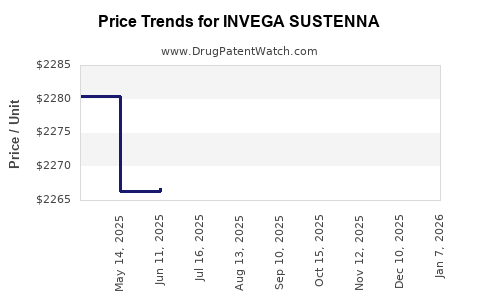
- What is Average Wholesale Price for INVEGA SUSTENNA?
Summary for INVEGA SUSTENNA
| US Patents: | 1 |
| Applicants: | 1 |
| NDAs: | 1 |
| Finished Product Suppliers / Packagers: | 1 |
| Raw Ingredient (Bulk) Api Vendors: | 65 |
| Clinical Trials: | 11 |
| Patent Applications: | 305 |
| Drug Prices: | Drug price information for INVEGA SUSTENNA |
| Patent Litigation and PTAB cases: | See patent lawsuits and PTAB cases for INVEGA SUSTENNA |
| What excipients (inactive ingredients) are in INVEGA SUSTENNA? | INVEGA SUSTENNA excipients list |
| DailyMed Link: | INVEGA SUSTENNA at DailyMed |
DrugPatentWatch® Estimated Loss of Exclusivity (LOE) Date for INVEGA SUSTENNA
Generic Entry Date for INVEGA SUSTENNA*:
Constraining patent/regulatory exclusivity:
NDA:
Dosage:
SUSPENSION, EXTENDED RELEASE;INTRAMUSCULAR |
*The generic entry opportunity date is the latter of the last compound-claiming patent and the last regulatory exclusivity protection. Many factors can influence early or later generic entry. This date is provided as a rough estimate of generic entry potential and should not be used as an independent source.
Recent Clinical Trials for INVEGA SUSTENNA
Identify potential brand extensions & 505(b)(2) entrants
| Sponsor | Phase |
|---|---|
| Alliance for Clinical Trials in Oncology | Phase 1 |
| Evolution Research Group | Phase 1 |
| Luye Pharma Group Ltd. | Phase 1 |
Pharmacology for INVEGA SUSTENNA
| Drug Class | Atypical Antipsychotic |
Paragraph IV (Patent) Challenges for INVEGA SUSTENNA
| Tradename | Dosage | Ingredient | Strength | NDA | ANDAs Submitted | Submissiondate |
|---|---|---|---|---|---|---|
| INVEGA SUSTENNA | Extended-release Injectable Suspension | paliperidone palmitate | 39 mg/0.25 mL, 78 mg/0.5 mL, 117 mg/0.75 mL, 156 mg/mL and 234 mg/1.5 mL | 022264 | 1 | 2017-11-21 |
US Patents and Regulatory Information for INVEGA SUSTENNA
INVEGA SUSTENNA is protected by two US patents.
Based on analysis by DrugPatentWatch, the earliest date for a generic version of INVEGA SUSTENNA is ⤷ Start Trial.
This potential generic entry date is based on patent 5,254,556.
Generics may enter earlier, or later, based on new patent filings, patent extensions, patent invalidation, early generic licensing, generic entry preferences, and other factors.
| Applicant | Tradename | Generic Name | Dosage | NDA | Approval Date | TE | Type | RLD | RS | Patent No. | Patent Expiration | Product | Substance | Delist Req. | Exclusivity Expiration |
|---|---|---|---|---|---|---|---|---|---|---|---|---|---|---|---|
| Janssen Pharms | INVEGA SUSTENNA | paliperidone palmitate | SUSPENSION, EXTENDED RELEASE;INTRAMUSCULAR | 022264-001 | Jul 31, 2009 | RX | Yes | Yes | 9,439,906 | ⤷ Start Trial | ⤷ Start Trial | ||||
| Janssen Pharms | INVEGA SUSTENNA | paliperidone palmitate | SUSPENSION, EXTENDED RELEASE;INTRAMUSCULAR | 022264-004 | Jul 31, 2009 | RX | Yes | Yes | 9,439,906 | ⤷ Start Trial | ⤷ Start Trial | ||||
| Janssen Pharms | INVEGA SUSTENNA | paliperidone palmitate | SUSPENSION, EXTENDED RELEASE;INTRAMUSCULAR | 022264-002 | Jul 31, 2009 | RX | Yes | Yes | 9,439,906 | ⤷ Start Trial | ⤷ Start Trial | ||||
| Janssen Pharms | INVEGA SUSTENNA | paliperidone palmitate | SUSPENSION, EXTENDED RELEASE;INTRAMUSCULAR | 022264-003 | Jul 31, 2009 | RX | Yes | Yes | 9,439,906 | ⤷ Start Trial | ⤷ Start Trial | ||||
| Janssen Pharms | INVEGA SUSTENNA | paliperidone palmitate | SUSPENSION, EXTENDED RELEASE;INTRAMUSCULAR | 022264-005 | Jul 31, 2009 | RX | Yes | Yes | 9,439,906 | ⤷ Start Trial | ⤷ Start Trial | ||||
| >Applicant | >Tradename | >Generic Name | >Dosage | >NDA | >Approval Date | >TE | >Type | >RLD | >RS | >Patent No. | >Patent Expiration | >Product | >Substance | >Delist Req. | >Exclusivity Expiration |
International Patents for INVEGA SUSTENNA
When does loss-of-exclusivity occur for INVEGA SUSTENNA?
Based on analysis by DrugPatentWatch, the following patents block generic entry in the countries listed below:
Australia
Patent: 08340101
Estimated Expiration: ⤷ Start Trial
Patent: 15200801
Estimated Expiration: ⤷ Start Trial
Brazil
Patent: 0821408
Estimated Expiration: ⤷ Start Trial
Canada
Patent: 55335
Estimated Expiration: ⤷ Start Trial
China
Patent: 1932327
Estimated Expiration: ⤷ Start Trial
Patent: 5560176
Estimated Expiration: ⤷ Start Trial
Colombia
Patent: 00949
Estimated Expiration: ⤷ Start Trial
Croatia
Patent: 0210669
Estimated Expiration: ⤷ Start Trial
Cyprus
Patent: 24103
Estimated Expiration: ⤷ Start Trial
Denmark
Patent: 34617
Estimated Expiration: ⤷ Start Trial
Ecuador
Patent: 10010289
Estimated Expiration: ⤷ Start Trial
Eurasian Patent Organization
Patent: 0697
Estimated Expiration: ⤷ Start Trial
Patent: 1070757
Estimated Expiration: ⤷ Start Trial
European Patent Office
Patent: 34617
Estimated Expiration: ⤷ Start Trial
Patent: 09585
Estimated Expiration: ⤷ Start Trial
Finland
Patent: 34617
Estimated Expiration: ⤷ Start Trial
Guatemala
Patent: 1000182
Estimated Expiration: ⤷ Start Trial
Hong Kong
Patent: 23850
Estimated Expiration: ⤷ Start Trial
Hungary
Patent: 53904
Estimated Expiration: ⤷ Start Trial
Israel
Patent: 6448
Patent: משטר מינון הקשור לאסטרים פאליפרידונים להזרקה עם פעילות ממושכת (Dosing regimen associated with long acting injectable paliperidone esters)
Estimated Expiration: ⤷ Start Trial
Japan
Patent: 25786
Estimated Expiration: ⤷ Start Trial
Patent: 11506555
Patent: 長時間作用型注入可能パリペリドンエステルに関連する投薬計画
Estimated Expiration: ⤷ Start Trial
Lithuania
Patent: 34617
Estimated Expiration: ⤷ Start Trial
Malaysia
Patent: 4500
Patent: DOSING REGIMEN ASSOCIATED WITH LONG ACTING INJECTABLE PALIPERIDONE ESTERS
Estimated Expiration: ⤷ Start Trial
New Zealand
Patent: 6221
Patent: Dosing regimen associated with long acting injectable paliperidone esters
Estimated Expiration: ⤷ Start Trial
Nicaragua
Patent: 1000105
Patent: RÉGIMEN DE DOSIFICACIÓN ASOCIADO CON ÉSTERES DE PALIPERIDONA INYECTABLES DE ACCIÓN PROLONGADA.
Estimated Expiration: ⤷ Start Trial
Poland
Patent: 34617
Estimated Expiration: ⤷ Start Trial
Portugal
Patent: 34617
Estimated Expiration: ⤷ Start Trial
Serbia
Patent: 765
Patent: REŽIM DOZIRANJA POVEZAN SA DUGODELUJUĆIM INJEKTABILNIM ESTRIMA PALIPERIDONA (DOSING REGIMEN ASSOCIATED WITH LONG ACTING INJECTABLE PALIPERIDONE ESTERS)
Estimated Expiration: ⤷ Start Trial
Slovenia
Patent: 34617
Estimated Expiration: ⤷ Start Trial
South Korea
Patent: 2163196
Estimated Expiration: ⤷ Start Trial
Patent: 2318070
Estimated Expiration: ⤷ Start Trial
Patent: 100099292
Patent: DOSING REGIMEN ASSOCIATED WITH LONG ACTING INJECTABLE PALIPERIDONE ESTERS
Estimated Expiration: ⤷ Start Trial
Patent: 170018489
Patent: 장기 작용성 주사가능 팔리페리돈 에스테르와 관련된 투여 요법 (DOSING REGIMEN ASSOCIATED WITH LONG ACTING INJECTABLE PALIPERIDONE ESTERS)
Estimated Expiration: ⤷ Start Trial
Patent: 190049933
Patent: 장기 작용성 주사가능 팔리페리돈 에스테르와 관련된 투여 요법 (DOSING REGIMEN ASSOCIATED WITH LONG ACTING INJECTABLE PALIPERIDONE ESTERS)
Estimated Expiration: ⤷ Start Trial
Spain
Patent: 68353
Estimated Expiration: ⤷ Start Trial
Ukraine
Patent: 163
Patent: СПОСІБ ДОЗУВАННЯ ІН'ЄКЦІЙНОЇ ФОРМИ ПАЛІПЕРИДОНУ ПАЛЬМІТАТУ ТРИВАЛОЇ ДІЇ (DOSING REGIMEN ASSOCIATED WITH LONG ACTING INJECTABLE PALIPERIDONE ESTERS)
Estimated Expiration: ⤷ Start Trial
Generics may enter earlier, or later, based on new patent filings, patent extensions, patent invalidation, early generic licensing, generic entry preferences, and other factors.
See the table below for additional patents covering INVEGA SUSTENNA around the world.
| Country | Patent Number | Title | Estimated Expiration |
|---|---|---|---|
| Austria | 122349 | ⤷ Start Trial | |
| Australia | 4443689 | ⤷ Start Trial | |
| Australia | 614437 | ⤷ Start Trial | |
| Canada | 2000786 | 3-PIPERIDINYL-1,2-BENZISOXAZOLES (3-PIPERIDINYL-1,2-BENZISOXAZOLES) | ⤷ Start Trial |
| Chile | 43432 | PROCEDIMIENTO DE PREPARACION DE 1,2-BENZISOXAZOL-3-IL-4-PIPERIDINIL-ALQUIL-6,7,8,9-TETRAHIDRO-PIRIDO[1,2a]PIRIMIDIN-4-ONA. | ⤷ Start Trial |
| Cyprus | 1926 | Novel 3-piperidinyl-1,2-benzisoxazoles | ⤷ Start Trial |
| Germany | 122007000081 | ⤷ Start Trial | |
| >Country | >Patent Number | >Title | >Estimated Expiration |
Supplementary Protection Certificates for INVEGA SUSTENNA
| Patent Number | Supplementary Protection Certificate | SPC Country | SPC Expiration | SPC Description |
|---|---|---|---|---|
| 0368388 | 91362 | Luxembourg | ⤷ Start Trial | 91362, EXPIRES: 20141030 |
| 0368388 | 07C0044 | France | ⤷ Start Trial | PRODUCT NAME: PALIPERIDONE; REGISTRATION NO/DATE IN FRANCE: EU/1/07/395/01 DU 20070626; REGISTRATION NO/DATE AT EEC: EU/1/07/395/01 DU 20070625 |
| 0368388 | SPC/GB07/065 | United Kingdom | ⤷ Start Trial | PRODUCT NAME: PALIPERIDONE, OPTIONALLY IN THE FORM OF A PHARMACEUTICALLY ACCEPTABLE SALT; REGISTERED: UK EU/1/07/395/001 20070625; UK EU/1/07/395/002 20070625; UK EU/1/07/395/003 20070625; UK EU/1/07/395/004 20070625; UK EU/1/07/395/005 20070625; UK EU/1/07/395/006 20070625; UK EU/1/07/395/007 20070625; UK EU/1/07/395/008 20070625; UK EU/1/07/395/009 20070625; UK EU/1/07/395/010 20070625; UK EU/1/07/395/011 20070625; UK EU/1/07/395/012 20070625; UK EU/1/07/395/013 20070625; UK EU/1/07/395/014 20070625; UK EU/1/07/395/015 20070625; UK EU/1/07/395/016 20070625; UK EU/1/07/395/017 20070625; UK EU/1/07/395/018 20070625; UK EU/1/07/395/019 20070625; UK EU/1/07/395/020 20070625; UK EU/1/07/395/021 |
| 0368388 | C300298 | Netherlands | ⤷ Start Trial | PRODUCT NAME: PALIPERIDON, DESGEWENST IN DE VORM VAN EEN FARMACEUTISCH AANVAARDBAAR ZUURADDITIE ZOUT; REGISTRATION NO/DATE: EU/1/07/395/001-064 20070625 |
| 0368388 | 78/2007 | Austria | ⤷ Start Trial | PRODUCT NAME: PALIPERIDON, GEGEBENENFALLS IN FORM EINES PHARMAZEUTISCH ANNEMBAREN SALZES; REGISTRATION NO/DATE: EU/1/07/395/001-064 20070625 |
| 0904081 | C300491 | Netherlands | ⤷ Start Trial | PRODUCT NAME: PALIPERIDONPALMITAAT; REGISTRATION NO/DATE: EU/1/11/672/001-006 20110304 |
| 0904081 | 91842 | Luxembourg | ⤷ Start Trial | 91842, EXPIRES: 20220512 |
| >Patent Number | >Supplementary Protection Certificate | >SPC Country | >SPC Expiration | >SPC Description |
INVEGA SUSTENNA (paliperidone palmitate) Market Dynamics and Financial Trajectory: Exclusivity Timeline, Generic/Biosimilar Risk, and Revenue Exposure
More… ↓
Make Better Decisions: Try a trial or see plans & pricing
Drugs may be covered by multiple patents or regulatory protections. All trademarks and applicant names are the property of their respective owners or licensors. Although great care is taken in the proper and correct provision of this service, thinkBiotech LLC does not accept any responsibility for possible consequences of errors or omissions in the provided data. The data presented herein is for information purposes only. There is no warranty that the data contained herein is error free. We do not provide individual investment advice. This service is not registered with any financial regulatory agency. The information we publish is educational only and based on our opinions plus our models. By using DrugPatentWatch you acknowledge that we do not provide personalized recommendations or advice. thinkBiotech performs no independent verification of facts as provided by public sources nor are attempts made to provide legal or investing advice. Any reliance on data provided herein is done solely at the discretion of the user. Users of this service are advised to seek professional advice and independent confirmation before considering acting on any of the provided information. thinkBiotech LLC reserves the right to amend, extend or withdraw any part or all of the offered service without notice.
ISSN: 2162-2639

Privacy and Cookies
Terms & Conditions
Site Map
DrugPatentWatch Alternatives
LOE / Major Patent Expirations 2026 - 2027
NCE-1 Patent Challenge Dates 2026 - 2027
Friedman, Yali. "DrugPatentWatch" DrugPatentWatch, thinkBiotech, 2026, www.DrugPatentWatch.com.
See Primary Research Papers Citing DrugPatentWatch