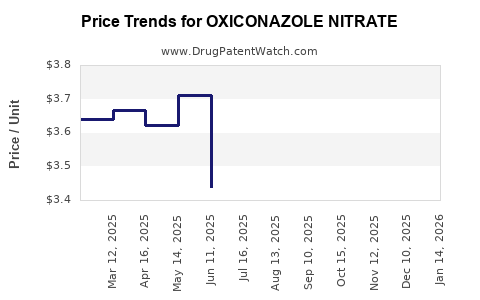
Last updated: February 19, 2026
Oxiconazole nitrate is a topical antifungal agent utilized for the treatment of dermatophytoses, commonly known as ringworm. Its market presence is defined by established generic competition and specific therapeutic niche.
What is Oxiconazole Nitrate's Mechanism of Action and Clinical Application?
Oxiconazole nitrate is an imidazole derivative. It functions by inhibiting the synthesis of ergosterol, a critical component of fungal cell membranes. This disruption leads to increased membrane permeability and ultimately cell death. The compound is formulated as a topical cream or lotion.
Primary clinical applications include:
- Tinea pedis (athlete's foot)
- Tinea cruris (jock itch)
- Tinea corporis (ringworm of the body)
- Tinea versicolor
It is generally applied once or twice daily for a specified duration, typically two to four weeks, depending on the site and severity of infection.
What is the Current Market Landscape for Oxiconazole Nitrate?
The market for oxiconazole nitrate is characterized by its mature stage and significant generic penetration. The drug has been off-patent for an extended period, leading to widespread availability of cost-effective generic alternatives.
Key market factors include:
- Generic Dominance: The vast majority of oxiconazole nitrate products available are manufactured by generic pharmaceutical companies. This has suppressed wholesale prices and limited the profitability of branded products.
- Therapeutic Niche: Oxiconazole nitrate occupies a specific niche within the antifungal market. It competes with other topical antifungals such as clotrimazole, miconazole, terbinafine, and ketoconazole. While effective, it does not hold a dominant position against all alternatives.
- Prescription Status: In many regions, oxiconazole nitrate is available both by prescription and over-the-counter (OTC). The OTC availability has further contributed to accessibility and price competition.
- Geographic Distribution: The drug is marketed globally, with consistent demand in regions experiencing high prevalence of fungal skin infections.
Market analysis indicates that demand is driven by the prevalence of fungal infections rather than novel therapeutic advancements. The overall market size for topical antifungals is substantial, but oxiconazole nitrate's share is fragmented among multiple generic manufacturers.
What are the Key Patent Expirations and Generic Entry Timelines?
The original patents protecting oxiconazole nitrate expired decades ago. For instance, key patents in the United States expired in the early to mid-1990s. This early expiration allowed for the prompt introduction of generic versions into the market.
- Original Patent Expiry (US): Circa 1993-1995.
- Generic Entry: Immediately following patent expiry, multiple generic manufacturers began marketing oxiconazole nitrate products.
- No Recent Patent Activity: There has been minimal significant patent litigation or new patent filings related to the core active pharmaceutical ingredient (API) or its primary formulations in recent years. This reflects the drug's established status.
This lack of patent protection for the original molecule means that the market dynamics are dictated by manufacturing efficiency, supply chain reliability, and pricing strategies rather than intellectual property exclusivity.
What is the Projected Financial Trajectory and Revenue Potential?
The financial trajectory for oxiconazole nitrate is characterized by stable, albeit low-margin, revenue streams. Significant growth is not anticipated due to market maturity and generic competition.
- Revenue Drivers: Revenue is primarily generated through high-volume sales of generic formulations. Demand is relatively inelastic for essential topical treatments but is highly sensitive to price.
- Profitability: Profit margins for individual generic manufacturers are typically narrow, necessitating efficient manufacturing processes and economies of scale. Brand recognition does not confer a significant pricing premium.
- Market Size Estimation: While precise figures for oxiconazole nitrate alone are not always segmented, the global market for topical antifungals is estimated to be in the billions of dollars. Oxiconazole nitrate represents a fraction of this larger market. For example, global topical antifungal market was projected to reach USD 7.7 billion in 2022, with growth expected at a CAGR of 4.5% from 2023 to 2030 (Source: Grand View Research). Oxiconazole nitrate's specific contribution is within the lower end of this spectrum due to intense generic competition.
- Investment Considerations: Investment in companies heavily reliant on oxiconazole nitrate would be considered a low-risk, low-reward strategy focused on operational efficiency and market share defense rather than innovation-driven growth. The potential for significant revenue increases is limited unless through substantial market share gains or cost reductions in manufacturing.
What are the Competitive Alternatives and Their Market Impact?
Oxiconazole nitrate faces competition from a range of topical antifungal agents, both synthetic and natural. The choice of agent often depends on physician preference, patient tolerance, specific fungal species, and cost.
Key competitors and their market impact:
- Clotrimazole: A widely available imidazole, often used for similar indications. It is a direct competitor with a long history of generic availability and OTC access.
- Miconazole: Another imidazole with broad-spectrum antifungal activity, also available OTC and by prescription. It competes directly with oxiconazole nitrate on price and efficacy for common fungal infections.
- Terbinafine: A well-established allylamine antifungal. It is considered highly effective for tinea infections, particularly tinea pedis, and is available in both topical and oral formulations. Its efficacy can position it as a preferred agent in certain cases, impacting oxiconazole nitrate's market share.
- Ketoconazole: An azole antifungal with a broader spectrum, including activity against yeasts like Malassezia. It is available in shampoos and topical creams. Its use may be limited by potential side effects and drug interactions, particularly with systemic use.
- Other Azoles (e.g., Econazole, Sulconazole): These agents offer similar mechanisms of action and compete within the same therapeutic class.
The competitive landscape is characterized by a "sea of sameness" for many generic topical antifungals. Pricing and physician prescribing habits are significant determinants of market share.
What are the Regulatory Considerations and Market Access Challenges?
Regulatory approval and market access for oxiconazole nitrate are relatively straightforward for generic manufacturers, given its established history and safety profile.
Key regulatory factors:
- ANDA Approval: Generic manufacturers seeking to market oxiconazole nitrate in the United States must obtain an Abbreviated New Drug Application (ANDA) approval from the Food and Drug Administration (FDA). This requires demonstrating bioequivalence to a reference listed drug.
- International Approvals: Similar regulatory pathways exist in other major markets (e.g., EMA in Europe). The drug has a long history of regulatory acceptance globally.
- Manufacturing Standards: Adherence to Good Manufacturing Practices (GMP) is essential for all manufacturers.
- Labeling Requirements: Generic products must carry appropriate labeling, including indications, contraindications, warnings, and precautions, consistent with the reference product.
- Pricing and Reimbursement: In markets with healthcare payers, reimbursement levels for generic topical antifungals are generally set at competitive, often low, rates. This reinforces the price-sensitive nature of the market.
Market access is primarily determined by the ability to produce the drug at a competitive cost and secure distribution channels. There are no significant unmet medical needs that oxiconazole nitrate uniquely addresses, which limits its ability to command premium pricing or access.
What is the Future Outlook for Oxiconazole Nitrate?
The future outlook for oxiconazole nitrate is one of continued stable demand within its established niche. Significant disruption or growth is unlikely.
Future trends:
- Sustained Generic Competition: The market will remain dominated by generic products. Price wars and efficiency in manufacturing will be the primary competitive factors.
- Limited Innovation: Due to its mature status and lack of patent protection, there is little incentive for significant R&D investment in novel formulations or delivery systems for oxiconazole nitrate itself. Research may focus on combination therapies or new agents.
- Prevalence-Driven Demand: Demand will continue to be influenced by the incidence and prevalence of superficial fungal infections, which are influenced by factors such as climate, hygiene, and population demographics.
- Potential for OTC Expansion: Further expansion of OTC availability in various markets could increase accessibility but also intensify price competition.
- Consolidation: The generic pharmaceutical industry may see consolidation, which could affect the competitive landscape for oxiconazole nitrate suppliers through economies of scale.
Overall, oxiconazole nitrate will likely remain a staple treatment for common fungal skin infections, offering a cost-effective option. Its financial trajectory will mirror the broader generic topical antifungal market: stable, low-margin, and volume-driven.
Key Takeaways
Oxiconazole nitrate is a mature, generic topical antifungal. Its market is characterized by intense price competition and stable, low-margin revenue. Original patent expirations in the mid-1990s enabled widespread generic entry. Key competitors include clotrimazole, miconazole, and terbinafine. Regulatory approval is straightforward for generic manufacturers. The future outlook indicates continued stable demand driven by the prevalence of fungal infections, with limited potential for significant growth or innovation.
Frequently Asked Questions
-
Are there any new patents filed for oxiconazole nitrate or its formulations?
No significant new patents related to the core oxiconazole nitrate molecule or its standard topical formulations have emerged in recent years. The drug's intellectual property landscape is largely characterized by expired foundational patents.
-
What is the typical wholesale price range for generic oxiconazole nitrate cream?
Wholesale prices for generic oxiconazole nitrate cream vary by manufacturer, volume, and region, but typically range from approximately $1.50 to $5.00 USD per tube (e.g., 15g or 30g).
-
Does oxiconazole nitrate have any advantages over newer topical antifungals?
Oxiconazole nitrate's primary advantage is its established safety profile, broad availability, and cost-effectiveness as a generic option for common fungal infections. It does not possess novel therapeutic advantages over all newer agents.
-
What is the market share of oxiconazole nitrate within the broader topical antifungal market?
Estimating precise market share for oxiconazole nitrate is challenging as it is often aggregated within broader topical antifungal categories. However, it represents a small, fragmented share due to the large number of competing generic products and alternative active ingredients.
-
What regulatory hurdles must a company overcome to market a generic oxiconazole nitrate product?
Companies must obtain an Abbreviated New Drug Application (ANDA) approval from the FDA (or equivalent international regulatory bodies), demonstrating bioequivalence to a reference listed drug and adherence to Good Manufacturing Practices (GMP).
Citations
[1] Grand View Research. (2023). Topical Antifungal Market Size, Share & Trends Analysis Report By Product (Azoles, Allylamines, Echinocandins, Others), By Formulations (Creams, Gels, Sprays, Powders, Others), By Application (Tinea Pedis, Tinea Cruris, Tinea Corporis, Others), By Distribution Channel, By Region, And Segment Forecasts, 2023 - 2030. Retrieved from https://www.grandviewresearch.com/industry-analysis/topical-antifungal-market