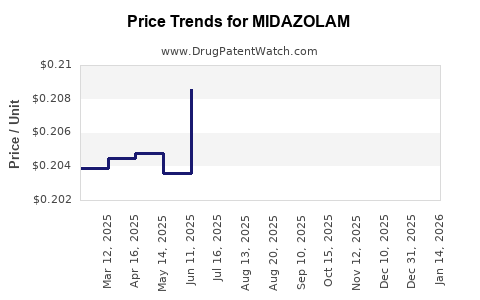
Last updated: August 3, 2026
Midazolam is a mature, low-cost benzodiazepine with stable hospital demand, limited brand pricing power, and declining revenue concentration in the original injectable product. The commercial opportunity is concentrated in differentiated delivery systems, especially intranasal rescue products such as Nayzilam. Generic injection remains the volume market, while branded nasal midazolam carries the strongest remaining pricing and intellectual-property protection.
What is the current market position of midazolam?
Midazolam is used primarily for procedural sedation, anesthesia induction, intensive-care sedation, seizure rescue, and preoperative medication. It is marketed in injectable, oral syrup, buccal, and intranasal forms.
| Segment |
Principal use |
Market structure |
Commercial outlook |
| Injectable midazolam |
Procedural sedation, anesthesia, ICU sedation |
Generic, multi-supplier |
Stable volume, low price |
| Oral syrup |
Pediatric premedication and sedation |
Generic and institutional supply |
Small, specialized market |
| Intranasal midazolam |
Out-of-hospital seizure rescue |
Branded and differentiated |
Higher price, prescription growth opportunity |
| Buccal or compounded products |
Seizure rescue in selected markets |
Regional, pharmacy or specialty supply |
Limited scale |
| Veterinary use |
Sedation and seizure management |
Generic and veterinary distribution |
Small but recurring demand |
The core injectable market is mature. Hospitals generally purchase midazolam through group purchasing organizations, health-system contracts, distributors, and public-sector tenders. Price competition is intense because the active ingredient is well established, manufacturing technology is conventional, and several suppliers can produce equivalent dosage forms.
The main commercial distinction is between institutional injectable midazolam and patient-administered rescue products. Injectable midazolam generates recurring unit demand but limited gross margins. Intranasal midazolam offers higher revenue per treatment because it improves administration outside hospitals and avoids the need for an intravenous line or specialized delivery equipment.
How has midazolam reached its current financial trajectory?
The original branded product, Versed, lost economic exclusivity decades ago. Midazolam now generates most of its global volume through generic injectable products rather than through the legacy brand.
Financial performance has followed four stages:
- The branded hospital product established clinical adoption in the 1980s and 1990s.
- Generic entry compressed injectable pricing and shifted purchasing power to hospitals and distributors.
- Supply disruptions and manufacturer exits periodically increased prices and procurement risk.
- New delivery systems created a separate branded market with higher pricing, especially for seizure rescue.
Public financial reporting does not generally disclose global midazolam revenue as a separate line item. Pfizer, Hikma, Fresenius Kabi, Sandoz, Teva, and other suppliers report broader portfolios rather than product-level midazolam sales. UCB reports commercial performance for its epilepsy franchise but does not necessarily provide a standalone annual revenue figure for Nayzilam in every reporting period.
A defensible market-sizing approach therefore separates revenue into:
- Generic injectable units multiplied by contract or channel price.
- Branded intranasal prescriptions multiplied by net realized price.
- Hospital and ambulatory-surgery utilization.
- Veterinary and international sales.
- Shortage-related price increases, which can distort annual comparisons.
The financial trajectory is likely to remain flat to modestly growing in unit terms for injectable midazolam, with revenue growth dependent on procedure volumes, hospital sedation protocols, and supply conditions. Branded intranasal products have greater percentage growth potential but remain much smaller than the injectable market.
Which companies manufacture or commercialize midazolam?
The supplier base varies by country and dosage form. Major participants in the United States and international markets have included Pfizer, Hikma Pharmaceuticals, Fresenius Kabi, Sandoz, Teva, Eugia Pharma, and other generic manufacturers.
| Company or group |
Relevant position |
| Pfizer |
Historical originator and established hospital-product supplier |
| Hikma Pharmaceuticals |
Generic injectable portfolio and institutional distribution |
| Fresenius Kabi |
Injectable hospital medicines and critical-care supply |
| Sandoz |
Generic pharmaceutical supplier in selected markets |
| Teva |
Generic midazolam products in selected jurisdictions |
| UCB |
Developer and marketer of Nayzilam in the United States |
| Regional manufacturers |
Important in tender markets and non-U.S. supply |
The commercial landscape is fragmented. No single company controls global midazolam supply across all formulations and jurisdictions. Supplier qualification, manufacturing capacity, preservative compatibility, container systems, and hospital contracts are often more important than brand recognition.
What FDA products contain midazolam?
The FDA-approved product landscape includes both legacy injectable products and newer rescue formulations.
| Product |
Active ingredient |
Route |
FDA milestone |
Commercial significance |
| Versed and generic equivalents |
Midazolam hydrochloride |
Intravenous, intramuscular |
Original U.S. approval in the 1980s |
Mature hospital market |
| Nayzilam |
Midazolam |
Intranasal |
Approved May 2019 |
Branded seizure-rescue product |
| Seizalam |
Midazolam |
Intramuscular |
Approved 2019 |
Acute seizure treatment in emergency settings |
Nayzilam was approved for the acute treatment of intermittent, stereotypic episodes of frequent seizure activity that are distinct from a patient’s usual seizure pattern in patients with epilepsy who are at least 12 years old. The product is supplied as a single-dose nasal spray and is designed for use by caregivers outside conventional clinical settings (U.S. Food and Drug Administration, 2019a).
Seizalam was approved for the treatment of status epilepticus in adults. Its commercial role is narrower because emergency medical personnel and hospitals already use injectable midazolam and other benzodiazepines under established protocols (U.S. Food and Drug Administration, 2019b).
What patents protect Nayzilam and other midazolam products?
The original midazolam compound and conventional injectable formulations are long off patent. Generic injectable midazolam therefore faces limited composition-of-matter protection.
The remaining patent value is concentrated in:
- Intranasal formulations.
- Spray-device architecture.
- Dose delivery and container systems.
- Stability and concentration parameters.
- Methods for treating seizure clusters.
- Patient-specific rescue protocols.
- Manufacturing controls for low-volume nasal delivery.
Nayzilam’s potential patent protection is materially stronger than that of generic injectable midazolam because the product combines a known active ingredient with a proprietary route, formulation, and delivery system. The relevant patent portfolio should be reviewed in the current FDA Orange Book and USPTO records because listed patents, expiration dates, pediatric extensions, terminal disclaimers, and litigation certifications can change over time (U.S. Food and Drug Administration, 2024a; United States Patent and Trademark Office, 2024).
| IP category |
Injectable generic midazolam |
Branded intranasal midazolam |
| Compound patent |
Expired |
Expired |
| Basic formulation protection |
Weak or expired |
Potentially relevant |
| Device protection |
Usually absent |
Potentially important |
| Method-of-use protection |
Limited |
Relevant to seizure rescue |
| Manufacturing know-how |
Moderate operational value |
Higher formulation and device value |
| Generic substitution risk |
High |
Lower until listed patents expire or are successfully challenged |
When does midazolam lose exclusivity?
Generic injectable midazolam has already lost market exclusivity. The central exclusivity question concerns branded intranasal and other specialized formulations.
Nayzilam received FDA approval in 2019. Its commercial protection is not determined by the approval date alone. Relevant periods may include listed patents, three-year clinical-investigation exclusivity, pediatric exclusivity, orphan-drug exclusivity if applicable, and regulatory protections attached to specific indications.
The practical entry date for an intranasal generic depends on:
- The expiration of relevant Orange Book-listed patents.
- Whether an ANDA applicant files a Paragraph IV certification.
- Patent litigation within the statutory period.
- The outcome of the litigation or settlement.
- FDA approval of the ANDA.
- Commercial launch terms agreed between the parties.
A definitive generic-entry date cannot be inferred from the 2019 approval date. FDA exclusivity and patent records must be evaluated separately.
Are there Paragraph IV challenges to branded midazolam?
A Paragraph IV challenge would target one or more patents listed for a branded midazolam product and assert that the patent is invalid, unenforceable, or not infringed. The first substantially complete ANDA containing a Paragraph IV certification may obtain 180-day generic exclusivity under the Hatch-Waxman framework, subject to statutory conditions (U.S. Food and Drug Administration, 2024b).
For generic injectable midazolam, Paragraph IV activity is commercially less significant because the original compound and basic hospital formulations are mature. For Nayzilam, a Paragraph IV filing could have greater strategic value because a successful challenge could open the branded rescue market to an intranasal generic.
Public FDA records should be checked for current ANDA certifications and Orange Book listings. FDA’s Orange Book does not provide a complete litigation history, and a patent challenge may be disclosed through court filings before it produces a visible change in product availability.
What is the Orange Book status of midazolam?
The Orange Book generally distinguishes between:
- Approved generic injectable midazolam products.
- Reference-listed drug entries for branded or designated products.
- Patent listings for products with formulation, method, or device claims.
- Therapeutic-equivalence codes for approved generic products.
Injectable midazolam products with an “AB” therapeutic-equivalence rating are generally substitutable under applicable state pharmacy laws, although hospital purchasing and institutional protocols determine actual utilization. Therapeutic equivalence does not eliminate differences in preservative content, concentration, vial size, packaging, supply reliability, or contract pricing.
Nayzilam is commercially differentiated from injectable midazolam because a conventional injectable generic is not therapeutically or operationally equivalent to a ready-to-use nasal spray. A future generic nasal spray would need to demonstrate product-specific pharmaceutical equivalence, bioequivalence, device performance, and manufacturing consistency.
What litigation and settlement risks affect midazolam?
The highest litigation risk is associated with branded intranasal products, not the mature injectable market. Potential disputes include:
- Patent infringement claims against ANDA applicants.
- Challenges to formulation and device patents.
- Regulatory litigation concerning patent listing or labeling.
- Trade-secret disputes involving spray manufacture or stability testing.
- Contract disputes involving specialty-pharmacy distribution.
No broad patent dispute changes the fundamental economics of generic injectable midazolam. Any significant litigation impact would more likely arise from a branded intranasal product and would affect the timing of generic entry rather than the entire midazolam market.
Settlement agreements could provide a licensed entry date before patent expiration. Their commercial value would depend on whether the generic launches with an authorized-generic arrangement, a restricted indication, or a delayed launch date. Settlement terms are not always publicly available in full.
What manufacturing and supply barriers exist for midazolam?
Midazolam is chemically established, but supply is not frictionless. The main barriers are operational rather than discovery-based.
Injectable supply risks
Hospitals can experience shortages when:
- A manufacturer exits the market.
- A plant undergoes regulatory remediation.
- Active pharmaceutical ingredient supply is interrupted.
- Demand rises during surgical or emergency-care surges.
- Low prices make production economically unattractive.
- Preservative-free or specific concentration presentations have limited suppliers.
The FDA has listed midazolam products in shortage-related records at various times. Shortages can temporarily improve supplier pricing, but they also create substitution risk and procurement penalties (U.S. Food and Drug Administration, 2024c).
Intranasal manufacturing risks
Intranasal midazolam requires tighter control over:
- Spray-pump dose uniformity.
- Droplet or plume performance.
- Viscosity and excipient composition.
- Container-closure integrity.
- Stability during storage.
- Human-factors performance.
- Commercial-scale filling and assembly.
These requirements create a higher barrier than producing a conventional vial, even though the active ingredient itself is generic.
How does midazolam compare with competing seizure-rescue drugs?
| Product |
Route |
Principal commercial advantage |
Main competitive constraint |
| Nayzilam |
Intranasal midazolam |
Familiar benzodiazepine, rapid caregiver administration |
Branded price and patent exposure |
| Valtoco |
Intranasal diazepam |
Established rescue positioning and longer commercial history |
Higher product cost and device differentiation |
| Rectal diazepam gel |
Rectal |
Established rescue treatment |
Administration burden and privacy concerns |
| Injectable midazolam |
Intramuscular or intravenous |
Low cost and broad clinical familiarity |
Requires trained administration or injection |
| Buccal midazolam |
Buccal |
Useful in some non-U.S. markets |
Regulatory and formulation fragmentation |
Nayzilam competes most directly with Valtoco and rectal diazepam for seizure-cluster rescue. Its economic proposition is based on convenience, caregiver usability, and reduced administration burden rather than a novel pharmacologic mechanism.
What generic launch scenarios exist for midazolam?
The market supports four main launch scenarios:
- Continued generic injectable competition with stable hospital volumes and low margins.
- A shortage-driven price rebound for selected vial sizes or concentrations.
- A delayed intranasal generic entry after patent litigation or settlement.
- A successful intranasal generic launch that reduces branded rescue revenue and expands overall use through lower patient cost.
The most likely near-term financial pattern is stable injectable demand with episodic price volatility. The largest step change would come from generic entry into branded intranasal midazolam, but timing depends on patent scope, FDA approval, and commercial manufacturing capability.
What is the revenue exposure for manufacturers?
Revenue exposure differs by business model:
- Generic manufacturers have volume exposure but limited product-level pricing power.
- Hospital-focused suppliers are sensitive to contract renewals, shortages, and manufacturing costs.
- UCB has greater exposure to branded rescue-product uptake and payer coverage.
- Distributors are exposed to inventory turnover, shortage premiums, and purchasing concentration.
- Device or formulation partners may capture value through technology licensing rather than active-ingredient sales.
For investors, midazolam is unlikely to be a major growth driver for diversified pharmaceutical companies. It is more relevant as a portfolio product that provides recurring hospital volume, improves injectable-market density, or supports a specialty rescue franchise.
How strong is the midazolam patent estate?
The patent estate is weak for conventional injectable midazolam and stronger, but narrower, for proprietary intranasal delivery.
| Factor |
Assessment |
| Compound protection |
Exhausted |
| Generic injectable barriers |
Low |
| Hospital formulation differentiation |
Low to moderate |
| Intranasal formulation protection |
Moderate to strong, depending on claim scope |
| Device protection |
Potentially material |
| Manufacturing know-how |
Relevant for nasal products |
| Litigation leverage |
Limited for injection, higher for branded nasal products |
| Long-term moat |
Narrow and formulation-specific |
The central commercial conclusion is that midazolam’s value is no longer based on the molecule. It is based on route of administration, device performance, regulatory status, distribution, and supply reliability.
Key Takeaways
- Midazolam is a mature generic drug with stable clinical demand and low injectable pricing.
- Generic injectable products dominate volume but have limited margin expansion potential.
- Nayzilam created a higher-value branded intranasal segment for seizure rescue.
- The strongest remaining IP relates to formulation, nasal delivery, device performance, and methods of use.
- FDA approval in 2019 does not establish a definitive generic-entry date for Nayzilam.
- Paragraph IV risk is more commercially important for intranasal midazolam than for injectable midazolam.
- Supply shortages can create temporary pricing gains but do not establish durable market power.
- No biosimilar pathway applies because midazolam is a small-molecule drug.
- The most important investment variables are intranasal generic timing, payer coverage, rescue-product adoption, and hospital supply concentration.
FAQs About Midazolam Market and Patent Risk
Is midazolam still a profitable pharmaceutical product?
Generic injectable midazolam can be profitable at scale, but it is usually a low-margin hospital product. Profitability improves during shortages or when a supplier has reliable manufacturing capacity.
Does midazolam have biosimilar competition?
No. Midazolam is a chemically synthesized small-molecule drug. Competition proceeds through generic-drug pathways such as ANDAs, not biosimilar applications.
Which drug is the closest competitor to Nayzilam?
Valtoco, an intranasal diazepam product, is the closest branded competitor because both products target out-of-hospital seizure rescue.
Can a generic injectable midazolam replace Nayzilam?
Usually no. Injectable midazolam requires a different administration route, presentation, and use environment. A generic nasal product would be the more direct substitute.
What would most increase midazolam market value?
A durable increase in procedure volumes, recurring hospital shortages, or broader adoption of intranasal rescue products would have the greatest effect. Conventional injectable demand alone is unlikely to produce substantial long-term revenue growth.
References
-
U.S. Food and Drug Administration. (2019a). FDA approves first generic version of Nayzilam nasal spray for seizure clusters. FDA.
-
U.S. Food and Drug Administration. (2019b). FDA approves first nasal spray for patients with seizure clusters. FDA.
-
U.S. Food and Drug Administration. (2024a). Approved drug products with therapeutic equivalence evaluations: Orange Book. FDA.
-
U.S. Food and Drug Administration. (2024b). Paragraph IV drug product and patent information. FDA.
-
U.S. Food and Drug Administration. (2024c). Drug shortages: Midazolam injection. FDA.
-
United States Patent and Trademark Office. (2024). Patent Center and patent search records. USPTO.