Last updated: September 1, 2026
Metolazone is a mature, off-patent thiazide-like diuretic used primarily for hypertension and edema, including edema associated with congestive heart failure and renal disease. The U.S. market is generic, low-priced, and fragmented. No active composition-of-matter patent or FDA regulatory exclusivity is known to block generic competition. Commercial value is driven by prescription volume, supply continuity, and institutional contracting rather than branded pricing power.
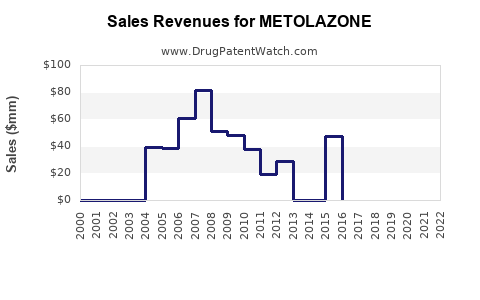
Standalone global revenue for metolazone is not publicly disclosed by major manufacturers. The product is generally included within broader generic portfolios, preventing reliable company-level revenue attribution.
What is metolazone and how is it used clinically?
Metolazone is an oral quinazoline-derived diuretic with pharmacology similar to thiazide diuretics. It inhibits sodium reabsorption in the distal renal tubule and is used to increase fluid excretion.
The principal uses are:
- Hypertension, either alone or with other antihypertensive agents.
- Edema associated with congestive heart failure.
- Edema associated with renal disease, including nephrotic syndrome.
- Sequential nephron blockade with loop diuretics in patients with diuretic-resistant fluid overload.
Metolazone is commonly prescribed in 2.5 mg, 5 mg, and 10 mg tablets. Lower doses are frequently used when combined with loop diuretics such as furosemide or torsemide. The FDA label warns about electrolyte depletion, dehydration, hypotension, and renal impairment, particularly when metolazone is combined with other diuretics. [1]
How does metolazone compare with competing diuretics?
| Drug or class |
Typical role |
Commercial position |
Main competitive issue |
| Metolazone |
Edema and hypertension; often combined with loop diuretics |
Generic, low cost |
Narrower use and electrolyte-monitoring burden |
| Hydrochlorothiazide |
First-line hypertension treatment |
Large generic market |
Greater guideline familiarity and broad availability |
| Chlorthalidone |
Hypertension |
Generic, increasingly used in guidelines |
Longer duration and strong evidence base |
| Indapamide |
Hypertension |
Generic, smaller market |
Geographic and prescribing variation |
| Furosemide |
Edema and heart failure |
Large generic market |
Often used as the primary loop diuretic |
| Torsemide |
Edema and heart failure |
Generic and branded legacy products |
Increasing use in heart failure management |
| Bumetanide |
Edema and heart failure |
Generic, smaller volume |
Potency and dosing flexibility |
Metolazone’s principal clinical differentiation is its use with loop diuretics when additional distal-tubule blockade is required. Its commercial position is therefore linked to heart-failure and renal-disease prescribing rather than the larger primary-hypertension market.
What is the FDA regulatory status of metolazone?
Metolazone is an FDA-approved small-molecule drug available in immediate-release oral tablets. The historical branded product Zaroxolyn was approved under NDA 018874. Generic metolazone tablets are marketed through abbreviated new drug applications, or ANDAs. [2]
The regulatory profile is mature:
| Regulatory attribute |
Status |
| Active ingredient |
Metolazone |
| Dosage form |
Immediate-release oral tablet |
| Common strengths |
2.5 mg, 5 mg, 10 mg |
| FDA pathway for generics |
ANDA |
| Reference brand |
Zaroxolyn |
| Biologic status |
Not applicable |
| Pediatric exclusivity |
No current exclusivity identified |
| Orphan-drug exclusivity |
None identified |
| New chemical entity exclusivity |
Expired |
| Current branded market protection |
None known to restrict generic supply |
The product does not require biosimilar development because metolazone is a chemically synthesized small molecule. Generic applicants rely on bioequivalence and pharmaceutical-equivalence requirements rather than clinical efficacy trials comparable to those required for a new drug.
What patents protect metolazone?
No active U.S. composition-of-matter patent is known to provide current market exclusivity for metolazone. The original product and its basic therapeutic technology date from the period before modern Orange Book patent practice became commercially significant for many generic drugs.
The relevant IP position is summarized below:
| IP category |
Current commercial effect |
| Composition-of-matter patent |
Expired |
| Original formulation patents |
Expired or commercially immaterial |
| Method-of-use patents |
No known active U.S. patent blocking routine generic use |
| Manufacturing patents |
Any surviving process claims would not ordinarily prevent tablet substitution unless specifically listed or enforced |
| Orange Book-listed patents |
No known active patent barrier that prevents ANDA approval |
| Regulatory exclusivity |
Expired |
FDA’s Orange Book is the primary public source for patents and exclusivity associated with approved drugs. For an old generic product such as metolazone, the practical market assessment is based on the absence of current listed patents and the long history of ANDA approvals. [3]
Are formulation patents a material risk for metolazone?
Formulation-patent risk is low for conventional immediate-release metolazone tablets. The commercial product does not depend on an extended-release delivery system, complex device, liposomal technology, or biologic manufacturing platform.
Potentially relevant formulation issues include:
- Tablet strength and scoring.
- Excipients and dissolution performance.
- Stability and impurity controls.
- Packaging designed to manage moisture or degradation.
- Bioequivalence for low-dose tablets.
These issues can create development or manufacturing work, but they are not generally equivalent to enforceable exclusivity. A manufacturer may need to design around a particular excipient or process patent, but such a patent would not ordinarily support branded pricing for the entire metolazone market.
When did metolazone lose exclusivity?
Metolazone lost meaningful branded exclusivity decades ago. The drug is now in the mature generic phase, with multiple approved manufacturers and no evident regulatory exclusivity that would support a protected launch.
The commercial timeline is:
| Period |
Market event |
| 1970s |
Original U.S. branded metolazone approval and commercialization |
| 1980s-1990s |
Expansion of generic-drug competition and erosion of branded pricing |
| 2000s |
Generic metolazone becomes the primary U.S. supply channel |
| 2010s |
Continued use in edema and resistant fluid-overload treatment |
| 2020s |
Mature, low-price market with manufacturer and supply-chain sensitivity |
The exact date of final patent expiry is less important for present commercial analysis than the current market structure: generic substitution is established, branded exclusivity has ended, and the product is available from multiple suppliers.
How many patents cover metolazone today?
No current patent estate appears to create a meaningful U.S. barrier to generic metolazone tablets. The relevant distinction is between historical patents and enforceable commercial rights.
Historical patents may have covered:
- The metolazone chemical entity.
- Early tablet formulations.
- Manufacturing or crystallization methods.
- Therapeutic use in edema or hypertension.
Those rights have either expired or do not appear to constrain ordinary generic entry. A patent count taken from historical databases would overstate current protection because it could include expired patents, foreign rights, abandoned applications, or patents unrelated to the approved tablet product.
Which companies manufacture or market metolazone?
Metolazone is supplied by generic manufacturers and private-label distributors. U.S. availability has historically included products associated with companies such as:
- Zydus Pharmaceuticals.
- Rising Pharmaceuticals.
- ANI Pharmaceuticals and other portfolio-based generic suppliers.
- Contract manufacturers and pharmacy-label suppliers.
- Wholesalers distributing products under repackaged or private-label arrangements.
Supplier participation changes over time because generic companies may discontinue low-margin products, transfer applications, or rely on contract manufacturing. FDA’s Drugs@FDA and the Orange Book provide the most reliable product-level regulatory records. [2,3]
The market is not controlled by a single integrated innovator. Pricing and supply therefore depend on the number of active ANDA holders, manufacturing capacity, wholesaler inventories, and procurement contracts.
What is the Orange Book status of metolazone?
Metolazone’s Orange Book position is consistent with an established generic product:
- The reference listed drug is Zaroxolyn.
- Generic metolazone tablets are approved through ANDAs.
- No known active listed patent provides current market exclusivity.
- Patent certification and litigation risk are limited relative to newer branded drugs.
- Generic substitution is routine where state substitution rules and prescriber instructions permit it.
The Orange Book does not measure all possible patent risk. It primarily records patents and exclusivity associated with approved products. A non-listed manufacturing or formulation patent could still be asserted, but the economic value of such rights would be limited for a low-cost, mature tablet unless the patent covered a commercially essential process.
Are there Paragraph IV challenges involving metolazone?
Paragraph IV litigation is not a central current market issue for metolazone. Paragraph IV certifications typically arise when an ANDA applicant seeks approval before expiration of an Orange Book-listed patent and certifies that the patent is invalid, unenforceable, or will not be infringed.
For metolazone:
- The principal patent window expired long ago.
- Generic entry is already established.
- Multiple suppliers have operated in the market.
- No widely reported current Paragraph IV dispute is known to determine U.S. market access.
- Future litigation would more likely concern manufacturing, supply contracts, or a specialized formulation than basic metolazone tablets.
The absence of a major Paragraph IV case reduces litigation-driven launch uncertainty. It does not eliminate routine regulatory, quality, or supply-chain risk.
What patent litigation and settlement agreements affect metolazone?
No active high-value U.S. patent litigation or settlement agreement is known to materially govern the current metolazone market.
The typical branded-generic settlement model is unlikely to create significant value here because:
- The reference product is old.
- Generic products are already available.
- There is no apparent late-life patent capable of delaying broad market entry.
- Tablet prices are too low to support substantial settlement economics.
Any historic litigation would have limited relevance to current investment or licensing decisions unless it involved a still-active manufacturing patent or a product-specific supply restriction.
How strong is the metolazone patent estate?
The patent estate is weak from a market-exclusivity perspective but potentially relevant at the manufacturing level.
| Strength factor |
Assessment |
| Composition protection |
Very weak; expired |
| Formulation protection |
Low for standard immediate-release tablets |
| Method-of-use protection |
Low; broad clinical uses are established |
| Manufacturing protection |
Possible narrow rights, but limited commercial leverage |
| Regulatory exclusivity |
None of practical significance |
| Litigation deterrence |
Low |
| Generic substitution barrier |
Low |
| Licensing value |
Limited unless tied to a differentiated formulation or supply asset |
A company evaluating metolazone should not treat historical patent documents as evidence of current pricing power. The economic value lies in reliable low-cost production, regulatory compliance, and distribution.
What generic entry risks exist for metolazone?
Generic entry risk is no longer a future event. It is the market’s established operating condition.
The principal risks for incumbent suppliers are:
- Price compression from additional ANDA holders.
- Loss of pharmacy or wholesaler contracts.
- Product discontinuation because of low gross margins.
- Active-ingredient or excipient shortages.
- Manufacturing-site observations or FDA enforcement.
- Inventory concentration among a small number of suppliers.
- Hospital and payer preference for alternative diuretics.
For a new entrant, regulatory entry risk is modest compared with complex generics, but commercial risk is high. Approval does not guarantee acceptable returns because the product has low pricing, mature demand, and established competitors.
What is the commercial market size and revenue trajectory for metolazone?
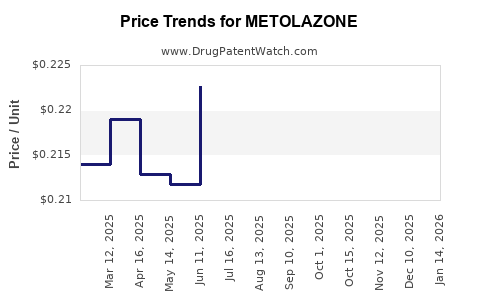
Public company filings generally do not report metolazone revenue separately. Manufacturers group it within broader generic pharmaceutical revenue, making a defensible global market-size estimate unavailable without prescription, pricing, and channel data from commercial databases.
The financial trajectory is nevertheless clear:
| Financial driver |
Direction |
| Unit price |
Low and generally pressured |
| Prescription demand |
Mature; linked to heart failure, edema, renal disease, and hypertension |
| Brand revenue |
Minimal or absent |
| Generic volume |
Stable but fragmented |
| Gross margin |
Dependent on scale and manufacturing efficiency |
| Revenue growth |
Limited; likely volume-driven rather than price-driven |
| Market volatility |
More sensitive to supply interruptions than innovation |
| Licensing value |
Low for ordinary tablets |
| Acquisition value |
Primarily portfolio and supply-chain based |
Metolazone can generate useful portfolio revenue for a generic company when produced at scale, but it is unlikely to be a material standalone growth driver. The product is better viewed as a stable maintenance asset than as a high-growth pharmaceutical opportunity.
What drives demand for metolazone?
Demand is supported by:
- An aging population with heart failure and chronic kidney disease.
- Continued use of sequential nephron blockade in resistant edema.
- Low acquisition cost.
- Familiarity among cardiologists, nephrologists, and hospital physicians.
- Availability in multiple tablet strengths.
Demand is constrained by:
- Safety monitoring requirements.
- Greater use of loop diuretics as primary therapy.
- Competition from hydrochlorothiazide, chlorthalidone, and indapamide in hypertension.
- Clinical caution around electrolyte disturbances and renal function.
- Lack of significant brand promotion.
What manufacturing and IP barriers affect metolazone?
Manufacturing barriers are more important than patent barriers.
A compliant supplier must control:
- Assay and content uniformity, particularly at the 2.5 mg strength.
- Dissolution and bioequivalence.
- Impurity profiles and degradation products.
- Tablet stability and packaging.
- Reliable sourcing of active pharmaceutical ingredient.
- FDA quality-system requirements.
- Continuity of supply across approved manufacturing sites.
These requirements can exclude weak suppliers but do not create durable exclusivity. The most valuable asset may be an approved, inspection-ready manufacturing network with dependable API access and low conversion cost.
What is the competitive outlook for metolazone?
The competitive outlook is stable but commercially limited. Metolazone should retain a clinical niche in edema and diuretic resistance, particularly when clinicians need additional natriuresis in patients already receiving loop diuretics.
The market is unlikely to experience major innovation-led expansion because:
- The molecule is old.
- The approved dosage form is simple.
- Clinical alternatives are widely available.
- No active branded patent platform supports premium pricing.
- Manufacturers have little incentive to fund large new clinical programs.
The main competitive events will be supplier exits, contract changes, shortages, and shifts in heart-failure treatment patterns rather than new patent-protected products.
Key Takeaways
- Metolazone is a mature generic diuretic with no meaningful current U.S. exclusivity.
- The original Zaroxolyn franchise has lost branded market protection.
- No active composition, method-of-use, or standard formulation patent is known to block generic tablets.
- Paragraph IV litigation and settlement risk are low in the current market.
- Biosimilar risk is irrelevant because metolazone is a small-molecule drug.
- Revenue is generally not disclosed on a standalone basis by manufacturers.
- Financial performance depends on generic volume, low-cost manufacturing, contracts, and supply reliability.
- Commercial upside from ordinary tablets is limited; differentiated formulations or supply assets would be required for a stronger investment thesis.
- The principal risk is supply disruption or margin erosion, not patent expiry.
FAQs About Metolazone Market and Patent Risk
Is metolazone still commercially profitable for generic manufacturers?
It can be profitable as part of a scaled generic portfolio, but standalone margins are likely constrained by low pricing, pharmacy contracting, and competition. Profitability depends on manufacturing efficiency and stable supply.
Can a new company launch a generic metolazone tablet in the United States?
A company can pursue an ANDA route if it meets FDA requirements for pharmaceutical equivalence, bioequivalence, manufacturing quality, labeling, and product approval. The main commercial challenge is achieving sufficient volume and pricing after approval.
Does metolazone have pediatric exclusivity or orphan-drug protection?
No current pediatric or orphan exclusivity is known to provide market protection for standard metolazone tablets.
Could a sustained-release metolazone product obtain new exclusivity?
A genuinely novel sustained-release product could potentially qualify for patent protection and, depending on its regulatory pathway, certain regulatory exclusivities. The protection would apply to the new formulation rather than automatically restoring exclusivity to conventional metolazone tablets.
What is the biggest investment risk in the metolazone market?
The largest risk is inadequate commercial scale. Low unit prices make the product vulnerable to manufacturing-cost inflation, contract losses, supplier exits, and quality-related interruptions.
References
- U.S. Food and Drug Administration. (2023). Zaroxolyn (metolazone) prescribing information.
- U.S. Food and Drug Administration. (n.d.). Drugs@FDA: FDA-approved drugs.
- U.S. Food and Drug Administration. (n.d.). Approved drug products with therapeutic equivalence evaluations: Orange Book.
- U.S. Food and Drug Administration. (n.d.). Abbreviated new drug application (ANDA) process.