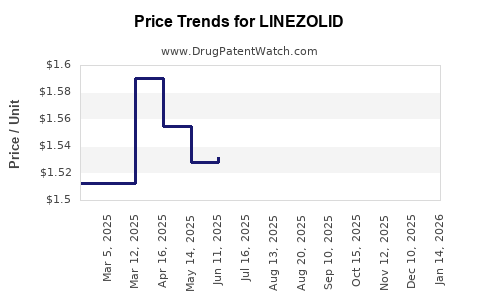
Last updated: November 10, 2026
Linezolid is a mature oxazolidinone antibiotic whose commercial value has shifted from Pfizer’s branded Zyvox to low-cost generic supply. U.S. composition and formulation exclusivity has largely expired, generic competition is established, and pricing is driven by hospital tenders, wholesalers, API availability, and antimicrobial stewardship. The molecule remains clinically valuable for resistant Gram-positive infections, but its financial trajectory is constrained by short treatment courses, reserve-antibiotic positioning, and intense generic competition.
What is the current market position of linezolid?
Linezolid is used primarily for complicated skin and soft-tissue infections, pneumonia caused by susceptible Gram-positive pathogens, and vancomycin-resistant Enterococcus faecium infections. It is available in oral tablets, oral suspension, and intravenous injection. The drug has high oral bioavailability, allowing hospitals to transition patients from intravenous to oral therapy without changing the active ingredient.[1]
Pfizer developed linezolid and marketed it as Zyvox. The U.S. Food and Drug Administration approved Zyvox in 2000. The product was the first marketed oxazolidinone antibiotic and initially commanded premium pricing because of its activity against methicillin-resistant Staphylococcus aureus and vancomycin-resistant enterococci.[2]
The commercial profile has since changed:
| Market factor |
Current effect on linezolid |
| Brand status |
Zyvox is a mature product with limited pricing power |
| Generic availability |
Broad generic competition in tablets, suspension, and injection |
| Clinical demand |
Stable demand in resistant Gram-positive infections |
| Volume growth |
Limited by antimicrobial stewardship |
| Pricing |
Low and tender-driven in institutional channels |
| Differentiation |
Oral bioavailability and established clinical evidence |
| Main risks |
Resistance, adverse-effect monitoring, shortages, and substitution |
| Main opportunity |
Reliable supply for hospital and outpatient antibiotic programs |
Linezolid remains a World Health Organization priority antibiotic because of its role in treating multidrug-resistant infections. Its clinical importance supports continued volume, but stewardship programs restrict indiscriminate use.[3]
When did linezolid lose exclusivity?
U.S. market exclusivity for linezolid ended after the expiration of Pfizer’s key patents and regulatory exclusivity. Generic linezolid entered the U.S. market in the mid-2010s, materially reducing branded Zyvox revenue.
Linezolid exclusivity timeline
| Event |
Approximate date |
Commercial effect |
| FDA approval of Zyvox |
2000 |
Pfizer established the branded market |
| Initial market protection |
Early 2000s |
Premium branded pricing |
| Pediatric exclusivity extension |
2005 |
Extended certain regulatory protections |
| Major patent protection period |
Through approximately 2014-2015 |
Delayed broad generic competition |
| Generic U.S. launches |
2015 onward |
Rapid price and share erosion |
| Current position |
2024-2025 |
Mature multi-source generic market |
The core linezolid patent estate is no longer a meaningful barrier to ordinary U.S. generic entry. Any remaining patent issues are more likely to concern specific formulations, manufacturing processes, combinations, or jurisdiction-specific claims than the basic active ingredient.
Pfizer reported substantial Zyvox revenue before generic competition. After loss of exclusivity, sales declined as hospitals and distributors shifted to lower-priced generic tablets and injections. Public company filings do not provide a single, consistent global market figure for all linezolid products because branded and generic revenue is distributed across manufacturers and procurement channels.[4]
What patents protect linezolid products?
The original commercial protection covered the linezolid chemical entity and related pharmaceutical compositions. Patent protection was followed by formulation and process claims, but these rights do not generally prevent the sale of standard generic linezolid products in the United States after expiration of the primary exclusivity period.
Patent categories historically relevant to linezolid
- Chemical compound patents covering linezolid and related oxazolidinones.
- Pharmaceutical composition patents covering oral and parenteral dosage forms.
- Solid-state or polymorph claims.
- Manufacturing-process patents.
- Method-of-use claims for bacterial infections.
- Pediatric formulations and dosage regimens.
The practical patent position differs by jurisdiction. In the United States, the key question is whether a patent is listed in the FDA Orange Book for the specific reference product and dosage form. In Europe, patent term, supplementary protection certificates, national validation, and local litigation determine the effective barrier. In India and other generic manufacturing jurisdictions, process and formulation claims can influence market access even where the basic compound is no longer protected.
What is the Orange Book status of Zyvox and generic linezolid?
The Orange Book identifies approved reference products and patent information submitted by sponsors. Zyvox is the reference product for linezolid tablets, oral suspension, and injection. Generic applicants rely on abbreviated new drug applications and demonstrate pharmaceutical equivalence and bioequivalence rather than repeating the full clinical development program.[5]
Standard generic linezolid products have entered through the ANDA pathway. A Paragraph IV certification would have been relevant before the principal patent barriers expired. The current commercial market is primarily a post-expiration market rather than an active Paragraph IV contest.
Paragraph IV and litigation exposure
Paragraph IV challenges can trigger patent litigation and a potential 30-month stay of ANDA approval. For linezolid, the major U.S. litigation risk was concentrated around the period preceding generic entry. That risk has declined sharply because:
- The core compound protection has expired.
- Multiple generic suppliers have established approval and market presence.
- Standard dosage forms are commercially routine.
- Hospitals have accepted therapeutic substitution and generic procurement.
- Remaining claims are less likely to block the entire market.
A company evaluating a new linezolid product should focus on formulation-specific patents, manufacturing claims, FDA approval status, and supply reliability rather than assuming that the expired core patent creates a current market barrier.
How large is the linezolid market?
Public market estimates vary because analysts use different definitions. Some include only prescription tablets, while others include hospital injections, oral suspension, branded products, and international sales. A reliable market analysis should separate:
- Global revenue from all linezolid products.
- U.S. institutional purchasing.
- Retail and specialty pharmacy volume.
- Active pharmaceutical ingredient sales.
- Branded Zyvox sales.
- Generic finished-dose sales.
The branded market contracted sharply after generic entry. The generic market is larger in unit volume but lower in value per dose. Hospital injection products generate significant institutional demand, yet they face competitive pricing and procurement pressure.
Market value drivers
Linezolid demand is supported by:
- MRSA and other resistant Gram-positive infections.
- VRE treatment.
- Hospital and long-term-care use.
- Oral step-down therapy.
- Use where vancomycin is unsuitable.
- Availability in both intravenous and oral forms.
Demand is limited by:
- Short treatment durations.
- Restricted prescribing.
- Hematologic toxicity monitoring.
- Drug interactions involving serotonergic agents.
- Peripheral and optic neuropathy risk with prolonged use.
- The availability of vancomycin, daptomycin, ceftaroline, tedizolid, and other alternatives.[1]
How has linezolid’s financial trajectory changed?
Linezolid followed the standard small-molecule anti-infective lifecycle: rapid branded adoption, premium pricing, patent-driven revenue concentration, then steep post-exclusivity erosion.
Financial lifecycle
| Period |
Revenue profile |
Competitive structure |
| 2000-2005 |
High-growth branded product |
Pfizer-led market |
| 2006-2013 |
Mature branded franchise |
Hospital adoption and resistant-infection demand |
| 2014-2015 |
Pre-expiry decline and generic preparation |
Patent litigation and ANDA activity |
| 2016-2019 |
Rapid branded erosion |
Multiple generic suppliers |
| 2020 onward |
Mature generic market |
Tender pricing, supply resilience, and API economics |
Pfizer’s historical filings show that Zyvox generated high commercial value before generic entry, but revenue fell after loss of exclusivity.[4] The post-expiry value pool moved downstream from the originator to generic manufacturers, distributors, hospital purchasing groups, and API suppliers.
For generic manufacturers, profitability depends on scale and supply discipline. Tablets can be manufactured at comparatively low cost, but margins can compress when several suppliers compete for the same institutional contracts. Injection products have higher manufacturing, quality, and shortage-management requirements. A supplier with dependable sterile capacity can maintain better economics than a company selling only on price.
Which companies compete in the linezolid market?
The market includes Pfizer’s Zyvox and generic products from multiple multinational and regional manufacturers. Generic participation has included companies such as Teva, Sandoz, Dr. Reddy’s Laboratories, Lupin, Glenmark, Cipla, Zydus, Hikma, and other suppliers, depending on dosage form and jurisdiction.
The competitive landscape is fragmented by product type:
| Product |
Competitive intensity |
Commercial characteristics |
| 600 mg tablet |
Very high |
Commodity-like pricing and broad substitution |
| 100 mg/5 mL oral suspension |
Moderate |
Smaller volume and formulation complexity |
| 600 mg/300 mL injection |
High |
Sterile manufacturing and hospital tenders |
| API |
High but supply-sensitive |
China and India are major manufacturing centers |
| Branded Zyvox |
Low current pricing power |
Retained where contract, familiarity, or supply preference matters |
Brand retention is more likely in markets with legacy prescribing, distributor contracts, or limited generic substitution. In the United States, generic substitution and institutional purchasing have reduced the strategic value of the brand.
What manufacturing and supply-chain barriers affect linezolid?
Linezolid is chemically more accessible than biologic medicines, but reliable commercial supply still requires validated synthesis, impurity control, regulatory compliance, and, for injection, sterile manufacturing capacity.
Key barriers include:
- Control of chiral intermediates and process impurities.
- Compliance with current good manufacturing practices.
- Consistent API supply.
- Sterile fill-finish capacity for injection.
- Stability of oral suspension products.
- Regulatory inspection and data-integrity requirements.
- Inventory management for hospital tenders.
The U.S. Food and Drug Administration has identified drug shortages and supply interruptions as recurring risks in generic injectable markets. A linezolid supplier with multiple API sources, redundant manufacturing sites, and validated sterile capacity can obtain a commercial advantage even when its list price is not the lowest.[6]
How does linezolid compare with tedizolid and other competitors?
Linezolid remains the lower-cost, higher-volume option, while tedizolid offers a newer oxazolidinone profile and shorter approved treatment duration for certain skin infections. Tedizolid has not displaced linezolid broadly because it has a smaller clinical evidence base, lower generic penetration, and a less established hospital purchasing position.
| Attribute |
Linezolid |
Tedizolid |
Vancomycin |
Daptomycin |
| Class |
Oxazolidinone |
Oxazolidinone |
Glycopeptide |
Lipopeptide |
| Oral option |
Yes |
Yes |
Limited oral role for systemic infections |
No |
| Generic intensity |
High |
Lower |
High |
Moderate |
| Hospital use |
Established |
Selective |
Very established |
Established |
| Main advantage |
Oral bioavailability and low generic cost |
Shorter course in approved indications |
Broad familiarity and low cost |
Activity in selected resistant infections |
| Main commercial pressure |
Generic price erosion |
Limited adoption and access |
Monitoring and IV administration |
High acquisition cost |
Linezolid’s value is strongest when oral therapy can avoid prolonged IV treatment or hospital stay. Its value is weakest in routine infections where cheaper agents are clinically appropriate.
What is the FDA regulatory status of linezolid?
Linezolid is FDA-approved in multiple dosage forms and remains an active component of the U.S. antibacterial market. Generic products are approved through ANDAs, subject to quality, bioequivalence, labeling, and manufacturing requirements.[1,5]
Regulatory risks include:
- Thrombocytopenia and other myelosuppression.
- Serotonin syndrome risk with serotonergic medicines.
- Peripheral and optic neuropathy with prolonged exposure.
- Lactic acidosis.
- Drug interaction concerns with monoamine oxidase activity.
- Pediatric dosing and formulation requirements.
These risks affect prescribing protocols and monitoring costs, but they have not eliminated linezolid’s role in resistant infections.
What generic entry scenarios exist for linezolid?
The principal generic-entry scenario has already occurred. Future commercial events are more likely to involve supplier exits, manufacturing disruptions, price stabilization, or market-share shifts than a single transformative launch.
Likely market scenarios
Base case: Generic prices remain low, multiple suppliers continue, and hospital demand stays broadly stable.
Supply-constrained case: API or sterile-product disruptions reduce supplier count, allowing remaining manufacturers to raise prices temporarily.
Stewardship-downside case: Improved diagnostics and narrower prescribing reduce empirical linezolid use.
Resistance-upside case: Increasing resistance to alternative antibiotics supports linezolid volume, although stewardship limits broad expansion.
Formulation opportunity case: Suppliers compete through hospital-ready packaging, oral suspension availability, dual sourcing, and dependable sterile supply rather than novel pharmacology.
What is the patent strength and commercial outlook for linezolid?
Linezolid has low residual composition-of-matter patent strength in the United States and moderate practical value as a mature generic product. Its commercial durability comes from clinical familiarity, resistant-pathogen utility, dual oral and intravenous administration, and established procurement pathways.
Patent strength by asset category:
| Asset category |
Current strength |
| Core compound |
Low after expiration |
| Standard tablets |
Low |
| Standard injection |
Low to moderate, depending on formulation claims |
| Specialized formulations |
Potentially moderate |
| Manufacturing processes |
Potentially moderate by jurisdiction |
| Method of use |
Limited ability to block routine generic use |
| Regulatory exclusivity |
Expired for the original product |
No biosimilar pathway applies because linezolid is a small-molecule drug. Competition occurs through generic drug applications, not biologic interchangeability.
Key Takeaways
- Linezolid is a mature, genericized antibiotic with continuing clinical demand.
- Pfizer’s Zyvox lost its commercial position after U.S. generic entry around 2015.
- Core patent protection no longer creates a meaningful barrier to standard generic linezolid.
- The largest markets are hospital tablets, injections, oral suspension, and API supply.
- Generic profitability depends on scale, contract access, manufacturing quality, and supply reliability.
- Linezolid’s oral bioavailability remains its main clinical and commercial differentiator.
- Tedizolid competes on newer-product positioning but has not displaced linezolid’s generic cost advantage.
- Future value is more likely to arise from supply security and specialized formulations than from new basic patents.
- Revenue exposure for the original innovator is low relative to the pre-expiry Zyvox franchise.
- Hospital stewardship, resistance trends, and sterile-product shortages are the main variables affecting future demand and pricing.
FAQs
Is linezolid still profitable for pharmaceutical companies?
It can be profitable for efficient generic manufacturers with scale, reliable API access, and hospital contracts. Profit margins are generally lower than during the branded Zyvox period.
Is linezolid still under patent in the United States?
The core U.S. patent protection for standard linezolid products has expired. Product-specific formulation or process claims must be assessed separately.
Can a generic company launch linezolid without clinical trials?
A U.S. generic applicant normally uses the ANDA pathway and must demonstrate pharmaceutical equivalence and bioequivalence. It does not repeat the full clinical efficacy program required for the original product.
Why do hospitals continue using linezolid after patent expiry?
Hospitals use linezolid because of its activity against resistant Gram-positive organisms, oral bioavailability, established safety experience, and availability in intravenous and oral dosage forms.
What could increase linezolid prices?
A reduction in qualified suppliers, API shortages, sterile manufacturing failures, regulatory enforcement, or a sudden increase in resistant infections could tighten supply and raise prices.
References
- U.S. Food and Drug Administration. (2024). Zyvox (linezolid) prescribing information. https://www.accessdata.fda.gov
- U.S. Food and Drug Administration. (2000). FDA approves Zyvox for serious Gram-positive infections. https://www.fda.gov
- World Health Organization. (2023). WHO bacterial priority pathogens list, 2024. https://www.who.int
- Pfizer Inc. (2015). Annual report 2015. https://www.pfizer.com/investors/financial-reports
- U.S. Food and Drug Administration. (2024). Approved drug products with therapeutic equivalence evaluations. https://www.fda.gov/drugs/drug-approvals-and-databases/orange-book
- U.S. Food and Drug Administration. (2023). Drug shortages: Root causes and potential solutions. https://www.fda.gov/drugs/drug-safety-and-availability/drug-shortages-index