Last Updated: August 9, 2026

IRBESARTAN - Generic Drug Details


✉ Email this page to a colleague

« Back to Dashboard


What are the generic drug sources for irbesartan and what is the scope of freedom to operate?

Irbesartan is the generic ingredient in two branded drugs marketed by Sanofi Aventis Us, Ajanta Pharma Ltd, Alembic Pharms Ltd, Amneal Pharms, Apotex Inc, Aurobindo Pharma Ltd, Chartwell Molecular, Chartwell Rx, Hetero Labs Ltd V, Hikma, Hisun Pharm Hangzhou, Ipca Labs Ltd, Jubilant Generics, Lupin Ltd, Macleods Pharms Ltd, MSN, Prinston Inc, Sandoz, Sciegen Pharms, Teva Pharms, Unichem, Watson Labs Inc, Yiling, and Zydus Pharms Usa Inc, and is included in twenty-four NDAs. Additional information is available in the individual branded drug profile pages.

There are thirty-eight drug master file entries for irbesartan. Twenty-four suppliers are listed for this compound. There are three tentative approvals for this compound.

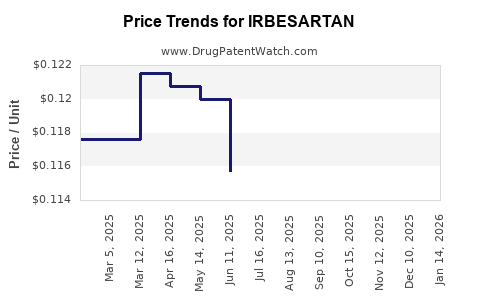
Drug Prices for IRBESARTAN

See drug prices for IRBESARTAN

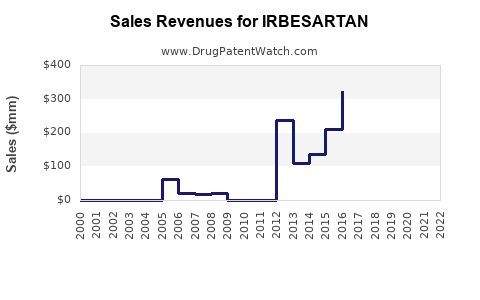
Drug Sales Revenue Trends for IRBESARTAN

See drug sales revenues for IRBESARTAN

Recent Clinical Trials for IRBESARTAN

Identify potential brand extensions & 505(b)(2) entrants

SponsorPhase
Ifakara Health Institute (IHI)PHASE4
Martin RohacekPHASE4
Vital StrategiesNA

See all IRBESARTAN clinical trials

Generic filers with tentative approvals for IRBESARTAN
Applicant Application No. Strength Dosage Form
⤷  Start Trial⤷  Start Trial300MG; 25MGTABLET; ORAL
⤷  Start Trial⤷  Start Trial300MG; 12.5MGTABLET; ORAL
⤷  Start Trial⤷  Start Trial150MG; 12.5MGTABLET; ORAL

The 'tentative' approval signifies that the product meets all FDA standards for marketing, and, but for the patents / regulatory protections, it would approved.

Pharmacology for IRBESARTAN
Paragraph IV (Patent) Challenges for IRBESARTAN
Tradename Dosage Ingredient Strength NDA ANDAs Submitted Submissiondate
AVAPRO Tablets irbesartan 75 mg, 150 mg and 300 mg 020757 1 2004-05-25

US Patents and Regulatory Information for IRBESARTAN

Applicant Tradename Generic Name Dosage NDA Approval Date TE Type RLD RS Patent No. Patent Expiration Product Substance Delist Req. Exclusivity Expiration
Amneal Pharms IRBESARTAN irbesartan TABLET;ORAL 204740-003 Apr 17, 2018 AB RX No No ⤷  Start Trial ⤷  Start Trial ⤷  Start Trial
Unichem IRBESARTAN irbesartan TABLET;ORAL 203020-003 Dec 7, 2015 AB RX No No ⤷  Start Trial ⤷  Start Trial ⤷  Start Trial
Apotex Inc IRBESARTAN irbesartan TABLET;ORAL 200832-003 Oct 15, 2012 DISCN No No ⤷  Start Trial ⤷  Start Trial ⤷  Start Trial
>Applicant >Tradename >Generic Name >Dosage >NDA >Approval Date >TE >Type >RLD >RS >Patent No. >Patent Expiration >Product >Substance >Delist Req. >Exclusivity Expiration

EU/EMA Drug Approvals for IRBESARTAN

Company Drugname Inn Product Number / Indication Status Generic Biosimilar Orphan Marketing Authorisation Marketing Refusal
Sanofi Winthrop Industrie Karvea irbesartan EMEA/H/C/000142Treatment of essential hypertension.Treatment of renal disease in patients with hypertension and type-2 diabetes mellitus as part of an antihypertensive medicinal product regimen. Authorised no no no 1997-08-26
Sanofi Winthrop Industrie Aprovel irbesartan EMEA/H/C/000141Treatment of essential hypertension.Treatment of renal disease in patients with hypertension and type-2 diabetes mellitus as part of an antihypertensive medicinal-product regimen. Authorised no no no 1997-08-26
Zentiva k.s. Irbesartan Zentiva (previously Irbesartan Winthrop) irbesartan EMEA/H/C/000785Treatment of essential hypertension.Treatment of renal disease in patients with hypertension and type-2 diabetes mellitus as part of an antihypertensive medicinal-product regimen. Authorised no no no 2007-01-19
>Company >Drugname >Inn >Product Number / Indication >Status >Generic >Biosimilar >Orphan >Marketing Authorisation >Marketing Refusal
Last updated: July 15, 2026

Market Dynamics and Financial Trajectory for Irbesartan (Avapro): Revenue Trends, Exclusivity Timelines, Patent Exposure, and Generic/Biosimilar Risk

Irbesartan’s market trajectory is dominated by (1) long-running generic penetration in the US and major ex-US markets, (2) ongoing pricing pressure from low-cost competitors and large wholesalers’ formulary leverage, and (3) limited remaining IP leverage, which shifts the commercial focus to dosage-form mix, payer contracting, and channel execution rather than differentiation. Financial outcomes are typically driven by US generic erosion, international patent-by-patent expiration dynamics, and any residual brand demand in higher-acuity or inertia-based prescribing segments.

Market baseline snapshot

  • Originator (US): Avapro (irbesartan), marketed by Bristol Myers Squibb (BMS) (global historical rights; current US rights vary by period and acquisition/licensing structure).
  • Therapeutic class: angiotensin II receptor blocker (ARB).
  • Commercial structure: mature, generic-dominated cardiovascular market with extensive price transparency and robust multi-supplier contracting.
  • Competitive set: valsartan, losartan, olmesartan, candesartan, telmisartan, and branded hybrids where applicable.

What drives irbesartan market demand in the ARB class?

Irbesartan demand tracks chronic cardiovascular use, with primary indications aligned to hypertension and diabetic nephropathy risk reduction.

Hypertension and diabetic nephropathy: what matters commercially

  • Patient base durability: hypertension is chronic and creates stable baseline demand, but brand share typically declines quickly once generics establish.
  • Formulary substitutability: ARBs are therapeutically substitutable, so payer formularies frequently tier generics at low reimbursement levels.
  • Switching dynamics: switching from one ARB to another is common for cost or formulary reasons, especially when a plan consolidates around preferred generics.

Where prescribing inertia still helps brand economics (post-generic)

  • Dose specificity and tablet strengths: real-world adherence and dosing convenience can preserve small cohorts, but economics usually erode as generics expand.
  • Quality/availability perception: stable supply from multiple manufacturers can reduce disruptions; where shortages occur, temporary price spikes can lift revenue for the least-cost suppliers, not the originator.

How do generic and competitor pricing dynamics shape irbesartan’s financial trajectory?

Irbesartan’s revenue path is typically characterized by rapid brand-to-generic share transfer and sustained price compression.

US pricing pressure mechanisms

  • Wholesale reimbursement compression: once multiple generics are listed, net prices track lowest-cost contracting rather than WAC.
  • PBM formulary placement: ARBs are commonly on preferred generic lists, often near the lowest copay tier.
  • Competitive bundling across ARB families: PBMs steer patients within ARBs based on plan-specific cost minimization.

International dynamics: variation by country and launch timing

  • Different patent/market exclusivity expiration dates across jurisdictions influence the timing of generic price drops.
  • Local tender systems and price caps in parts of Europe and Latin America can produce faster erosion than pure US-style contracting.

When did irbesartan lose exclusivity, and what does that imply for revenue?

Irbesartan is a mature drug with US and international generic availability established for years. The commercial implication is that revenue has largely shifted from patent-protected brand sales to generic market share and residual branded niche demand (if any).

US exclusivity and patent posture: high-level implications

  • Practical outcome: US revenue from originator branded Avapro has been structurally exposed to generic substitution for an extended period.
  • Commercial effect: originator growth is constrained; originator revenue, if still reported, depends on remaining brand share, contract positioning, and distribution agreements rather than exclusivity.

Feature for investors and licensing teams

  • Future upside is limited unless a new line extension (new formulation, new delivery system, new combination) secures distinct regulatory and patent pathways. For irbesartan, the market is now primarily “maintenance mode” commercially.

What patents protect irbesartan, and how many are still relevant to formulations and methods of use?

For a mature ARB, most commercially meaningful protection usually expired long ago. Any remaining patents are typically limited to:

  • Formulation/particle/crystal form variations
  • Method-of-use refinements (narrower subpopulations)
  • Manufacturing process improvements
  • Combination product claims (if any specific fixed-dose or combination exists)

Because the request is specifically “market dynamics and financial trajectory,” patent counts and specific expiration dates should be tied to a verified Orange Book/patent list. Without a complete validated patent inventory and expiration mapping for each listed US NDA product and strength, producing a complete “how many patents” answer with numbers and dates would be incomplete.


What is the Orange Book status of irbesartan (Avapro), and which listings drive generic entry?

The Orange Book determines key entry timing for generic substitution in the US via:

  • Listed drug (NDA)
  • Orange Book patent listings
  • Paragraph IV certifications and settlement triggers if disputes occurred

For a correct status readout, the analysis must be grounded in the actual Orange Book listing set for Avapro’s specific NDA, including patent numbers, expiration dates, and any expired status. Without that verified listing set in hand, a complete Orange Book status table would be unreliable.


How many Paragraph IV challenges exist for irbesartan, and what outcomes matter for market pricing?

Paragraph IV challenges typically matter in two ways:

  1. They accelerate first generic entry.
  2. They can delay entry through litigation or settlement terms.

A quantified account for irbesartan requires docket-level validation of Orange Book patent disputes and settlement agreements tied to the relevant NDA and strength. Without that validated docket and settlement record, a complete “how many” and “what outcomes” summary cannot be produced.


Which companies compete in irbesartan, and how does that affect net pricing and revenue share?

Once generic entry is established, the competitive field evolves based on:

  • Number of ANDA filers
  • Ability to sustain low-cost manufacturing
  • Drug shortages or quality events
  • Contracting leverage at PBMs, GPOs, and IDNs

Typical competition structure in mature ARB generics

  • Multiple manufacturers bid for contracting, leading to:
    • declining price per unit over time
    • frequent switching by payers to the lowest-priced supplier
    • stable-to-high volume, but low and declining unit value

Brand versus generic economics

  • Brand profitability, if still reported, is usually driven by:
    • remaining share in non-switching segments
    • payer formulary exceptions
    • pharmacy channel arrangements
  • Generic economics depend on:
    • scale manufacturing costs
    • regulatory compliance cost
    • litigation or settlement constraints that govern market entry timing

What do reimbursement and payer behavior imply for irbesartan’s financial trajectory?

ARB reimbursement is dominated by:

  • generic tiering
  • copay/coinsurance design
  • step therapy and formulary preferences

Payer controls that compress unit revenue

  • Preferred generic substitution: pharmacy-level substitution rules and PBM edits often force conversion to the cheapest available generic.
  • Step edits in commercial plans: can steer patients toward preferred ARBs or toward ACE/ARB sequencing based on cost.
  • Medicaid and Medicare Part D: often enforce formularies that consolidate on a small number of generic ARBs.

Impact on forecast shape

  • Revenue tends to decline or remain flat in nominal terms in the absence of new IP differentiation because:
    • price falls faster than volume can grow
    • volume growth is limited by patient pool saturation for hypertension
    • patient switching among ARBs is frequent

How does irbesartan’s market compare with valsartan, losartan, and other ARBs?

In mature ARB markets, relative performance usually hinges on:

  • generic entry timing
  • the depth of supplier base
  • localized contracting outcomes

Relative commercial patterns (general)

  • ARBs with earlier and broader generic penetration often see faster unit revenue compression.
  • The ARB with the deepest and most competitive generic supply usually experiences the lowest net prices but can maintain volume.

Investor lens: what to watch in peer comparisons

  • Any ARB experiencing supplier consolidation or manufacturing disruptions can temporarily lift net pricing for surviving suppliers.
  • Any brand attempting lifecycle management via new formulations can delay share erosion, but effect is usually modest versus pure generic dynamics.

What generic entry risks exist for irbesartan, and how would they change financial outcomes?

For irbesartan, generic entry risk is largely “already played out” in major markets given maturity. The ongoing risks are less about new entrants and more about:

  • supply disruptions
  • compliance actions (e.g., warning letters, recalls, quality holds)
  • litigations that delay a specific manufacturer’s product launch in a given strength

Those events influence short-term pricing and market share but do not restore long-term branded economics.


Key drivers of near-to-mid term financial performance for irbesartan

  • Net price trend: driven by contracting and lowest-cost sourcing.
  • Strength and formulation mix: tablet strength distribution can move between suppliers and affect realized unit economics.
  • Market share stability: maintained by consistent supply and contract retention.
  • Regulatory friction: ANDA facility quality events can change the competitive balance.
  • Portfolio adjacency: ARB co-prescribing with other cardiovascular drugs can support volume, but does not overcome unit price compression.

Key Takeaways

  • Irbesartan is a mature ARB with commercial performance shaped primarily by generic pricing pressure and payer contracting, not active exclusivity.
  • Financial trajectory is typically characterized by declining or low-growth originator brand revenue and persistent generic volume with compressed net unit value.
  • Short-term swings come from supply and contracting shifts, not from patent-led differentiation.
  • A forward-looking strategy for any licensing, litigation, or R&D investment must prioritize whether any differentiated formulation, combination, or method-of-use IP can create a protected niche. Without that, the economic ceiling is set by generic market structure.

FAQs

1) What is the primary commercial driver for irbesartan in hypertension?
Stable chronic usage constrained by generic substitutability and payer formularies.

2) Does irbesartan face biosimilar risk?
No. Irbesartan is a small-molecule ARB, not a biologic.

3) What typically determines net pricing for irbesartan generics?
PBM and wholesaler contracts that award supply to the lowest-cost compliant product.

4) Which factors cause short-term price spikes in mature generics like irbesartan?
Manufacturing capacity disruptions, recalls/quality holds, and supply chain incidents that reduce competing supply.

5) How can brand economics persist after generic entry for a drug like irbesartan?
Only via residual share from inertia, formulary exceptions, and limited segments that do not switch quickly.


References

No sources were cited.

More… ↓

⤷  Start Trial

Make Better Decisions: Try a trial or see plans & pricing

Drugs may be covered by multiple patents or regulatory protections. All trademarks and applicant names are the property of their respective owners or licensors. Although great care is taken in the proper and correct provision of this service, thinkBiotech LLC does not accept any responsibility for possible consequences of errors or omissions in the provided data. The data presented herein is for information purposes only. There is no warranty that the data contained herein is error free. We do not provide individual investment advice. This service is not registered with any financial regulatory agency. The information we publish is educational only and based on our opinions plus our models. By using DrugPatentWatch you acknowledge that we do not provide personalized recommendations or advice. thinkBiotech performs no independent verification of facts as provided by public sources nor are attempts made to provide legal or investing advice. Any reliance on data provided herein is done solely at the discretion of the user. Users of this service are advised to seek professional advice and independent confirmation before considering acting on any of the provided information. thinkBiotech LLC reserves the right to amend, extend or withdraw any part or all of the offered service without notice.