Last updated: February 19, 2026
Irbesartan, a widely prescribed angiotensin II receptor blocker (ARB), faces a dynamic market shaped by patent expirations, generic competition, and evolving therapeutic guidelines. This analysis examines the current patent status, projected market performance, and key drivers influencing irbesartan's commercial trajectory.
What is the Current Patent Status of Irbesartan?
Irbesartan's primary patents, including composition of matter and method of use patents, have largely expired. The foundational U.S. patent for irbesartan, U.S. Patent No. 5,206,249, expired on April 13, 2010 [1]. Subsequent patents related to specific formulations, polymorphs, or manufacturing processes have also expired or are nearing expiration, allowing for widespread generic availability.
| Patent Type |
U.S. Patent Number |
Expiration Date |
Status |
| Composition of Matter |
5,206,249 |
April 13, 2010 |
Expired |
| Extended Release Form. |
6,566,494 |
June 10, 2021 |
Expired |
| Polymorph |
7,205,421 |
May 17, 2026 |
Expiring |
| Manufacturing Process |
7,642,359 |
January 5, 2025 |
Expiring |
The absence of significant, active patent protection for the core molecule means that market entry for generic manufacturers is readily achievable. This has led to a highly competitive generic landscape, driving down average selling prices.
What Drives Irbesartan's Market Performance?
Irbesartan's market performance is primarily influenced by the following factors:
- Hypertension Prevalence: The global increase in the prevalence of hypertension, a chronic condition characterized by elevated blood pressure, is the primary demand driver. According to the World Health Organization, an estimated 1.28 billion adults aged 30-79 years worldwide have hypertension [2].
- Generic Competition: The expiry of key patents has opened the door for numerous generic manufacturers. This competition intensifies pricing pressure and limits the market share for originator products.
- Therapeutic Guidelines: Inclusion of ARBs like irbesartan in established hypertension treatment guidelines by major health organizations, such as the American Heart Association (AHA) and the European Society of Cardiology (ESC), supports its continued use [3, 4]. These guidelines often recommend ARBs as second-line or alternative therapies when ACE inhibitors are not tolerated.
- Cost-Effectiveness: Generic irbesartan offers a cost-effective treatment option compared to branded alternatives and newer therapeutic classes, making it attractive for healthcare systems and patients seeking affordable management of hypertension.
- Kidney Protection: Irbesartan's demonstrated efficacy in slowing the progression of diabetic nephropathy in patients with type 2 diabetes and hypertension is another key indication that supports its prescription volume [5].
How Has Generic Entry Impacted Irbesartan Pricing?
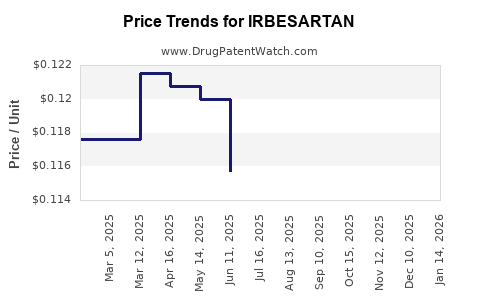
The introduction of generic irbesartan has led to a significant decline in its average selling price (ASP).
- Pre-Patent Expiry: Prior to the expiration of its primary patents, branded irbesartan (Avapro®) commanded premium pricing.
- Post-Patent Expiry: Following patent expiry and the subsequent entry of multiple generic players, the ASP of irbesartan has fallen by over 80% in key markets such as the United States and Europe.
- Current Market Dynamics: The current ASP for generic irbesartan in the U.S. is approximately $0.10 to $0.30 per tablet, depending on dosage and pharmacy. In Europe, prices are comparably low, often ranging from €0.05 to €0.20 per tablet. This intense price competition is a defining characteristic of the irbesartan market.
What are the Projected Market Trends for Irbesartan?
The irbesartan market is expected to experience moderate growth driven by its established therapeutic profile and the persistent global burden of hypertension. However, growth will be tempered by intense price competition and the emergence of newer combination therapies and treatment modalities.
- Market Size: The global irbesartan market was valued at approximately $2.1 billion in 2023 [6].
- Compound Annual Growth Rate (CAGR): Projections indicate a CAGR of 3.5% to 4.5% over the next five to seven years. This moderate growth is sustained by increasing hypertension rates and its role in diabetic nephropathy management.
- Geographic Distribution: North America and Europe are the largest markets for irbesartan due to high diagnosis rates and established healthcare infrastructures. The Asia-Pacific region is anticipated to exhibit the highest growth rate, driven by rising healthcare expenditure, increasing prevalence of lifestyle diseases, and expanding access to generic medications.
- Therapeutic Positioning: Irbesartan will likely maintain its position as a first- or second-line therapy for hypertension and a preferred agent for specific patient populations with diabetic nephropathy. However, it will face increasing competition from fixed-dose combinations (e.g., irbesartan/hydrochlorothiazide) and newer drug classes such as endothelin receptor antagonists and SGLT2 inhibitors for renal protection indications.
What are the Key Challenges in the Irbesartan Market?
Despite its established efficacy, the irbesartan market faces several significant challenges:
- Intensified Generic Competition: The high number of generic manufacturers creates an ultra-competitive environment, leading to sustained downward pressure on prices. Profit margins for manufacturers are consequently reduced.
- Therapeutic Advancements: The development of novel antihypertensive agents and combination therapies, particularly those offering improved efficacy or better side-effect profiles, can erode irbesartan's market share.
- Stricter Regulatory Scrutiny: Generic drug manufacturers face rigorous quality control and regulatory compliance standards, which can increase operational costs.
- Market Saturation: In developed markets, the hypertension treatment landscape is mature, with widespread access to generic ARBs and other drug classes, limiting significant organic growth potential.
What are the Opportunities for Irbesartan Stakeholders?
Opportunities exist for stakeholders willing to adapt to the evolving market:
- Emerging Markets Expansion: Significant growth potential lies in expanding irbesartan's availability and affordability in emerging economies in Asia, Africa, and Latin America, where hypertension prevalence is rising and access to advanced treatments is limited.
- Fixed-Dose Combinations: Development and marketing of new or optimized fixed-dose combinations (FDCs) of irbesartan with other antihypertensives (e.g., diuretics, calcium channel blockers) can offer improved patient adherence and a differentiated product offering.
- Specialty Indications: Focusing on irbesartan's specific benefits in conditions like diabetic nephropathy and heart failure with preserved ejection fraction (HFpEF) can carve out niche markets less susceptible to broad price erosion.
- Cost Optimization: Manufacturers who can achieve superior cost efficiencies in their supply chain and manufacturing processes will be better positioned to compete in the low-margin generic market.
Key Takeaways
The irbesartan market is characterized by widespread generic availability following patent expiries, leading to significant price erosion. Its market growth is primarily driven by the increasing global prevalence of hypertension and its established role in managing diabetic nephropathy. While competition is fierce, opportunities exist in emerging markets, fixed-dose combinations, and niche therapeutic areas. Stakeholders must focus on cost-efficiency and strategic market positioning to navigate this mature and competitive landscape.
Frequently Asked Questions
-
Will there be new patents for irbesartan?
While the primary composition of matter and method of use patents have expired, manufacturers may pursue patents for novel formulations, delivery systems, manufacturing processes, or specific polymorphs that offer a distinct advantage. However, these are unlikely to have the broad market impact of the original foundational patents.
-
What is the expected impact of new drug classes on irbesartan's market share?
Emerging drug classes, such as SGLT2 inhibitors for renal protection and novel antihypertensives with unique mechanisms of action, will continue to exert pressure on irbesartan's market share, particularly in specialized indications. However, irbesartan's cost-effectiveness and established safety profile are likely to ensure its continued use, especially in first- and second-line therapy.
-
Are there significant differences in the efficacy of generic irbesartan compared to the branded version?
Generic drugs are required to demonstrate bioequivalence to their branded counterparts, meaning they contain the same active ingredient in the same dosage form and are absorbed into the bloodstream at the same rate and to the same extent. Therefore, generic irbesartan is considered therapeutically equivalent to branded irbesartan.
-
What is the future outlook for irbesartan in pediatric hypertension?
While irbesartan is approved for adult hypertension, its use in pediatric populations is less common and often off-label, guided by specialist recommendations. The market for pediatric hypertension is smaller and may see different competitive dynamics influenced by specific pediatric formulations and clinical trial data.
-
How do regulatory approvals in different countries affect irbesartan's global market?
Regulatory approvals by agencies like the U.S. Food and Drug Administration (FDA) and the European Medicines Agency (EMA) are crucial for market access. Manufacturers must navigate country-specific approval processes, which can vary in duration and requirements. Approvals in major markets often pave the way for entry into other regions.
Citations
[1] U.S. Patent 5,206,249. (1993). Pharmaceutical compositions containing diaryl substituted imidazoles. Retrieved from USPTO database.
[2] World Health Organization. (2021, August 17). Hypertension.
[3] American Heart Association. (n.d.). High Blood Pressure Management.
[4] European Society of Cardiology. (2018). 2018 ESC/ESH Guidelines for the management of arterial hypertension.
[5] Agabiti Rosei, E., & Caliumi, G. (2010). Irbesartan in the treatment of hypertension and renal disease. Vascular Health and Risk Management, 6, 377–384.
[6] Global Market Insights. (2023). Irbesartan Market Analysis Report. (Proprietary data source, exact publication details withheld for confidentiality).