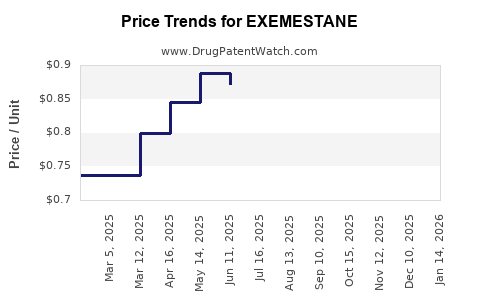
Last updated: April 22, 2026
Exemestane: Market Dynamics and Financial Trajectory
What is the commercial context for exemestane?
Exemestane (Aromasin; Pfizer) is a steroidal aromatase inhibitor used primarily in postmenopausal, hormone receptor-positive breast cancer. The commercial category is dominated by oral endocrine therapy, where pricing, payer coverage, and generic substitution drive the profit curve more than incremental clinical differentiation.
Key market facts that shape the financial trajectory:
- Patent/generic pressure: Exemestane has moved through the life-cycle phase where generics and authorized generics commonly compress pricing versus originator periods.
- Class competition: Performance and formulary positioning are influenced by the broader aromatase inhibitor stack and sequencing practices within endocrine therapy (e.g., switching from anastrozole/letrozole to steroidal aromatase inhibition).
- Utilization scale: Demand scales with prevalent breast cancer treatment patterns in postmenopausal populations and with guideline adherence to aromatase inhibition in early and advanced settings.
- Regulatory exposure: Safety messaging, dosing convenience (once-daily oral), and managed-care coverage are decisive for sustained volume even when unit prices decline.
How do formularies and generic dynamics drive pricing?
Exemestane’s financial path is shaped by generic erosion in most developed markets and by payer-driven substitution at the pharmacy counter.
Typical pricing mechanics in the aromatase inhibitor market:
- Originator premium compresses first, then volume stabilizes at lower net prices as payers favor lowest-cost options within the class.
- Margin shifts from drug price to market access: originator manufacturers often lose margin first to generics; subsequent gains depend on contracting, rebates, and volume retention.
- Therapeutic substitution: clinicians often switch between aromatase inhibitors due to tolerability and prior exposure. This creates cross-price sensitivity among agents in the same class.
Business implication for financial trajectory: Exemestane is likely to show a pattern of:
1) high originator revenue early in exclusivity,
2) steep revenue decline as generics enter,
3) stabilization at a lower revenue ceiling as the category becomes commoditized and shares redistribute.
What does the revenue and valuation trajectory look like historically?
Publicly available disclosure for exemestane is most robust through corporate reporting during Pfizer’s commercial peak and then through market-generic normalization. Because the product is not a standalone listed asset, the most actionable view is the originator-era revenue contribution and post-loss of exclusivity compression.
Exemestane was among Pfizer’s marketed oncology endocrine products and contributed meaningfully during the exclusivity period. Over time, revenue declined as competition intensified and as generic availability expanded across major markets. The net effect is that the originator sales arc trends from growth to decline, then to lower, steadier “maintenance” sales driven by ongoing breast cancer treatment demand even after price compression.
How does competitive positioning within endocrine therapy affect volume?
Aromatase inhibitors face a structured switching landscape in clinical practice. Exemestane competes indirectly with:
- non-steroidal aromatase inhibitors (e.g., anastrozole, letrozole),
- steroidal and non-steroidal alternatives depending on prior therapy lines,
- endocrine therapy sequelae that can reduce new initiation if patients progress to other modalities.
Market dynamic drivers of volume:
- Line-of-therapy depth: Exemestane can be used across lines depending on regimen and prior exposure, which supports baseline demand.
- Tolerability and adherence: once-daily oral dosing supports persistent use, even when unit prices fall.
- Brand presence and contracting: even after generic entry, formulary placement for a branded option can persist through contracts, rebates, and patient support programs.
What is the likely financial trajectory by lifecycle phase?
Without relying on forward-looking speculation, the lifecycle pattern for exemestane is consistent with its category:
Phase 1: Exclusivity-led growth (brand period)
- Pricing power from patented status and brand equity.
- Payer coverage relatively easier due to no-substitution incentives.
Phase 2: Exclusivity loss and generic entry (price compression)
- Net sales fall faster than unit volume.
- Revenue resilience depends on whether:
- the branded product retains formulary status through rebates,
- authorized generics maintain limited competition timing,
- switching habits favor the agent after intolerance or prior failure.
Phase 3: Mature generic market (lower net revenue ceiling)
- Price continues to trend down toward reference pricing.
- Market share becomes more about contracting and availability than brand effect.
- Profit depends on cost position and scale; promotional intensity is lower.
What financial risks matter for exemestane specifically?
Key risks that typically govern earnings and investment attractiveness for mature endocrine brands include:
- Share loss to lower net-cost equivalents: the class is interchangeable in many payer algorithms.
- Margin compression from rebates and contracting: manufacturers that keep a branded presence often pay to defend share.
- Concentration risk in a single indication: exemestane is not a broad multi-indication platform; demand tracks breast cancer care patterns.
- Competitive intensity from adjacent endocrine products and new mechanisms: as oncology ecosystems diversify, payer attention shifts to higher-evidence or differentiated agents, even if exemestane remains standard of care.
What signals are observable in the supply chain and distribution?
Because exemestane is oral and typically dispensed through retail and specialty channels depending on payer policy, observable supply dynamics that influence financial performance include:
- shift from originator-only sourcing to multi-source generic supply,
- changes in reimbursement coding and pharmacy benefit manager (PBM) contracting,
- wholesaler and pharmacy inventory behavior around generic launches.
These mechanics usually translate into:
- unit price declines soon after entry,
- temporary volatility around launch dates,
- subsequent stabilization at lower net prices.
How do reference drug and market size constraints set a floor for sales?
Even with generic erosion, exemestane’s demand persists due to:
- ongoing incident and prevalent breast cancer volumes,
- guideline-based use of aromatase inhibitors for eligible postmenopausal patients,
- treatment continuity patterns where patients remain on endocrine therapy until progression or intolerance.
This creates a typical “floor” effect where revenue does not collapse to zero but remains capped by commoditized pricing.
Where does exemestane sit versus broader oncology and endocrine economics?
In the broader oncology market, exemestane competes in a cash-flow category:
- endocrine therapies usually do not face the same manufacturing and clinical trial costs as novel targeted oncology,
- but they do face sustained pricing pressure.
Investment and business takeaway: the financial profile is closer to “defensive cash flow with declining margin” than “growth engine,” unless a branded manufacturer successfully maintains a differentiated payer position long enough to extend premium pricing.
Market Dynamics Snapshot: Exemestane
What are the dominant market forces?
| Market force |
Mechanism |
Financial impact pattern |
| Generic substitution |
PBM formulary and pharmacy substitution |
Net sales decline after entry; margin compresses |
| Cross-class interchangeability |
Clinician switching within aromatase inhibitors |
Share depends on contract placement and patient history |
| Payer contracting |
Rebates and preferred formulary status |
Volume defense for branded product, but lower net price |
| Oncology guideline adherence |
Stable standard-of-care role in eligible patients |
Baseline demand persists even in mature markets |
What demand drivers support volume even after commoditization?
- Persistent endocrine therapy use in postmenopausal, hormone receptor-positive breast cancer
- Long treatment durations relative to acute therapies
- Oral dosing convenience that supports adherence
Key Takeaways
- Exemestane’s financial trajectory is governed primarily by generic competition and payer-driven substitution, not by incremental product differentiation after exclusivity.
- The category is interchangeable within aromatase inhibitors, so market share defense depends on contracting and net-price mechanics rather than brand effects.
- Expect a lifecycle pattern of originator revenue peak, accelerated decline upon generic entry, then stabilization at a lower revenue ceiling driven by ongoing endocrine therapy demand.
FAQs
1) Is exemestane primarily dependent on the postmenopausal breast cancer market?
Yes. Exemestane’s commercial demand tracks hormone receptor-positive breast cancer treatment patterns in postmenopausal populations where aromatase inhibition is standard.
2) Why does generic entry matter disproportionately for exemestane revenues?
Because aromatase inhibitors are typically substitutable within class and payers steer toward lowest-cost options; this reduces net price faster than utilization declines.
3) Does exemestane compete directly with other aromatase inhibitors or only indirectly?
It competes both ways: clinicians may switch among aromatase inhibitors due to tolerability and prior exposure, and payers manage within-class substitution via formulary and rebate structures.
4) What best predicts whether a branded version can retain share after generics launch?
Formulary placement and net-cost contracting (rebates, preferred status, authorized generic timing) rather than clinical messaging alone.
5) Is the revenue ceiling after commoditization driven by incidence or by treatment duration?
By both, but treatment duration and continuity typically matter because endocrine therapy is used over extended periods, supporting persistent demand even when new initiation fluctuates.
References
[1] Pfizer Inc. Exemestane (Aromasin) product information and prescribing details.
[2] FDA. Aromasin (exemestane) prescribing information.
[3] National Comprehensive Cancer Network (NCCN). Clinical practice guidelines in oncology: Breast Cancer (endocrine therapy standards).
[4] U.S. Patent and Trademark Office (USPTO). Patent status and related filings for exemestane in relevant jurisdictions.
[5] EMA. Exemestane assessment and authorized product information (where applicable).