Last updated: September 7, 2026
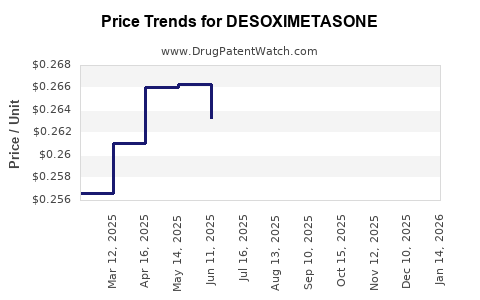
Desoximetasone is a mature topical corticosteroid with limited pricing power, broad generic availability, and low standalone financial visibility. The market is driven by prescription volume, formulation mix, payer reimbursement, dermatology demand, and manufacturer participation rather than by patent exclusivity. Branded Topicort has limited commercial leverage against generic desoximetasone creams, ointments, gels, and sprays.
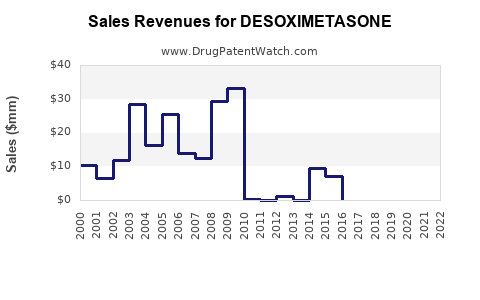
The product’s financial trajectory is best characterized as stable-to-declining for branded sales and fragmented for generic manufacturers. Public companies generally do not disclose desoximetasone revenue separately, preventing a reliable standalone market-size calculation from public filings.
What is desoximetasone used for?
Desoximetasone is a synthetic topical corticosteroid used to treat corticosteroid-responsive dermatoses, including atopic dermatitis, eczema, psoriasis, and other inflammatory skin conditions. It is available in several strengths and dosage forms, including cream, ointment, gel, and spray.
Desoximetasone is generally classified as a medium- to high-potency topical corticosteroid, depending on formulation and concentration. The 0.25% products are stronger than the 0.05% products, while the vehicle influences absorption, patient preference, and prescribing behavior.
Desoximetasone product forms
| Formulation |
Common strength |
Commercial role |
| Cream |
0.05%, 0.25% |
Broadest generic substitution and outpatient use |
| Ointment |
0.25% |
Higher occlusiveness; useful for thick or dry lesions |
| Gel |
0.05% |
Niche vehicle with cosmetic and application advantages |
| Spray |
0.25% |
Convenience-oriented formulation, including scalp and larger-area use |
| Emollient cream |
0.05% |
Formulation differentiation and tolerability positioning |
FDA labeling limits duration and treated body-surface area because prolonged topical corticosteroid exposure can cause skin atrophy, striae, telangiectasia, hypothalamic-pituitary-adrenal-axis suppression, and other adverse effects.[1]
What is the market position of desoximetasone?
Desoximetasone occupies a mature, low-growth segment of the topical corticosteroid market. It competes with other prescription corticosteroids, including triamcinolone acetonide, fluocinonide, betamethasone dipropionate, mometasone furoate, hydrocortisone butyrate, and clobetasol propionate.
Its commercial position has four characteristics:
- Generic competition is extensive.
- Clinical substitution is relatively high within topical corticosteroid classes.
- Product differentiation depends heavily on vehicle and convenience.
- Pricing is constrained by payer formularies and pharmacy substitution.
Desoximetasone is not a biologic, specialty injectable, or protected drug-delivery platform. It does not benefit from the premium pricing associated with biologics such as dupilumab or tralokinumab, or from the commercial growth seen in newer nonsteroidal topical agents such as topical ruxolitinib.
How does desoximetasone compare with competing dermatology drugs?
| Drug |
Class |
Competitive position |
Commercial profile |
| Desoximetasone |
Topical corticosteroid |
Mature prescription generic |
Low price, broad substitution |
| Triamcinolone acetonide |
Topical corticosteroid |
High-volume benchmark |
Extensive generic use |
| Fluocinonide |
High-potency corticosteroid |
Stronger-potency alternative |
Generic, established reimbursement |
| Clobetasol propionate |
Super-high-potency corticosteroid |
Severe or localized disease |
Higher potency and greater safety restrictions |
| Mometasone furoate |
Topical corticosteroid |
Branded and generic presence |
Vehicle and once-daily positioning |
| Crisaborole |
Nonsteroidal PDE-4 inhibitor |
Steroid-sparing option |
Higher branded pricing |
| Ruxolitinib cream |
Topical JAK inhibitor |
Newer targeted therapy |
Specialty pricing and safety restrictions |
| Dupilumab |
Biologic |
Moderate-to-severe atopic dermatitis |
High-cost specialty product |
Desoximetasone retains demand where clinicians want a prescription-strength corticosteroid but do not need a novel mechanism or systemic biologic treatment.
When did desoximetasone lose exclusivity?
Desoximetasone has been marketed for decades, and its original product-level exclusivity has expired. The commercial market is therefore governed primarily by abbreviated new drug applications, manufacturing economics, formulation differentiation, and distribution.
The original Topicort franchise does not have the exclusivity profile of a recently approved small molecule. Any current commercial protection is more likely to arise from formulation-specific intellectual property, trademarks, manufacturing know-how, or distribution agreements than from broad compound exclusivity.
What patents protect desoximetasone?
No broad, commercially meaningful compound patent is expected to block generic desoximetasone supply. The relevant intellectual-property categories are:
- Formulation patents covering emollient systems, gels, sprays, or delivery vehicles.
- Method-of-use patents covering specific dermatologic indications or dosing regimens.
- Manufacturing patents covering intermediates, purification, or process controls.
- Trademark rights covering Topicort and related brand names.
- Regulatory exclusivity attached to a specific new formulation, if applicable.
For a mature topical corticosteroid, these rights generally have narrower commercial effect than the original active-ingredient patent. Generic competitors can often enter through alternative formulations that avoid a narrow formulation claim.
What is the FDA regulatory status of desoximetasone?
Desoximetasone is an FDA-approved prescription topical corticosteroid. FDA-approved products include multiple strengths and dosage forms marketed under both branded and generic names.[1]
Generic versions are generally submitted through the abbreviated new drug application pathway. A generic applicant must demonstrate pharmaceutical equivalence and bioequivalence or otherwise satisfy FDA requirements for the applicable topical product. Approval does not require a full clinical-efficacy program comparable to the original new drug application.
What is the Orange Book status of desoximetasone?
The Orange Book identifies FDA-approved prescription drug products and may include patent and exclusivity information for listed products.[2] For mature desoximetasone products, Orange Book value is limited because:
- The original active-ingredient exclusivity has expired.
- Generic products are widely available.
- Product-specific patents, where listed, tend to have formulation-level scope.
- ANDA competition can proceed when relevant listed patents are expired, delisted, or successfully challenged.
The commercial importance of any listed patent depends on the exact product, strength, dosage form, NDA holder, and patent status. A patent associated with a spray or emollient cream may not affect generic entry for a conventional cream or ointment.
How many patents cover desoximetasone?
The number of potentially relevant patents varies by dosage form and product owner. A single count is not commercially meaningful because patents can cover different strengths, vehicles, manufacturing processes, or branded products.
The practical patent estate is narrow compared with newer dermatology products. Conventional desoximetasone cream and ointment products face the greatest generic pressure. Spray, gel, and emollient formulations may have greater differentiation, but that advantage depends on prescribing volume, payer coverage, and the availability of design-around formulations.
What formulations are protected by desoximetasone patents?
The most commercially relevant formulation categories are:
- Low-residue or rapidly absorbed creams.
- Emollient creams designed to improve skin feel.
- Aerosol or spray systems for scalp and difficult-to-reach areas.
- Gels intended for oily or hair-bearing skin.
- Formulations designed to improve stability, dispersion, or delivery.
Formulation protection rarely supports premium pricing by itself in a mature topical market. The manufacturer must also secure formulary placement, pharmacy distribution, and sufficient prescription volume.
Which companies market desoximetasone?
The commercial field includes branded and generic manufacturers. Topicort has historically been associated with Valeant and related dermatology businesses, while Taro Pharmaceuticals has marketed desoximetasone products in the generic and prescription dermatology markets.[3][4]
The competitive set can include:
- Taro Pharmaceuticals.
- Perrigo and related generic dermatology operations.
- Glenmark Pharmaceuticals.
- Actavis and other Teva-affiliated generic operations.
- Mylan and other Viatris-affiliated operations.
- Amneal Pharmaceuticals.
- Smaller ANDA holders and contract manufacturers.
Market participation changes as companies discontinue low-volume topical products, transfer applications, or consolidate dermatology portfolios. The presence of an approved ANDA does not guarantee active commercial supply.
What is the financial trajectory of desoximetasone?
The financial trajectory is mature and volume-driven:
| Period |
Financial condition |
Main driver |
| Original branded period |
Higher pricing and limited competition |
Brand recognition and prescription demand |
| Early generic entry |
Rapid price compression |
ANDA competition and substitution |
| Mature generic period |
Stable or declining revenue per unit |
Low prices and payer pressure |
| Current market |
Fragmented, formulation-sensitive economics |
Supply discipline, vehicle mix, and contracts |
Public filings from manufacturers generally aggregate topical dermatology revenue or report broader prescription-generic sales. They do not typically identify desoximetasone revenue as a separate line item.[3][4]
Revenue is therefore influenced by:
- Prescription volume.
- Average selling price.
- Generic supplier count.
- Formulation mix.
- Retail versus specialty distribution.
- Medicaid and commercial reimbursement.
- Product shortages or discontinuations.
- Changes in dermatology treatment guidelines.
What is the revenue exposure for manufacturers?
Desoximetasone is unlikely to represent a material share of revenue for diversified pharmaceutical companies. Its financial value is more relevant at the product-line level than at the enterprise level.
For a generic manufacturer, the product can contribute incremental revenue if it has:
- Limited active competitors.
- Reliable API supply.
- Efficient tube, bottle, or aerosol packaging.
- Favorable payer contracts.
- A differentiated dosage form.
- Manufacturing capacity that supports low-cost production.
The product becomes less attractive when several manufacturers compete for the same conventional cream or ointment volume. Price erosion can outpace prescription growth, producing declining revenue even when unit demand remains stable.
What generic entry risks exist for desoximetasone?
Generic entry risk is high for conventional desoximetasone cream and ointment products. The active ingredient is established, the clinical use is well understood, and multiple manufacturers can produce standard topical forms.
Risk is lower, but not eliminated, for:
- Spray products with specialized packaging.
- Emollient or low-residue vehicles.
- Products requiring complex manufacturing controls.
- Dosage forms with limited approved competitors.
- Formulations with device or container-closure requirements.
Generic entrants may pursue a product when expected price erosion remains acceptable because topical manufacturing costs are comparatively manageable. They may also enter after an incumbent exits, creating a temporary opportunity for higher prices.
Which companies are challenging desoximetasone exclusivity?
Desoximetasone is principally challenged through generic ANDA filings rather than high-profile Paragraph IV litigation. Paragraph IV certification is relevant when an ANDA applicant asserts that a listed patent is invalid, unenforceable, or not infringed.
For mature conventional products, the most likely pathway is an ANDA filing against expired or nonblocking patents. Litigation risk rises when a brand owner lists formulation patents for a commercially important dosage form.
Publicly visible litigation involving desoximetasone has less commercial significance than the broader generic-entry pattern. A formulation-specific dispute may affect one spray, gel, or emollient product without protecting the broader desoximetasone market.
What patent litigation affects desoximetasone?
The key litigation questions are:
- Whether the challenged patent is listed for the exact reference product.
- Whether the patent covers the active ingredient or only the vehicle.
- Whether the ANDA product uses a noninfringing formulation.
- Whether a 30-month stay applies.
- Whether the settlement delays generic launch.
- Whether the patent expires before litigation can produce meaningful commercial protection.
Because the molecule is old, litigation is more likely to center on product-specific formulation claims than on the active ingredient.
What settlement agreements affect generic desoximetasone entry?
No broad, market-defining settlement structure is associated with desoximetasone comparable to major blockbuster drug settlements. Any settlement would likely be product-specific and could address:
- An agreed generic launch date.
- A license to a formulation patent.
- Restrictions on dosage form or strength.
- Supply or authorized-generic terms.
- A covenant not to sue.
The economic impact of a settlement depends on whether it controls the leading formulation or only a small product segment.
What is the biosimilar risk for desoximetasone?
Biosimilar risk is not applicable. Desoximetasone is a chemically synthesized small molecule administered topically, not a biologic. Competitive pressure comes from generic drugs and therapeutic substitutes, not biosimilar products.
The relevant alternatives include other topical corticosteroids, topical nonsteroidal anti-inflammatory agents, topical calcineurin inhibitors, topical PDE-4 inhibitors, topical JAK inhibitors, phototherapy, and systemic or injectable biologics for more severe disease.
How does desoximetasone compare with newer dermatology products?
Desoximetasone has lower pricing and weaker differentiation than newer targeted treatments. Its advantages are familiarity, broad availability, straightforward prescribing, and low acquisition cost. Its disadvantages are class-related safety restrictions, limited suitability for chronic extensive use, and strong generic competition.
| Attribute |
Desoximetasone |
Newer targeted dermatology therapy |
| Mechanism |
Broad corticosteroid anti-inflammatory effect |
Targeted immune or inflammatory pathway |
| Price |
Low to moderate |
Moderate to very high |
| Generic competition |
Extensive |
Often limited or absent |
| Chronic-use profile |
Restricted by steroid risks |
Product-specific |
| Patent strength |
Mature and narrow |
Often stronger and longer-lived |
| Revenue growth |
Low |
Potentially high during launch and expansion |
What is the outlook for desoximetasone?
The base-case outlook is stable prescription demand with continued unit-level competition and limited revenue growth. The strongest commercial opportunities are likely to come from supply reliability, niche formulations, and selective market exits by competitors rather than from large expansion of the overall molecule market.
Manufacturers should focus on:
- Product availability.
- Cost-efficient topical production.
- Accurate demand forecasting.
- Formulation-specific differentiation.
- Reimbursement and channel management.
- Regulatory maintenance of ANDAs.
- Control of API and packaging supply.
A conventional desoximetasone cream is unlikely to support sustained premium pricing. A differentiated spray, gel, or emollient formulation may produce better margins, but only if the product achieves meaningful utilization and avoids rapid generic replication.
Key Takeaways
- Desoximetasone is a mature prescription topical corticosteroid with extensive generic competition.
- Topicort has limited ability to sustain premium pricing against generic creams, ointments, gels, and sprays.
- The original active-ingredient exclusivity has expired; current protection is formulation-specific.
- Generic-entry risk is high for conventional cream and ointment products.
- Paragraph IV and litigation risk is more relevant to specialized formulations than to the molecule broadly.
- Biosimilar risk does not apply because desoximetasone is a small-molecule topical drug.
- Public companies generally do not disclose standalone desoximetasone revenue.
- Financial performance depends on volume, price erosion, formulation mix, supply reliability, and payer access.
- The market outlook is stable-to-declining in value, with selective opportunities in differentiated dosage forms.
FAQs
Is desoximetasone a high-value pharmaceutical product?
No. It is a mature, low-price prescription topical product. Its value lies in recurring generic volume and formulation-specific niches rather than in exclusivity or premium pricing.
Can desoximetasone be purchased over the counter?
Most prescription-strength desoximetasone products are prescription medicines in the United States. Over-the-counter hydrocortisone products are more accessible, but they are not direct substitutes in potency or prescribing status.
Which desoximetasone formulation has the strongest commercial potential?
Sprays, gels, and emollient creams may offer greater differentiation than standard creams or ointments. Commercial potential depends on active competitors, reimbursement, packaging economics, and prescription volume.
Does desoximetasone compete with dupilumab?
Yes, in a broad treatment-market sense. Both can be used in inflammatory dermatologic conditions, but they occupy different positions. Desoximetasone is a low-cost topical corticosteroid, while dupilumab is a high-cost injectable biologic used for eligible moderate-to-severe disease.
What is the principal investment risk in desoximetasone?
The principal risk is price erosion caused by generic competition. Additional risks include low prescription growth, product discontinuation, manufacturing-cost inflation, payer substitution, and limited ability to defend market share through patents.
References
- U.S. Food and Drug Administration. (2023). Desoximetasone prescribing information. FDA.
- U.S. Food and Drug Administration. (2024). Approved drug products with therapeutic equivalence evaluations: The Orange Book. FDA.
- Taro Pharmaceuticals. (2024). Annual report and product information. Taro Pharmaceuticals.
- Bausch Health Companies Inc. (2024). Annual report. Bausch Health Companies Inc.
- National Library of Medicine. (2024). DailyMed: Desoximetasone drug labels. U.S. National Library of Medicine.