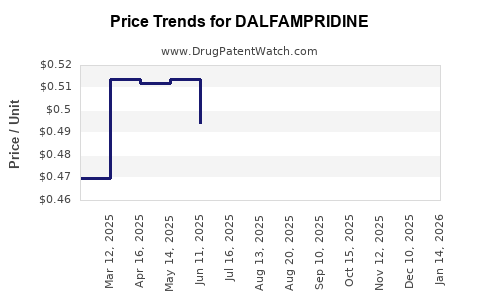
Last updated: September 5, 2026
Dalfampridine is a mature symptomatic multiple-sclerosis product facing sustained generic erosion. In the United States, Ampyra generated peak annual sales of roughly $490 million before generic entry. The market has since shifted from branded growth to price competition, payer substitution, and manufacturing scale. The drug remains commercially relevant because it is the only FDA-approved therapy specifically indicated to improve walking in adults with multiple sclerosis, but its patent-based pricing power has weakened substantially.
What is dalfampridine and how is it used?
Dalfampridine is the extended-release formulation of 4-aminopyridine, also known as fampridine outside the United States. Ampyra is approved to improve walking in adults with multiple sclerosis, as measured by walking speed. The recommended dose is 10 mg twice daily, approximately 12 hours apart. Higher dosing increases seizure risk and is not recommended.[1]
The drug does not modify the underlying course of multiple sclerosis. Its value proposition is symptomatic: it improves nerve conduction in some patients with demyelinated axons. Clinical response is limited to a subset of patients, and treatment is generally continued only when measurable walking improvement occurs.
| Attribute |
Dalfampridine |
| Active ingredient |
4-aminopyridine |
| U.S. brand |
Ampyra |
| International brand |
Fampyra |
| Dosage form |
Extended-release tablet |
| Typical strength |
10 mg |
| U.S. dosing |
10 mg twice daily |
| FDA approval |
2010 |
| Approved use |
Improvement of walking in adults with multiple sclerosis |
| Drug type |
Small-molecule symptomatic therapy |
| Biosimilar exposure |
None |
| Main competitive threat |
Generic extended-release dalfampridine |
What is the FDA regulatory status of Ampyra and generic dalfampridine?
Ampyra was approved under NDA 022250 in January 2010. FDA approval established a distinct regulatory category for the extended-release product, separating it from immediate-release or compounded 4-aminopyridine preparations.[1]
Generic dalfampridine extended-release tablets have received FDA approval through abbreviated new drug applications. Generic applicants must demonstrate pharmaceutical equivalence and bioequivalence to Ampyra. The principal technical challenge is the modified-release profile, which must control exposure and avoid excessive peak concentrations associated with seizure risk.
The U.S. market now includes multiple generic manufacturers and an authorized-generic channel. Generic availability has shifted prescriber and payer behavior toward substitution, although some patients remain on branded Ampyra because of continuity, prior authorization history, or physician preference.
Is dalfampridine a biologic or a biosimilar market?
No. Dalfampridine is a conventional small molecule. The relevant competitive pathway is the ANDA generic pathway, not the 351(k) biosimilar pathway. Biosimilar development, interchangeability, immunogenicity, and biologic manufacturing issues do not apply.
The commercial risks are therefore faster substitution, lower prices, and multiple suppliers rather than biosimilar switching or reference-product exclusivity.
When did dalfampridine lose market exclusivity?
Dalfampridine began losing practical U.S. exclusivity after FDA approval of generic products in 2018. Generic competition became the principal commercial force before the full expiry of every listed patent because patent settlements, authorized-generic arrangements, and approved ANDAs affected the timing of market entry.[2][3]
The relevant commercial timeline is:
| Period |
Market development |
Commercial effect |
| 2010 |
FDA approves Ampyra |
Acorda establishes the U.S. market |
| 2011-2016 |
Brand adoption expands |
Revenue rises toward approximately $490 million |
| 2017 |
Generic challenges and patent activity intensify |
Future price erosion becomes visible |
| 2018 |
FDA approvals of generic dalfampridine products |
Substitution and payer pressure begin |
| 2019-2020 |
Generic penetration expands |
Ampyra revenue declines sharply |
| 2021 onward |
Mature generic market |
Value shifts to manufacturing cost, contracting, and distribution |
The distinction between patent expiry and market exclusivity is important. A branded product can lose pricing power before the final patent expiration date if generic entrants are licensed to launch, if an authorized generic is introduced, or if payers treat multiple products as interchangeable.
What patents protect Ampyra and dalfampridine extended-release tablets?
Ampyra’s protection centered on extended-release formulations and related methods of use rather than on a new chemical entity. The patent estate included U.S. patents covering sustained-release 4-aminopyridine formulations and treatment methods for improving walking in multiple-sclerosis patients.[3][4]
Publicly reported core patents included:
| Patent family |
Protected subject matter |
Commercial significance |
| U.S. 8,007,826 |
Sustained-release 4-aminopyridine formulation |
Core formulation protection |
| U.S. 8,663,685 |
Related extended-release formulation claims |
Supported patent litigation and launch control |
| Later formulation and method patents |
Additional dosage-form or treatment claims |
Potentially narrowed design-around options |
The principal patent issue was not whether a company could make 4-aminopyridine. It was whether the company could reproduce the controlled-release profile used by Ampyra without infringing formulation claims.
Patent term calculations depend on priority dates, patent-term adjustment, terminal disclaimers, and Orange Book listing status. The commercially relevant protection extended into the 2020s, but generic entry occurred before the full economic life of the branded franchise had ended.[3][4]
What formulations are protected by dalfampridine patents?
The commercially important formulation is a 10 mg extended-release tablet designed for twice-daily administration. Formulation claims may address:
- Release-control matrices
- Drug loading and excipient composition
- Dissolution profiles
- Tablet architecture
- Sustained exposure over a 12-hour dosing interval
- Treatment of walking impairment using the extended-release product
A generic company can avoid some claims through alternative excipients or release mechanisms, but it must still meet FDA bioequivalence requirements. That combination creates a dual constraint: the product must be legally noninfringing and pharmacokinetically equivalent.
Were there Paragraph IV challenges to Ampyra?
Yes. Ampyra faced Paragraph IV patent challenges from generic applicants. A Paragraph IV certification alleges that a listed patent is invalid, unenforceable, or not infringed. Filing such a certification can trigger Hatch-Waxman litigation and a 30-month stay of FDA approval, subject to statutory exceptions and court developments.[2]
Acorda litigated against generic applicants and entered into commercial arrangements that influenced launch timing. The patent disputes focused on extended-release formulation and method claims rather than the basic 4-aminopyridine molecule.
The generic challenge pattern followed a conventional Hatch-Waxman sequence:
- ANDA applicant files a Paragraph IV certification.
- Patent holder receives notice.
- Patent holder files an infringement action.
- FDA approval may be subject to a statutory stay.
- Litigation or settlement determines the practical launch date.
- Generic entry expands as additional applicants receive approval.
The presence of a Paragraph IV filing did not guarantee an immediate launch. For Ampyra, actual market impact depended on settlements, court outcomes, authorized-generic strategy, and the number of approved competitors.
What is the Orange Book status of Ampyra?
Ampyra’s Orange Book strategy relied on listed patents directed to the approved extended-release product and its use. Orange Book-listed patents can support infringement litigation against ANDA applicants, but listing does not guarantee that every claim will survive validity or noninfringement challenges.
The commercial value of the listings declined as:
- Generic applicants developed alternative release systems.
- Multiple products entered or prepared to enter the market.
- Settlements authorized future generic launches.
- Payers imposed substitution and step-edit requirements.
- The product moved from a protected brand market to a multisource market.
For investment or litigation analysis, the operative question is not only whether a patent appears in the Orange Book. It is whether the patent can block a noninfringing, bioequivalent product long enough to preserve a meaningful price premium.
How strong is the dalfampridine patent estate?
The estate was commercially meaningful but not durable after generic entry.
Strengths
- The extended-release dosage form created a technically defined product.
- Formulation patents gave the sponsor a basis for Hatch-Waxman litigation.
- The drug had a narrow approved product configuration, limiting some early substitution.
- Clinical use patents supported additional enforcement theories.
Weaknesses
- The active ingredient, 4-aminopyridine, was known before Ampyra.
- The product did not have strong new-chemical-entity protection.
- Generic manufacturers could target the release system rather than the molecule.
- Multiple ANDA applicants reduced the value of any single litigation win.
- Chronic treatment created strong payer incentives to force generic substitution.
The estate was strongest during the period when one or a small number of generic applicants faced litigation delay. It became materially weaker once approved competitors and authorized-generic supply established a multisource market.
What patent litigation affected dalfampridine?
Acorda brought Hatch-Waxman litigation against generic applicants seeking approval of dalfampridine extended-release tablets. The cases addressed infringement and validity of Ampyra-related formulation and method patents.[3][5]
The litigation had two commercial consequences. First, it delayed or structured generic entry. Second, it exposed the limits of relying on formulation patents for a mature small molecule. Once a generic manufacturer demonstrated a viable alternative release profile, the branded product’s ability to maintain premium pricing declined.
Acorda’s broader corporate stress also affected the economic value of Ampyra. The company entered bankruptcy proceedings in 2020 and later completed a restructuring, reflecting the combined effects of generic erosion, debt obligations, and underperformance of newer products.[6]
What were the Ampyra and dalfampridine financial trends?
Ampyra was Acorda’s primary commercial asset for much of the 2010s. U.S. product sales reached approximately $489 million in 2016 and approximately $473 million in 2017, according to company filings.[6][7]
| Year |
Approximate Ampyra sales trend |
Main driver |
| 2010-2012 |
Rapid growth |
Launch and patient adoption |
| 2013-2015 |
Continued expansion |
Broader prescribing and reimbursement |
| 2016 |
Approximately $489 million |
Peak branded scale |
| 2017 |
Approximately $473 million |
Early generic and payer pressure |
| 2018 |
Material decline |
Generic approvals and reduced brand volume |
| 2019 onward |
Steep erosion |
Multisource generic competition |
The decline was structural rather than cyclical. Once payers gained access to generic alternatives, the brand faced simultaneous volume and price pressure. Patient retention alone could not offset formulary substitution.
How exposed was Acorda to Ampyra revenue?
Acorda was highly exposed. Ampyra financed a substantial portion of the company’s operations before generic competition. The company attempted to diversify through Inbrija, an inhaled levodopa product for OFF episodes in Parkinson’s disease, but Inbrija did not replace the scale or maturity of the Ampyra franchise.[6]
The company’s financial trajectory illustrates a common specialty-pharmaceutical pattern:
- One product reaches commercial maturity.
- Patent challenges begin before replacement revenue is established.
- Generic entry compresses revenue faster than operating costs decline.
- Debt and launch expenses amplify the impact.
- Restructuring becomes necessary when pipeline products cannot replace the lost cash flow.
Which companies compete in the dalfampridine market?
The competitive market includes the branded product, authorized-generic supply, and conventional generic manufacturers. Publicly reported generic participants have included companies such as Mylan, Teva, Apotex, Zydus, and other ANDA holders, although the active supplier group changes with contracts, product availability, and wholesaler positioning.[2][8]
Competition occurs on four levels:
- FDA approval and product availability.
- Wholesale acquisition cost and payer discounts.
- Reliable supply of the extended-release tablet.
- Contracting with specialty pharmacies and distributors.
The molecule has limited differentiation after generic entry. Manufacturing reliability and cost control are more important than promotional innovation.
What licensing deals affect dalfampridine?
Acorda licensed rights to market fampridine outside the United States to Biogen. Biogen commercialized Fampyra in international markets, subject to local regulatory approvals and reimbursement conditions.[6][9]
The international model differs from the U.S. model:
- The United States uses the Ampyra brand and ANDA generic pathway.
- Europe and other markets use the Fampyra name.
- International reimbursement decisions have a larger effect on uptake.
- Generic entry follows local patent, data-exclusivity, and pricing rules.
- Royalty and licensing economics reduce the sponsor’s direct exposure but also limit retained gross profit.
The deal provided geographic reach without requiring Acorda to build a full international commercial infrastructure.
What generic launch risks exist for dalfampridine?
Generic launch risk is high for the branded product and moderate for new entrants.
Risks to Ampyra
- Rapid payer-mandated substitution
- Lower net price
- Loss of preferred formulary status
- Multiple approved suppliers
- Authorized-generic competition
- Lower patient acquisition spending
- Reduced specialty-pharmacy leverage
Risks to generic manufacturers
- Bioequivalence failure caused by modified-release variability
- Formulation patent litigation
- Supply interruptions
- Low net prices after several entrants
- Limited market size relative to development and litigation costs
- Dependence on payer contracts and wholesaler access
The market can support several suppliers, but it may not support high margins for all of them. Generic profitability depends on launch timing, manufacturing cost, and the number of competitors entering within the same period.
How does dalfampridine compare with competing multiple-sclerosis therapies?
Dalfampridine is different from disease-modifying therapies such as ocrelizumab, natalizumab, dimethyl fumarate, fingolimod, and ofatumumab. Those products target relapse reduction, disability progression, or inflammatory disease activity. Dalfampridine targets walking function and can be used alongside disease-modifying therapy.
| Category |
Dalfampridine |
Disease-modifying therapies |
| Primary objective |
Improve walking |
Reduce disease activity or progression |
| Patient selection |
Patients with walking impairment who respond |
Patients with active or progressive MS, depending on product |
| Treatment role |
Symptomatic adjunct |
Core disease management |
| Market structure |
Mature generic market |
Mix of branded, generic, and biologic products |
| Biosimilar exposure |
None |
Relevant for biologic products |
| Pricing power |
Low after generic entry |
Often higher, particularly for biologics |
| Clinical differentiation |
Walking-speed response |
Relapse, MRI, disability, and progression outcomes |
Dalfampridine’s narrow indication limits its total addressable market but also gives it a clear treatment role for patients with mobility impairment.
What manufacturing and intellectual-property barriers remain?
The active ingredient is not the principal barrier. The key barriers are:
- Consistent extended-release manufacturing
- Dissolution-profile control
- Low-dose content uniformity
- Bioequivalence across fed and fasted conditions
- Stability and packaging
- Compliance with seizure-related safety controls
- Avoidance of remaining formulation claims
A manufacturer with a low-cost, reliable extended-release platform has a stronger position than one relying on a novel active-ingredient process. Manufacturing economics become decisive after patent-based exclusivity ends.
What is the geographic market outlook for dalfampridine?
The United States remains the largest commercial reference market because Ampyra established a high-value branded category before generic entry. International sales under Fampyra are more dependent on health-technology assessment, national reimbursement, and local pricing controls.
Geographic outlook:
| Region |
Market condition |
| United States |
Mature, generic-dominated, price-sensitive |
| European Union |
Brand and generic markets vary by country |
| Canada |
Reimbursement and provincial formulary decisions are important |
| Asia-Pacific |
Smaller and unevenly reimbursed opportunity |
| Latin America |
Access depends on local registration and affordability |
The global opportunity is stable rather than high growth. Patient prevalence supports demand, but pricing and reimbursement limit expansion.
What is the likely financial trajectory for dalfampridine?
Dalfampridine revenue is likely to remain a low-growth or declining mature-market opportunity. Branded revenue will continue to be constrained by generic substitution. Generic manufacturers can generate recurring sales, but per-unit economics will compress as additional suppliers enter.
The most defensible commercial positions are:
- Low-cost manufacturing
- Reliable supply
- Established payer contracts
- Authorized-generic arrangements
- International licensing rights
- Formulation expertise that reduces regulatory failure risk
The drug remains clinically useful, but clinical utility does not restore the pricing power lost through generic entry.
Key Takeaways
- Dalfampridine is a symptomatic MS therapy, not a disease-modifying treatment.
- Ampyra was approved by FDA in 2010 and reached approximately $489 million in annual sales by 2016.
- Generic competition began materially affecting the U.S. market in 2018.
- The relevant patents protected extended-release formulations and treatment methods, not a new chemical entity.
- Paragraph IV litigation and settlements shaped launch timing but did not prevent long-term erosion.
- The market has no biosimilar risk because dalfampridine is a small molecule.
- Acorda’s historical financial exposure to Ampyra was substantial, contributing to later restructuring after generic entry.
- Manufacturing consistency, bioequivalence, supply reliability, and payer contracting now matter more than brand promotion.
- The U.S. market is mature and generic dominated; international Fampyra markets remain fragmented by reimbursement and local patent rules.
FAQs
Is dalfampridine the same drug as 4-aminopyridine?
Yes. Dalfampridine is the U.S. name for the extended-release formulation of 4-aminopyridine. Fampridine is the name commonly used outside the United States.
Can dalfampridine be compounded by pharmacies?
Immediate-release 4-aminopyridine has been compounded in some settings, but compounded products are not equivalent to FDA-approved extended-release dalfampridine and have different quality, dosing, and regulatory characteristics.
Does dalfampridine reduce multiple-sclerosis relapses?
No. Dalfampridine is indicated to improve walking. It does not replace disease-modifying therapy and is not approved to reduce relapses or MRI disease activity.
Why is extended-release manufacturing important for dalfampridine?
The extended-release profile controls systemic exposure and permits twice-daily dosing. Excessive peak exposure can increase seizure risk, making dissolution performance and bioequivalence critical.
Can a generic dalfampridine product be automatically substituted for Ampyra?
Substitution depends on FDA therapeutic-equivalence ratings, state pharmacy-substitution law, payer policy, and product availability. FDA approval alone does not determine every state-level substitution outcome.
References
-
U.S. Food and Drug Administration. (2023). Ampyra (dalfampridine) extended-release tablets prescribing information. FDA.
-
U.S. Food and Drug Administration. (2024). Approved drug products with therapeutic equivalence evaluations: Orange Book. FDA.
-
Acorda Therapeutics, Inc. (2018). Annual report pursuant to Section 13 or 15(d) of the Securities Exchange Act of 1934. U.S. Securities and Exchange Commission.
-
United States Patent and Trademark Office. (2007-2014). U.S. Patents 8,007,826 and 8,663,685. USPTO Patent Center.
-
U.S. District Court for the District of Delaware. (2017-2019). Acorda Therapeutics, Inc. v. Roxane Laboratories, Inc. and related Hatch-Waxman matters. PACER.
-
Acorda Therapeutics, Inc. (2020). Annual report and restructuring disclosures. U.S. Securities and Exchange Commission.
-
Acorda Therapeutics, Inc. (2017). 2016 annual report. U.S. Securities and Exchange Commission.
-
U.S. Food and Drug Administration. (2018-2024). Dalfampridine extended-release abbreviated new drug application approvals. FDA.
-
Biogen Inc. (2011). Fampyra commercialization and collaboration disclosures. U.S. Securities and Exchange Commission.