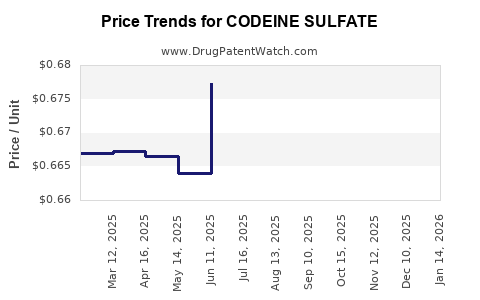
Last updated: February 19, 2026
Codeine sulfate, a widely used opioid analgesic, faces a complex market environment shaped by evolving regulatory landscapes, increasing competition from alternative pain management therapies, and ongoing scrutiny regarding its potential for misuse and addiction. Its financial trajectory is influenced by patent expirations of key branded formulations, the rise of generic competition, and the shifting prescription patterns driven by pain management guidelines.
What is the current market size and projected growth for codeine sulfate?
The global market for codeine sulfate is substantial, though precise, real-time figures are often fragmented due to its classification as a controlled substance and its availability in various formulations and combination products. Market analysis indicates that the overall pain management market, within which codeine sulfate operates, is experiencing steady growth. This growth is driven by an aging global population, increasing prevalence of chronic pain conditions, and advancements in medical treatments requiring pain relief.
However, codeine sulfate's specific market segment is subject to pressures that temper its growth potential compared to newer or non-opioid alternatives. Factors such as the U.S. Centers for Disease Control and Prevention's (CDC) opioid prescribing guidelines, which recommend limiting opioid use for chronic pain, have impacted prescription volumes.
Estimates for the global codeine market, often including combination products where codeine is a primary active ingredient, generally place it in the hundreds of millions of U.S. dollars annually. Projections for this specific segment are often modest, with a compound annual growth rate (CAGR) estimated between 2% and 4% over the next five to seven years. This growth is primarily sustained by its continued use in specific indications like cough suppression and short-term pain management where alternatives may be less effective or more costly.
Which key patents have expired or are nearing expiration for codeine sulfate products?
Codeine sulfate itself is a well-established compound with a long history of use, meaning the primary patents covering its synthesis and basic formulations expired decades ago. The patents of significant commercial interest for codeine sulfate typically relate to:
- Specific Formulations: Novel delivery systems (e.g., extended-release formulations, combination therapies with other active ingredients) that offered improved efficacy, reduced side effects, or enhanced patient compliance.
- Manufacturing Processes: Patented methods for producing codeine sulfate with higher purity, greater efficiency, or reduced environmental impact.
- Combination Products: Patents covering specific therapeutic combinations where codeine sulfate is combined with other active pharmaceutical ingredients (APIs) for synergistic effects or to manage a broader spectrum of symptoms. For example, combination products for cough and cold symptoms often featured codeine.
Examples of historically significant patent expirations include:
- Extended-Release Formulations: Brands that introduced extended-release versions of codeine sulfate to provide longer-lasting pain relief saw their patent exclusivity periods expire, paving the way for generic entrants. The exact dates vary by specific product and region, but many of these foundational patents began expiring in the late 2000s and early 2010s.
- Combination Therapies: Patents for many widely prescribed combination products, such as those containing codeine sulfate and acetaminophen for pain relief, have largely expired. This has led to widespread generic availability of these formulations. The expiry of patents for drugs like APAP/Codeine (various brand names) occurred throughout the 2010s.
The lack of significant, recently expiring patents directly covering novel codeine sulfate APIs means that the market is largely driven by generics. Future patent activity related to codeine sulfate is more likely to involve niche formulations or novel delivery mechanisms rather than core compound patents.
Who are the major manufacturers and generic suppliers of codeine sulfate?
The manufacturing and supply chain for codeine sulfate involves both the production of the raw API and the formulation of finished dosage forms. Due to its controlled substance status, manufacturing is highly regulated.
Major API Manufacturers (often include both branded and generic API producers):
- Perrigo Company plc: A significant player in generic pharmaceuticals, including opioid APIs.
- Teva Pharmaceutical Industries Ltd.: A global leader in generic drug manufacturing, with a broad portfolio that includes controlled substances.
- Mallinckrodt Pharmaceuticals: Historically a major supplier of controlled substances, though facing ongoing legal challenges.
- Norwich Pharmaceuticals: Involved in the manufacturing of generic APIs.
- Various contract manufacturing organizations (CMOs): Several specialized CMOs produce codeine sulfate API for smaller formulators.
Major Branded and Generic Formulators (finished dosage forms):
- Perrigo Company plc: Markets various generic codeine sulfate formulations.
- Teva Pharmaceutical Industries Ltd.: Offers a range of codeine sulfate products, both branded and generic.
- Amneal Pharmaceuticals: A growing generic manufacturer with codeine sulfate products.
- Endo International plc: While also involved in branded products, Endo has a significant generic presence.
- Hikma Pharmaceuticals PLC: A global pharmaceutical company with a strong generic portfolio.
The market is characterized by a high degree of generic competition, with numerous companies offering codeine sulfate in various strengths and dosage forms (tablets, capsules, oral solutions). Pricing is highly competitive among these generic suppliers.
How do regulatory actions and controlled substance scheduling impact the market?
Regulatory actions and scheduling are paramount drivers of the codeine sulfate market. The classification of codeine sulfate as a controlled substance under various national and international laws significantly impacts its availability, prescribing practices, and manufacturing.
- U.S. Controlled Substances Act (CSA): Codeine sulfate is scheduled under the CSA. In the U.S., it is typically a Schedule II or Schedule III controlled substance depending on the concentration and combination with other ingredients.
- Schedule II: Drugs with a high potential for abuse, which may lead to severe psychological or physical dependence. Prescriptions are highly regulated.
- Schedule III: Drugs with a moderate to low potential for physical and psychological dependence. Prescriptions are less stringent than Schedule II but still regulated.
- The specific scheduling dictates prescription refill limitations, dispensing requirements, and manufacturer quotas.
- International Narcotics Control Board (INCB): Codeine sulfate is subject to international control under the Single Convention on Narcotic Drugs, 1961. This requires countries to implement measures to control its manufacture, distribution, and use.
- Opioid Prescribing Guidelines: Regulatory bodies and professional organizations, such as the CDC in the U.S., have issued guidelines recommending a cautious approach to opioid prescribing for chronic pain. These guidelines often advocate for non-opioid analgesics as first-line treatments and emphasize limiting opioid duration and dosage.
- The CDC Guideline for Prescribing Opioids for Chronic Pain (updated in 2022) advises against the routine use of opioids for chronic pain and prioritizes non-pharmacologic and non-opioid pharmacologic therapies.
- Diversion and Abuse Prevention: Regulatory agencies mandate stringent security measures for manufacturing, distribution, and dispensing to prevent diversion for illicit use. This includes track-and-trace requirements and reporting of suspicious transactions.
These regulations directly influence the cost of compliance for manufacturers, limit the number of prescribers willing to prescribe opioids, and encourage the development and adoption of alternative pain management strategies, thereby constraining the growth potential for codeine sulfate.
What are the principal therapeutic uses and indications for codeine sulfate?
Codeine sulfate's primary therapeutic utility stems from its analgesic and antitussive properties. Its principal indications include:
- Pain Management:
- Mild to Moderate Pain: Codeine sulfate is effective for the relief of mild to moderate pain. It is often used for post-operative pain, musculoskeletal pain, and other conditions where over-the-counter analgesics are insufficient.
- Combination Therapies: It is frequently formulated in combination with non-opioid analgesics like acetaminophen (paracetamol) or ibuprofen to provide synergistic pain relief. Examples include Acetaminophen and Codeine Phosphate/Sulfate tablets (e.g., Tylenol with Codeine).
- Cough Suppression (Antitussive): Codeine sulfate acts on the cough center in the brainstem to reduce the frequency and intensity of coughing. It is commonly found in prescription cough syrups and cold remedies.
- Acute Cough: Used to alleviate bothersome, non-productive cough associated with upper respiratory infections.
- Chronic Cough: In some cases, it may be prescribed for chronic cough, though its use is more restricted due to dependence potential.
Key Considerations for Usage:
- Dosage: Dosage is carefully controlled and depends on the severity of pain or cough, patient weight, and individual response.
- Duration of Use: It is generally recommended for short-term use, especially for pain, to minimize the risk of dependence.
- Contraindications: It is contraindicated in patients with respiratory depression, severe asthma, known hypersensitivity, or gastrointestinal obstruction.
The most significant market segment for codeine sulfate in terms of volume often relates to its use in combination with acetaminophen for pain relief and its role as an antitussive.
What is the competitive landscape for codeine sulfate?
The competitive landscape for codeine sulfate is characterized by a dual dynamic: competition among generic suppliers for existing formulations and competition from alternative pain and cough management therapies.
Intra-Class Competition (Generic Suppliers):
- Price Sensitivity: The market for generic codeine sulfate is highly price-sensitive. Manufacturers compete primarily on cost, leading to thin profit margins for individual products.
- Market Share Concentration: While numerous generic manufacturers exist, a few large players dominate the API and finished dosage form markets, leveraging economies of scale.
- Regulatory Hurdles: Obtaining and maintaining regulatory approvals (FDA, EMA, etc.) for controlled substances is complex and resource-intensive, creating barriers to entry for smaller players.
Inter-Class Competition (Alternative Therapies):
- Non-Opioid Analgesics:
- Acetaminophen: Remains a first-line treatment for mild to moderate pain.
- Non-Steroidal Anti-Inflammatory Drugs (NSAIDs): Ibuprofen, naproxen, and celecoxib offer effective pain relief for many conditions and have a lower risk of dependence compared to opioids.
- Topical Analgesics: Lidocaine patches, capsaicin creams, and topical NSAIDs provide localized pain relief with reduced systemic side effects.
- Other Pain Management Modalities:
- Physical Therapy and Exercise: Crucial for managing chronic pain conditions like back pain and osteoarthritis.
- Psychological Therapies: Cognitive Behavioral Therapy (CBT) and mindfulness-based stress reduction are increasingly recognized for their role in pain management.
- Interventional Pain Management: Injections (e.g., corticosteroid injections), nerve blocks, and spinal cord stimulation are used for more severe or refractory pain.
- Non-Opioid Antitussives:
- Dextromethorphan: A common over-the-counter cough suppressant with a lower abuse potential.
- Guaifenesin: An expectorant that helps to thin mucus, aiding in its clearance.
- Antihistamines and Decongestants: Often used in combination products for cough and cold symptoms.
The increasing adoption of these alternative therapies, driven by concerns about opioid safety and efficacy in the long term, represents the most significant competitive threat to codeine sulfate's market share.
What is the financial trajectory and outlook for codeine sulfate?
The financial trajectory for codeine sulfate is characterized by stability in specific, well-defined therapeutic niches, counterbalanced by pressure from regulatory restrictions and the rise of alternatives.
- Stable Revenue from Established Markets: Codeine sulfate is likely to maintain a baseline level of revenue due to its established efficacy in certain indications, particularly for short-term pain management and cough suppression where generic formulations are cost-effective and widely available. The presence of established supply chains and broad physician familiarity contributes to this stability.
- Declining Growth in Opioid-Naive Populations: As opioid prescribing guidelines become more stringent and the public becomes more aware of opioid risks, the initiation of codeine sulfate therapy, especially for chronic pain, is expected to decline further. This limits overall market expansion.
- Impact of Genericization: The market has long been genericized, meaning price competition among manufacturers is fierce. Profitability for individual generic products relies on high-volume sales and efficient manufacturing.
- Research and Development (R&D) Focus Shift: Pharmaceutical R&D investment has largely shifted away from developing new codeine sulfate formulations or novel applications. Instead, R&D is focused on non-opioid pain management solutions, abuse-deterrent formulations of other opioids, and addiction treatment. This lack of innovation directly impacts the potential for significant future revenue growth.
- Geographic Variations: The financial outlook may vary by region. Countries with less restrictive opioid policies or a greater reliance on older, more affordable analgesics might see more stable or slightly growing markets for codeine sulfate, while regions with aggressive opioid control measures will likely experience declines.
- Potential for Niche Growth: While unlikely to drive significant overall market expansion, there could be niche opportunities in the development of abuse-deterrent formulations or highly specialized combination products, though the investment required for such innovations must be weighed against the inherent risks of the opioid market.
The overall financial outlook is one of mature market dynamics with modest, potentially declining, growth. It is unlikely to be a significant growth engine for pharmaceutical companies but will likely persist as a necessary component of pain and cough management for specific patient populations and indications where alternatives are less suitable or available.
Key Takeaways
- Codeine sulfate operates within a mature market segment primarily driven by generic competition and subject to stringent regulatory controls.
- The market size is in the hundreds of millions of U.S. dollars, with projected modest growth (2-4% CAGR) due to ongoing use in cough suppression and short-term pain relief.
- Patents for core codeine sulfate formulations expired decades ago; current patent activity is limited to niche formulations or manufacturing processes.
- Major API manufacturers and generic formulators include Teva, Perrigo, and Mallinckrodt, among others, competing on price and regulatory compliance.
- Regulatory actions, including controlled substance scheduling (e.g., DEA Schedules II/III in the U.S.) and strict prescribing guidelines, significantly impact market dynamics and constrain growth.
- Principal therapeutic uses are for mild-to-moderate pain (often in combination with acetaminophen) and as an antitussive for cough suppression.
- Competition is intense, both among generic suppliers and from a growing array of non-opioid analgesics and alternative pain management modalities.
- The financial trajectory indicates stability in established niches but limited overall growth potential due to regulatory pressures, genericization, and a shift in R&D focus towards non-opioid alternatives.
Frequently Asked Questions
-
What is the primary driver of price fluctuations for generic codeine sulfate?
Price fluctuations for generic codeine sulfate are primarily driven by intense competition among a large number of suppliers, manufacturing costs (including API sourcing and compliance with controlled substance regulations), and shifts in demand influenced by prescribing patterns and payer formularies.
-
Are there any emerging therapeutic applications for codeine sulfate?
There are no significant emerging therapeutic applications for codeine sulfate. Research and development efforts in the pharmaceutical industry have largely shifted away from new applications for codeine sulfate towards non-opioid pain management and addiction treatment.
-
How does the scheduling of codeine sulfate by regulatory bodies affect its global availability?
The scheduling of codeine sulfate by bodies like the DEA in the U.S. and the INCB internationally dictates strict controls on its manufacturing, distribution, and dispensing. This leads to varying levels of availability and differing prescribing requirements across countries, impacting global market access and volume.
-
What is the typical profit margin for a generic codeine sulfate product?
Profit margins for generic codeine sulfate products are generally low due to fierce price competition and the commoditized nature of the market. Companies rely on high sales volumes and efficient supply chain management to achieve profitability, often in the single-digit percentage range.
-
What are the long-term market prospects for codeine sulfate in the context of the opioid crisis?
The long-term market prospects for codeine sulfate are characterized by continued use in specific, well-defined indications where alternatives are less effective or suitable, such as certain types of cough suppression and short-term pain management. However, its overall market expansion is severely limited by ongoing efforts to mitigate the opioid crisis, stringent prescribing guidelines, and the increasing adoption of non-opioid pain management strategies.
Citations
[1] U.S. Centers for Disease Control and Prevention. (2022). Guideline for Prescribing Opioids for Chronic Pain. Retrieved from https://www.cdc.gov/mmwr/volumes/71/rr/rr7103a1.htm
[2] Drug Enforcement Administration. (n.d.). Controlled Substances Act. Retrieved from https://www.dea.gov/controlled-substances-act
[3] International Narcotics Control Board. (n.d.). INCB Functions. Retrieved from https://www.incb.org/incb/en/about-incb/functions.html