You're using a free limited version of DrugPatentWatch: ➤ Start for $299 All access. No Commitment.

Last Updated: December 14, 2025

CICLOPIROX - Generic Drug Details


✉ Email this page to a colleague

« Back to Dashboard


What are the generic sources for ciclopirox and what is the scope of patent protection?

Ciclopirox is the generic ingredient in three branded drugs marketed by Cosette, Fougera Pharms, Glenmark Pharms, Padagis Israel, Sun Pharma Canada, Medimetriks Pharms, Alvogen, Glenmark Pharms Inc, Padagis Us, Actavis Mid Atlantic, Encube, Bausch, Acella, Chartwell Rx, Epic Pharma Llc, Hikma, Mylan Pharms Inc, Rising, Taro Pharm Inds, Teva Pharms, and Valeant Bermuda, and is included in thirty-two NDAs. Additional information is available in the individual branded drug profile pages.

There are ten drug master file entries for ciclopirox. Fourteen suppliers are listed for this compound.

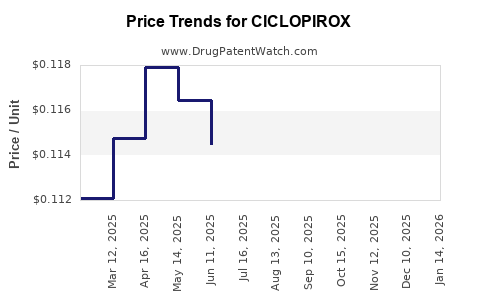
Drug Prices for CICLOPIROX

See drug prices for CICLOPIROX

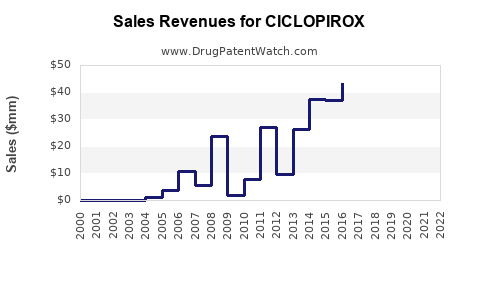
Drug Sales Revenue Trends for CICLOPIROX

See drug sales revenues for CICLOPIROX

Recent Clinical Trials for CICLOPIROX

Identify potential brand extensions & 505(b)(2) entrants

SponsorPhase
Atlas Molecular PharmaPHASE1
Universidad Complutense de MadridPhase 4
Atlas Molecular PharmaPhase 1

See all CICLOPIROX clinical trials

Pharmacology for CICLOPIROX
Paragraph IV (Patent) Challenges for CICLOPIROX
Tradename Dosage Ingredient Strength NDA ANDAs Submitted Submissiondate
CICLOPIROX Gel ciclopirox 0.77% 020519 1 2006-05-10

US Patents and Regulatory Information for CICLOPIROX

Applicant Tradename Generic Name Dosage NDA Approval Date TE Type RLD RS Patent No. Patent Expiration Product Substance Delist Req. Exclusivity Expiration
Encube CICLOPIROX ciclopirox SHAMPOO;TOPICAL 209975-001 Apr 5, 2018 AT RX No No ⤷  Get Started Free ⤷  Get Started Free ⤷  Get Started Free
Acella CICLOPIROX ciclopirox SOLUTION;TOPICAL 078172-001 Sep 18, 2007 AT RX No No ⤷  Get Started Free ⤷  Get Started Free ⤷  Get Started Free
Chartwell Rx CICLOPIROX ciclopirox SOLUTION;TOPICAL 078046-001 Sep 18, 2007 AT RX No No ⤷  Get Started Free ⤷  Get Started Free ⤷  Get Started Free
Fougera Pharms CICLOPIROX ciclopirox SHAMPOO;TOPICAL 090146-001 May 25, 2010 AT RX No No ⤷  Get Started Free ⤷  Get Started Free ⤷  Get Started Free
Encube CICLOPIROX ciclopirox SOLUTION;TOPICAL 077687-001 Sep 18, 2007 AT RX No No ⤷  Get Started Free ⤷  Get Started Free ⤷  Get Started Free
Glenmark Pharms CICLOPIROX ciclopirox CREAM;TOPICAL 090273-001 Nov 10, 2009 AB RX No No ⤷  Get Started Free ⤷  Get Started Free ⤷  Get Started Free
>Applicant >Tradename >Generic Name >Dosage >NDA >Approval Date >TE >Type >RLD >RS >Patent No. >Patent Expiration >Product >Substance >Delist Req. >Exclusivity Expiration

Expired US Patents for CICLOPIROX

Applicant Tradename Generic Name Dosage NDA Approval Date Patent No. Patent Expiration
Medimetriks Pharms LOPROX ciclopirox SUSPENSION;TOPICAL 019824-001 Dec 30, 1988 ⤷  Get Started Free ⤷  Get Started Free
Medimetriks Pharms LOPROX ciclopirox CREAM;TOPICAL 018748-001 Dec 30, 1982 ⤷  Get Started Free ⤷  Get Started Free
Valeant Bermuda PENLAC ciclopirox SOLUTION;TOPICAL 021022-001 Dec 17, 1999 ⤷  Get Started Free ⤷  Get Started Free
Bausch LOPROX ciclopirox SHAMPOO;TOPICAL 021159-001 Feb 28, 2003 ⤷  Get Started Free ⤷  Get Started Free
Alvogen CICLOPIROX ciclopirox GEL;TOPICAL 020519-001 Jul 21, 1997 ⤷  Get Started Free ⤷  Get Started Free
>Applicant >Tradename >Generic Name >Dosage >NDA >Approval Date >Patent No. >Patent Expiration

Market Dynamics and Financial Trajectory of Ciclopirox

Last updated: July 27, 2025

Introduction

Ciclopirox, a hydroxypyridone antifungal agent, has established itself as a vital component in dermatological and systemic antifungal therapy. Approved initially in the 1980s, it has gained widespread use owing to its broad-spectrum activity against fungi and some bacteria. As the pharmaceutical landscape evolves, understanding the market dynamics and financial trajectory of ciclopirox becomes imperative for stakeholders, ranging from pharmaceutical companies to healthcare investors.

This article offers a comprehensive analysis of the current market environment, key drivers, challenges, and future growth prospects influencing ciclopirox’s commercial trajectory. By identifying these factors, decision-makers can better anticipate investment opportunities and competitive strategies.


Market Overview

Therapeutic Applications and Market Penetration

Ciclopirox's primary applications are in dermatology, particularly for conditions like onychomycosis, tinea infections, and seborrheic dermatitis. It is available in topical formulations such as creams, shampoos, and lacquers. Its relatively favorable safety profile and broad antifungal activity have fostered steady adoption in both developed and emerging markets.

The drug's penetration is strongest in North America and Europe, where dermatological antifungals have a high count of prescription and over-the-counter (OTC) formulations. While ciclopirox faces competition from newer azoles and terbinafine derivatives, its unique spectrum remains competitive, especially in cases resistant to other antifungals.

Market Size and Revenue Estimates

The global antifungal drugs market was valued at approximately USD 15 billion in 2021, with dermatological products accounting for about 25%[1]. Ciclopirox contributes an estimated USD 200–300 million annually, predominantly from prescription topical products. Regional sales heavily favor North America (roughly 50%), with notable markets in Europe, Asia-Pacific, and Latin America.

Growth has been modest, averaging around 3-5% annually over the past five years, driven mainly by the rise in dermatophyte infections and increased awareness. However, the advent of OTC formulations has expanded accessibility, positively influencing overall revenue.


Market Drivers

Growing Prevalence of Fungal Infections

The rising incidence of fungal infections—particularly onychomycosis—serves as a primary driver. Aging populations, diabetes prevalence, and immunosuppressive therapies contribute to higher infection rates, increasing demand for effective antifungal agents like ciclopirox.

Emerging Resistance and Therapeutic Gaps

The increasing resistance to azole antifungals[2], compounded by limitations in systemic treatments, positions ciclopirox as a viable alternative, especially in dermatological applications. Its unique mechanism of action, involving inhibition of iron-dependent enzymes integral to fungal cell viability, offers an advantage in resistant cases.

Regulatory Approvals and Product Innovations

Recent global regulatory clearances, particularly in emerging markets, have increased ciclopirox’s accessibility. Additionally, formulation innovations such as once-daily lacquers and combination creams enhance patient compliance and therapeutic efficacy.

Growing Emphasis on Outpatient and OTC Use

Healthcare cost-containment policies favor OTC readiness, reducing physician visits and expanding consumer-driven demand. Ciclopirox's availability OTC in some territories fosters broader usage, especially for mild to moderate infections.


Market Challenges

Competitive Landscape

Ciclopirox faces intense competition from azole antifungals (e.g., terbinafine, clotrimazole), which often offer shorter treatment courses and higher efficacy. Additionally, systemic agents like itraconazole are preferred for severe cases, limiting topical market growth.

Limited Patent Protection and Generic Entry

Most ciclopirox formulations are off-patent, leading to generic competition that exerts downward pressure on prices and profit margins. This dynamics constrains R&D investment and diminishes incentives for product differentiation.

Adverse Events and Regulatory Hurdles

While generally well tolerated, ciclopirox's side effects—such as skin irritation—may hinder adherence. Stringent regulatory requirements, especially in emerging markets, pose barriers to market expansion.

Limited Evidence for Systemic Use

Unlike newer antifungals with extensive clinical data, ciclopirox lacks broad systemic indications. This constrains its application scope, especially as newer formulations for systemic or invasive fungal infections continue to evolve.


Future Financial Trajectory

Innovation and Formulation Development

Further investment in innovative delivery systems—such as sustained-release lacquers or combination therapies—may elevate therapeutic outcomes, sparking renewed interest. Such advancements could differentiate ciclopirox in a crowded market.

Market Expansion in Emerging Economies

Expanding access in Asia-Pacific, Latin America, and Southeast Asia presents significant growth opportunities. Increasing urbanization, rising healthcare spending, and growing antifungal disease awareness will catalyze sales inflows.

Strategic Partnerships and Licensing

Partnerships with regional pharmaceutical firms can facilitate market penetration, especially in markets with regulatory complexities. Licensing agreements may also enable faster access to new formulations and indications.

Impact of Resistance Trends

The evolution of antifungal resistance patterns could solidify ciclopirox’s role as a second-line or alternative therapy, maintaining its relevance despite competition. Conversely, if resistance diminishes its utility, market size could contract.

Regulatory and Patent Landscape

The expiry of patents and subsequent generic proliferation will maintain price pressures but may stimulate volume sales. Navigating regulatory pathways efficiently will be crucial for entering new territories and expanding indications.


Key Market Trends and Strategic Outlook

  • Shift Towards OTC Availability: Accessibility through OTC channels will continue to boost household usage, especially in dermatology.
  • Emergence of Combination Therapies: Combining ciclopirox with other agents could improve efficacy and patient adherence.
  • Personalized Medicine Approaches: Tailoring antifungal therapies based on resistance profiles may define future applications.
  • Digital Health Integration: Teledermatology and digital prescriptions could streamline ciclopirox deployment and monitoring.

Conclusion

Ciclopirox’s market position remains stable but faces headwinds from generic competition and evolving treatment paradigms. Its future financial trajectory hinges on strategic formulation innovations, expanding regional footprints, and adaptive regulatory strategies. Continued emphasis on resistance management, patient compliance, and targeted marketing could sustain and even enhance ciclopirox’s role within the broader antifungal landscape.


Key Takeaways

  • Steady Market Presence: Ciclopirox maintains relevance primarily due to its broad-spectrum activity and favorable safety profile.
  • Competitive Dynamics: Azoles and systemic agents challenge topical ciclopirox, particularly in severe or refractory cases.
  • Growth Opportunities: Emerging markets and OTC channels offer significant upside, especially with innovative formulations.
  • Challenges Ahead: Patent expiry and generic competition will pressure margins; ongoing resistance development requires vigilant monitoring.
  • Strategic Focus: Expansion through partnerships, formulation advancements, and resistance-focused marketing will underpin future financial success.

FAQs

1. What are the primary indications for ciclopirox?
Ciclopirox is predominantly used for dermatophyte and yeast infections, including onychomycosis, tinea corporis, tinea cruris, and seborrheic dermatitis.

2. How does ciclopirox compare to other antifungals?
It offers a broad-spectrum activity and a unique mechanism of inhibiting vital fungal enzymes, making it a suitable alternative in resistant cases. However, it generally has a longer treatment course compared to azoles.

3. What are the main markets driving ciclopirox sales?
North America leads, followed by Europe, with emerging markets in Asia-Pacific and Latin America contributing increasing revenues due to expanding healthcare access and awareness.

4. How will patent expiries influence ciclopirox’s market?
Patent expiries will lead to generic entry, reducing prices and profit margins but potentially increasing volume sales, especially if marketed widely in emerging markets.

5. What are the key innovation areas for ciclopirox's future?
Development of sustained-release formulations, combination therapies, and expanding indications could enhance its therapeutic and commercial viability.


Citations
[1] MarketWatch. "Global Antifungal Drugs Market," 2022.
[2] CDC. "Antifungal Resistance Threats," 2021.

More… ↓

⤷  Get Started Free

Make Better Decisions: Try a trial or see plans & pricing

Drugs may be covered by multiple patents or regulatory protections. All trademarks and applicant names are the property of their respective owners or licensors. Although great care is taken in the proper and correct provision of this service, thinkBiotech LLC does not accept any responsibility for possible consequences of errors or omissions in the provided data. The data presented herein is for information purposes only. There is no warranty that the data contained herein is error free. We do not provide individual investment advice. This service is not registered with any financial regulatory agency. The information we publish is educational only and based on our opinions plus our models. By using DrugPatentWatch you acknowledge that we do not provide personalized recommendations or advice. thinkBiotech performs no independent verification of facts as provided by public sources nor are attempts made to provide legal or investing advice. Any reliance on data provided herein is done solely at the discretion of the user. Users of this service are advised to seek professional advice and independent confirmation before considering acting on any of the provided information. thinkBiotech LLC reserves the right to amend, extend or withdraw any part or all of the offered service without notice.