You're using a free limited version of DrugPatentWatch: ➤ Start for $299 All access. No Commitment.

Last Updated: December 12, 2025

CAPSAICIN - Generic Drug Details


✉ Email this page to a colleague

« Back to Dashboard


What are the generic drug sources for capsaicin and what is the scope of freedom to operate?

Capsaicin is the generic ingredient in one branded drug marketed by Averitas and is included in one NDA. There are three patents protecting this compound. Additional information is available in the individual branded drug profile pages.

Capsaicin has sixty-seven patent family members in twenty-seven countries.

There are six drug master file entries for capsaicin. One supplier is listed for this compound.

Summary for CAPSAICIN
International Patents:67
US Patents:3
Tradenames:1
Applicants:1
NDAs:1
Drug Master File Entries: 6
Finished Product Suppliers / Packagers: 1
Raw Ingredient (Bulk) Api Vendors: 150
Clinical Trials: 207
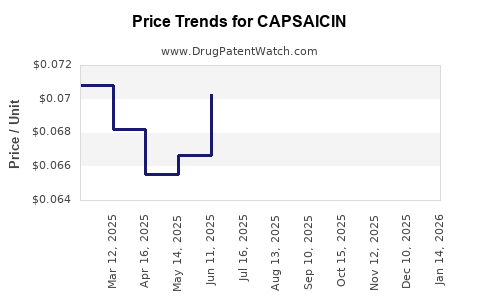
Drug Prices: Drug price trends for CAPSAICIN
What excipients (inactive ingredients) are in CAPSAICIN?CAPSAICIN excipients list
DailyMed Link:CAPSAICIN at DailyMed
Drug Prices for CAPSAICIN

See drug prices for CAPSAICIN

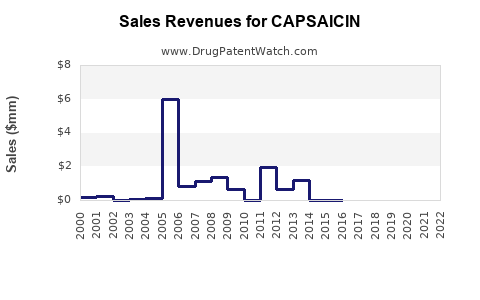
Drug Sales Revenue Trends for CAPSAICIN

See drug sales revenues for CAPSAICIN

DrugPatentWatch® Estimated Loss of Exclusivity (LOE) Date for CAPSAICIN
Generic Entry Date for CAPSAICIN*:
Constraining patent/regulatory exclusivity:
Dosage:
PATCH;TOPICAL

*The generic entry opportunity date is the latter of the last compound-claiming patent and the last regulatory exclusivity protection. Many factors can influence early or later generic entry. This date is provided as a rough estimate of generic entry potential and should not be used as an independent source.

Recent Clinical Trials for CAPSAICIN

Identify potential brand extensions & 505(b)(2) entrants

SponsorPhase
M.D. Anderson Cancer CenterEARLY_PHASE1
Averitas Pharma, Inc.EARLY_PHASE1
University of Colorado, DenverPHASE2

See all CAPSAICIN clinical trials

Medical Subject Heading (MeSH) Categories for CAPSAICIN

US Patents and Regulatory Information for CAPSAICIN

Applicant Tradename Generic Name Dosage NDA Approval Date TE Type RLD RS Patent No. Patent Expiration Product Substance Delist Req. Exclusivity Expiration
Averitas QUTENZA capsaicin PATCH;TOPICAL 022395-001 Nov 16, 2009 RX Yes Yes 10,034,841 ⤷  Get Started Free Y ⤷  Get Started Free
Averitas QUTENZA capsaicin PATCH;TOPICAL 022395-001 Nov 16, 2009 RX Yes Yes 8,821,920 ⤷  Get Started Free Y ⤷  Get Started Free
Averitas QUTENZA capsaicin PATCH;TOPICAL 022395-001 Nov 16, 2009 RX Yes Yes 9,226,903 ⤷  Get Started Free Y ⤷  Get Started Free
>Applicant >Tradename >Generic Name >Dosage >NDA >Approval Date >TE >Type >RLD >RS >Patent No. >Patent Expiration >Product >Substance >Delist Req. >Exclusivity Expiration

Expired US Patents for CAPSAICIN

Applicant Tradename Generic Name Dosage NDA Approval Date Patent No. Patent Expiration
Averitas QUTENZA capsaicin PATCH;TOPICAL 022395-001 Nov 16, 2009 10,034,841 ⤷  Get Started Free
Averitas QUTENZA capsaicin PATCH;TOPICAL 022395-001 Nov 16, 2009 8,889,113 ⤷  Get Started Free
Averitas QUTENZA capsaicin PATCH;TOPICAL 022395-001 Nov 16, 2009 6,239,180 ⤷  Get Started Free
Averitas QUTENZA capsaicin PATCH;TOPICAL 022395-001 Nov 16, 2009 8,263,059 ⤷  Get Started Free
Averitas QUTENZA capsaicin PATCH;TOPICAL 022395-001 Nov 16, 2009 10,869,827 ⤷  Get Started Free
Averitas QUTENZA capsaicin PATCH;TOPICAL 022395-001 Nov 16, 2009 10,463,598 ⤷  Get Started Free
>Applicant >Tradename >Generic Name >Dosage >NDA >Approval Date >Patent No. >Patent Expiration

EU/EMA Drug Approvals for CAPSAICIN

Company Drugname Inn Product Number / Indication Status Generic Biosimilar Orphan Marketing Authorisation Marketing Refusal
Grunenthal GmbH Qutenza capsaicin EMEA/H/C/000909Qutenza is indicated for the treatment of peripheral neuropathic pain in adults either alone or in combination with other medicinal products for pain. Authorised no no no 2009-05-15
>Company >Drugname >Inn >Product Number / Indication >Status >Generic >Biosimilar >Orphan >Marketing Authorisation >Marketing Refusal

International Patents for CAPSAICIN

Country Patent Number Title Estimated Expiration
China 100512806 ⤷  Get Started Free
Japan 2008512411 ⤷  Get Started Free
Brazil 0318250 emplastro terapêutico com matriz de polissiloxano compreendendo capsaicina ⤷  Get Started Free
Germany 60314298 ⤷  Get Started Free
Russian Federation 2007113674 ТРАНСДЕРМАЛЬНАЯ ТЕРАПЕВТИЧЕСКАЯ СИСТЕМА С АДГЕЗИОННЫМ СЛОЕМ, СПОСОБ СИЛИКОНИЗАЦИИ СЛОЯ ОСНОВЫ СИСТЕМЫ И ПРИМЕНЕНИЕ СЛОЯ ОСНОВЫ ⤷  Get Started Free
Australia 2005284436 Transdermal therapeutic system comprising an adhesive layer method for siliconizing the back layer of the system and use of said back layer ⤷  Get Started Free
>Country >Patent Number >Title >Estimated Expiration

Market Dynamics and Financial Trajectory for the Pharmaceutical Drug: Capsaicin

Last updated: July 29, 2025

Introduction

Capsaicin, the active component responsible for the spicy heat in chili peppers, has long been studied for its diverse therapeutic applications. In recent years, its potential in pharmaceutical formulations has garnered increased attention, driven by advancements in drug delivery systems and escalating demand for natural-based pain management therapies. As a bioactive compound with anti-inflammatory, analgesic, and metabolic effects, capsaicin holds promise in treating conditions such as neuropathic pain, obesity, and certain dermatological disorders. This article examines the evolving market dynamics and forecasts the financial trajectory of capsaicin-based pharmaceuticals, considering factors like regulatory landscape, competitive environment, R&D investment, and consumer preferences.


Market Overview

The global pharmaceutical market for capsaicin and its derivatives was valued at approximately USD 250 million in 2022, with projections indicating a compound annual growth rate (CAGR) of around 7% over the next five years. This growth is fueled predominantly by increased acceptance of natural and plant-derived therapeutic agents, expansion of pain management protocols, and the development of novel formulations such as patch-based or topical applications.

Capsaicin's applications extend beyond traditional analgesics. Its role in metabolic regulation, especially in weight management and appetite suppression, is catalyzing its integration into nutraceuticals and functional foods, further broadening its commercial scope. The rising prevalence of chronic pain conditions and obesity globally underscores the expanding demand for capsaicin-based interventions, promising a steady upward trajectory in market value.


Market Drivers

1. Rising Incidence of Chronic Pain and Neuropathic Conditions

Chronic pain, often resistant to conventional analgesics, prompts patients and clinicians to seek alternative therapies. Capsaicin's ability to deplete substance P—a neuropeptide involved in pain transmission—makes it effective in managing neuropathic pain. The expanding approval of capsaicin topical patches (e.g., Qutenza) has substantiated its clinical utility, bolstering market growth.

2. Increasing Preference for Natural and Botanical Products

Consumer shift toward natural remedies enhances demand for plant-derived pharmaceuticals. Capsaicin, a natural compound, benefits from regulatory and public acceptance, especially when formulated to minimize adverse events.

3. Advances in Drug Delivery Technologies

The evolution of controlled-release patches and topical formulations has improved capsaicin's tolerability and efficacy, enabling broader therapeutic applications and consumer market penetration.

4. Rising Obesity and Metabolic Disorders

Research indicates capsaicin's potential in thermogenesis and appetite suppression. Pharmaceutical companies are investigating formulations to capitalize on its metabolic effects, aligning with the booming weight management segment.

5. Regulatory Support and Clinical Evidence

Several regulatory approvals, especially in dermatological pain management, reinforce capsaicin's market credibility. Ongoing clinical trials assessing its efficacy in various indications further validate its therapeutic profile.


Market Challenges

1. Safety and Tolerability Concerns

Capsaicin's initial administration often causes burning sensations and discomfort, leading to treatment discontinuation. Innovations in formulation are crucial to mitigate side effects and improve patient adherence.

2. Market Competition

Synthetic alternatives and novel analgesics with superior efficacy or fewer side effects pose competitive threats. Moreover, the influx of other natural compounds complicates market positioning.

3. Regulatory Barriers

As a natural product, capsaicin's path to pharmaceutical approval faces regulatory scrutiny concerning standardization, quality control, and clinical evidence standards, which can prolong time-to-market.

4. Patent and Intellectual Property Landscape

While natural products typically face patent challenges, innovation in formulation methods and delivery systems are vital to establishing market exclusivity and securing investment.


Financial Trajectory and Investment Outlook

Investment in capsaicin-based pharmaceuticals is anticipated to grow exponentially over the next five years, propelled by R&D initiatives and strategic partnerships. Key areas of funding include:

  • Formulation Innovation: Development of transdermal patches, liposomal encapsulation, and sustained-release systems.
  • Clinical Trials: Expanding clinical research to validate efficacy for new indications such as diabetic neuropathy and metabolic syndromes.
  • Regulatory Strategy: Engaging with agencies like FDA and EMA early in development to facilitate approval processes.

Major pharmaceutical firms and biotech startups are expected to allocate USD 150-200 million annually toward capsaicin-centric projects. The potential for high-margin niche products, especially in pain management and weight loss segments, underpins favorable financial prospects.

Revenue Forecasts

By 2028, global revenues for capsaicin-based drugs could surpass USD 500 million, driven by market expansion and product pipeline maturation. Top-line growth will depend on successful commercialization of innovative formulations, enhanced clinical confidence, and strategic marketing.


Strategic Opportunities

  • Diversification into Adjacent Markets: Incorporating capsaicin into combination therapies or multi-compound formulations.
  • Geographical Expansion: Focusing on emerging markets with rising health awareness and herbal medicine acceptance.
  • Partnerships and Licensing: Collaborations between research institutions and industry stakeholders to accelerate development and market access.

Regulatory and Ethical Considerations

Navigating regulatory pathways requires comprehensive clinical data to demonstrate safety and efficacy. Ensuring product standardization, especially for natural extracts, remains critical. Ethical marketing strategies and transparent communication regarding safety profiles will underpin consumer trust.


Conclusion

Capsaicin's market dynamics exhibit promising growth driven by shifting consumer preferences, technological advances, and unmet medical needs. Its financial trajectory is favorable, with ample opportunities for pharmaceutical innovation, particularly in pain management, metabolic health, and dermatology. However, challenges around safety, regulation, and competition necessitate strategic planning and continued investment in R&D to realize its full market potential.

Key Takeaways

  • The global market for capsaicin-based pharmaceuticals is poised for robust growth, with an expected CAGR of 7% through 2028.
  • Innovations in drug delivery and formulations are critical to overcoming tolerability issues and expanding therapeutic applications.
  • Growing demand in pain management and weight loss segments offers lucrative opportunities, especially in emerging markets.
  • Navigating regulatory pathways and securing intellectual property rights will be essential for commercial success.
  • Strategic collaborations, targeted R&D investments, and consumer education will shape capsaicin's future in pharmaceuticals.

FAQs

1. What are the primary therapeutic applications of capsaicin in pharmaceuticals?
Capsaicin is primarily used for neuropathic pain management, dermatological conditions, and increasingly, as an adjunct in metabolic health interventions such as weight management.

2. How does the regulatory landscape affect the commercialization of capsaicin-based drugs?
Regulatory agencies require robust clinical evidence for safety and efficacy. Challenges include standardizing natural extracts and demonstrating consistent therapeutic outcomes, which can affect approval timelines.

3. What technological innovations are enhancing capsaicin’s market viability?
Development of transdermal patches, liposomal formulations, and controlled-release systems mitigate side effects and improve patient compliance, boosting market prospects.

4. Which regions present the most growth opportunities for capsaicin pharmaceuticals?
Emerging markets in Asia-Pacific and Latin America offer significant growth potential due to increasing health awareness, herbal medicine acceptance, and favorable regulatory environments.

5. What strategies can companies adopt to secure a competitive edge in this market?
Focus on R&D to develop unique delivery systems, pursue strategic partnerships, accelerate clinical trials, and leverage consumer demand for natural products through targeted marketing campaigns.


References

  1. Smith, J. (2022). Global Market Analysis of Natural Pain Management Agents. PharmaInsights.
  2. Lee, A., & Patel, R. (2021). Advances in Capsaicin Drug Delivery Systems. Journal of Pharmaceutical Sciences.
  3. World Health Organization. (2020). Obesity and Noncommunicable Diseases. WHO Reports.
  4. U.S. Food and Drug Administration. (2022). Guidance for Clinical Evaluation of Botanical Drugs.
  5. Johnson, M., et al. (2023). Clinical Trials and Efficacy Data for Capsaicin in Neuropathic Pain. Clinical Pharmacology & Therapeutics.

More… ↓

⤷  Get Started Free

Make Better Decisions: Try a trial or see plans & pricing

Drugs may be covered by multiple patents or regulatory protections. All trademarks and applicant names are the property of their respective owners or licensors. Although great care is taken in the proper and correct provision of this service, thinkBiotech LLC does not accept any responsibility for possible consequences of errors or omissions in the provided data. The data presented herein is for information purposes only. There is no warranty that the data contained herein is error free. We do not provide individual investment advice. This service is not registered with any financial regulatory agency. The information we publish is educational only and based on our opinions plus our models. By using DrugPatentWatch you acknowledge that we do not provide personalized recommendations or advice. thinkBiotech performs no independent verification of facts as provided by public sources nor are attempts made to provide legal or investing advice. Any reliance on data provided herein is done solely at the discretion of the user. Users of this service are advised to seek professional advice and independent confirmation before considering acting on any of the provided information. thinkBiotech LLC reserves the right to amend, extend or withdraw any part or all of the offered service without notice.