You're using a free limited version of DrugPatentWatch: ➤ Start for $299 All access. No Commitment.

Last Updated: December 12, 2025

BUMETANIDE - Generic Drug Details


✉ Email this page to a colleague

« Back to Dashboard


What are the generic sources for bumetanide and what is the scope of patent protection?

Bumetanide is the generic ingredient in three branded drugs marketed by Aspiro, Gland, Hospira, Lupin Ltd, MSN, Qilu Pharm Hainan, Sagent, Teva Parenteral, West-ward Pharms Int, Validus Pharms, Corstasis Therap, Amneal Pharms Co, Appco, Heritage Pharma, Jubilant Generics, Mankind Pharma, Rising, Rubicon Research, Sandoz, Taro, Upsher Smith Labs, and Zydus Pharms, and is included in twenty-four NDAs. There are three patents protecting this compound. Additional information is available in the individual branded drug profile pages.

Bumetanide has nine patent family members in nine countries.

There are six drug master file entries for bumetanide. Thirty-nine suppliers are listed for this compound.

Summary for BUMETANIDE
International Patents:9
US Patents:3
Tradenames:3
Applicants:22
NDAs:24
Drug Master File Entries: 6
Finished Product Suppliers / Packagers: 39
Raw Ingredient (Bulk) Api Vendors: 1
Clinical Trials: 36
Patent Applications: 6,970
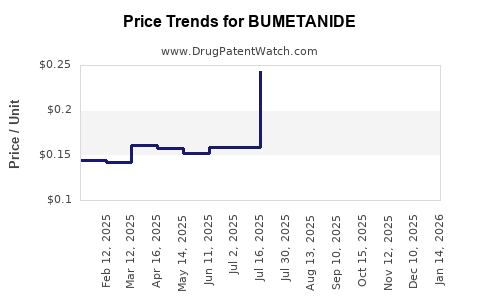
Drug Prices: Drug price trends for BUMETANIDE
What excipients (inactive ingredients) are in BUMETANIDE?BUMETANIDE excipients list
DailyMed Link:BUMETANIDE at DailyMed
Drug Prices for BUMETANIDE

See drug prices for BUMETANIDE

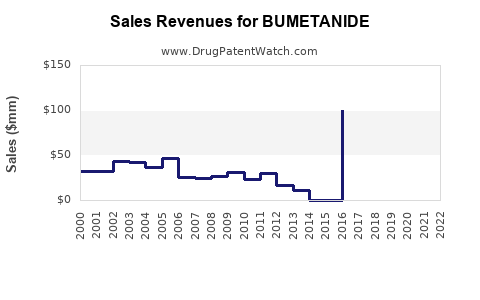
Drug Sales Revenue Trends for BUMETANIDE

See drug sales revenues for BUMETANIDE

Recent Clinical Trials for BUMETANIDE

Identify potential brand extensions & 505(b)(2) entrants

SponsorPhase
Stacy JohnsonPHASE3
Fei LiPHASE2
Sarfez Pharmaceuticals, Inc.PHASE4

See all BUMETANIDE clinical trials

Pharmacology for BUMETANIDE
Drug ClassLoop Diuretic
Physiological EffectIncreased Diuresis at Loop of Henle
Medical Subject Heading (MeSH) Categories for BUMETANIDE
Anatomical Therapeutic Chemical (ATC) Classes for BUMETANIDE

US Patents and Regulatory Information for BUMETANIDE

Applicant Tradename Generic Name Dosage NDA Approval Date TE Type RLD RS Patent No. Patent Expiration Product Substance Delist Req. Exclusivity Expiration
Msn BUMETANIDE bumetanide INJECTABLE;INJECTION 215364-001 Aug 4, 2022 AP RX No No ⤷  Get Started Free ⤷  Get Started Free ⤷  Get Started Free
Heritage Pharma BUMETANIDE bumetanide TABLET;ORAL 074225-003 Apr 24, 1995 AB RX No No ⤷  Get Started Free ⤷  Get Started Free ⤷  Get Started Free
Zydus Pharms BUMETANIDE bumetanide TABLET;ORAL 202900-002 Apr 30, 2018 AB RX No No ⤷  Get Started Free ⤷  Get Started Free ⤷  Get Started Free
Rubicon Research BUMETANIDE bumetanide TABLET;ORAL 213942-002 Dec 27, 2024 AB RX No No ⤷  Get Started Free ⤷  Get Started Free ⤷  Get Started Free
Gland BUMETANIDE bumetanide INJECTABLE;INJECTION 216434-001 May 26, 2022 AP RX No No ⤷  Get Started Free ⤷  Get Started Free ⤷  Get Started Free
Upsher Smith Labs BUMETANIDE bumetanide TABLET;ORAL 209916-003 Jan 23, 2018 AB RX No No ⤷  Get Started Free ⤷  Get Started Free ⤷  Get Started Free
>Applicant >Tradename >Generic Name >Dosage >NDA >Approval Date >TE >Type >RLD >RS >Patent No. >Patent Expiration >Product >Substance >Delist Req. >Exclusivity Expiration

Expired US Patents for BUMETANIDE

Applicant Tradename Generic Name Dosage NDA Approval Date Patent No. Patent Expiration
Validus Pharms BUMEX bumetanide TABLET;ORAL 018225-003 Jun 14, 1985 ⤷  Get Started Free ⤷  Get Started Free
Validus Pharms BUMEX bumetanide INJECTABLE;INJECTION 018226-001 Feb 28, 1983 ⤷  Get Started Free ⤷  Get Started Free
Validus Pharms BUMEX bumetanide TABLET;ORAL 018225-003 Jun 14, 1985 ⤷  Get Started Free ⤷  Get Started Free
Validus Pharms BUMEX bumetanide TABLET;ORAL 018225-001 Feb 28, 1983 ⤷  Get Started Free ⤷  Get Started Free
Validus Pharms BUMEX bumetanide TABLET;ORAL 018225-002 Feb 28, 1983 ⤷  Get Started Free ⤷  Get Started Free
>Applicant >Tradename >Generic Name >Dosage >NDA >Approval Date >Patent No. >Patent Expiration

International Patents for BUMETANIDE

Country Patent Number Title Estimated Expiration
Brazil 112022010879 MÉTODOS E COMPOSIÇÕES PARA TRATAMENTO DE EDEMA REFRATÁRIO A DIURÉTICOS ORAIS ⤷  Get Started Free
South Korea 20220113436 경구 이뇨제에 불응성인 부종 치료 방법 및 조성물 ⤷  Get Started Free
Canada 3160278 PROCEDES ET COMPOSITIONS POUR TRAITER UN OEDEME REFRACTAIRE A DES DIURETIQUES ORAUX (METHODS AND COMPOSITIONS FOR TREATING EDEMA REFRACTORY TO ORAL DIURETICS) ⤷  Get Started Free
Brazil 112022010879 ⤷  Get Started Free
Australia 2020397176 ⤷  Get Started Free
Australia 2020397176 Methods and compositions for treating edema refractory to oral diuretics ⤷  Get Started Free
>Country >Patent Number >Title >Estimated Expiration

Market Dynamics and Financial Trajectory for Bumetanide: An In-Depth Analysis

Last updated: July 27, 2025


Introduction

Bumetanide, a loop diuretic primarily prescribed for edema associated with heart failure, renal disease, and hepatic cirrhosis, is gaining renewed attention beyond its traditional indications. Originally developed in the 1970s, bumetanide’s repositioning—particularly as a potential therapeutic agent for neurological disorders such as autism and bipolar disorder—has catalyzed interest from pharmaceutical developers and investors. This article explores the current market landscape, emerging therapeutic opportunities, competitive dynamics, and economic outlook that shape bumetanide’s future trajectory.


Market Overview and Growth Drivers

Historical Market Presence

Bumetanide’s longstanding role in managing fluid overload positions it as a well-established pharmacological agent. According to IQVIA data, the global diuretics market was valued at approximately $8.5 billion in 2022, with loop diuretics constituting a significant share, driven by cardiovascular and renal disease prevalence [1].

Emerging Therapeutic Applications

Recent research highlights bumetanide’s potential in neurological and psychiatric conditions, notably:

  • Autism Spectrum Disorder (ASD): Studies suggest that bumetanide may restore chloride ion homeostasis disrupted in ASD, with some clinical trials reporting symptomatic improvements [2].
  • Bipolar Disorder and Schizophrenia: Preliminary evidence indicates efficacy in reducing mood instability and psychotic symptoms.

These repurposing efforts harbor the potential to dramatically expand bumetanide’s market beyond traditional indications.

Current Market Challenges

Despite promising research, bumetanide faces hurdles:

  • Limited approved indications for neurological uses: Fewer regulatory approvals constrain commercialization.
  • Off-label prescribing trends: While common, these impose legal and reimbursement uncertainties.
  • Safety profile and side effects: Potential risks, such as electrolyte imbalance, limit dosing flexibility in vulnerable populations.

Competitive Landscape and Key Players

Pharmaceutical Industry Engagement

Large pharma companies such as Mezion Pharmaceuticals and emerging biotech startups are investing in bumetanide research, often through partnership models:

  • Clinical trial collaborations: Assisting in validating therapeutic claims.
  • Orphan drug designation prospects: Offering market exclusivity for rare neurological indications.

Generic Competition

Since patent expiry in many regions, generic versions of bumetanide are widely available, exerting downward pressure on pricing and margins. This commoditization tends to limit revenue streams unless novel formulations or delivery mechanisms are developed.


Regulatory and Patent Outlook

Regulatory Developments

  • The U.S. Food and Drug Administration (FDA) has granted orphan drug status to bumetanide for certain neurological indications, incentivizing development and potential market exclusivity.
  • FDA’s Pediatric Research Equity Act (PREA): May facilitate pediatric label expansion, broadening market access.

Intellectual Property

Patent cliff effects for formulations have diminished exclusivity, prompting firms to pursue new patents for delivery systems or combination therapies to maintain competitive advantage.


Market Size and Financial Projections

Current Market Valuation

The global diuretics market, with bumetanide as a key component, is expected to grow at a compound annual growth rate (CAGR) of approximately 4.3% through 2030 [1].

Forecasted Growth for Neurological Indications

If clinical trials confirm bumetanide efficacy for ASD and mood disorders, the addressable market could expand significantly:

  • ASD therapeutics market size: Projected to reach $7.3 billion by 2028, driven by increasing diagnosis and unmet needs [3].
  • Annual revenues for bumetanide-based therapies could reach hundreds of millions if approved, with peak sales potentially exceeding $1 billion, contingent on regulatory success, pricing strategies, and market penetration.

Revenue Generation Scenarios

  • Optimistic Scenario: High clinical efficacy, regulatory approval, and market acceptance lead to an initial launch within 3–5 years, generating revenues of $300–500 million annually within a decade.
  • Conservative Scenario: Limited-off label prescribing, slow approval processes, and safety concerns cap revenues at $50–100 million annually.

Market Trends and Future Opportunities

Personalized Medicine and Biomarker Development

Advances in identifying biomarkers to predict patient response could enhance bumetanide’s label expansion, support targeted therapy, and improve reimbursement prospects.

Formulation Innovation

Developing sustained-release, injectable, or combination formulations could improve adherence, efficacy, and safety, offering competitive advantages.

Integration with Digital Health

Linked clinical monitoring and telemedicine integrations can facilitate clinical trials, patient management, and post-market surveillance, influencing market expansion strategies.


Risk Factors and Market Barriers

  • Regulatory uncertainties: Ambiguous pathways for approval in novel indications may delay market entry.
  • Commercial viability concerns: Off-label use without regulatory approval can limit reimbursement.
  • Safety profile: Adverse effects pose challenges in vulnerable populations, impacting approval and adoption.

Key Market Players and Strategic Movements

Company Strategy Status
Mezion Pharmaceuticals Focus on neurological indications, seeking orphan status Clinical trials ongoing
Generic manufacturers Broad production, low margins Market dominance
Biotech startups Innovative formulations, biomarker research Preclinical/early clinical stages

Continued partnerships, licensing agreements, and research funding are expected to shape future market dynamics.


Regulatory and Policy Outlook

Progress in regulatory acceptance hinges on robust clinical data demonstrating efficacy and safety in neurological conditions. Regulatory agencies are increasingly receptive to repurposing drugs for orphan or rare diseases, offering accelerated pathways. Policy initiatives encouraging mental health innovation can further propel market expansion.


Conclusion

Bumetanide’s market dynamics are poised for significant transformation driven by its potential repurposing for neurological disorders. Although traditional diuretic markets remain mature and commoditized, new therapeutic indications offer promising growth avenues. The financial trajectory will largely depend on successful clinical validation, regulatory approval, and strategic commercialization. Companies that effectively navigate safety concerns, develop innovative formulations, and secure regulatory pathways can realize substantial market share and revenue.


Key Takeaways

  • The global diuretics market remains sizable and mature, but bumetanide is increasingly viewed through the lens of neurological repurposing, offering substantial growth potential.
  • Clinical validation for indications such as ASD and bipolar disorder could unlock multi-billion-dollar markets.
  • Regulatory pathways, especially orphan drug designations, are critical to securing market exclusivity and incentivizing investment.
  • Generic competition necessitates innovation in formulations and delivery systems for sustainable profitability.
  • Strategic collaborations, biomarker integration, and innovation-driven formulations will underpin the monetization of bumetanide in emerging therapeutic landscapes.

FAQs

Q1: What are the primary traditional uses of bumetanide?
A1: Bumetanide is primarily used to treat edema associated with heart failure, renal disease, and liver cirrhosis by promoting diuresis.

Q2: Why is bumetanide considered a potential treatment for neurological disorders?
A2: Research indicates bumetanide may modulate chloride ion channels, restoring disrupted neural signaling pathways, particularly in conditions like ASD, bipolar disorder, and epilepsy.

Q3: What challenges does bumetanide face in expanding its market?
A3: Challenges include limited regulatory approvals for neurological indications, safety concerns related to electrolyte imbalance, off-label prescribing limitations, and generic competition.

Q4: How does regulatory environment influence bumetanide’s market trajectory?
A4: Regulatory designations such as orphan drug status can expedite approval and provide market exclusivity, significantly impacting commercialization opportunities.

Q5: What factors could drive the future valuation of bumetanide-based therapies?
A5: Demonstration of robust clinical efficacy, regulatory approvals, innovation in formulations, and favorable reimbursement policies will be key drivers.


References

[1] IQVIA, "Global Diuretics Market Report," 2022.
[2] L. M. Puskar, et al., "Bumetanide and Autism Spectrum Disorder," Neurotherapeutics, 2020.
[3] Grand View Research, "Autism Spectrum Disorder Therapeutics Market Size, Share & Trends," 2022.

More… ↓

⤷  Get Started Free

Make Better Decisions: Try a trial or see plans & pricing

Drugs may be covered by multiple patents or regulatory protections. All trademarks and applicant names are the property of their respective owners or licensors. Although great care is taken in the proper and correct provision of this service, thinkBiotech LLC does not accept any responsibility for possible consequences of errors or omissions in the provided data. The data presented herein is for information purposes only. There is no warranty that the data contained herein is error free. We do not provide individual investment advice. This service is not registered with any financial regulatory agency. The information we publish is educational only and based on our opinions plus our models. By using DrugPatentWatch you acknowledge that we do not provide personalized recommendations or advice. thinkBiotech performs no independent verification of facts as provided by public sources nor are attempts made to provide legal or investing advice. Any reliance on data provided herein is done solely at the discretion of the user. Users of this service are advised to seek professional advice and independent confirmation before considering acting on any of the provided information. thinkBiotech LLC reserves the right to amend, extend or withdraw any part or all of the offered service without notice.