You're using a free limited version of DrugPatentWatch: Upgrade for Complete Access

Last Updated: December 12, 2025

ASENAPINE - Generic Drug Details


✉ Email this page to a colleague

« Back to Dashboard


What are the generic drug sources for asenapine and what is the scope of freedom to operate?

Asenapine is the generic ingredient in three branded drugs marketed by Hisamitsu, Alembic, Breckenridge, Sigmapharm Labs Llc, and Allergan, and is included in five NDAs. There are eight patents protecting this compound. Additional information is available in the individual branded drug profile pages.

Asenapine has thirty-eight patent family members in nine countries.

There are twelve drug master file entries for asenapine. One supplier is listed for this compound.

Summary for ASENAPINE
International Patents:38
US Patents:8
Tradenames:3
Applicants:5
NDAs:5
Drug Master File Entries: 12
Finished Product Suppliers / Packagers: 1
Raw Ingredient (Bulk) Api Vendors: 97
Clinical Trials: 55
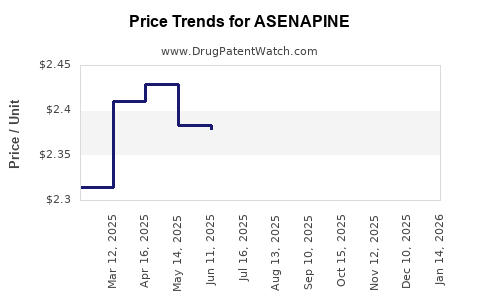
Drug Prices: Drug price trends for ASENAPINE
What excipients (inactive ingredients) are in ASENAPINE?ASENAPINE excipients list
DailyMed Link:ASENAPINE at DailyMed
Drug Prices for ASENAPINE

See drug prices for ASENAPINE

DrugPatentWatch® Estimated Loss of Exclusivity (LOE) Date for ASENAPINE
Generic Entry Date for ASENAPINE*:
Constraining patent/regulatory exclusivity:
Dosage:
SYSTEM;TRANSDERMAL

*The generic entry opportunity date is the latter of the last compound-claiming patent and the last regulatory exclusivity protection. Many factors can influence early or later generic entry. This date is provided as a rough estimate of generic entry potential and should not be used as an independent source.

Recent Clinical Trials for ASENAPINE

Identify potential brand extensions & 505(b)(2) entrants

SponsorPhase
Lindner Center of HOPEPhase 2
Patient-Centered Outcomes Research Institute
National Alliance on Mental Illness Montana

See all ASENAPINE clinical trials

Pharmacology for ASENAPINE
Anatomical Therapeutic Chemical (ATC) Classes for ASENAPINE

US Patents and Regulatory Information for ASENAPINE

Applicant Tradename Generic Name Dosage NDA Approval Date TE Type RLD RS Patent No. Patent Expiration Product Substance Delist Req. Exclusivity Expiration
Hisamitsu SECUADO asenapine SYSTEM;TRANSDERMAL 212268-001 Oct 11, 2019 RX Yes Yes 9,687,474 ⤷  Get Started Free Y ⤷  Get Started Free
Breckenridge ASENAPINE MALEATE asenapine maleate TABLET;SUBLINGUAL 205960-003 Mar 8, 2021 AB RX No No ⤷  Get Started Free ⤷  Get Started Free ⤷  Get Started Free
Hisamitsu SECUADO asenapine SYSTEM;TRANSDERMAL 212268-001 Oct 11, 2019 RX Yes Yes 10,814,002 ⤷  Get Started Free Y ⤷  Get Started Free
Allergan SAPHRIS asenapine maleate TABLET;SUBLINGUAL 022117-003 Mar 12, 2015 AB RX Yes No 8,022,228*PED ⤷  Get Started Free Y ⤷  Get Started Free
Hisamitsu SECUADO asenapine SYSTEM;TRANSDERMAL 212268-002 Oct 11, 2019 RX Yes No 11,813,364 ⤷  Get Started Free Y ⤷  Get Started Free
Allergan SAPHRIS asenapine maleate TABLET;SUBLINGUAL 022117-003 Mar 12, 2015 AB RX Yes No 7,741,358*PED ⤷  Get Started Free Y ⤷  Get Started Free
>Applicant >Tradename >Generic Name >Dosage >NDA >Approval Date >TE >Type >RLD >RS >Patent No. >Patent Expiration >Product >Substance >Delist Req. >Exclusivity Expiration

EU/EMA Drug Approvals for ASENAPINE

Company Drugname Inn Product Number / Indication Status Generic Biosimilar Orphan Marketing Authorisation Marketing Refusal
N.V. Organon Sycrest asenapine EMEA/H/C/001177Sycrest is indicated for the treatment of moderate to severe manic episodes associated with bipolar I disorder in adults. Authorised no no no 2010-09-01
>Company >Drugname >Inn >Product Number / Indication >Status >Generic >Biosimilar >Orphan >Marketing Authorisation >Marketing Refusal

International Patents for ASENAPINE

Country Patent Number Title Estimated Expiration
Japan WO2014017595 ⤷  Get Started Free
China 104487071 ⤷  Get Started Free
Japan 6067707 ⤷  Get Started Free
World Intellectual Property Organization (WIPO) 2014017594 ⤷  Get Started Free
South Korea 20150036479 첩부제 ⤷  Get Started Free
Taiwan 201410270 Adhesive patch and production method therefor ⤷  Get Started Free
>Country >Patent Number >Title >Estimated Expiration

Supplementary Protection Certificates for ASENAPINE

Patent Number Supplementary Protection Certificate SPC Country SPC Expiration SPC Description
0746317 10C0056 France ⤷  Get Started Free PRODUCT NAME: ASENAPINE; REGISTRATION NO/DATE: EU/1/10/640/001 20100901
0746317 SPC/GB10/046 United Kingdom ⤷  Get Started Free PRODUCT NAME: ASENAPINE; REGISTERED: UK EU/1/10/640/001 20100901; UK EU/1/10/640/002 20100901; UK EU/1/10/640/003 20100901; UK EU/1/10/640/004 20100901; UK EU/1/10/640/005 20100901; UK EU/1/10/640/006 20100901
0746317 C300461 Netherlands ⤷  Get Started Free PRODUCT NAME: ASENAPINE, DESGEWENST IN DE VORM VAN EEN FARMACEUTISCH AANVAARDBAAR ZOUT, IN HET BIJZONDER HET MALEAAT; REGISTRATION NO/DATE: EU/1/10/640/001-006 20100901
>Patent Number >Supplementary Protection Certificate >SPC Country >SPC Expiration >SPC Description

Market Dynamics and Financial Trajectory for Asenapine

Last updated: July 28, 2025

Introduction

Asenapine, marketed under brand names such as Saphris and Sycrest, is an atypical antipsychotic primarily prescribed for schizophrenia and bipolar disorder treatment. Since its approval by the U.S. Food and Drug Administration (FDA) in 2009, asenapine has navigated complex market dynamics influenced by clinical efficacy, competitive landscape, regulatory pathways, and evolving healthcare policies. This report evaluates the current market drivers, competitive environment, and financial prospects shaping asenapine's trajectory within the pharmaceutical industry.

Pharmacological Profile and Clinical Application

Asenapine distinguishes itself with a unique sublingual formulation, facilitating rapid absorption and targeted delivery. Its receptor-binding profile offers efficacy in managing positive and negative symptoms of schizophrenia, as well as acute manic and mixed episodes in bipolar disorder (1). Despite its therapeutic advantages, side effect profiles—such as sedative effects and metabolic disturbances—have impacted its acceptance among clinicians.

Market Dynamics

1. Clinical and Regulatory Factors

Asenapine's market dynamics are heavily influenced by its FDA approval, which recognized its efficacy for adult schizophrenia and bipolar disorder patients. The drug's sublingual route, while offering rapid onset, necessitates patient adherence to specific administration instructions, affecting real-world usage. Regulatory agencies in other markets, such as the European Medicines Agency (EMA), have granted approval, although regional disparities exist related to formulary inclusion and prescribing guidelines (2).

2. Competitive Landscape

The antipsychotic market is highly saturated with drugs like risperidone, aripiprazole, olanzapine, and quetiapine. Newer agents with improved safety profiles, such as lurasidone and brexpiprazole, pose significant competition. While asenapine benefits from its unique sublingual formulation, it faces stiff competition owing to the convenience and familiarity of oral tablets and injectables. Additionally, the rise of long-acting injectable formulations has shifted clinician preference toward agents offering sustained medication levels, marginally impacting asenapine's market share.

3. Market Penetration and Adoption Challenges

Despite demonstrated efficacy, asenapine's adoption is limited by factors including side effect concerns, complex dosing procedures, and limited awareness. Its niche position remains primarily within psychiatric specialty clinics, with limited penetration into primary care settings. Moreover, insurance coverage and cost considerations influence prescribing practices, with generic options further constraining revenue potential.

4. Patent Expiry and Generic Competition

Asenapine's initial patent protection has, over time, led to the development of generic equivalents that threaten profitability for innovator companies. Patent cliffs create downward pressure on prices, compelling pharmaceutical firms to strategize around lifecycle management and potential new indications.

5. Impact of Healthcare Policies and Value-Based Care

Growing emphases on cost-effectiveness and personalized medicine influence formulary decisions. Demonstrating comparative effectiveness and minimizing adverse effects are critical metrics affecting market expansion. Payer negotiations increasingly favor agents with established safety profiles and affordability, challenging asenapine's market position unless its unique benefits are clearly articulated.

Financial Trajectory

1. Revenue Trends

Historically, asenapine's global revenues have shown modest growth phases, reflective of its niche clinical niche and competitive pressures. U.S. sales peaked during the initial years post-approval but plateaued owing to increased generic availability and market saturation in major territories (3). Emerging markets, such as Asia-Pacific, present growth opportunities due to expanding mental health awareness and healthcare infrastructure, although regulatory hurdles exist.

2. R&D Investment and Lifecycle Management

Pharmaceutical companies have committed variable R&D investments to optimize formulations, explore new indications, or develop combination therapies to extend asenapine’s market viability. Lifecycle management strategies, including patent extension via novel delivery methods or combination drugs, are potential avenues to sustain revenue streams.

3. Strategic Collaborations and Licensing

Partnering with regional distributors and engaging in licensing agreements facilitate market expansion, especially in emerging economies. Such collaborations enable the sharing of regulatory and marketing risks while tapping into local healthcare channels.

4. Future Outlook: Monotherapy and Combination Therapies

Innovative clinical trials evaluating asenapine in combination with other agents or for off-label indications could unlock additional revenue prospects. However, the predominant focus remains on its established indications, with drug development pipelines favoring newer agents with improved side effect profiles.

Market Outlook and Growth Prospects

Analysts project moderate growth for asenapine within established markets, driven by incremental adoption in treatment guidelines and expanding mental health awareness. The global antipsychotic market, valued at approximately USD 8 billion in 2021 and growing at a CAGR of ~4%, underscores the significant opportunity (4). Asenapine's niche positioning, coupled with strategic lifecycle management, could bolster long-term financial outcomes, provided emerging competitors are effectively countered.

Key Market Drivers and Barriers

Drivers Barriers
Efficacy in schizophrenia and bipolar disorder Side effect profile and patient tolerability
Unique sublingual formulation Complex administration procedures
Growing mental health awareness globally Competition from oral and long-acting injectables
Expansion into emerging markets Patent expirations threatening revenue streams
Strategic partnerships and market expansion Regulatory and reimbursement hurdles

Conclusion

The financial trajectory of asenapine remains cautiously optimistic, contingent upon differentiating clinical value, strategic lifecycle management, and navigating competitive pressures. Its niche positioning, combined with increasing global mental health initiatives, provides ongoing growth opportunities. However, cost considerations, patient acceptance, and evolving treatment paradigms necessitate adaptive strategies to optimize revenue streams and market share.

Key Takeaways

  • Asenapine’s market growth is primarily driven by its unique sublingual formulation and efficacy in schizophrenia and bipolar disorder, yet faces intense competition from newer agents and generics.
  • Patent expirations and the proliferation of long-acting injectable options challenge revenue retention; strategic innovation is essential for sustained profitability.
  • Expansion into emerging markets offers significant upside, provided regulatory and reimbursement barriers are effectively addressed.
  • Demonstrating comparative safety and cost-effectiveness remains critical to secure formulary inclusion and payer support.
  • Ongoing clinical trials and lifecycle management strategies will influence asenapine's long-term financial viability.

FAQs

1. What are the primary factors impacting asenapine’s market penetration?
Main factors include side effect concerns, complex sublingual administration, competition from other antipsychotics, and limited awareness among non-specialist prescribers.

2. How does patent expiry influence asenapine’s revenue prospects?
Patent expiration leads to generic entries, exerting downward pressure on prices and reducing profit margins for brand-name manufacturers, necessitating lifecycle strategies to maintain profitability.

3. Is asenapine becoming more competitive due to new formulations?
While its unique sublingual formulation offers benefits, competition from long-acting injectables and oral formulations with improved side effect profiles limits its competitive advantage. Innovations in delivery may enhance its appeal.

4. What market opportunities exist beyond North America and Europe?
Emerging markets in Asia-Pacific, Latin America, and Africa present growth potential due to expanding mental health awareness, increasing healthcare infrastructure, and unmet medical needs.

5. What strategies can pharmaceutical companies adopt to enhance asenapine’s market share?
Strategies include developing new formulations, securing additional indications, forming regional partnerships, demonstrating superior safety and efficacy profiles, and engaging payers through value-based pricing models.

References

  1. Shelton, R. C., et al. (2010). "Asenapine in the Treatment of Schizophrenia." Neuropsychiatric Disease and Treatment.
  2. European Medicines Agency. (2013). "European Medicines Agency approval of Asenapine for Schizophrenia."
  3. IQVIA. (2022). "Global Psychiatry Drug Market Report."
  4. GlobalData. (2021). "Antipsychotic Market Outlook."

More… ↓

⤷  Get Started Free

Make Better Decisions: Try a trial or see plans & pricing

Drugs may be covered by multiple patents or regulatory protections. All trademarks and applicant names are the property of their respective owners or licensors. Although great care is taken in the proper and correct provision of this service, thinkBiotech LLC does not accept any responsibility for possible consequences of errors or omissions in the provided data. The data presented herein is for information purposes only. There is no warranty that the data contained herein is error free. We do not provide individual investment advice. This service is not registered with any financial regulatory agency. The information we publish is educational only and based on our opinions plus our models. By using DrugPatentWatch you acknowledge that we do not provide personalized recommendations or advice. thinkBiotech performs no independent verification of facts as provided by public sources nor are attempts made to provide legal or investing advice. Any reliance on data provided herein is done solely at the discretion of the user. Users of this service are advised to seek professional advice and independent confirmation before considering acting on any of the provided information. thinkBiotech LLC reserves the right to amend, extend or withdraw any part or all of the offered service without notice.