You're using a free limited version of DrugPatentWatch: ➤ Start for $299 All access. No Commitment.

Last Updated: December 19, 2025

TREMFYA Drug Profile


✉ Email this page to a colleague

« Back to Dashboard


Summary for Tradename: TREMFYA
Recent Clinical Trials for TREMFYA

Identify potential brand extensions & biosimilar entrants

SponsorPhase
University of PennsylvaniaPhase 3
Janssen Scientific Affairs, LLCPhase 3
Janssen Research & Development, LLCPhase 3

See all TREMFYA clinical trials

Pharmacology for TREMFYA
Mechanism of ActionInterleukin-23 Antagonists
Established Pharmacologic ClassInterleukin-23 Antagonist
Note on Biologic Patents

Matching patents to biologic drugs is far more complicated than for small-molecule drugs.

DrugPatentWatch employs three methods to identify biologic patents:

  1. Brand-side disclosures in response to biosimilar applications
  2. These patents were identified from disclosures by the brand-side company, in response to a potential biosimilar seeking to launch. They have a high certainty of blocking biosimilar entry. The expiration dates listed are not estimates — they're expiration dates as indicated by the brand-side company.

  3. DrugPatentWatch analysis and company disclosures
  4. These patents were identified from searching various sources, including drug labels and other general disclosures from the brand-side company. This list may exclude some of the patents which block biosimilar launch, and some of these patents listed may not actually block biosimilar launch. The expiration dates listed for these patents are estimates, based on the grant date of the patent.

  5. Patents from broad patent text search
  6. For completeness, these patents were identified by searching the patent literature for mentions of the branded or ingredient name of the drug. Some of these patents protect the original drug, whereas others may protect follow-on inventions or even inventions casually mentioning the drug. The expiration dates listed for these patents are estimates, based on the grant date of the patent.

1) High Certainty: US Patents for TREMFYA Derived from Brand-Side Litigation

No patents found based on brand-side litigation

2) High Certainty: US Patents for TREMFYA Derived from DrugPatentWatch Analysis and Company Disclosures

These patents were obtained from company disclosures
Applicant Tradename Biologic Ingredient Dosage Form BLA Patent No. Estimated Patent Expiration Source
Janssen Biotech, Inc. TREMFYA guselkumab Injection 761061 10,065,995 2032-03-26 DrugPatentWatch analysis and company disclosures
Janssen Biotech, Inc. TREMFYA guselkumab Injection 761061 10,155,823 2035-08-21 DrugPatentWatch analysis and company disclosures
Janssen Biotech, Inc. TREMFYA guselkumab Injection 761061 10,233,256 2035-11-25 DrugPatentWatch analysis and company disclosures
Janssen Biotech, Inc. TREMFYA guselkumab Injection 761061 10,233,257 2037-09-01 DrugPatentWatch analysis and company disclosures
Janssen Biotech, Inc. TREMFYA guselkumab Injection 761061 10,301,389 2033-06-13 DrugPatentWatch analysis and company disclosures
Janssen Biotech, Inc. TREMFYA guselkumab Injection 761061 10,301,390 2038-05-04 DrugPatentWatch analysis and company disclosures
>Applicant >Tradename >Biologic Ingredient >Dosage Form >BLA >Patent No. >Estimated Patent Expiration >Source

3) Low Certainty: US Patents for TREMFYA Derived from Patent Text Search

These patents were obtained by searching patent claims

Supplementary Protection Certificates for TREMFYA

Supplementary Protection Certificate SPC Country SPC Expiration SPC Description
LUC00071 Luxembourg ⤷  Get Started Free PRODUCT NAME: AN ANTIBODY COMPRISING A COMPLEMENTARY DETERMINING REGION LIGHT CHAIN 1 (CDRL1) AMINO ACID SEQUENCE OF SEQ ID NO:50, A CDRL2 AMINO ACID SEQUENCE OF SEQ ID NO:56, AND A CDRL3 AMINO ACID SEQUENCE OF SEQ ID NO:73, AND A COMPLEMENTARY DETERMINING REGION HEAVY CHAIN 1 (CDRH1) AMINO ACID SEQUENCE OF SEQ ID NO:5; A CDRH2 AMINO ACID SEQUENCE OF SEQ ID NO:20; AND A CDRH3 AMINO ACID SEQUENCE OF SEQ ID NO:44; SUCH AS AN ANTIBODY COMPRISING A LIGHT CHAIN VARIABLE REGION COMPRISING AN AMINO ACID SEQUENCE OF SEQ ID NO:116 AND A HEAVY CHAIN VARIABLE REGION COMPRISING AN AMINO ACID SEQUENCE OF SEQ ID NO: 106, IN PARTICULAR GUSELKUMAB; AUTHORISATION NUMBER AND DATE: EU/1/17/1234 20171114
796 Finland ⤷  Get Started Free
22C1019 France ⤷  Get Started Free PRODUCT NAME: ANIFROLUMAB; REGISTRATION NO/DATE: EU/1/21/1623 20220215
C01971366/01 Switzerland ⤷  Get Started Free PRODUCT NAME: GUSELKUMAB; REGISTRATION NO/DATE: SWISSMEDIC-ZULASSUNG 66583 13.06.2018
PA2022514 Lithuania ⤷  Get Started Free PRODUCT NAME: ANIFROLUMABAS; REGISTRATION NO/DATE: 1/21/1623 20220215
2022016 Norway ⤷  Get Started Free PRODUCT NAME: ANIFROLUMAB; REG. NO/DATE: EU/1/21/1623 20220221
>Supplementary Protection Certificate >SPC Country >SPC Expiration >SPC Description

Market Dynamics and Financial Trajectory for the Biologic Drug TREMFYA (Guselkumab)

Last updated: November 20, 2025

Introduction

TREMFYA (guselkumab) is a monoclonal antibody developed by Janssen Pharmaceuticals, targeting the p19 subunit of interleukin-23 (IL-23), a cytokine pivotal to the inflammatory process in several autoimmune conditions. Approved by the U.S. Food and Drug Administration (FDA) in July 2017 for the treatment of moderate to severe plaque psoriasis, TREMFYA has since expanded its indications to include psoriatic arthritis and Crohn's disease. Its market positioning, driven by innovative mechanism and strategic expansion, is instrumental in shaping its financial trajectory amid competitive dynamics in the biologics landscape.


Market Landscape and Drivers

Key Indications and Market Expansion

Initially marketed for moderate-to-severe plaque psoriasis, TREMFYA’s broader therapeutic scope includes psoriatic arthritis (approved in 2020) and Crohn's disease (approved in 2023). These extensions tap into sizable markets: psoriasis alone affects approximately 125 million globally, with around 7 million in the U.S. suffering from moderate to severe forms [2]. Psoriatic arthritis affects about 30% of psoriasis patients, and Crohn’s disease impacts over 3 million Americans [3].

The expansion into multiple autoimmune indications underpins its revenue potential—market exclusivity, increased prescription volume, and a diversified patient base bolster financial prospects.

Competitive Positioning

TREMFYA faces competition primarily from other IL-23 inhibitors like AbbVie's Skyrizi (risankizumab) and Takeda's Ilumya (tildrakizumab), as well as IL-17 inhibitors (e.g., Cosentyx, Secukinumab). While IL-23 inhibitors have shown superior efficacy and safety profiles in some comparisons, patent protections and clinical differentiation are critical for maintaining market share.

Moreover, the emerging biologic landscape is increasingly saturated, necessitating innovative marketing strategies, biomarker-driven personalized treatments, and favorable pricing to sustain growth.

Market Penetration and Adoption

As of 2023, TREMFYA holds a substantial share within the IL-23 class in the U.S. and Europe, leveraging Janssen’s extensive salesforce and targeted marketing campaigns. Its once-every-eight-week dosing offers convenience, a competitive advantage. Additionally, real-world data demonstrates high compliance, strengthening adoption among dermatologists and rheumatologists.


Financial Trajectory and Revenue Analysis

Historical Performance

Janssen reported that TREMFYA generated approximately $2.2 billion globally for the fiscal year 2022, representing a significant portion of the company’s immunology portfolio growth [1]. Sales surged nearly 25% YoY (year-over-year), driven by increased prescriptions, expanded indications, and geographic penetration.

Forecasted Growth

Industry analysts project sustained growth for TREMFYA, with estimates of reaching $3 billion globally by 2025. Key growth drivers include:

  • Expanded Indications: The Crohn's disease approval is expected to accelerate sales, particularly in gastroenterology markets where biologics are preferred over traditional therapies.
  • Increased Penetration: Emerging markets like Asia-Pacific offer high growth potential owing to the rising prevalence of autoimmune diseases and increasing healthcare access.
  • Pipeline Developments: Ongoing trials for additional indications, such as ulcerative colitis, could further augment revenue streams.

Pricing and Reimbursement Factors

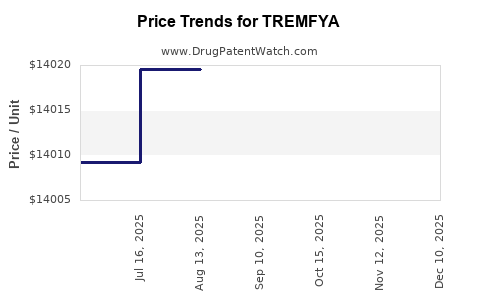
Pricing strategies remain competitive, with list prices around $70,000 annually in the U.S. for psoriasis, influenced by insurance negotiations, formulary placements, and biosimilar developments. Janssen’s partnerships with payers aim to ensure favorable coverage, although increased biosimilar competition in the IL-23 space could pressure prices.


Market Challenges and Risks

Competitive Pressures

The biologics market is characterized by fierce competition, patent cliffs, and evolving biosimilar entrants. The loss of exclusivity and entry of biosimilars similar to TREMFYA could erode market share and margins.

Regulatory and Developmental Risks

Approval processes for new indications involve substantial time and cost investments, with clinical trial outcomes influencing the product’s value trajectory. Regulatory hurdles and potential safety concerns, although currently minimal, remain inherent risks.

Patent Strategies and Intellectual Property

Janssen's focus on securing robust patent protections in key markets mitigates risks of biosimilar encroachment. Nonetheless, patent litigations and challenges remain ongoing, influencing long-term exclusivity.


Strategic Outlook

Janssen’s strategic focus on expanding TREMFYA’s therapeutic footprint, coupled with investment in real-world effectiveness research, aims to reinforce its market position. Developments in personalized medicine—such as biomarkers predicting response—may optimize patient selection and outcomes, driving sustained revenue.

The company's regional expansion efforts, clinical pipeline advancements, and competitive pricing will shape TREMFYA’s financial trajectory. The biologic’s success hinges not only on clinical efficacy but also on navigating competitive, regulatory, and reimbursement landscapes.


Key Takeaways

  • Robust Market Opportunity: The global autoimmune disease market's size and TREMFYA’s broadening indications position it for sustained growth, potentially surpassing $3 billion in annual revenue by 2025.
  • Competitive Advantage: Once-every-eight-week dosing, expanded indications, and Janssen’s extensive marketing support underpin its market share.
  • Risks and Challenges: Biosimilar competition, patent challenges, and market saturation pose ongoing threats; strategic patent protection and pipeline developments are crucial.
  • Geographic Expansion: High-growth regions provide significant avenues for future revenue, contingent on regulatory approvals and healthcare infrastructure.
  • Innovation and Personalization: Future success depends on clinical differentiation through personalized therapies, improving efficacy and reducing costs for patients and payers.

FAQs

1. How does TREMFYA compare to other IL-23 inhibitors in terms of efficacy?
TREMFYA demonstrates comparable or superior efficacy in clinical trials for plaque psoriasis and psoriatic arthritis, with high rates of skin clearance and symptom improvement. It distinguishes itself with a favorable safety profile and infrequent dosing schedule, which enhances patient adherence.

2. What is TREMFYA’s current patent protection status?
Janssen secured patent protections through various filings across markets extending into the late 2020s to early 2030s. However, patent challenges and biosimilar entries are ongoing risks that may influence future exclusivity.

3. How significant is the Crohn’s disease indication for TREMFYA’s market prospects?
The Crohn's disease approval broadens TREMFYA's therapeutic reach into a large and unmet market segment. Early data suggest promising efficacy, but real-world adoption will depend on comparative effectiveness against existing biologics and the management of safety profiles.

4. What are the main barriers for TREMFYA’s international expansion?
Regulatory approvals, local healthcare policies, reimbursement frameworks, and biosimilar competition are significant barriers. Additionally, differences in treatment paradigms and healthcare infrastructure influence market penetration.

5. How might biosimilars impact TREMFYA’s financials?
Although biosimilars in the IL-23 class are still emerging, their entry can lead to price erosion and market share redistribution. Janssen’s patent protections and focus on unique clinical differentiation aim to mitigate these impacts.


Sources

[1] Janssen Pharmaceuticals. "2022 Annual Report." 2023.
[2] Global Psoriasis Market Report, 2023.
[3] American Gastroenterological Association. "Crohn’s Disease Statistics," 2023.

More… ↓

⤷  Get Started Free

Make Better Decisions: Try a trial or see plans & pricing

Drugs may be covered by multiple patents or regulatory protections. All trademarks and applicant names are the property of their respective owners or licensors. Although great care is taken in the proper and correct provision of this service, thinkBiotech LLC does not accept any responsibility for possible consequences of errors or omissions in the provided data. The data presented herein is for information purposes only. There is no warranty that the data contained herein is error free. We do not provide individual investment advice. This service is not registered with any financial regulatory agency. The information we publish is educational only and based on our opinions plus our models. By using DrugPatentWatch you acknowledge that we do not provide personalized recommendations or advice. thinkBiotech performs no independent verification of facts as provided by public sources nor are attempts made to provide legal or investing advice. Any reliance on data provided herein is done solely at the discretion of the user. Users of this service are advised to seek professional advice and independent confirmation before considering acting on any of the provided information. thinkBiotech LLC reserves the right to amend, extend or withdraw any part or all of the offered service without notice.