You're using a free limited version of DrugPatentWatch: Upgrade for Complete Access

Last Updated: December 18, 2025

STELARA Drug Profile


✉ Email this page to a colleague

« Back to Dashboard


Summary for Tradename: STELARA
Recent Clinical Trials for STELARA

Identify potential brand extensions & biosimilar entrants

SponsorPhase
Biocon Biologics UK LtdPHASE1
Teva takedaPhase 4
RANI TherapeuticsPhase 1

See all STELARA clinical trials

Pharmacology for STELARA
Note on Biologic Patents

Matching patents to biologic drugs is far more complicated than for small-molecule drugs.

DrugPatentWatch employs three methods to identify biologic patents:

  1. Brand-side disclosures in response to biosimilar applications
  2. These patents were identified from disclosures by the brand-side company, in response to a potential biosimilar seeking to launch. They have a high certainty of blocking biosimilar entry. The expiration dates listed are not estimates — they're expiration dates as indicated by the brand-side company.

  3. DrugPatentWatch analysis and company disclosures
  4. These patents were identified from searching various sources, including drug labels and other general disclosures from the brand-side company. This list may exclude some of the patents which block biosimilar launch, and some of these patents listed may not actually block biosimilar launch. The expiration dates listed for these patents are estimates, based on the grant date of the patent.

  5. Patents from broad patent text search
  6. For completeness, these patents were identified by searching the patent literature for mentions of the branded or ingredient name of the drug. Some of these patents protect the original drug, whereas others may protect follow-on inventions or even inventions casually mentioning the drug. The expiration dates listed for these patents are estimates, based on the grant date of the patent.

1) High Certainty: US Patents for STELARA Derived from Brand-Side Litigation

No patents found based on brand-side litigation

2) High Certainty: US Patents for STELARA Derived from DrugPatentWatch Analysis and Company Disclosures

These patents were obtained from company disclosures
Applicant Tradename Biologic Ingredient Dosage Form BLA Patent No. Estimated Patent Expiration Source
Janssen Biotech, Inc. STELARA ustekinumab Injection 125261 10,065,007 2031-03-18 DrugPatentWatch analysis and company disclosures
Janssen Biotech, Inc. STELARA ustekinumab Injection 125261 10,099,039 2036-11-17 DrugPatentWatch analysis and company disclosures
Janssen Biotech, Inc. STELARA ustekinumab Injection 125261 10,155,018 2037-07-06 DrugPatentWatch analysis and company disclosures
Janssen Biotech, Inc. STELARA ustekinumab Injection 125261 10,232,014 2037-06-05 DrugPatentWatch analysis and company disclosures
>Applicant >Tradename >Biologic Ingredient >Dosage Form >BLA >Patent No. >Estimated Patent Expiration >Source

3) Low Certainty: US Patents for STELARA Derived from Patent Text Search

These patents were obtained by searching patent claims

Supplementary Protection Certificates for STELARA

Supplementary Protection Certificate SPC Country SPC Expiration SPC Description
C 2018 017 Romania ⤷  Get Started Free PRODUCT NAME: GUSELKUMAB; NATIONAL AUTHORISATION NUMBER: EU/1/17/1234; DATE OF NATIONAL AUTHORISATION: 20171110; NUMBER OF FIRST AUTHORISATION IN EUROPEAN ECONOMIC AREA (EEA): EU/1/17/1234; DATE OF FIRST AUTHORISATION IN EEA: 20171110
SPC/GB18/017 United Kingdom ⤷  Get Started Free PRODUCT NAME: GUSELKUMAB; REGISTERED: UK EU/1/17/1234 (NI) 20171114; UK PLGB 00242/0665 20171114
PA2018010,C1971366 Lithuania ⤷  Get Started Free PRODUCT NAME: GUSELKUMABAS; REGISTRATION NO/DATE: EU/1/17/1234 20171110
PA2018010 Lithuania ⤷  Get Started Free PRODUCT NAME: ANTIKUNAS, APIMANTIS CDRL1 SEKA NR. 50; CDRL2 SEKA NR. 56; IR CDRL3 SEKA NR. 73; IR CDRH1 SEKA NR.5; CDRH2 SEKA NR. 20; CDRH3 SEKA NR. 44; ANTIKUNAS, AB APIMANTIS L GRANDINES VD SEKA NR. 116 IR H GRANDINES VD SEKA NR. 106, YPAC GUSELKUMABAS; REGISTRATION NO/DATE: EU/1/17/1234 20171114
>Supplementary Protection Certificate >SPC Country >SPC Expiration >SPC Description

Market Dynamics and Financial Trajectory for the Biologic Drug: STELARA

Last updated: November 7, 2025


Introduction

STELARA (ustekinumab), a monoclonal antibody developed by Janssen Pharmaceuticals, stands as a pivotal player in the biologic therapeutics landscape. Approved by the U.S. Food and Drug Administration (FDA) in 2009 for moderate-to-severe plaque psoriasis, its indications have since expanded, impacting inflammatory diseases such as Crohn’s disease, psoriatic arthritis, and ulcerative colitis. This analysis explores the evolving market dynamics and projected financial trajectory for STELARA, considering clinical, regulatory, competitive, and market access factors shaping its future.


Market Overview and Therapeutic Indications

STELARA's success hinges on its innovative mechanism targeting the interleukins IL-12 and IL-23 pathways, critical mediators in immune-mediated conditions. Since its launch, it has established a strong foothold in the biologics segment with annual sales surpassing $3 billion globally by 2022 [1].

Initially approved for psoriasis, its indications expanded to include Crohn’s disease (2016), psoriatic arthritis (2013), and ulcerative colitis (2021). These extensions have amplified its market potential, especially as biologics continue to be the preferred therapy for patients unresponsive to conventional treatments.


Market Dynamics

1. Competitive Landscape

STELARA operates amidst a highly competitive biologics market, featuring rivals like Humira (adalimumab), Cosentyx (secukinumab), and Skyrizi (risankizumab). While Humira historically dominated due to first-mover advantage, biosimilar erosion and the emergence of more targeted agents have shifted market share.

The recent entry of IL-23 inhibitors like Skyrizi and Tremfya (guselkumab) intensifies competition, especially in psoriasis and Crohn’s disease segments. Nevertheless, STELARA maintains distinct positioning owing to its unique dual cytokine blockade, offering efficacy in patient subsets less responsive to other agents [2].

2. Physician and Patient Adoption

Prescriber confidence in STELARA's long-term safety profile and efficacy influences adoption. Its dosing convenience and evidence-backed remission rates have supported sustained growth. The expansion into ulcerative colitis, endorsed by positive phase III trial outcomes, is projected to catalyze clinical uptake, especially as treatment algorithms favor biologics with proven cytokine targeting [3].

3. Regulatory Environment

Regulatory approvals and label expansions significantly impact market size. The recent FDA approval for ulcerative colitis amplifies opportunities in this field. Future submissions for indications like hidradenitis suppurativa or other inflammatory conditions could further broaden its scope.

4. Pricing and Reimbursement

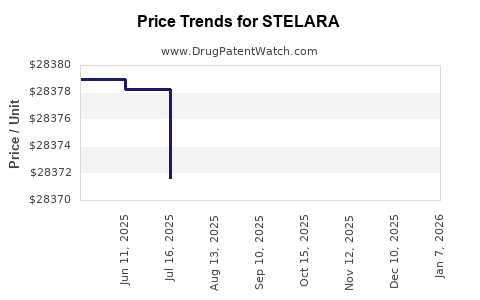
Pricing strategies impact revenue generation amid increasing pressure to reduce drug costs. STELARA's premium pricing faces challenges from biosimilars and the push for value-based reimbursement. However, disease severity and limited alternatives sustain its premium status in select markets.

5. Market Penetration and Access

Market penetration varies across geographies, shaped by healthcare infrastructure, approval timelines, and local pricing policies. While North America and Europe remain primary markets, emerging economies present growth opportunities, contingent upon pricing negotiation and healthcare expenditure policies.


Financial Trajectory Forecast

1. Revenue Trends

STELARA’s sales are projected to grow modestly, driven primarily by indication expansion and increasing treatment penetration. Analysts forecast a compound annual growth rate (CAGR) of approximately 4-6% over the next five years, assuming continued adoption of ulcerative colitis indications and incremental uptake in Crohn’s disease and psoriatic arthritis [4].

2. Impact of Patent Expiry and Biosimilars

While STELARA’s primary patent in the U.S. expired in 2019, biological manufacturing complexities and brand loyalty sustain revenue. Nonetheless, biosimilar competition in other regions threatens market share erosion, whereas in the U.S., patent protections, or potential exclusivity extensions due to formulation changes, could prolong premium performance [5].

3. Cost of Goods and Revenue Generation

As a biologic, manufacturing and cold-chain logistics impact costs. Economies of scale and process optimizations are expected to improve margins marginally, supporting profitability even amid rising competition.

4. R&D and Pipeline Contributions

Janssen’s ongoing pipeline development, including biosimilars and next-generation cytokine inhibitors, could influence STELARA’s long-term financials. Lifecycle management strategies, such as developing subcutaneous formulations or fixed-dose combinations, aim to enhance patient compliance and adherence, positively impacting revenues.


Market Opportunities and Challenges

Opportunities

  • Indication Expansion: Securing approval in additional inflammatory diseases could substantially increase market size.
  • Biomarker-Driven Personalization: Advances in patient stratification promise to optimize outcomes, supporting premium positioning.
  • Digital Health and Patient Support Programs: These initiatives can improve adherence, leading to better long-term outcomes and sustained revenues.

Challenges

  • Biosimilar Competition: Particularly in Europe, biosimilars threaten to diminish STELARA’s market share.
  • Pricing Pressures: Payer resistance and political debates over drug pricing could restrict revenue growth.
  • Market Saturation: In developed markets, penetration rates approach saturation, limiting upside potential.

Strategic Outlook

The outlook for STELARA hinges on its ability to sustain competitive differentiation through clinical efficacy, safety, and strategic indication expansion. Close monitoring of biosimilar evolution, payer strategies, and regulatory developments is vital. Partnering with healthcare providers to demonstrate value through real-world evidence can reinforce its market presence.

Furthermore, advancements in immunology and cytokine biology may spawn next-generation biologics that challenge or complement STELARA’s position. Therefore, maintaining investment in innovation and lifecycle management remains critical for stakeholders.


Key Takeaways

  • Market Position: STELARA maintains a strong position within inflammatory disease biologics, supported by ongoing indication expansions and robust efficacy data.
  • Growth Outlook: Anticipated CAGR of 4-6% over five years, driven by expanding FDA labels and ongoing market adoption.
  • Competitive Risks: Biosimilar entry, pricing pressures, and emerging competitors pose challenges; differentiating clinical benefits and strategic expansion are critical.
  • Financial Strategy: Sustained revenue growth relies on innovation, indication diversification, and global access strategies.
  • Long-Term Potential: Continuous development of next-generation biologics and personalized medicine approaches could sustain or enhance STELARA’s market longevity.

FAQs

1. How does STELARA differentiate itself from other biologics in its class?
STELARA targets both IL-12 and IL-23 cytokines, providing a broader immunomodulatory approach compared to agents that inhibit only IL-23, potentially offering efficacy in different patient subsets.

2. What are the primary drivers of STELARA’s revenue growth?
Indication expansion, increased adoption in ulcerative colitis, and higher adherence rates contribute to its revenue growth, with ongoing market penetration in emerging economies also playing a role.

3. How will biosimilar entry affect STELARA’s market share?
Though biosimilars pose a threat, especially outside the U.S., patent protections and brand loyalty help preserve its market share in key regions. Nonetheless, biosimilar competition will likely lead to price concessions and market erosion over time.

4. What regulatory milestones are expected to influence its trajectory?
Approval for additional indications and potential formulations, along with post-marketing safety data, could reinforce its market position and drive sales.

5. What strategic actions should stakeholders prioritize?
Investing in life-cycle management, real-world evidence collection, and global access initiatives will be essential to sustain competitiveness amid evolving market dynamics.


Sources:
[1] Janssen Pharmaceuticals, STELARA Sales Data, 2022.
[2] Clinical trial reports and comparative efficacy studies on IL-12/23 inhibitors.
[3] FDA approvals and label expansions, 2021–2022.
[4] Market Analytics Firms, Biologic Market Forecasts, 2023–2028.
[5] Industry reports on biosimilar competition and patent landscapes.

More… ↓

⤷  Get Started Free

Make Better Decisions: Try a trial or see plans & pricing

Drugs may be covered by multiple patents or regulatory protections. All trademarks and applicant names are the property of their respective owners or licensors. Although great care is taken in the proper and correct provision of this service, thinkBiotech LLC does not accept any responsibility for possible consequences of errors or omissions in the provided data. The data presented herein is for information purposes only. There is no warranty that the data contained herein is error free. We do not provide individual investment advice. This service is not registered with any financial regulatory agency. The information we publish is educational only and based on our opinions plus our models. By using DrugPatentWatch you acknowledge that we do not provide personalized recommendations or advice. thinkBiotech performs no independent verification of facts as provided by public sources nor are attempts made to provide legal or investing advice. Any reliance on data provided herein is done solely at the discretion of the user. Users of this service are advised to seek professional advice and independent confirmation before considering acting on any of the provided information. thinkBiotech LLC reserves the right to amend, extend or withdraw any part or all of the offered service without notice.