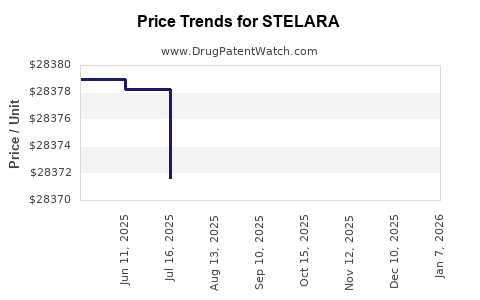
Last Updated: May 11, 2026

STELARA Drug Profile


✉ Email this page to a colleague

« Back to Dashboard


Summary for Tradename: STELARA
Recent Clinical Trials for STELARA

Identify potential brand extensions & biosimilar entrants

SponsorPhase
Biocon Biologics UK LtdPHASE1
Teva takedaPhase 4
RANI TherapeuticsPhase 1

See all STELARA clinical trials

Pharmacology for STELARA
Note on Biologic Patents

Matching patents to biologic drugs is far more complicated than for small-molecule drugs.

DrugPatentWatch employs three methods to identify biologic patents:

  1. Brand-side disclosures in response to biosimilar applications
  2. These patents were identified from disclosures by the brand-side company, in response to a potential biosimilar seeking to launch. They have a high certainty of blocking biosimilar entry. The expiration dates listed are not estimates — they're expiration dates as indicated by the brand-side company.

  3. DrugPatentWatch analysis and company disclosures
  4. These patents were identified from searching various sources, including drug labels and other general disclosures from the brand-side company. This list may exclude some of the patents which block biosimilar launch, and some of these patents listed may not actually block biosimilar launch. The expiration dates listed for these patents are estimates, based on the grant date of the patent.

  5. Patents from broad patent text search
  6. For completeness, these patents were identified by searching the patent literature for mentions of the branded or ingredient name of the drug. Some of these patents protect the original drug, whereas others may protect follow-on inventions or even inventions casually mentioning the drug. The expiration dates listed for these patents are estimates, based on the grant date of the patent.

1) High Certainty: US Patents for STELARA Derived from Brand-Side Litigation

No patents found based on brand-side litigation

2) High Certainty: US Patents for STELARA Derived from DrugPatentWatch Analysis and Company Disclosures

These patents were obtained from company disclosures
Applicant Tradename Biologic Ingredient Dosage Form BLA Patent No. Estimated Patent Expiration Source
Janssen Biotech, Inc. STELARA ustekinumab Injection 125261 ⤷  Start Trial 2031-03-18 DrugPatentWatch analysis and company disclosures
Janssen Biotech, Inc. STELARA ustekinumab Injection 125261 ⤷  Start Trial 2036-11-17 DrugPatentWatch analysis and company disclosures
Janssen Biotech, Inc. STELARA ustekinumab Injection 125261 ⤷  Start Trial 2037-07-06 DrugPatentWatch analysis and company disclosures
Janssen Biotech, Inc. STELARA ustekinumab Injection 125261 ⤷  Start Trial 2037-06-05 DrugPatentWatch analysis and company disclosures
Janssen Biotech, Inc. STELARA ustekinumab Injection 125261 ⤷  Start Trial 2037-07-24 DrugPatentWatch analysis and company disclosures
Janssen Biotech, Inc. STELARA ustekinumab Injection 125261 ⤷  Start Trial 2038-06-29 DrugPatentWatch analysis and company disclosures
>Applicant >Tradename >Biologic Ingredient >Dosage Form >BLA >Patent No. >Estimated Patent Expiration >Source

3) Low Certainty: US Patents for STELARA Derived from Patent Text Search

These patents were obtained by searching patent claims

Supplementary Protection Certificates for STELARA

Supplementary Protection Certificate SPC Country SPC Expiration SPC Description
PA2018010 Lithuania ⤷  Start Trial PRODUCT NAME: ANTIKUNAS, APIMANTIS CDRL1 SEKA NR. 50; CDRL2 SEKA NR. 56; IR CDRL3 SEKA NR. 73; IR CDRH1 SEKA NR.5; CDRH2 SEKA NR. 20; CDRH3 SEKA NR. 44; ANTIKUNAS, AB APIMANTIS L GRANDINES VD SEKA NR. 116 IR H GRANDINES VD SEKA NR. 106, YPAC GUSELKUMABAS; REGISTRATION NO/DATE: EU/1/17/1234 20171114
2018C/019 Belgium ⤷  Start Trial PRODUCT NAME: TREMFYA; AUTHORISATION NUMBER AND DATE: EU/1/17/1234 20171114
300935 Netherlands ⤷  Start Trial PRODUCT NAME: GUSELKUMAB; REGISTRATION NO/DATE: EU/1/17/1234 20171114
16/2018 Austria ⤷  Start Trial PRODUCT NAME: GUSELKUMAB; REGISTRATION NO/DATE: EU/1/17/1234 (MITTEILUNG) 20171114
PA2018010,C1971366 Lithuania ⤷  Start Trial PRODUCT NAME: GUSELKUMABAS; REGISTRATION NO/DATE: EU/1/17/1234 20171110
2018/018 Ireland ⤷  Start Trial PRODUCT NAME: GUSELKUMAB; REGISTRATION NO/DATE: EU/1/17/1234 20171114
>Supplementary Protection Certificate >SPC Country >SPC Expiration >SPC Description

STELARA (ustekinumab): Market Dynamics and Financial Trajectory

Last updated: April 24, 2026

How is STELARA positioned across indications and routes of administration?

STELARA is a biologic (ustekinumab) used for immune-mediated inflammatory diseases. Its commercial footprint spans multiple therapeutic areas, with label expansion in inflammatory bowel disease and psoriasis driving the mid-to-late product life cycle. Key marketed forms include subcutaneous (SC) dosing and intravenous (IV) induction for certain indications, which supports broader payer and site-of-care coverage decisions.

Core indication footprint (commercial relevance)

Indication Typical market impact driver Commercial implication
Plaque psoriasis (PsO) Historical base revenue Sustained demand from established patient base and payer familiarity
Psoriatic arthritis (PsA) Expansion engine post-psoriasis Uses separate reimbursement pathways, improving total addressable revenue
Crohn’s disease (CD) IBD growth engine Induction and maintenance dosing creates stickiness through chronic therapy
Ulcerative colitis (UC) Higher growth potential within IBD Broadens prescriber pool and patient funnel

What market dynamics shape uptake, retention, and pricing power?

STELARA competes in categories with high biologic intensity, which compresses net price and increases competitive churn risk. Market dynamics fall into five structural buckets.

1) Competitive intensity is persistent

STELARA’s primary competitors include TNF inhibitors, anti-integrins (e.g., vedolizumab), IL-17 pathway agents, and other biologics across PsO, PsA, and IBD. Competitive pressure affects:

  • Switching behavior after inadequate response
  • Payer tiering and formulary placement
  • Utilization management (step edits, prior authorization)

2) Immunology pathway breadth affects line-of-therapy placement

STELARA’s IL-12/23 mechanism positions it differently from TNF and IL-17 classes. That can support durable use in patients who failed other mechanisms, but it does not prevent payer “algorithmization” of therapy selection.

3) IBD induction mechanics increase early-cycle lock-in

For CD and UC, induction dosing followed by maintenance supports treatment continuity. That tends to:

  • Reduce “time to persistence” once induction is accepted
  • Increase switching friction because clinicians face a stable maintenance regimen

4) Site-of-care and administration logistics matter

SC administration supports convenience and outpatient continuity. Where IV induction is required, infusion center access and payer authorization influence the patient pathway.

5) Biosimilar risk changes the economics of the class, not just the drug

As biologics age, biosimilar entry generally compresses price across the class. Even when a product remains formulary-relevant, net price can decline as alternatives proliferate and pharmacy benefit leverage increases.

What is STELARA’s financial trajectory and what does it imply for future revenue?

STELARA’s financial trajectory has followed a broad late-cycle pattern: strong historical growth driven by label expansion, then deceleration as competition rises and as net price pressures intensify. While the exact revenue curve depends on period and country mix, the direction is consistent across company reporting: the drug remains a major revenue contributor but faces declining growth rates and margin pressure as the therapeutic landscape matures.

Revenue behavior drivers (what moves the P&L)

Revenue line component Primary drivers impacting STELARA
Unit demand Patient growth in PsA and IBD, offset by competition and switching
Net price Contraction from formulary pressure, rebates, and biosimilar dynamics in later life cycle
Mix IBD vs PsO shift and dosing schedule changes
Market access Geographic differences in payer policy and authorization regimes

Takeaway on the trajectory

The financial story for STELARA is that it continues to generate substantial sales, supported by chronic indication use and ongoing label relevance. The slope of growth flattens as competitive intensity increases and as price leverage erodes. That puts the drug into a “large but pressured” revenue profile rather than a high-growth phase.

How do payer and channel mechanics influence STELARA’s net sales path?

STELARA’s commercial performance is highly sensitive to net price and utilization management.

Payer behavior patterns seen in biologics

  • Formulary placement: preferred status can shift as competitors add safety, efficacy, or cost advantages.
  • Prior authorization: requirements can increase time-to-start, especially when patients move between insurers.
  • Step therapy: payers often enforce trials of lower-cost biologics or non-biologics before approving IL-12/23 therapy in certain scenarios.
  • Rebate pressure: high biologic spend enables larger rebate negotiations, which affects net revenue more than gross price.

Channel and contracting effects

  • Institutional contracting for infusion and specialty pharmacy distribution impacts net economics.
  • Geography changes the competitive roster and thus the bargaining position of the innovator.

What are the implications for R&D and investment planning?

For decision-making, STELARA’s market dynamics translate into clear R&D and portfolio implications.

Portfolio decisions

  1. Defend chronic access in IBD
    • Maintenance-based continuity supports resistance to rapid churn.
  2. Prepare for price normalization
    • Expect ongoing net price erosion as competition expands and reference product pressure rises.
  3. Watch sequencing trends
    • Patients who fail first-line biologics represent both a retention opportunity and a switching risk when alternative pathways improve.

R&D execution priorities (pragmatic)

  • Higher-efficacy differentiators in head-to-head or comparative-effectiveness positioning
  • Administration advantages (SC convenience, reduced monitoring burden)
  • Patient stratification strategies that improve durable responders to sustain retention

Key Takeaways

  • STELARA’s market position is anchored by chronic, maintenance-driven use in psoriasis, psoriatic arthritis, and IBD.
  • Competitive intensity across immunology pathways drives payer tiering and reduces pricing power over time.
  • IBD induction-to-maintenance dosing supports retention once therapy starts, slowing churn relative to acute regimens.
  • Financially, STELARA remains a large revenue contributor but operates in a late-cycle environment characterized by decelerating growth and continuing net price pressure.
  • Planning should assume a “defend access, manage net price” framework rather than a high-growth model.

FAQs

  1. Which STELARA characteristics most influence market uptake?
    Its IL-12/23 mechanism, chronic maintenance dosing in psoriasis and IBD, and both SC convenience and induction dosing where applicable.

  2. What role do payers play in STELARA’s financial performance?
    Payers shape net revenue through formulary placement, prior authorization, step edits, and rebate contracting that can compress net price even if demand holds.

  3. Why does IBD matter disproportionately for long-term revenue stability?
    CD and UC treatment pathways are maintenance-based after induction, which increases persistence and reduces rapid discontinuation.

  4. What risks most threaten STELARA’s late-cycle revenue?
    Competitive switching across immunology classes and ongoing net price erosion from payer leverage and biosimilar pressure in adjacent biologic markets.

  5. How should investors interpret STELARA’s revenue slope?
    A flatter growth profile with sustained absolute sales is consistent with late-stage biologic dynamics: chronic demand offsets, but does not eliminate, net price contraction.


References

[1] Janssen Biotech, Inc. STELARA (ustekinumab) prescribing information. U.S. Food and Drug Administration. https://www.accessdata.fda.gov
[2] AbbVie. Annual report / Form 10-K disclosures on STELARA and immunology portfolio financial performance. https://www.sec.gov
[3] U.S. Securities and Exchange Commission. Filings for AbbVie and Janssen containing segment and product revenue disclosures for ustekinumab. https://www.sec.gov
[4] FDA. Labeling and approval history for STELARA (ustekinumab) indications. https://www.fda.gov

More… ↓

⤷  Start Trial

Make Better Decisions: Try a trial or see plans & pricing

Drugs may be covered by multiple patents or regulatory protections. All trademarks and applicant names are the property of their respective owners or licensors. Although great care is taken in the proper and correct provision of this service, thinkBiotech LLC does not accept any responsibility for possible consequences of errors or omissions in the provided data. The data presented herein is for information purposes only. There is no warranty that the data contained herein is error free. We do not provide individual investment advice. This service is not registered with any financial regulatory agency. The information we publish is educational only and based on our opinions plus our models. By using DrugPatentWatch you acknowledge that we do not provide personalized recommendations or advice. thinkBiotech performs no independent verification of facts as provided by public sources nor are attempts made to provide legal or investing advice. Any reliance on data provided herein is done solely at the discretion of the user. Users of this service are advised to seek professional advice and independent confirmation before considering acting on any of the provided information. thinkBiotech LLC reserves the right to amend, extend or withdraw any part or all of the offered service without notice.