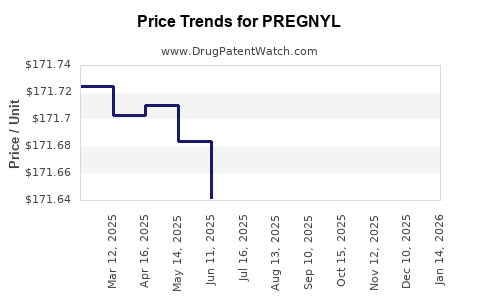
Last updated: September 7, 2026
Pregnyl is a urinary-derived human chorionic gonadotropin, or hCG, used primarily in fertility treatment and selected male reproductive-health indications. Its commercial outlook is shaped by mature product economics, limited brand differentiation, generic injectable competition, fertility-cycle demand and manufacturing complexity rather than by active patent exclusivity.
Organon markets Pregnyl in the United States as a prescription injectable supplied in 10,000 USP-unit vials with diluent. The product has no publicly disclosed product-level revenue, and Organon reports it within broader product portfolios rather than as a separate financial line item. The brand’s economic value is therefore best assessed through market access, supply continuity, fertility-treatment volumes and competition from generic urinary hCG and recombinant hCG products.
What is Pregnyl and how is it used?
Pregnyl contains chorionic gonadotropin, a glycoprotein hormone with luteinizing-hormone activity. It is administered by injection after reconstitution.
The FDA-approved label identifies three principal uses:
| Indication |
Commercial role |
| Female anovulatory infertility |
Induces ovulation after follicular stimulation |
| Male hypogonadotropic hypogonadism |
Stimulates testosterone production and spermatogenesis |
| Prepubertal cryptorchidism |
Hormonal treatment in selected cases |
Pregnyl is also used in assisted reproductive technology protocols, although treatment regimens vary by clinic and physician. In fertility care, hCG may be used as a trigger injection after ovarian stimulation because it mimics the luteinizing-hormone surge.
Pregnyl is not FDA-approved for weight loss. Historical off-label weight-loss use has been associated with regulatory warnings and is not supported as a standalone obesity treatment by the FDA.[1]
How does Pregnyl differ from recombinant hCG?
Pregnyl is urinary-derived hCG. Ovidrel, marketed as choriogonadotropin alfa, is a recombinant hCG product manufactured through recombinant technology. Both products provide LH-like activity, but they differ in production platform, formulation, dose presentation, administration convenience and pricing.
| Attribute |
Pregnyl |
Ovidrel |
| Active ingredient |
Urinary-derived chorionic gonadotropin |
Recombinant choriogonadotropin alfa |
| Typical presentation |
Lyophilized powder requiring reconstitution |
Prefilled syringe |
| Main use |
Ovulation induction and male hypogonadism |
Ovulation induction |
| Manufacturing platform |
Human urine-derived purification |
Recombinant cell culture |
| Principal commercial risk |
Generic injectable hCG |
Alternative recombinant products and fertility protocols |
The choice between products depends on clinic protocol, payer coverage, supply, price and patient preference. Pregnyl’s multi-indication label gives it a broader commercial profile than products positioned mainly for ovulation triggering.
What is the FDA regulatory status of Pregnyl?
Pregnyl is an FDA-approved prescription drug marketed as a human chorionic gonadotropin injection. The U.S. product is associated with NDA 017501 in FDA regulatory records and is supplied as a lyophilized injectable product with a separate diluent.[2]
The FDA label includes warnings concerning ovarian hyperstimulation syndrome, thromboembolic events, multiple gestation, androgen-related effects in males and other risks associated with gonadotropin treatment.[2]
Pregnyl is not a biosimilar reference product in the commercial sense used for newer monoclonal antibodies and other large biologics. Its regulatory history predates the modern biosimilar market, and competing hCG products have historically entered through drug-approval pathways applicable to their specific formulations and reference products.
What is the Orange Book status of Pregnyl?
Pregnyl’s commercial protection is not based on a current, high-value patent estate. The product is an older injectable hormone with long-established regulatory and manufacturing history. The Orange Book is relevant to listed drug and approved product status, but it does not indicate a meaningful period of remaining market exclusivity for the brand comparable to a recently approved biologic.
No material active patent barrier is generally associated with the core Pregnyl molecule. Chorionic gonadotropin is an established biological substance, and composition-of-matter protection has long expired.
What patents protect Pregnyl?
The core Pregnyl product is not protected by a modern blocking patent estate. Any historical patents covering hCG production, purification, formulations or fertility protocols have either expired or have limited relevance to present-day generic entry.
| Protection category |
Current commercial significance |
| hCG composition of matter |
Expired or commercially irrelevant |
| Urinary extraction and purification |
Potential manufacturing know-how, not a broad product monopoly |
| Lyophilized injectable formulation |
No known material current exclusivity barrier |
| Fertility method-of-use patents |
Limited impact because core indications are longstanding |
| Device patents |
Limited, because Pregnyl is supplied as a vial and diluent rather than a proprietary injector |
| Manufacturing trade secrets |
Potentially relevant to consistency, yield and supply reliability |
Pregnyl’s defensibility is therefore operational rather than patent-based. A manufacturer may protect source qualification, purification controls, analytical methods, process parameters and supply relationships as confidential know-how. Those measures can affect product quality and continuity but do not prevent competitors from selling hCG products.
How strong is the Pregnyl patent estate?
The patent estate is weak from a modern exclusivity perspective. The product has:
- No apparent unexpired composition patent blocking hCG competition.
- No meaningful pediatric or orphan exclusivity.
- No proprietary delivery system comparable to an autoinjector.
- No disclosed lifecycle patent platform that materially extends exclusivity.
- Limited ability to prevent substitution by generic or alternative hCG products.
The principal barrier is the need to manufacture a consistent injectable biological hormone under FDA current good manufacturing practice requirements.
When does Pregnyl lose exclusivity?
Pregnyl has already lost core patent exclusivity. The relevant commercial question is not when exclusivity expires, but how efficiently competing products can maintain FDA approval, secure supply and obtain payer access.
The product’s current competitive position depends on:
- FDA-approved generic or alternative hCG supply.
- Pharmacy and fertility-clinic purchasing preferences.
- Wholesale acquisition cost and reimbursement.
- Manufacturing reliability.
- Availability of recombinant hCG substitutes.
- Physician familiarity with the Pregnyl brand.
Older sterile injectables often retain sales after patent expiry because supply interruptions, limited manufacturing capacity and clinical familiarity can support branded demand. Those factors can protect revenue temporarily, but they do not create durable exclusivity.
How many patents cover Pregnyl?
There is no publicly evident set of active, commercially significant U.S. patents that blocks generic hCG entry. Historical patent families may appear in patent databases under hCG production, purification or fertility treatment, but the existence of an old patent record does not establish current exclusivity.
For diligence purposes, Pregnyl should be classified as a mature, off-patent injectable biologic with process-sensitive manufacturing risk rather than as a patent-protected growth asset.
Which companies compete with Pregnyl?
Pregnyl competes across several product categories.
Urinary hCG competitors
Urinary hCG products are the closest substitutes. Products marketed under generic names or competing brands can be used in fertility and male hypogonadism protocols, subject to their approved labeling and physician practice.
Recombinant hCG competitors
Ovidrel, marketed by EMD Serono, is the most visible recombinant hCG alternative in U.S. fertility care. Its prefilled-syringe format provides a convenience advantage over Pregnyl’s powder-and-diluent presentation.[3]
Other fertility-treatment products
Pregnyl also competes indirectly with fertility regimens using:
- GnRH agonists for ovulation triggering in selected patients.
- GnRH antagonists within controlled ovarian stimulation protocols.
- Recombinant follicle-stimulating hormone products.
- Urinary menotropins such as Menopur.
- Other assisted-reproduction products supplied by fertility pharmacies.
These are not all direct substitutes. Their use depends on the treatment protocol, ovarian hyperstimulation risk, reimbursement and clinic practice.
What is the competitive landscape for Pregnyl?
The market is mature but commercially important because hCG remains integrated into fertility-treatment workflows. Three dynamics dominate.
Fertility demand supports baseline volume
Demand is linked to infertility diagnosis, assisted reproductive technology cycles, age-related fertility treatment and insurance coverage. In vitro fertilization and ovulation-induction volumes can support hCG demand even when individual product pricing is constrained.
Generic entry limits pricing power
With no meaningful patent barrier, generic hCG products can pressure price and formulary position. A brand may retain demand where clinics prefer a known supplier or where generic availability is inconsistent, but premium pricing is difficult to sustain.
Supply reliability can affect market share
Urinary-derived products require collection, screening, pooling and purification of biological source material. This creates supply-chain requirements that differ from small-molecule generics. Manufacturing interruptions, batch-release issues or shortages can move demand among Pregnyl, generic hCG and recombinant alternatives.
What generic entry risks exist for Pregnyl?
Generic entry risk is high because the active ingredient is old, the clinical uses are established and the core patents have expired. The main risks are:
| Risk |
Effect on Pregnyl |
| Additional generic hCG approvals |
Price erosion and formulary substitution |
| Pharmacy substitution |
Reduced brand retention |
| Fertility-clinic purchasing contracts |
Lower net pricing |
| Compounding or specialty-pharmacy alternatives |
Possible channel diversion, subject to regulatory limits |
| Recombinant hCG adoption |
Volume migration from urinary hCG |
| Supply disruption |
Can either reduce sales or temporarily increase demand |
The risk is moderated by the technical requirements for sterile injectable manufacturing and by the need for consistent biological potency. These requirements may reduce the number of reliable competitors, but they do not restore patent exclusivity.
Are biosimilars a material risk for Pregnyl?
Traditional monoclonal-antibody biosimilar competition is not the primary risk. Pregnyl is an older hormonal biologic, and the practical competitive threat comes from generic hCG products, alternative approved hCG formulations and recombinant products rather than from a wave of branded biosimilars.
A competing hCG product can still create clinical and commercial substitution pressure without being marketed through the modern interchangeable-biosimilar model. The relevant questions are approval pathway, labeling, formulation, supply and payer treatment.
What is the financial trajectory for Pregnyl?
Organon does not publicly report Pregnyl revenue as a separate line item in its annual financial disclosures. The company reports revenue across broader product categories and geographic markets, preventing a reliable standalone sales estimate from public filings.[4]
The likely financial trajectory is mature to declining in nominal share, with intermittent resilience driven by fertility demand and supply conditions.
| Period |
Likely commercial pattern |
| Historical period |
Stronger brand recognition and limited direct competition |
| Post-expiry period |
Generic price pressure and reduced branded leverage |
| Current mature phase |
Stable niche demand, with revenue dependent on supply and fertility volumes |
| Forward outlook |
Low growth, possible share erosion, and episodic upside during competitor shortages |
Pregnyl is unlikely to be a major growth driver for Organon relative to larger women’s-health products, biosimilars and established specialty brands. Its financial contribution is better viewed as recurring portfolio revenue from a mature product with low research-and-development requirements.
What drives Pregnyl revenue?
Revenue is primarily influenced by:
- Number of ovulation-induction and assisted-reproduction cycles.
- U.S. and international fertility-treatment access.
- Reimbursement policies.
- Generic hCG availability.
- Product shortages and back orders.
- Relative pricing of Pregnyl and Ovidrel.
- Clinic procurement agreements.
- Male hypogonadism prescribing.
What could reduce Pregnyl revenue?
Revenue pressure could increase if generic hCG supply becomes more reliable, fertility clinics shift to prefilled recombinant hCG, payers impose mandatory substitution or Organon reduces promotional and distribution support.
A decline in fertility treatment volumes, tighter reimbursement or regulatory restrictions on compounding could also affect market demand, although the direction and size of each effect vary by market.
What manufacturing and intellectual-property barriers affect Pregnyl?
The largest barrier is process execution. Urinary-derived hCG requires:
- Qualified biological source material.
- Viral and pathogen safety controls.
- Consistent extraction and purification.
- Potency and impurity testing.
- Sterile fill-finish capability.
- Reliable vial, diluent and packaging supply.
- FDA-compliant batch release.
These requirements create a higher entry burden than ordinary oral generic drugs. They also make manufacturing know-how commercially useful. The barrier remains narrower than patent exclusivity because a capable competitor can reproduce the product category without infringing a current core patent.
Geographic supply is also relevant. A product can have global regulatory approvals but depend on a limited number of manufacturing sites, source-material networks or fill-finish facilities. Country-specific approvals, import controls and procurement rules can produce different competitive conditions in the United States, Europe, Latin America and Asia.
What patent litigation or Paragraph IV challenges affect Pregnyl?
No major current Paragraph IV litigation campaign is publicly associated with a modern Pregnyl patent estate. Because the key product patents are expired or commercially immaterial, litigation risk is more likely to involve:
- Product-quality disputes.
- Manufacturing or supply contracts.
- Trademark and brand confusion.
- Regulatory exclusivity interpretations.
- Patent disputes involving competing fertility formulations rather than core Pregnyl.
Paragraph IV risk is therefore low as a litigation issue but high as a commercial outcome: generic products can compete without confronting a meaningful active-patent barrier.
What licensing deals affect Pregnyl?
No major recent licensing transaction is publicly identified as a central driver of Pregnyl’s value. The product’s economics are primarily tied to Organon’s ownership, manufacturing, distribution and commercial portfolio strategy.
The absence of a visible licensing catalyst limits the probability of a material near-term value re-rating. Any transaction involving Pregnyl would likely be a portfolio divestiture, regional commercialization agreement or mature-brand acquisition rather than a platform licensing deal.
How does Pregnyl compare with Ovidrel?
| Factor |
Pregnyl |
Ovidrel |
| Product type |
Urinary hCG |
Recombinant hCG |
| Administration |
Reconstitution and injection |
Prefilled syringe |
| Indication breadth |
Fertility, male hypogonadism and cryptorchidism |
Primarily fertility |
| Patent profile |
Mature, off-patent product |
Potentially stronger historical formulation and manufacturing protection, depending on jurisdiction |
| User convenience |
Lower |
Higher |
| Price competition |
High from generic hCG |
Competition from fertility alternatives and payer controls |
| Supply risk |
Source-material and sterile manufacturing dependence |
Recombinant manufacturing and biologics supply dependence |
| Strategic position |
Mature value product |
Differentiated fertility product |
Pregnyl retains relevance where broad labeling, physician familiarity, availability or price outweighs the convenience of a prefilled recombinant product.
What generic launch scenarios exist for Pregnyl?
Base case
Generic hCG remains available and gradually captures additional volume. Pregnyl maintains a residual branded share through physician familiarity and supply reliability. Net pricing declines modestly.
Downside case
Multiple reliable generic suppliers enter or expand. Payers and fertility clinics prefer the lowest-cost approved product. Ovidrel or other recombinant options gain share. Pregnyl revenue declines faster than market volume.
Supply-disruption case
A competitor experiences a shortage or manufacturing interruption. Pregnyl gains temporary demand and may improve volume, but the benefit is unlikely to create durable structural growth.
Defense case
Generic supply remains inconsistent, while Organon maintains dependable distribution and clinic relationships. Pregnyl retains a meaningful niche despite weak patent protection.
Key Takeaways
- Pregnyl is a mature urinary-derived hCG injectable used in fertility treatment, male hypogonadism and selected cryptorchidism cases.
- Organon does not publicly disclose standalone Pregnyl revenue.
- Core patent exclusivity has expired; the product has no apparent modern blocking patent estate.
- Generic hCG and recombinant hCG products are the principal competitive threats.
- Biosimilar-style competition is less important than generic injectable and alternative-product substitution.
- Manufacturing quality, source-material control and supply reliability are the main commercial barriers.
- The financial trajectory is likely stable to declining, with temporary upside during competitor shortages.
- Pregnyl is a recurring mature-brand asset, not a high-growth or patent-protected product.
- Paragraph IV litigation and patent settlement risk appear limited relative to supply, pricing and regulatory risks.
- Ovidrel has a convenience advantage, while Pregnyl has broader established use and brand familiarity.
FAQs
Is Pregnyl still commercially available?
Pregnyl remains an established hCG injectable brand in markets where Organon or its commercial partners maintain supply and regulatory authorization. Availability can vary by country and by period because injectable hCG products are vulnerable to manufacturing and distribution interruptions.
Is Pregnyl interchangeable with Ovidrel?
Pregnyl and Ovidrel are not identical products. Pregnyl is urinary-derived hCG supplied as a powder requiring reconstitution, while Ovidrel is recombinant choriogonadotropin alfa supplied in a prefilled format. Clinical substitution depends on the treatment protocol, physician decision and payer requirements.
Does Pregnyl have patent protection in Europe?
Core hCG patent protection is long expired in Europe. Country-specific formulation, process or regulatory rights may differ, but they are unlikely to create a broad monopoly over established hCG therapy.
Can a pharmacy automatically substitute generic hCG for Pregnyl?
Automatic substitution depends on the applicable product approvals, state or national pharmacy law, payer rules and whether the products are considered therapeutically equivalent. Pharmacy substitution should not be assumed solely because both products contain hCG.
Is Pregnyl a major revenue product for Organon?
Organon does not identify Pregnyl as a standalone material reporting segment. Its commercial role is that of a mature portfolio product with recurring demand, rather than a separately disclosed growth driver.
References
- U.S. Food and Drug Administration. (2011). FDA and FTC take action against marketers of unapproved human chorionic gonadotropin (HCG) products sold as weight-loss drugs. https://www.fda.gov
- U.S. Food and Drug Administration. (n.d.). Pregnyl: Chorionic gonadotropin for injection USP prescribing information. Organon USA, Inc.
- EMD Serono, Inc. (n.d.). Ovidrel prefilled syringe: Choriogonadotropin alfa prescribing information.
- Organon & Co. (2024). Annual report on Form 10-K for the fiscal year ended December 31, 2023. U.S. Securities and Exchange Commission.