Last Updated: June 25, 2026

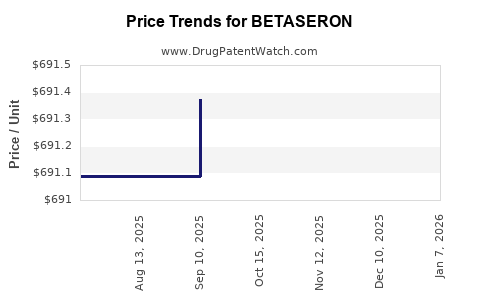
BETASERON Drug Profile


✉ Email this page to a colleague

« Back to Dashboard


Summary for Tradename: BETASERON
Recent Clinical Trials for BETASERON

Identify potential brand extensions & biosimilar entrants

SponsorPhase
BiogenPhase 4
National Institutes of Health (NIH)Phase 2
MediciNovaPhase 2

See all BETASERON clinical trials

Note on Biologic Patents

Matching patents to biologic drugs is far more complicated than for small-molecule drugs.

DrugPatentWatch employs three methods to identify biologic patents:

  1. Brand-side disclosures in response to biosimilar applications
  2. These patents were identified from disclosures by the brand-side company, in response to a potential biosimilar seeking to launch. They have a high certainty of blocking biosimilar entry. The expiration dates listed are not estimates — they're expiration dates as indicated by the brand-side company.

  3. DrugPatentWatch analysis and company disclosures
  4. These patents were identified from searching various sources, including drug labels and other general disclosures from the brand-side company. This list may exclude some of the patents which block biosimilar launch, and some of these patents listed may not actually block biosimilar launch. The expiration dates listed for these patents are estimates, based on the grant date of the patent.

  5. Patents from broad patent text search
  6. For completeness, these patents were identified by searching the patent literature for mentions of the branded or ingredient name of the drug. Some of these patents protect the original drug, whereas others may protect follow-on inventions or even inventions casually mentioning the drug. The expiration dates listed for these patents are estimates, based on the grant date of the patent.

1) High Certainty: US Patents for BETASERON Derived from Brand-Side Litigation

No patents found based on brand-side litigation

2) High Certainty: US Patents for BETASERON Derived from DrugPatentWatch Analysis and Company Disclosures

These patents were obtained from company disclosures
Applicant Tradename Biologic Ingredient Dosage Form BLA Patent No. Estimated Patent Expiration Source
Bayer Healthcare Pharmaceuticals Inc. BETASERON interferon beta-1b For Injection 103471 ⤷  Start Trial 2002-03-01 DrugPatentWatch analysis and company disclosures
Bayer Healthcare Pharmaceuticals Inc. BETASERON interferon beta-1b For Injection 103471 ⤷  Start Trial 2004-10-17 DrugPatentWatch analysis and company disclosures
Bayer Healthcare Pharmaceuticals Inc. BETASERON interferon beta-1b For Injection 103471 ⤷  Start Trial 2004-09-28 DrugPatentWatch analysis and company disclosures
>Applicant >Tradename >Biologic Ingredient >Dosage Form >BLA >Patent No. >Estimated Patent Expiration >Source

3) Low Certainty: US Patents for BETASERON Derived from Patent Text Search

These patents were obtained by searching patent claims

Supplementary Protection Certificates for BETASERON

Supplementary Protection Certificate SPC Country SPC Expiration SPC Description
96C0019 Belgium ⤷  Start Trial PRODUCT NAME: BETAFERON INTERFERON BETA-1B; REGISTRATION NO/DATE: EU/1/95/003/001 19951130
SZ 10/1996 Austria ⤷  Start Trial PRODUCT NAME: BETAFERON - INTERFERON BETA-1B
SPC/GB96/019 United Kingdom ⤷  Start Trial
>Supplementary Protection Certificate >SPC Country >SPC Expiration >SPC Description

Market Dynamics and Financial Trajectory for BETASERON

Last updated: April 12, 2026

What is BETASERON and its Current Market Position?

BETASERON (interferon beta-1a) is a biologic drug used to treat multiple sclerosis (MS). Approved in 1983 by Bayer, it was among the first disease-modifying therapies (DMTs) for MS. It primarily reduces relapse rates and slows disease progression.

The drug maintains a presence primarily in Europe, Canada, and select markets in Asia. In the United States, it faces competition from newer oral and injectable therapies.

What Are the Market Dynamics Influencing BETASERON?

Competitive Landscape

BETASERON's primary competitors include:

  • Avonex (interferon beta-1a)
  • Rebif (interferon beta-1a)
  • Tecfidera (dimethyl fumarate)
  • Aubagio (teriflunomide)
  • Gilenya (fingolimod)
  • Ocrevus (ocrelizumab)

The shift toward oral and high-efficacy monoclonal antibody therapies has decreased BETASERON’s market share, particularly in North America.

Patent and Regulatory Environment

BETASERON's patent protections have expired or are nearing expiration in several key markets, leading to biosimilar competition:

  • In the EU, biosimilar versions entered or are expected to enter the market from 2024 onwards.
  • In the US, biosimilar approval is anticipated after patent litigations conclude.

Regulatory pathways for biosimilars in the US and EU have become more streamlined, increasing market competition.

Market Penetration and Adoption

BETASERON maintains a user base primarily in long-standing MS treatment protocols. Its injection schedule (every other day) and side effect profile limit its appeal compared to newer options with less frequent dosing and improved tolerability.

Pricing and Reimbursement Trends

Pricing strategies in Europe feature discounts, with list prices decreasing over time. Reimbursement policies favor high-efficacy therapies; thus, BETASERON's reimbursement prospects are uncertain in regions prioritizing newer agents.

Demographic and Disease Prevalence Factors

Global MS prevalence is rising, especially among women aged 20-40. The growth in diagnosed cases sustains overall demand. However, the attractiveness of BETASERON wanes relative to newer therapies with better efficacy and convenience.

Supply Chain and Manufacturing

Bayer’s manufacturing facilities comply with Good Manufacturing Practices (GMP). Ingredient sourcing and biosimilar entry may alter supply dynamics in coming years.

What Is the Financial Trajectory for BETASERON?

Revenue Trends

  • Global sales in 2022: approximately €200 million, down from peak sales of €350 million in 2015.
  • European revenues account for 65% of sales; US contributions comprise less than 10%.
  • Revenue declines correlate with patent loss and increased biosimilar competition.

Cost Structure and Profitability

  • R&D expenses: €25-30 million annually, mainly for biosimilar development.
  • Manufacturing costs: stable but under pressure from biosimilar price reductions.
  • Gross margins: approximately 70%, with net margins estimated at 20% due to increased competition.

Investment in Biosimilars

Bayer has announced investment in biosimilar interferon beta products. This diversification may offset declining revenues but entails significant capital expenditure.

Market Entry of Biosimilars

Expected biosimilar entry in Europe from 2024 could lead to price erosion of 30-50%. In the US, biosimilar approvals could diminish BETASERON’s US market share further.

Outlook and Growth Potential

  • Short-term: revenue decline due to biosimilar competition; stabilization in existing markets.
  • Long-term: potential niche markets for injectable therapies in patients contraindicated for oral options; growth depends on biosimilar success and regulatory decisions.

How Will Market Changes Affect BETASERON’s Financial Outlook?

Factor Impact Timeline
Biosimilar competition in Europe 30-50% price erosion; revenue decline 2024-2028
Patent expiry in US Entry of biosimilars reduces US sales 2023–2025
Adoption of newer therapies Decrease in new patient prescriptions 2022–2026
Development of biosimilar portfolio Diversification into biosimilars 2022–2025

Key Takeaways

  • BETASERON remains a historically significant MS biologic but faces declining revenues due to patent expiry and biosimilar entry.
  • The shift to oral and monoclonal antibody therapies constrains market growth.
  • Pricing pressures intensify as biosimilars gain market share, especially post-2024.
  • Bayer invests in biosilars to sustain its presence in the MS biologic segment.
  • Long-term growth depends on biosimilar competitiveness, regulatory approvals, and potential niche markets.

FAQs

Q1: When do biosimilars for BETASERON enter the market?
A1: Biosimilar versions are expected in Europe from 2024 and potentially after 2025 in the US, contingent on patent litigations.

Q2: How has BETASERON's revenue changed recently?
A2: In 2022, global revenue declined to approximately €200 million from €350 million in 2015.

Q3: What factors could stabilize BETASERON’s sales?
A3: Niche application in patients intolerant to newer therapies and biosimilar competitive pricing.

Q4: How does the competitive landscape impact BETASERON?
A4: Increased adoption of oral and high-efficacy therapies reduces the patient base and prescriber preference for BETASERON.

Q5: What strategic moves has Bayer made regarding biosimilars?
A5: Bayer invests in biosimilar interferons to diversify revenue streams and maintain market presence.

References

  1. European Medicines Agency. (2022). BETASERON (interferon beta-1a): Summary of Product Characteristics.
  2. Bayer AG. (2022). Annual Report 2022.
  3. MarketWatch. (2022). Multiple Sclerosis Drugs Market Analysis.
  4. FDA. (2022). Biosimilar Product Approvals and Pathways.
  5. GlobalData. (2023). Biologics and Biosimilars Market Forecast.

More… ↓

⤷  Start Trial

Make Better Decisions: Try a trial or see plans & pricing

Drugs may be covered by multiple patents or regulatory protections. All trademarks and applicant names are the property of their respective owners or licensors. Although great care is taken in the proper and correct provision of this service, thinkBiotech LLC does not accept any responsibility for possible consequences of errors or omissions in the provided data. The data presented herein is for information purposes only. There is no warranty that the data contained herein is error free. We do not provide individual investment advice. This service is not registered with any financial regulatory agency. The information we publish is educational only and based on our opinions plus our models. By using DrugPatentWatch you acknowledge that we do not provide personalized recommendations or advice. thinkBiotech performs no independent verification of facts as provided by public sources nor are attempts made to provide legal or investing advice. Any reliance on data provided herein is done solely at the discretion of the user. Users of this service are advised to seek professional advice and independent confirmation before considering acting on any of the provided information. thinkBiotech LLC reserves the right to amend, extend or withdraw any part or all of the offered service without notice.