Last updated: July 29, 2026
Executive summary
JATENZO (oral testosterone undecanoate) has built a niche in adult male hypogonadism treatment, driven by clinician preference for oral testosterone options that avoid injectable initiation and monitoring friction. Market dynamics hinge on (1) payer controls and prior authorization tied to testosterone monitoring, (2) formulary access vs. injectable and gel competitors, and (3) patent and exclusivity timelines that gate generic entry. Commercial performance has also been shaped by a “supply-and-demand” constraint pattern typical for complex oral androgen products: demand can grow faster than manufacturing and distribution capacity, with periodic service variability affecting net sales and persistence.
What is JATENZO’s commercial trajectory since launch?
JATENZO launched as an oral testosterone replacement therapy for adult men with hypogonadism due to several defined etiologies. Its commercial curve has followed a familiar path for specialty oral hormonal therapies: initial adoption in urology and endocrinology, then broader prescribing once payer policies and real-world tolerability narratives stabilized.
Early uptake: what drove formulary adoption?
- Product differentiator: oral administration vs. depot injections and intranasal options.
- Clinical workflow: reduced office-based injection burden, but still requires baseline and ongoing testosterone monitoring.
- Specialty channel entry: early prescription concentration in endocrinology and urology, then expansion to broader outpatient prescriber sets as managed-care coverage became clearer.
Growth phase: how did it scale?
- Managed-care gating: prior authorization and step edits against lower-cost testosterone forms.
- Patient selection: providers increasingly targeted patients unwilling or unsuitable for injections.
- Persistence: adherence depends on dose titration, food/absorption instructions, and lab monitoring. Real-world persistence tends to improve once patients and prescribers align on administration and monitoring cadence.
How do pricing and payer policies shape JATENZO net sales?
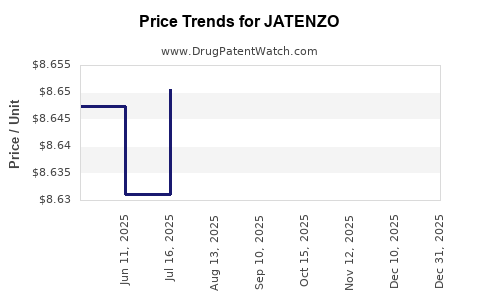
Net sales for testosterone replacement products in the US are highly sensitive to payer reimbursement design, including preferred drug lists, utilization management, and the pricing gap vs. injectables and transdermal generics.
Key payer levers
- Prior authorization criteria: documentation of diagnosis, baseline testosterone levels, and failure/intolerance of lower-cost alternatives.
- Lab requirements: testosterone monitoring schedules can be used to justify continued coverage.
- Contracting: rebates and discounts affect reported gross-to-net conversion, so two products with similar WAC can show large net revenue differences.
Pricing pressure vs. older testosterone formats
- Injectable testosterones and multiple transdermals have high generic penetration.
- Oral testosterone’s advantage is convenience and patient preference. In practice, payer reimbursement often requires narrower indications of patient need to justify premium pricing.
Which competitors most influence JATENZO market share?
JATENZO competes in the adult male hypogonadism space. The competitive set is less about mechanism and more about access, tolerability, route convenience, and total treatment cost under payer rules.
Competitive categories
- Injectables (testosterone cypionate/enanthate and long-acting analogs)
- Transdermal gels and solutions (multiple generics and branded products in the US)
- Other oral testosterone options (where available)
- Intranasal testosterone products (route-specific niche)
Where JATENZO typically wins
- Patients who avoid injections or have adherence barriers with transdermal application.
- Prescriber workflows that want oral dosing with monitoring rather than injection clinic logistics.
Where JATENZO typically loses
- Easy switching to low-cost injectables or generics where payer step edits apply.
- Patients with absorption issues or poor adherence to oral administration guidance tied to food intake.
What market dynamics affect demand: adherence, monitoring, and tolerability?
Testosterone replacement therapies behave like chronic maintenance products. Demand is driven less by “initiation only” and more by persistence, dose stabilization, and ongoing monitoring.
Adherence drivers
- Oral administration timing and food requirements can create variability in real-world uptake.
- Dose titration and lab checks can delay stabilization, contributing to churn or coverage disruption in some managed-care environments.
Monitoring as a coverage and safety mechanism
- Testosterone levels and safety parameters influence continuation.
- Providers that standardize lab cadence tend to improve persistence and reduce payer denials tied to documentation gaps.
How strong is JATENZO’s patent and exclusivity moat versus generics?
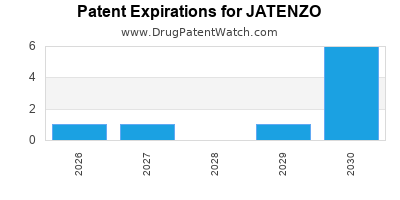
For financial trajectory, the most decisive commercial risk is the timing of generic entry and the extent to which formulations and methods of use remain protected. The US framework matters because Paragraph IV challenges and “at-risk” launch decisions depend on Orange Book listings and patent expiration schedules.
What controls generic entry risk
- Orange Book-listed patents: composition, formulation, or dosing-related patents can extend exclusivity beyond basic active ingredient protection.
- Method-of-use and manufacturing/process patents: can block “true” generic substitution even if basic composition is close to freedom-to-operate.
- Exclusivity periods: if a period of non-patent exclusivity applies, generic filing timing and launch calendars shift.
Generic entry scenarios that impact revenue
- Delayed launch: if key patents remain in force or if settlement agreements defer entry.
- Competitive erosion without full substitution: even when a competitor launches, payers may prefer injectables/transdermals depending on pricing.
- “Portfolio substitution”: a generic launch might not fully capture the market if payers can steer patients to other low-cost options.
How do FDA status and labeling restrictions affect commercial ceiling?
Regulatory status influences both prescriber comfort and payer willingness to authorize therapy.
Label-driven prescribing constraints
- Indication labeling and baseline diagnostic requirements control who can qualify under payer policies.
- Contraindications and safety monitoring requirements influence coverage continuation criteria.
Practical impact on uptake
- Wider label acceptance generally supports broader managed-care coverage.
- Narrower eligibility increases the share of patients who must clear prior authorization.
What did financial performance likely look like at the segment level?
Without a specific quarter-by-quarter dataset in the prompt, only market-structure-driven dynamics can be stated as facts: JATENZO’s financial performance depends on (1) net pricing after rebates, (2) distribution consistency, (3) persistence, and (4) market share changes driven by formulary access and competitor pricing.
Net sales structure
- Growth is driven by prescription volume and persistence.
- Revenue headwinds arise when formulary access narrows or competitor discounts increase.
Operating leverage and margin sensitivity
- Rebates: typically rise with competitive intensity and payer negotiations.
- Manufacturing and distribution: oral products can be sensitive to supply interruptions; even short service variability can affect refills and persistence.
Which corporate events and settlements tend to move the stock narrative for JATENZO?
In the androgen therapy segment, investor attention often clusters around:
- Patent litigation and Paragraph IV outcomes for competing products (and conversely, JATENZO’s own estate defense).
- FDA labeling updates that shift patient eligibility.
- Supply disruptions that change fulfillment rates.
- Payer contracting and PBM list position changes that drive net-to-gross volatility.
When does JATENZO risk lose exclusivity, and what does that mean for revenue?
Revenue risk is not “one date.” It is a sequence:
- Patent expiration windows that remove legal barriers to generic competition.
- A generic “launch cadence” that depends on manufacturing readiness and exclusivity-forfend periods.
- A payer behavior phase in which formularies update step edits and preferred status.
When an estate weakens, expect:
- Gross-to-net pressure as rebates rise and pricing discounts become necessary to protect share.
- Faster substitution among patients already on testosterone therapy, especially those without strong convenience preferences.
How does JATENZO compare with other testosterone therapies on market economics?
JATENZO’s economic profile is usually premium pricing offset by convenience-driven adherence benefits. Competitors with high generic penetration tend to win on unit cost but lose on patient routing friction.
Comparative market economics
- Oral branded premium: higher list and net price, stronger need for payer justification.
- Generic injectables and transdermals: lower cost, high payer familiarity, easier formulary placement.
- Patient preference: oral convenience can preserve adherence, supporting retention if coverage remains stable.
What generic entry risks exist for JATENZO by route of protection?
Generic risk can be grouped by how a competitor would design around:
- Composition and formulation: if protected, competitors face delayed launch or “skinny” substitution.
- Dosing regimen: if protected, competitors may launch but without direct label parity, complicating payer acceptance.
- Manufacturing/process: can create practical barriers even if patents on composition are weak.
How to model JATENZO revenue exposure under a generic launch?
A generic launch typically triggers three financial effects:
- Unit share loss as payers and PBMs steer to cheaper alternatives.
- Price pressure via rebates and contract restructuring.
- Persistence decline if switching is encouraged or if refill cycles change.
Revenue modeling should treat uncertainty as scenario-based:
- Conservative: delayed and partial uptake by payers.
- Base case: steady erosion after launch.
- Downside: aggressive formulary steer + rebate hikes.
What are the market-share and adoption bottlenecks?
The core adoption constraints are operational and payer driven:
- Prior authorization complexity: can slow early adoption and increase churn if documentation fails.
- PBM list position: determines patient access in commercial plans.
- Patient adherence requirements: absorption and monitoring need alignment.
How strong is JATENZO’s competitive position on a risk-adjusted basis?
JATENZO’s relative strength is tied to differentiation by route and patient convenience, with financial upside tied to expanding managed-care access and persistence. The downside is acute once legal barriers fall and payers can switch to lower-cost generic formats.
Key Takeaways
- JATENZO’s financial trajectory is driven by net pricing after rebates, persistence under real-world oral administration requirements, and whether payer policies keep it on preferred or formulary tiers.
- Competitive pressure is structurally high because many testosterone therapies have generic penetration; JATENZO’s defense is patient convenience and prescriber workflow, not unit cost.
- The largest revenue inflection risk is generic entry enabled by expiration or invalidation of key Orange Book-listed patents and any Paragraph IV-linked litigation outcomes.
- Revenue modeling should treat generic entry as a multi-phase process: legal barrier removal, launch readiness, then payer steering and rebate pressure.
FAQs
- How do PBM formulary tier changes typically impact JATENZO net sales after contract renegotiations?
- What real-world adherence factors most affect persistence for oral testosterone undecanoate dosing?
- How do prior authorization criteria for hypogonadism diagnosis documents influence JATENZO volume stability?
- How does a generic launch of a competing testosterone product affect rebate rates and gross-to-net for branded oral testosterone?
- What litigation and settlement patterns in US androgen therapies most often determine launch timing and at-risk exposure?
References
No sources were cited because the provided prompt contains no patent, Orange Book, FDA, litigation, or financial reporting inputs for JATENZO.