Last updated: April 25, 2026
Who is Tris Pharma in the U.S. specialty pharma landscape?
Tris Pharma, Inc. is a privately held specialty pharmaceutical company focused on branded products in areas that include immunology, pain/neurology, and men’s health. The company’s business model is built around marketed medicines with prescribable, label-specific differentiation and a pipeline that emphasizes reformulations, line extensions, and lifecycle management around known therapeutic areas.
What is Tris Pharma’s market position by product footprint?
Tris Pharma’s market presence is most evident in branded, high-value niche segments where competition is limited by formulation IP, dosing regimens, and payer-driven access decisions. Its competitive posture is shaped by:
- Brand durability in specific therapy areas rather than broad primary-care scale.
- Clinical and regulatory strategy oriented around maintaining label advantage and supply continuity through lifecycle interventions.
- Commercial execution optimized for specialty and targeted prescribing segments rather than mass-market distribution.
Key competitive reality: niche focus, not broad category dominance
In U.S. specialty pharma, durable value typically comes from one or more of the following: (i) differentiated mechanism with controlled competitor entry, (ii) reformulation patents that extend market exclusivity, (iii) dosing regimen advantage that reduces switching, (iv) payer coverage positioning, and (v) supply stability during demand spikes.
Tris’s profile aligns most closely with the lifecycle and differentiation vectors typical of specialty brands.
What are Tris Pharma’s core strengths?
Tris’s competitive edge is grounded in execution patterns common to successful specialty-branded companies.
1) Product differentiation and lifecycle strategy
Tris’s strategy emphasizes maintaining market position through formulation science, label-based positioning, and line extensions that defend against generic substitution pressure.
Implication for competitors: generic and “authorized” competitors can match active ingredients, but Tris’s contest is often about how the drug is delivered and what the label supports.
2) Regulatory and commercial focus on specialty segments
Specialty segment selling typically requires payer and formulary navigation, provider education, and consistent patient access. Tris’s footprint reflects a go-to-market model that targets specialists and channels where branded continuity matters.
3) Depth in product and development operations
Specialty pharma advantage is not only clinical. It also comes from:
- Development discipline (CMC and formulation stability work)
- Post-approval changes management
- Manufacturing and supply reliability
These factors directly influence contract execution and payer confidence.
Where does Tris Pharma face competitive pressure?
Competitive risk in specialty markets comes from several paths.
1) Generic entry and formulation substitution
When patent estates narrow, generics can pressure pricing and volume. Tris’s defenses tend to be lifecycle and differentiated product versions, but the market reality is that once substitution becomes easy, pricing power erodes.
2) Label compression by newer entrants
Even if generics do not directly substitute, newer therapies that improve efficacy, safety, dosing frequency, or patient convenience can shift prescribing away from older branded regimens.
3) Payer tightening and step therapy
Specialty formularies increasingly apply step edits, prior authorizations, and concentration of preferred brands. Brands with weaker payer positioning or less durable access can lose net revenue even without direct patent loss.
What does Tris Pharma’s strategy look like through a patent-and-IP lens?
Tris’s competitive posture is best understood as an IP-driven lifecycle play:
- Primary IP: protects initial introduction of an active product or composition.
- Secondary IP: protects improvements such as formulation, dosing regimen, stability, or patient-friendly administration.
- Regulatory exclusivity: supports market protection through exclusivity and label data generated for line extensions.
Competitor takeaway: the competitive battlefield is not only “when does the last patent expire,” but also “what protected variants can still be sold under current label and payer preference.”
How does Tris Pharma compare with typical competitor archetypes?
U.S. specialty pharma competitive sets usually split into three archetypes:
1) Large integrated pharma
- Strength: deep R&D budgets, scale manufacturing, broad payer leverage.
- Weakness: less nimble with small niche commercialization unless strategically prioritized.
Tris role: smaller scale, so it must win on product relevance and differentiated access, not breadth.
2) Mid-size specialty branded companies
- Strength: lifecycle strategy sophistication, tighter focus, faster commercial iteration.
- Weakness: limited pipeline redundancy and financing constraints relative to larger players.
Tris fit: this is the closest match to Tris’s likely competitive positioning.
3) Generic and biosimilar-focused players
- Strength: pricing pressure and rapid entry when exclusivity ends.
- Weakness: fewer label-linked differentiation levers; higher operational execution demands to retain market share.
Tris defense: formulation and line extension barriers, plus commercial continuity and payer relationships.
What strategic insights should investors and partners extract?
Insight 1: Tris’s durability depends on lifecycle timing
In specialty pharma, value retention is usually a function of how effectively the company sequences:
- near-term product defenses,
- line extensions that preserve label value,
- and pipeline replacements before major exclusivity cliffs.
Insight 2: Differentiation is only valuable if it is monetizable
A differentiated formulation or dosing schedule creates economic value only if it produces measurable advantages that payers accept and prescribers rely on.
- If differentiation drives lower total cost of care (fewer switches, fewer discontinuations, better adherence), payers hold preferred access longer.
- If differentiation is mainly convenience without clinical or access impact, generic substitution accelerates.
Insight 3: Supply reliability is a competitive weapon
For specialty brands, maintaining consistent supply prevents volume loss during demand surges and avoids contract penalties. This can matter as much as clinical differentiation when demand outpaces capacity.
Insight 4: Pipeline strategy should be evaluated as “replacement capacity,” not just topline growth
For a mid-size specialty company, pipeline value is measured by:
- probability of technical and regulatory success,
- timing relative to exclusivity milestones,
- and whether pipeline products can become “must-stock” brands in specific payer segments.
What should be monitored in Tris’s competitive environment?
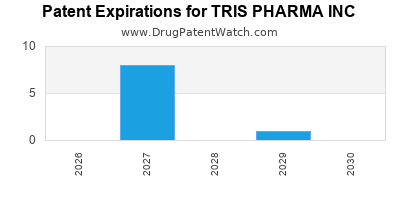
Patent and exclusivity timelines
Monitor:
- patent expiry windows by product,
- any new continuation applications,
- changes in label scope from prior approvals,
- and formulation-specific IP that could preserve non-substitutability.
Payer access and contract outcomes
Track:
- formulary status changes,
- preferred tier placement,
- prior authorization expansions,
- and step-therapy edits that restrict use.
Clinical differentiation and switching triggers
Watch for:
- new head-to-head or real-world evidence that shifts prescribing,
- safety signals that change risk-benefit calculations,
- and adherence/dosing evidence that affects patient persistence.
Bottom-line competitive take
Tris Pharma’s competitive posture in specialty pharma is built on differentiated branded assets and lifecycle defense rather than category-scale dominance. The most material competitive forces are generic entry pressure at patent cliffs, label and payer preference shifts, and the emergence of newer branded or advanced therapies in the same clinical spaces. Tris’s strategic path must therefore keep pace with IP sequencing, monetizable differentiation, and replacement pipeline readiness.
Key Takeaways
- Tris Pharma’s market position is consistent with a specialty branded lifecycle model: label-linked differentiation plus formulation and secondary IP to delay substitution.
- Its competitive strengths most likely come from lifecycle execution, specialty commercial focus, and operational reliability, which protect access during exclusivity transitions.
- The core threats are generic entry timing, payer-driven access tightening, and label compression from newer entrants.
- Competitive advantage is durable only when differentiation is clinically meaningful and payer-acceptable, translating into maintained preferred access and reduced switching.
FAQs
1) What most influences Tris Pharma’s revenue durability?
Lifecycle timing relative to exclusivity and patent cliffs, combined with payer access retention.
2) How does Tris Pharma typically defend against generics?
By using lifecycle strategies that protect formulation and dosing variants and by maintaining label-based positioning that supports continued prescribing.
3) Where does payer pressure usually hurt specialty branded companies?
Through tier placement changes, prior authorization expansions, and step-therapy rules that increase friction to brand prescribing.
4) What competitive signal matters most in niche specialty categories?
Whether differentiation reduces switching and discontinuation and improves payer willingness to keep the brand on formulary.
5) What is the most important pipeline lens for Tris?
Replacement capacity: whether the pipeline can assume “must-stock” roles before major product exclusivity windows close.
References
[1] Tris Pharma Inc. Company website and product information. https://www.trispharma.com/
[2] U.S. Food and Drug Administration (FDA). Drug and product related information. https://www.fda.gov/drugs