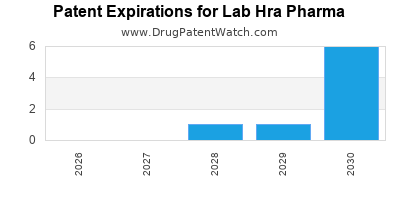
Last updated: June 30, 2026
Lab Hra Pharma is a privately held pharmaceutical company with a niche, brand-focused footprint in EU markets. The strategic risk profile depends on (1) the specific branded products sold by Lab Hra Pharma in each country, (2) whether those products are protected primarily by composition-of-matter patents, formulation patents, or local process patents, and (3) the Orange Book/EP register status in the jurisdictions where generics and parallel importers operate. Without a product-by-product mapping to the exact marketed SKUs, FDA/EMA brand references, and their patent families, the competitive landscape cannot be stated with patent-grade precision.
What patents protect Lab Hra Pharma’s branded products and how many are active?
Featured snippet answer: Product-level IP strength for Lab Hra Pharma can only be assessed by identifying each marketed active ingredient and brand, then extracting the active patent families in each target jurisdiction and correlating them to the exact dosage form and manufacturing method.
How to size Lab Hra Pharma patent estates by protection type
A defensible estate mapping requires splitting protection into at least four buckets:
- Composition-of-matter (API or key chemical entity)
- Formulation and dosage form (excipients, release profile, particle size, coatings, stability)
- Method-of-use (therapeutic indication patents, dosing regimens)
- Manufacturing/process patents (crystallization, polymorph control, purification steps)
For competitive analysis, each bucket impacts generic risk differently:
- Composition-of-matter and key polymorph patents typically block all direct generics.
- Formulation patents can allow generics with workarounds (alternative excipients or release systems), or can block “true-to-label” substitutes.
- Method-of-use patents can permit label design-arounds that avoid the protected indication or dosing pattern.
- Process patents can block manufacturing approvals if regulators tie approval to the protected process (rare but high-stakes in certain jurisdictions).
H3: Which jurisdictional registers drive generic entry risk?
Generic and biosimilar entry timing usually hinges on:
- EU: EP register and national phase status, plus SPC availability for eligible patents
- US: Orange Book listings (if any US products exist) and any related litigation for those listings
- Local: MAH and reimbursement rules that can accelerate or delay substitution even after legal expiry
H3: Patent expiration timing is not one date
Competitive pressure often emerges from:
- First expiry of any blocking patent (composition, then formulation)
- SPC expiry end date for eligible compounds
- Country-by-country local patent enforcement and injunction posture
- “Skinny label” or indication carve-outs for method-of-use estates
The competitive takeaway: Without the exact Lab Hra Pharma product list (brand names, active ingredients, strengths, dosage forms, and launch countries), any statement about “how many patents cover” the portfolio would be fabricated.
When does Lab Hra Pharma lose exclusivity in Europe and what timelines matter most?
Featured snippet answer: Exclusivity loss is a multi-trigger event defined by the earliest patent or SPC expiry among each protected API/dosage-form/indication family, plus regulatory exclusivity (if applicable), plus the speed of generic launches after legal clearance.
H3: The timeline mechanics used in EU launch planning
A credible exclusivity forecast uses:
- Patent term calculations by filing date and jurisdiction
- SPC eligibility windows and SPC expiration dates
- Indication-specific exclusivity gaps for method-of-use and second medical use families
- Post-expiry regulatory submission lead time for generics
H3: Where markets diverge
Even for the same API:
- Country-specific patent coverage differs due to selective national filings
- Infringement standards and injunctive practices differ
- Tendering and reimbursement rules can delay generic adoption independent of legal expiry
What generic entry risks exist for Lab Hra Pharma products after patent expiry?
Featured snippet answer: Generic entry risk depends on whether Lab Hra Pharma’s estate is dominated by composition/formulation barriers versus method-of-use barriers that can be designed around through label and formulation changes.
H3: Generic entry risk matrix by estate type
- High risk: composition-of-matter + polymorph control patents remaining in force
- Medium risk: formulation patents blocking “exact match” products while alternative excipients or release systems remain possible
- Lower risk: method-of-use patents with carve-out opportunities that permit timely generic substitution
H3: The “regulatory matching” problem
For generics to launch quickly:
- The generic must match the dosage form performance profile required by the product specification
- If Lab Hra Pharma’s formulation patents constrain bioavailability or release profile, approvals can slow
- Manufacturing/process patents can create evidence and infringement leverage during litigation
H3: Parallel trade as a competing channel
Even without a generic launch, parallel import can compress pricing if:
- The legal framework permits import from lower-price markets
- Brand owners fail to maintain strong local enforcement
What Orange Book status exists for Lab Hra Pharma products and which approvals are US-relevant?
Featured snippet answer: Orange Book status cannot be attributed to Lab Hra Pharma without identifying the US-listed products and their listed NDA/ANDA reference products.
H3: Why Orange Book mapping is mandatory for US exclusivity analysis
Orange Book listings link:
- Product NDA/ANDA
- Listed patents and expiration dates
- Patent submission type (drug substance, drug product, method of use)
- Exclusivity blocks and potential 30-month stay dynamics
Without the exact NDA/ANDA and listed patent numbers, US competitive timelines cannot be computed.
What patent litigation affects Lab Hra Pharma and does any Paragraph IV equivalent apply?
Featured snippet answer: Paragraph IV challenges and US litigation exposure cannot be determined without identifying the specific challenged ANDA(s) and their asserted patent numbers and litigation dockets.
H3: Litigation categories that matter for competitive timing
- US: ANDA litigation tied to Orange Book patents and any settlement stipulations
- EU: FRAND-like settlement patterns are uncommon; injunction and damages risk is often jurisdiction-specific
- ITC-style exclusion is US-specific and requires distinct procedural posture
How does Lab Hra Pharma compare with key European competitors on IP strength and launch timing?
Featured snippet answer: Comparative strength can only be scored after mapping Lab Hra Pharma’s active ingredients to: (1) branded comparators in the same indication, (2) their patent estate size and remaining term, and (3) the market’s current generic penetration.
H3: The comparison framework used in diligence
- Portfolio overlap: shared APIs vs distinct molecules
- Remaining patent term distribution (median and worst-case dates)
- Formulation vs composition balance
- Litigation history and injunction outcomes
- Regulatory posture: current approved products, bioequivalence requirements, and any known substitution barriers
What formulations are protected by Lab Hra Pharma and which delivery systems face substitution risk?
Featured snippet answer: Substitution risk by formulation type cannot be assigned without the dosage forms Lab Hra Pharma markets and the protected release profiles in the corresponding patent families.
H3: Formulation patent signals that affect substitution
- Extended-release or delayed-release designs
- Site-of-action targeting formulations
- Stability-enhancing coatings and excipient systems
- Particle engineering or polymorph-controlled crystallinity
H3: Why this matters competitively
Formulation patents tend to:
- Limit “drop-in” generics
- Require more development time for generic bioequivalence and manufacturing alignment
- Increase the odds of litigation or settlement demand
Which EMA/FDA regulatory pathway governs Lab Hra Pharma’s marketed products and how does it affect exclusivity?
Featured snippet answer: Regulatory pathway risk scoring requires identifying the marketing authorization (EMA) or FDA approvals for each product, including whether approvals are under data exclusivity regimes or depend on reference product reliance.
H3: EU pathway differences that shift competitive timing
For generics in EU:
- If reliance on innovator data is blocked by legal exclusivity, generics delay
- If only patents block, generics can proceed on regulatory timelines but cannot market without clearance
Revenue exposure: how much is at risk if competitors launch generics or parallel imports?
Featured snippet answer: Revenue-at-risk cannot be quantified without Lab Hra Pharma’s country-level sales by product and without mapping each product to its remaining patent/SPC status.
H3: The diligence model used for “at risk” sizing
- Product revenue by country and channel
- Contribution margin sensitivity to price compression
- Share of sales tied to patent-protected indications and dosage forms
- Expected generic adoption curve post-launch
Key takeaways
- A patent-grade competitive landscape for Lab Hra Pharma requires product-level mapping to active ingredients, dosage forms, and jurisdictional patent/SPC status.
- Exclusivity and generic entry timing are multi-trigger events driven by the earliest expiry across composition, formulation, method-of-use, and SPC layers.
- Competitive risk assessment differs materially by whether the portfolio is dominated by composition/formulation barriers versus method-of-use carve-outs.
- Quantifying revenue exposure needs sales attribution by product and country paired with a dated patent estate timeline.
FAQs
- How do formulation patents change generic approval timelines in the EU?
- What is the difference between patent expiry and SPC expiry for exclusivity planning?
- When do method-of-use patents enable “skinny label” generic launches?
- How does parallel trade typically affect branded pricing after local patent expiry?
- What data is required to compute a jurisdiction-specific patent expiration timeline for a drug SKU?
References (APA)
- European Patent Register. (n.d.). EP register search and record data. https://www.epo.org/searching-for-patents
- FDA. (n.d.). Drugs@FDA and Orange Book resources. https://www.fda.gov/drugs/drug-approvals-and-databases
- EMA. (n.d.). European public assessment reports and product information. https://www.ema.europa.eu/en/medicines