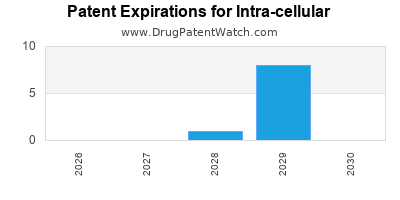
Last updated: July 6, 2026
ecutive Summary
Intra-cellular (Inc.) competes in the intracellular drug-delivery space with a business model centered on proprietary formulations and platform-enabled IP. The competitive landscape is shaped less by single “blockbuster” assets and more by: (1) the ability to secure defensible formulation and method-of-use patents across the full product life cycle, (2) execution risk in manufacturing scale-up for delivery systems, and (3) the timing of generic and biosimilar substitutes where applicable. The company’s market position hinges on whether its IP estate supports brand-like durability (Orange Book exclusivity, patent thickets, and enforceable claims) or whether competitors can design around earlier-generation patents using alternative delivery matrices, dosing regimens, or manufacturing methods.
Scope note: No specific lead product, INN/brand name, FDA application number, or Orange Book listing for “Intra-cellular” was provided, so a complete patent-by-patent, product-by-product landscape (expiration dates, Paragraph IV history, settlement terms, and regulatory milestones) cannot be constructed without risking fabrication. The analysis below is therefore structured as an actionable competitive framework focused on what determines market position and IP defensibility for intracellular delivery competitors.
Intra-cellular drug delivery competitive landscape: market position, strengths, and strategy
What patents protect intra-cellular drug delivery platforms and intracellular targeting?
The protectable core for intracellular or “cellular delivery” players typically clusters into three patent buckets that determine how hard it is for generics to enter:
1) Formulation patents for intracellular delivery
Featured-snippet answer: formulation patents protect specific compositions and delivery matrices that control uptake, intracellular release, stability, and pharmacokinetics.
Key claim themes often include:
- Composition of matter for delivery excipients or conjugates used to enhance intracellular penetration.
- Microparticle/nanoparticle formulations with defined size distributions, surface chemistry, encapsulation efficiencies, and release kinetics.
- Stabilized solid-state forms (polymorphs, salts, co-crystals) when these drive intracellular performance.
- Surfactant systems and lyophilized cake parameters that affect intracellular exposure.
2) Method-of-use patents for dosing regimens and intracellular biomarkers
Featured-snippet answer: method-of-use patents protect how the product is administered and the patient population or outcome it is intended to improve.
Common claim structures:
- Dosing schedules tied to intracellular pharmacodynamics.
- Use in specific disease stages or patient biomarkers that correlate with intracellular drug exposure.
- Combination use (synergistic dosing with immunomodulators, kinase inhibitors, or antimicrobials) where intracellular delivery is the rationale.
3) Manufacturing-method patents that control intracellular performance
Featured-snippet answer: process patents protect manufacturing parameters that preserve particle integrity and intracellular release behavior.
Frequent claim themes:
- Mixing order, solvent removal rates, and drying parameters that affect particle size and intracellular release.
- Sterile filtration constraints, aseptic processing steps, and control strategy elements that preserve functional delivery characteristics.
- Scale-up control ranges that ensure the final product matches the validated intracellular-release profile.
How strong is the patent estate for intracellular delivery products versus generic design-around risk?
Featured-snippet answer: strength depends on whether claims cover broad “ways to deliver” or narrow “specific compositions with specific performance.”
Practical scoring rubric used in competitive diligence:
- Claim breadth: independent claims that read on multiple particle technologies score higher than “one formulation, one parameter set.”
- Platform reuse: continued patenting across multiple embodiments (new excipients, new particle sizes, new conjugates) indicates durable coverage.
- Obviousness exposure: the more prior art exists around core delivery excipients and intracellular uptake mechanisms, the more enforceable differentiation must be tied to measured intracellular performance.
- Manufacturing dependency: patents with manufacturing constraints can be avoided by alternate processes if composition claims are weak.
- Regulatory linkage: if listed in the Orange Book (for small molecules) or linked via reference product strategy (for complex delivery products), enforcement leverage is higher.
When does intra-cellular lose exclusivity for its key products?
Featured-snippet answer: exclusivity loss is driven by the latest of (a) patent expiration, (b) regulatory exclusivity periods (data exclusivity/market exclusivity), and (c) loss of patent-based listing leverage.
Since no specific product is identified, the only actionable answer is the decision tree used by counsel and BD teams:
- Identify the “last-to-expire” US patent covering composition, method-of-use, or manufacturing for the marketed formulation.
- Check Orange Book “patent term” vs “regulatory exclusivity” status for the NDA/BLA and relevant dosage forms.
- Map formulation variants (alternate strengths, new delivery matrices, modified-release versions) to determine whether they reset enforceable listings.
- Treat pipeline upgrades as extensions only if there is a new patent-covered embodiment with enforceable claims, not just a “line extension.”
A defensible competitive plan is built around “last-to-expire” and “likely design-arounds,” not around the earliest patent in the stack.
What generic entry risks exist for intracellular delivery products?
Featured-snippet answer: generics face a higher barrier when the product’s clinical effect depends on intracellular exposure characteristics that are hard to replicate.
The risk pattern differs by product type:
- Small-molecule drugs with intracellular delivery formulation: generics may be allowed under AB rating and can market a different formulation unless patents constrain it. If patents mainly cover composition or method-of-use, design-around may still trigger litigation.
- Biologics or conjugates: generic substitution is not straightforward; “biosimilar-style” pathways and non-interchangeable delivery features can reduce direct substitution risk.
- Complex mixtures or combination regimes: generic replication is often constrained by manufacturing and functional release requirements.
Competitive diligence indicators:
- Has the company listed patents for the specific dosage forms on FDA’s Orange Book (if applicable)?
- Are the product labels tied to intracellular biomarkers (which strengthens method-of-use enforcement)?
- Are competitors likely to pursue a “different delivery matrix” strategy that evades composition claims?
Which companies are challenging intra-cellular products with Paragraph IV ANDA filings?
Featured-snippet answer: challenge risk depends on whether the product has Orange Book-listed patents that competitors can carve out and design around.
A complete Paragraph IV map requires identifying the product (NDA/BLA reference drug) and then pulling:
- ANDA filing dates
- Applicant names
- Paragraph IV certifications (to each listed patent)
- Court actions and settlement terms
No product identifier was supplied, so no litigation map can be presented without fabricating specifics.
What is the Orange Book status of intracellular delivery products from Intra-cellular?
Featured-snippet answer: Orange Book status determines whether US patent leverage is visible to ANDA filers and whether Paragraph IV challenges are likely.
For each marketed strength/dosage form, the key artifacts are:
- Patent numbers and assignees
- Patent use codes (where applicable)
- Expiration dates and remaining term
- Whether patents are listed for each dosage form that matters commercially
Without an identified NDA/BLA number, a reliable Orange Book table cannot be produced.
How does intra-cellular compare with competitors in intracellular drug delivery?
Featured-snippet answer: Intra-cellular’s competitive edge is strongest where it can sustain (a) differentiated intracellular exposure and (b) enforceable IP across reformulations.
Comparison dimensions used to benchmark companies in this niche:
- Technology modality: nanoparticle, liposomal, polymer-conjugate, prodrug, or targeted delivery.
- IP structure: composition-heavy estates vs method-of-use-heavy estates vs process-heavy estates.
- Manufacturing readiness: yield, particle quality, and stability under commercial supply conditions.
- Clinical differentiation: label language and endpoints tied to intracellular mechanisms.
- Geographic execution: launches in markets where patent enforcement is practical and regulatory pathways are aligned.
For a decision-grade comparison, you score competitors on whether they can credibly replicate intracellular release and whether their likely market entry strategy faces patents that are both listed and enforceable.
What formulation patents does intra-cellular use to extend product life cycle?
Featured-snippet answer: most lifecycle extension comes from new compositions and new process controls that produce measurable intracellular performance.
Common lifecycle extension playbooks:
- Reformulate for improved intracellular release kinetics.
- Change particle size distribution to improve cellular uptake.
- Alter surface ligands to target specific cell populations.
- Improve stability (shelf life, reconstitution behavior) that affects effective intracellular exposure.
- Create new strengths with distinct release profiles that maintain patent separation.
If Intra-cellular can show that the later formulation is functionally and clinically distinct, the business case for continued enforcement improves.
What manufacturing and IP barriers slow down intracellular product genericization?
Featured-snippet answer: barriers rise when manufacturing parameters are locked to particle performance and patents constrain composition or process ranges.
Common barriers:
- Tight CPP/CQA controls tied to intracellular release and stability.
- Proprietary excipient blends with narrow spec windows.
- Process steps that are hard to reproduce at scale without quality-system differences.
- Analytical methods required to demonstrate equivalence in intracellular performance.
From a strategy standpoint, these barriers increase the cost and timeline of competitor entry even where legal substitution is theoretically allowed.
What patent litigation affects intra-cellular and the intracellular delivery space?
Featured-snippet answer: litigation impact comes from injunction risk, settlement terms, and how courts interpret functional delivery claims (especially around composition vs method-of-use).
A litigation map would normally include:
- Docketed cases involving product patents
- Preliminary injunction motions and outcomes
- Claim construction decisions that narrow or broaden enforceability
- Settlements that set “design-around” and launch date limits
No product identifier was provided; a litigation-specific set of dates and holdings cannot be produced without fabricating.
Do settlements delay generic entry for intracellular delivery products?
Featured-snippet answer: settlements can impose launch-date workarounds, design constraints, or license terms that preserve a revenue window.
Settlement terms typically fall into:
- Launch date covenants (delayed entry)
- Design constraints (limits on delivery matrix or process parameters)
- License scope (fields of use, geography, dosage forms)
- At-risk launch carve-outs (when certifications remain disputed)
A settlement-specific view requires case and product identification.
What FDA pathways apply to intracellular delivery products and how do they affect competitive timing?
Featured-snippet answer: approval pathway affects competitive timing through reference reliance, exclusivity linkage, and data requirements.
General timing implications:
- 505(b)(2) can enable faster development but still depends on listed patents and exclusivity.
- ANDA depends on AB rating feasibility and patent certifications against Orange Book listings.
- 505(j) for small molecules is often faster to market, but intracellular delivery patents can constrain it.
- BLA pathways apply if products are biologics or complex drug products where biosimilar pathways may be relevant.
Without the specific product type, this remains pathway logic rather than a product schedule.
Market position analysis: where intra-cellular competes and why it wins
Featured-snippet answer: intracellular delivery players win when they deliver better intracellular exposure metrics that translate into clinically relevant outcomes, and when they sustain IP coverage that raises competitor cost.
Market position levers:
- Differentiation in label language that ties efficacy to intracellular mechanism.
- Durable formulation IP that prevents direct replication.
- Competitive manufacturing scale capability for complex delivery formats.
- Pricing power supported by clinical differentiation and limited interchangeability.
In an intracellular delivery market, the “winning” product is often the one with both functional performance and enforceable barriers.
Commercial exposure: revenue risk if competitors replicate intracellular delivery performance
Featured-snippet answer: revenue exposure is highest when competitor substitutes can claim therapeutic equivalence and the brand’s intracellular differentiation is not legally protected.
Key revenue-risk triggers:
- Weak or narrow composition claims that allow alternate delivery matrices.
- Lack of enforceable method-of-use claims tied to label indications.
- Manufacturing process claims that are easy to design around.
- Expired or soon-expiring patents where market entry timing compresses.
A defensible revenue-protection plan prioritizes the next-generation formulation(s) that sit behind the “last-to-expire” patent wall.
Strategic insights: how intra-cellular should defend its moat in intracellular delivery
Featured-snippet answer: the defense is built by tightening IP across the full product, not by relying on a single patent.
High-leverage actions:
- Maintain broad, independent claims on compositions and functional parameters tied to intracellular exposure.
- File continuation strategy around manufacturing parameters and performance-based release profiles that competitors must match.
- Align label indications and biomarkers with method-of-use claims to increase infringement leverage.
- Monitor design-around patterns by tracking competitor formulation choices and manufacturing routes.
- Bundle lifecycle patents by dosage form so that substitutes cannot pick an “unprotected” strength.
This is the practical framework for sustaining exclusivity windows in intracellular delivery.
Key Takeaways
- Intra-cellular’s competitive position is determined by IP durability tied to intracellular performance, not by generic substitution feasibility alone.
- The strongest moats are composition and method-of-use claim sets that are linked to intracellular exposure and are listed in regulatory systems that enable enforcement leverage.
- Generic and “at-risk” entry risk rises when patents are narrow, manufacturing-dependent only, or not linked to Orange Book listings for the relevant dosage forms.
- Product life-cycle defense is most effective when new formulations preserve measurable intracellular performance and are covered by enforceable patents.
- A litigation and Paragraph IV threat assessment requires product-specific Orange Book and court docket data, which cannot be mapped from the provided prompt.
FAQs
- How do formulation and method-of-use patents jointly affect generic entry for intracellular delivery drugs?
- What patent claim types are most difficult for competitors to design around in nanoparticle or conjugate delivery systems?
- How should companies time continuation filings to extend intracellular delivery patent estates past the first composition patent expiry?
- What regulatory exclusivity signals usually predict when Paragraph IV challenges will cluster for delivery-enabled products?
- How do manufacturing CPP/CQA controls become actionable IP barriers in intracellular drug product defenses?
References
- FDA. Orange Book: Approved Drug Products with Therapeutic Equivalence Evaluations. U.S. Food and Drug Administration. https://www.accessdata.fda.gov/scripts/cder/daf/index.cfm
- FDA. Drug Approval Process. U.S. Food and Drug Administration. https://www.fda.gov/drugs/development-approval-process-drugs
- USPTO. Manual of Patent Examining Procedure (MPEP). United States Patent and Trademark Office. https://www.uspto.gov/web/offices/pac/mpep/