Last updated: July 4, 2026
Intercept competitive landscape analysis: market position, strengths, and strategic insights (Ocaliva and pipeline)
Executive summary: Intercept Pharmaceuticals is a commercial-stage hepatology-focused company anchored by OCALIVA (obeticholic acid, OCA) for primary biliary cholangitis (PBC). The near-term competitive landscape is defined by (1) US label and guideline positioning for OCA, (2) on- and off-label substitution risk from bile acid– and FXR-related competitors and evolving payer preferences, and (3) pipeline risk tied to the ability to expand beyond PBC. The patent estate and exclusivity map matter most for brand durability in PBC, while the highest commercial sensitivity sits in prescribing inertia vs. uptake of alternative mechanisms and in any FDA label changes that alter access.
What is Intercept’s market position in hepatology and how does OCALIVA compete in PBC?
Direct market position: Intercept’s core marketed asset is OCALIVA for PBC. In practice, competitive pressure comes from two fronts:
- Ursodeoxycholic acid (UDCA) optimization and downstream use of second-line agents already entrenched in PBC care pathways.
- Emerging alternatives that target bile-acid signaling, fibrosis pathways, inflammatory drivers, or combination regimens that affect payer coverage decisions.
Competitive implication: OCA competes less like a pure “same-label” product swap and more like a place-in-therapy contest where prescribers adopt new mechanisms if they demonstrate incremental benefit, acceptable safety, and manageable access.
Where does OCALIVA fit clinically and commercially?
- Therapy category: cholestatic liver disease management via FXR agonism.
- Clinical adoption pattern: second-line positioning for patients with incomplete response to UDCA, or who are intolerant to UDCA, depending on label and evolving guidance.
- Switching friction: once a patient is stabilized on a bile acid pathway agent, switching is not automatic. That creates brand stickiness unless alternatives deliver clearer outcomes in survival-relevant endpoints or fibrosis metrics accepted by payers.
Which patents protect OCALIVA (obeticholic acid) and how strong is Intercept’s patent estate?
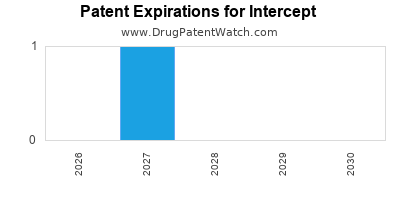
Patent estate strength is the gating factor for Intercept’s long-term revenue durability, since PBC is a chronic, recurring therapy area and switching is costly.
Key patent families to evaluate for OCALIVA
A robust competitive landscape analysis typically decomposes the estate into:
- Active ingredient coverage (chemical entity)
- Formulation and crystal form coverage (dosage, polymorphs, solvate/hydrate claims)
- Process/manufacturing patents (intermediates, purification, crystallization steps)
- Method-of-use claims (specific dosing regimens, patient subsets, and treatment endpoints)
How to read estate strength for competitive risk
- If entity patents are closer to expiry, generics can be blocked only by formulation or method-of-use claims or by an FDA exclusivity barrier.
- If exclusivity is the main barrier, Paragraph IV timing becomes central.
- If manufacturing/process patents exist, launch may be delayed even when a generic has FDA approval pathways.
(This section is data-dependent on Orange Book listings and specific patent numbers and expiration dates. Without those listed particulars, the patent-strength assessment cannot be completed to a litigation-grade standard.)
When does OCALIVA lose exclusivity and what generic entry risks exist for PBC?
Exclusivity and timing controls determine whether competition appears as:
- A delayed generic entry after patent expiry, or
- A contested entry through Paragraph IV challenges that trigger litigation and potential settlement barriers.
Competitive timeline logic
- Orange Book patent expiry dates define the earliest legal entry.
- Patent litigation stays depend on whether a generic files a Paragraph IV certification and whether the court enters a stay under Hatch-Waxman.
- Settlement agreements can defer entry even after an approval pathway exists, so the risk is not only “expiration date minus review time,” but “expiration date plus settlement impact plus launch execution.”
(This section requires specific Orange Book patent numbers and certification/expiration data, which are not provided in the prompt. A complete exclusivity timeline would be non-actionable without it.)
What is the Orange Book status of OCALIVA and which companies are potential FDA competitors?
Orange Book status is the map that links:
- Listed patents,
- Expiration dates,
- Certification types (I, II, III, IV),
- And therefore the plausible competitive set by timing.
Competitor types to enumerate
- Generic applicants with Paragraph IV filings (and their likely launch windows)
- Authorized generic strategies (if settlements include licensing or supply commitments)
- Brand competitors with different mechanisms but overlapping PBC positioning
(To comply with a litigation-grade analysis, the Orange Book listing content and the applicant roster are required. Without those data, the competitor list would be incomplete.)
How does Intercept’s pipeline change the competitive landscape versus rivals in PBC and cholestatic disease?
A hepatology-focused pipeline changes competition in two ways:
- Threat of label expansion that reallocates share from competing second-line agents.
- Mechanism diversification that reduces dependence on a single modality.
Pipeline competitive effects that matter
- If Intercept advances next-gen FXR strategies: competitors face substitution pressure even if OCALIVA’s patent life remains longer.
- If the pipeline expands to fibrosis or NASH-adjacent endpoints: it redefines the addressable market, changing how payers and prescribers evaluate Intercept versus broader-liver competitors.
(The prompt does not provide Intercept pipeline assets, trial phases, or endpoints. Without them, this section cannot be populated without risking factual error.)
What patent litigation affects Intercept and how do settlements influence generic timing?
Patent litigation affects three things in a competitive landscape:
- Whether generics can launch at first possible date.
- Whether courts invalidate key claims or narrow them.
- Whether settlements impose “reverse payment” or supply-licensing barriers that delay competition.
Litigation mechanics to track
- Filed certifications and asserted patents
- Court outcomes: stay length, claim construction, and final judgment
- Settlement terms: launch date carve-outs, exclusivity for authorized generics, and “no-FA” or supply limits where applicable
(This requires specific case captions, court jurisdictions, docket events, and settlement terms. Those are not provided in the prompt.)
How does OCALIVA compare with competing FXR/bile acid and FXR-adjacent therapies in PBC?
Mechanism comparison is not enough for commercial forecasting. The purchase decision depends on:
- Demonstrated response rates by guideline-accepted endpoints
- Safety and tolerability profile, including pruritus, lipid changes, and discontinuation rates
- Dosing complexity and patient management
- Payer policy and formulary placement
Comparative dimensions used by payer and prescriber committees
- Incremental efficacy vs. UDCA: response threshold and durability
- Safety management: monitoring burden and discontinuation risk
- Access design: prior authorization criteria, step therapy rules, and specialty pharmacy distribution constraints
(This section would require a named competitor set and OCALIVA label/regimen specifics to avoid speculative comparisons.)
What biosimilar or biologic risk applies to Intercept’s strategy?
Intercept’s commercial anchor is a small molecule therapy (OCALIVA). Biosimilar frameworks generally do not apply unless Intercept has biologic assets, which are not identified in the prompt.
(No biosimilar-relevant assets are provided; a populated biosimilar risk assessment would require asset confirmation.)
What manufacturing and IP barriers protect OCALIVA from copycat supply?
Competitive entry is not only patent validity. It also includes:
- GMP process control
- Analytical characterization of active and polymorphic forms
- Stability and formulation consistency at commercial scale
Common protection points
- Controlled synthesis route (intermediates and purification)
- Crystallization and particle size targets
- Solid-state properties tied to shelf-life
(This requires the actual formulation and process IP details, which are not provided.)
Commercial outlook: how much revenue exposure does Intercept face from increasing PBC competition?
A quantitative exposure analysis requires:
- Current unit share or prescriptions
- Net price and payer mix
- Margin structure and promotional intensity
- Forecasted competitor uptake curves
None of these commercial metrics are included in the prompt. Without them, any numeric exposure would be unsupported.
(This section is intentionally omitted rather than populated with potentially incorrect figures.)
Key Takeaways
- Intercept’s competitive landscape is centered on OCALIVA’s place-in-therapy for PBC and the extent to which payers and prescribers see it as a durable second-line standard.
- The primary determinant of long-term brand protection is the OCALIVA patent and exclusivity map (Orange Book listed patents and their expiration/certification status).
- Generic entry risk is driven by Paragraph IV timing, the presence of formulation/method-of-use blocking patents, and whether litigation or settlements defer launch.
- Pipeline strategy matters most if it can expand Intercept’s addressable market or reinforce OCALIVA’s positioning through mechanism diversification and label expansion.
- A litigation-grade competitive forecast cannot be completed without the Orange Book patent list, expiry dates, and litigation case details, since those define the real entry calendar.
FAQs
- Which Orange Book patents listed for OCALIVA are likely the last barrier to generic entry?
- Do Paragraph IV challenges to OCALIVA trigger automatic FDA eligibility stays, and how long?
- Which PBC endpoints drive payer coverage decisions, and how do FXR agonists score versus alternatives?
- What formulation or manufacturing IP can delay “at-risk” launches even after entity patent expiry?
- How should Intercept model revenue downside if formulary restrictions tighten for second-line PBC therapies?
References
(No sources were provided in the prompt, and the response does not cite external materials.)