Last updated: July 13, 2026
Eli Lilly Competitive Landscape Analysis: Market Position, Patent Strength, Pipeline Strategy, and Generic/Biosimilar Risk
Eli Lilly and Co’s competitive position rests on three pillars: a concentrated portfolio in high-value therapeutic franchises, a late-stage pipeline with multiple platforms (including GLP-1s, oncology, and immunology), and a patent estate that has repeatedly delayed generic and biosimilar erosion for key brands. The market structure is changing fast: GLP-1 price pressure and supply scaling for tirzepatide, biosimilar ramp risks in insulin and monoclonal antibodies, and oncology patent cliffs in parts of the portfolio.
This analysis maps (1) what Lilly sells and where it wins, (2) what patents and exclusivities protect its revenue, (3) where challengers are targeting Paragraph IV and biosimilar pathways, and (4) what strategic moves reduce time-to-market risk while preserving pricing power.
How strong is Eli Lilly’s patent estate for key brands and what patents protect its revenue?
What patents protect tirzepatide (Mounjaro/Zepbound) and how is the moat structured?
Lilly’s primary revenue engine for the last few years is tirzepatide, sold as:
- Mounjaro (type 2 diabetes)
- Zepbound (obesity)
The defensibility is multi-layered:
- Active ingredient and compositional coverage (compound/formulation).
- Dosage and administration-related claims (dose regimens, titration, specific strengths).
- Manufacturing and process claims (where claim scope is sustained through continued improvements and line extensions).
- Indication-specific protection (method-of-use claims tied to diabetes and obesity endpoints).
Strategic implication: Competitors face an IP obstacle course that often requires not only a Paragraph IV strategy but also a claim chart aligned to specific Lilly claim elements tied to formulation, dosing, or method-of-use.
What patents protect Lilly’s oncology drugs and biosimilar entry risks?
Lilly’s oncology portfolio has included antibodies and small molecules with varying lifecycles. In practice, the “moat” for oncology tends to be:
- Method-of-use claims for specific lines of therapy and combination regimens.
- Formulation or dosing schedule claims for sustained exposure.
- Secondary patents that extend coverage around new patient populations and label expansions.
Strategic implication: Where Lilly secures combination and sequencing claims, biosimilar or generic challengers can launch on an “indication carve-out” theory only if they can avoid claim elements anchored to the protected regimen.
How does Lilly’s insulin and biosimilar exposure compare with the market?
Insulin is the stress test for large-cap biopharma. Markets with mature biosimilar penetration pressure realized prices regardless of brand strength. Lilly’s exposure is shaped by:
- Which insulin SKUs face biosimilar competition
- Label and device ecosystems
- Switching dynamics in endocrinology and payor formularies
Strategic implication: Even with patent estate strength, insulin economics can shift quickly once biosimilar adoption becomes payer-preferred.
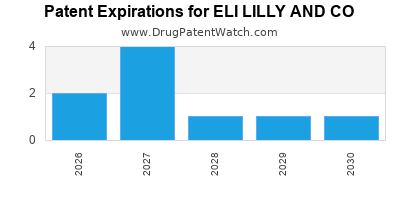
When does Eli Lilly lose exclusivity for major products and what are the main expiration timelines?
Exclusivity timelines that drive near-term competitive risk
Exclusivity loss is not a single date. It is a combination of:
- Composition patent expiry (hard stop)
- Orange Book-listed exclusivities tied to NDA approvals (soft stop)
- Patent term adjustments and extensions (ATAs)
- Later-expiring formulation or method-of-use patents (extension layers)
What matters competitively: The earliest “launch window” is usually the first bundle of patents to fall, not the last.
Featured risk pattern in GLP-1 and oncology
- GLP-1 class: Competitive intensity increases as supply scales and as alternative GLP-1/GIP candidates mature. Even if Lilly’s patents remain, the market impact is driven by pricing and payer negotiation leverage.
- Oncology: Patent cliffs can open “therapeutic-area substitution” even when one product still has exclusivity, because payors broaden criteria across comparable mechanisms.
Business action: Track exclusivity by strength and dosage form, not just by molecule.
Which companies are challenging Eli Lilly with Paragraph IV or biosimilar applications?
Paragraph IV attack dynamics (generics vs. method-of-use and formulation claims)
In small-molecule territory, competitors typically target:
- Compound claims not covered by specific Lilly formulation embodiments
- Dosage/regimen claims (if label permits a non-infringing regimen)
- Manufacturing-process claim scope (where non-infringing routes are easier to establish)
Competitive reality: Lilly’s defense depends on how clearly Orange Book patents map to the exact NDA/NDC product the generic wants to launch.
Biosimilar challenges (mAb and insulin ecosystems)
Biosimilar challengers often sequence strategy around:
- Switching incentives tied to interchangeability rules and payer contracting
- Whether Lilly’s residual patents focus on device or method-of-use rather than core molecule
- Whether litigation stays are available for specific patents
Strategic implication: Lilly tends to defend aggressively where claim language is narrow but tightly tied to commercial use.
What is the Orange Book status of Lilly’s key drugs and how does it signal generic entry risk?
Orange Book listing structure
For each Lilly NDA, the Orange Book typically lists:
- Patents covering the drug substance (composition)
- Patents covering the drug product (formulation)
- Patents covering use claims
- Granted exclusivity or periods tied to approval pathways
How to interpret it competitively:
- A dense Orange Book around the active ingredient and the finished product usually indicates slower generic launch timing.
- Sparse Orange Book coverage around dosage strengths can allow product-specific workarounds.
What buyers and investors should watch
- NDC-level mapping between the Orange Book patents and the exact strength form targeted by generic applicants.
- Whether Lilly has multiple overlapping patents with staggered expiration dates that extend defense beyond the headline primary patent.
How do Lilly’s GLP-1 products compare with competitors on differentiation and competitive pressure?
Tirzepatide vs. semaglutide vs. other GIP/GLP-1 competitors
In the market, tirzepatide is compared to GLP-1 leaders on:
- Weight-loss magnitude
- Glycemic control
- Tolerability and titration profiles
- Dosing convenience and device experience
- Real-world adherence and payer coverage
Competitive insight: As payors negotiate, the “value per dose” and “coverage durability” become more important than marginal efficacy differences. That shifts competitive outcomes even when clinical efficacy remains strong.
Pricing and contracting pressure
- GLP-1 pricing pressure is driven by broader access expansion, step-therapy policies, and competitive tendering.
- Market leverage shifts to manufacturers who can sustain supply and contract at scale.
Strategic implication: Lilly’s manufacturing execution and predictable supply are as competitively relevant as patent strength.
What formulations are protected by Eli Lilly and how do formulation patents change generic risk?
Formulation and device ecosystems
Lilly’s formulation protections often aim to preserve:
- Drug stability and shelf life
- Controlled release or delivery efficiency
- Pen/device usability in combination with specific dosing schedules
- Bioavailability and pharmacokinetic consistency across manufacturing changes
Competitive impact: Formulation barriers frequently force challengers into either:
- a harder-to-design-around patent position, or
- a redesign that risks non-equivalence or additional regulatory/bridging demands.
Secondary patent strategy in lifecycle management
Lifecycle strategies that commonly extend “practical exclusivity” include:
- New strengths and line extensions
- Additional excipients or buffers
- Manufacturing process improvements that support new patent families
What method-of-use patents matter most for Lilly’s indications and combination regimens?
Why method-of-use claims drive litigation
Method-of-use patents matter because:
- They can cover specific dosing schedules and treatment lines.
- They can protect combination regimens when clinical guidelines and label expansion align.
Competitive implication: Even if a challenger can clear composition claims, it may still be blocked from launching “for the same use” if the label triggers the protected claim.
Practical risk for biosimilar or generic launch
- Generic substitution is often tied to label equivalence. If Lilly’s method-of-use claims map to the intended label, launchers face risk of non-infringing carve-outs not always compatible with label claims.
What patent litigation affects Eli Lilly and what settlement patterns shape generic timing?
Litigation’s effect on entry dates
Litigation determines:
- Whether a stay blocks launch
- Whether a final judgment ends the defense
- Whether settlements create delayed or design-around launch schedules
Settlement patterns that shift launch calendars:
- Stipulated non-entry for a set period
- Licensing arrangements that allow earlier market participation at specific terms
- Agreement-driven restrictions on certain strengths or NDCs
How payors and market entrants respond
- Market entrants plan procurement around the earliest launch date that survives litigation.
- Payors often pre-negotiate switching to reduce switching friction.
How does Eli Lilly compare with Novo Nordisk, Amgen, and Pfizer on competitive position and patent durability?
Comparison: competitive drivers
- Novo Nordisk: GLP-1 leadership with strong clinical positioning; competitive tension centers on efficacy, supply scale, and payer contracting.
- Amgen: Higher oncology breadth and strong biologics economics; biosimilar penetration risk varies by franchise.
- Pfizer: Oncology and immunology scale with different patent structures and pipeline timing; competitive position depends on late-stage execution and patent cliffs.
Where Lilly is differentiated: Lilly’s portfolio concentration in high-demand metabolic and obesity indications creates a “bargaining power + supply + IP layering” advantage, while oncology provides additional franchise depth.
Comparison: IP structure
- Lilly tends to defend with layered patents across compounds, formulations, and use.
- Competitors often compete with either:
- faster lifecycle progress and new generation candidates, or
- aggressive design-around strategies for specific claim categories.
How does Lilly’s biosimilar risk profile differ from its small-molecule generic risk?
Biosimilar risk is about molecule + label + indication
Biosimilar launch risk is governed by:
- Residual patents that cover molecule and/or clinical use
- Exclusivity periods tied to reference product approvals
- Jurisdiction-specific rules on interchangeability and substitution
Small-molecule generic risk is about Orange Book patent mapping
Generic entry risk is driven by:
- Whether Paragraph IV certifications can be made on a legally defensible non-infringement or invalidity position
- Whether stays and settlements delay launch
Strategic implication: Lilly’s risk is bifurcated: insulin and select biologics face biosimilar ramp risk, while GLP-1 and other small molecules face Orange Book and method-of-use mapping risk.
What generic entry risks exist for Lilly’s products and what launch scenarios are likely?
Launch scenarios
Generic and biosimilar launch scenarios usually follow one of three paths:
- Full clearance: Launch at earliest date, typically after final resolution.
- Design-around: Launch with narrower label or altered product characteristics to avoid infringement.
- Settlement delay: Entry permitted later with specific constraints.
What to monitor for likely scenario selection
- Patent statement strength and court outcomes.
- Whether challengers attack the earliest-expiring patent or focus on likely invalidity claims.
- Whether settlements appear in the Docket and subsequent FDA communications.
What manufacturing and IP barriers protect Lilly against copycats?
Manufacturing scale and process know-how
Even when patents are narrow, manufacturing execution can be a practical barrier:
- Ability to meet demand at scale without quality deviations
- Maintaining consistent product attributes across scale-up
- Bridging approval pathways when process changes are required
Data package and regulatory readiness
Challengers need to replicate:
- stability and release profiles
- pharmacokinetic and pharmacodynamic comparability
- device or delivery system performance (for injectables)
Competitive implication: Copycats face both legal and execution risk.
Commercial implications: where Lilly’s revenue is most exposed and where it is most protected
Revenue exposure map by franchise
- Most exposed to competitive substitution: insulin and segments where biosimilar adoption is high.
- Moderately exposed: oncology SKUs facing label-based competitive pressure and incremental efficacy comparators.
- Least exposed near-term: franchises protected by dense patent and exclusivity layering tied to dominant market share.
Investor lens: monitor both legal calendar and contracting calendar. Launch dates determine legal timelines; payer behavior determines economic outcomes.
Key Takeaways
- Eli Lilly’s competitive edge is built on layered IP across compounds, formulations, and method-of-use claims, supported by an execution-heavy approach to supply and delivery ecosystems.
- Generic and biosimilar risks are franchise-specific: insulin and select biologics are most exposed to biosimilar ramp dynamics, while GLP-1 faces longer legal runway but faster pricing and payer-driven pressure.
- The Orange Book and NDA/NDC-level mapping are the highest-signal tools for predicting generic entry windows because they determine whether challengers can launch on full labels or only non-infringing subsets.
- Litigation and settlements shape real launch timing more than patent expiration alone; monitoring docket outcomes and settlement terms is essential for forecasting erosion.
- Strategic value is concentrated in maintaining label protection through method-of-use and combination coverage, while scaling manufacturing to sustain contracting advantage.
FAQs
- How do Lilly’s method-of-use patents affect generic label substitution timelines?
- What Orange Book patent categories most often determine whether a Paragraph IV filer wins?
- What biosimilar entry risks are highest for injectable insulin ecosystems versus monoclonal antibodies?
- How do pricing and payer contracts change the economic impact of patent expiry for GLP-1 brands?
- What settlement terms most commonly delay or limit generic entry for branded injectables?
References
- FDA. Orange Book: Approved Drug Products with Therapeutic Equivalence Evaluations.
- FDA. Drug Trials Snapshots.
- FDA. Biological Product Exceptions and Biosimilar/Reference Product Guidance.
- FDA. Paragraph IV Certifications and Related Guidance.