Last updated: August 7, 2026
Prozac, the brand name for fluoxetine, has moved from one of Eli Lilly’s largest products to a mature generic antidepressant with limited standalone commercial visibility. U.S. approval came in 1987, generic fluoxetine entered after the primary patent expired in 2001, and Lilly’s Prozac revenue fell sharply after generic substitution. The product remains clinically important, but its current economics are driven by low-cost generic supply, multiple dosage forms, and broad international availability rather than brand pricing power.[1][2]
What is Prozac and how large was its original market?
Prozac is fluoxetine hydrochloride, a selective serotonin reuptake inhibitor used for major depressive disorder, obsessive-compulsive disorder, bulimia nervosa, and panic disorder. It is also approved with olanzapine as Symbyax for bipolar depression and treatment-resistant depression. Fluoxetine is available in capsules, delayed-release weekly capsules, oral solution, and tablets in some markets.[1]
Lilly developed Prozac into one of the largest-selling antidepressants of the 1990s. The product benefited from:
- Early entry into the modern SSRI category
- Once-daily dosing
- A relatively favorable safety profile compared with older tricyclic antidepressants
- Long half-life and lower discontinuation risk
- Expansion into multiple psychiatric indications
- Strong physician and consumer recognition
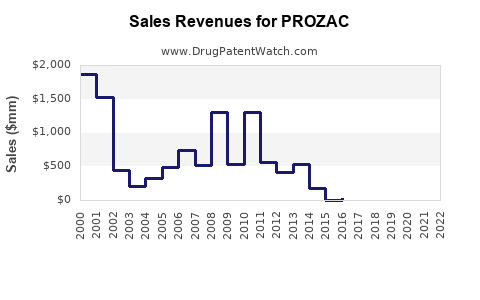
Public reports commonly place peak annual Prozac sales at approximately $2.6 billion around 2000. Lilly’s reported sales declined rapidly after U.S. generic entry, with Prozac revenue falling to roughly $600 million in 2002.[2][3]
| Period |
Commercial position |
Financial implication |
| 1987-1994 |
Initial U.S. launch and indication expansion |
Rapid prescription growth |
| 1995-2000 |
Blockbuster period |
Annual sales reached approximately $2.6 billion |
| 2001 |
Primary U.S. patent expiration |
Generic substitution began |
| 2002-2004 |
Generic erosion |
Lilly revenue declined sharply |
| 2005 onward |
Mature generic market |
No meaningful originator pricing power |
| Current market |
Generic fluoxetine and limited brand use |
Drug-level revenue is fragmented and difficult to isolate |
When did Prozac lose exclusivity?
Prozac’s core U.S. compound patent was U.S. Patent No. 4,314,081, covering fluoxetine and related compounds. The patent was issued in 1982 and had a term that extended to 2001, subject to the patent-term rules applicable at the time. FDA approval of Prozac occurred in December 1987 under NDA 018936.[1][4]
Generic fluoxetine became available in the United States in 2001 after the expiration of Lilly’s principal compound protection. The resulting loss of exclusivity was commercially significant because fluoxetine had high prescription volume and was relatively straightforward to manufacture as a small-molecule oral product.
Prozac exclusivity timeline
| Event |
Date |
Commercial significance |
| Core compound patent issued |
1982 |
Established primary composition-of-matter protection |
| FDA approval of Prozac |
December 1987 |
U.S. commercial launch |
| Pediatric exclusivity period |
2001-era product lifecycle |
Delayed certain generic timing but did not preserve long-term exclusivity |
| Core patent expiry |
2001 |
Opened the U.S. market to generic fluoxetine |
| Generic fluoxetine launch |
2001 |
Rapid price and market-share erosion |
| Prozac Weekly approval |
2001 |
Extended product-line coverage through a weekly formulation |
| Current position |
Mature generic market |
No material U.S. compound exclusivity remains |
The precise timing of generic entry reflected the interaction between patent expiry, FDA approval of ANDAs, and litigation involving generic challengers. Regulatory exclusivity and patent protection were separate rights. FDA exclusivity did not recreate the commercial protection provided by the original compound patent.[1][5]
What patents protected Prozac?
The principal protection was the fluoxetine compound patent. Later intellectual-property rights covered selected formulations, dosing schedules, and product presentations rather than the basic active ingredient.
Core composition-of-matter patent
U.S. Patent No. 4,314,081 covered fluoxetine and related chemical subject matter. Composition-of-matter protection generally provides the broadest exclusionary scope because it can cover the active ingredient regardless of manufacturer, dosage strength, or many formulation details.
Once this patent expired, a generic manufacturer could market fluoxetine if it satisfied FDA requirements and avoided any enforceable later patent claims.
Formulation and dosing patents
Lilly pursued additional protection for delivery formats, including Prozac Weekly. U.S. Patent No. 5,985,850 is associated with fluoxetine pharmaceutical compositions and was relevant to the weekly product line. These patents did not restore broad exclusivity for ordinary immediate-release fluoxetine capsules.
Later rights could create narrower barriers around:
- Weekly dosing
- Delayed-release delivery
- Specific excipient systems
- Selected dosage forms
- Combination products
- Method-of-use claims
The commercial value of these rights was materially lower than the original compound patent because generic manufacturers could often launch standard daily fluoxetine without practicing a protected weekly or specialized formulation.
What is the FDA and Orange Book status of Prozac?
The FDA approved Prozac under NDA 018936. The original product was approved for major depressive disorder and subsequently received additional indications. FDA-approved generic fluoxetine products are listed under abbreviated new drug applications and are therapeutically equivalent to the applicable reference products when assigned an “AB” rating.[1]
The Orange Book historically listed patents associated with Prozac products, including patents directed to particular formulations or dosing regimens. The core fluoxetine patent is expired. Any remaining Orange Book listings for specific presentations would not provide broad protection for all fluoxetine products.
| Regulatory issue |
Current assessment |
| Reference drug |
Prozac, fluoxetine hydrochloride |
| Original sponsor |
Eli Lilly and Company |
| Original U.S. NDA |
018936 |
| FDA pathway for competitors |
ANDA for generic fluoxetine |
| Active compound exclusivity |
None for ordinary fluoxetine |
| Biosimilar pathway |
Not applicable |
| Orange Book relevance |
Limited to any surviving product-specific listings |
| Generic substitution |
Broad and established |
Brand availability varies by dosage form and distributor. In commercial practice, “Prozac” is often used clinically as a reference brand even when the dispensed product is generic fluoxetine.
Which companies challenged Prozac patents?
Barr Laboratories was among the principal generic companies associated with the historical Prozac patent challenge and subsequent generic entry process. Other generic manufacturers entered after the relevant patent barriers were removed or became commercially irrelevant.
The Prozac litigation history illustrates a standard small-molecule lifecycle pattern:
- The originator obtained broad compound protection.
- Generic companies filed ANDAs supported by Paragraph IV certifications or other patent-status positions.
- Lilly pursued patent enforcement and related regulatory protection.
- Generic entry followed expiration or resolution of the principal barriers.
- Competition rapidly reduced the originator’s share and price.
Paragraph IV litigation can delay FDA approval through the statutory 30-month stay. That mechanism matters only while a listed patent remains enforceable and relevant to the ANDA product. It no longer creates a meaningful barrier to standard fluoxetine capsules because the foundational patent has expired.[5]
What was the Prozac patent litigation outcome?
The commercially decisive outcome was generic availability in 2001. Litigation and regulatory timing delayed some generic access but did not preserve a durable Prozac monopoly. The later formulation patents did not prevent the broad generic market for daily fluoxetine.
There is no current, widely reported U.S. patent dispute that threatens ordinary generic fluoxetine availability. Litigation risk is concentrated in product-specific claims, labeling, manufacturing disputes, or commercial disputes between generic suppliers rather than in a remaining core patent estate.
How strong is the Prozac patent estate today?
The current patent estate is weak for the base drug and potentially stronger only for narrow delivery or combination concepts.
| Patent category |
Historical strength |
Current commercial strength |
| Fluoxetine composition of matter |
Very high |
Expired |
| Standard daily capsules |
Dependent on compound patent |
Minimal |
| Oral solution |
Could involve formulation claims |
Limited and design-around feasible |
| Weekly delayed-release capsules |
Product-specific protection |
Narrow |
| Method-of-use claims |
Relevant to selected indications |
Limited after broad clinical use |
| Combination products |
Potentially separate estate |
Depends on the combination |
| Manufacturing processes |
May protect specific routes or intermediates |
Usually avoidable through alternative processes |
Fluoxetine is a relatively old, chemically defined small molecule. Generic manufacturers generally have multiple options for sourcing, synthesis, formulation, and packaging. That reduces the practical value of narrow process patents unless they cover a low-cost or difficult-to-replace manufacturing route.
What generic entry risks exist for Prozac?
Generic entry risk is no longer prospective. It is the established market structure.
For an originator seeking to defend Prozac revenue, the principal risks are:
- Low generic pricing
- Therapeutic substitution within the SSRI class
- Pharmacy benefit manager preference for generic fluoxetine
- Limited physician demand for branded fluoxetine
- Lack of enforceable compound claims
- Multiple approved generic suppliers
- Potential supply concentration among low-cost manufacturers
For generic manufacturers, the principal risks are different:
- Commodity pricing
- Low margins
- FDA manufacturing inspections
- API sourcing concentration
- Recalls or supply interruptions
- Competition from established suppliers
- Limited ability to differentiate a therapeutically substitutable product
Fluoxetine’s long half-life and established clinical profile support continuing use, but these characteristics do not create meaningful brand pricing power.
What is the financial trajectory for Prozac?
Prozac’s financial trajectory follows the classic blockbuster-to-generic pattern.
1. Launch and rapid adoption
From 1987 through the 1990s, Prozac captured substantial SSRI demand. Lilly expanded the product into additional indications and dosage formats. The brand became one of the most commercially valuable psychiatric medicines in the world.
2. Peak revenue
Prozac sales reached approximately $2.6 billion around 2000, according to historical industry and company reporting. At peak, Prozac represented a material share of Lilly’s pharmaceutical revenue and carried the economics of a protected branded medicine.[2][3]
3. Patent expiry and price compression
Generic entry in 2001 caused rapid loss of branded prescriptions. The principal economic effects were:
- Lower net price
- Reduced market share
- Generic substitution at the pharmacy
- Declining promotional return
- Reduced value of brand-specific manufacturing capacity
- Lower contribution to Lilly’s consolidated revenue
4. Mature generic phase
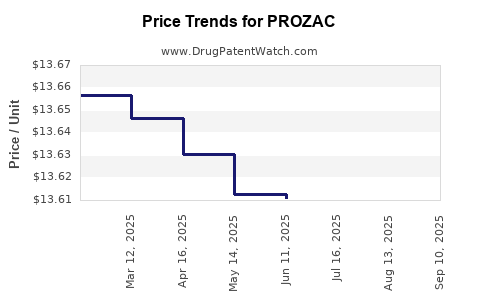
After the early post-expiry decline, fluoxetine became a low-price, high-volume generic. Current U.S. revenue is distributed among generic manufacturers and pharmacy channels. Eli Lilly does not report Prozac as a standalone material revenue product in its modern financial disclosures, so a precise current Prozac revenue figure is not available from public company filings.[6]
Financial exposure by stakeholder
| Stakeholder |
Current financial exposure |
| Eli Lilly |
Minimal direct Prozac exposure relative to newer products |
| Generic manufacturers |
Volume-driven, low-margin revenue |
| Pharmacies and distributors |
High substitution volume, low unit economics |
| Payers |
Low-cost SSRI coverage |
| Patients |
Broad access and low out-of-pocket pricing |
| Investors |
Little direct Prozac earnings sensitivity |
The product’s financial value now lies in aggregate generic volume, not brand sales. Market estimates that assign a large current “Prozac market” value often combine generic fluoxetine, branded prescriptions, international sales, and related products. Those estimates should not be treated as Lilly revenue.
How does Prozac compare with competing antidepressants?
Fluoxetine competes with sertraline, escitalopram, citalopram, paroxetine, venlafaxine, duloxetine, and newer branded antidepressants. Most major SSRI competitors also face generic competition.
| Drug |
Class |
U.S. brand status |
Generic position |
Commercial profile |
| Fluoxetine, Prozac |
SSRI |
Mature reference brand |
Broad generic supply |
Large historical franchise |
| Sertraline, Zoloft |
SSRI |
Mature reference brand |
Broad generic supply |
High-volume generic |
| Escitalopram, Lexapro |
SSRI |
Mature reference brand |
Broad generic supply |
Strong generic utilization |
| Citalopram, Celexa |
SSRI |
Mature reference brand |
Broad generic supply |
Mature generic |
| Paroxetine, Paxil |
SSRI |
Mature reference brand |
Broad generic supply |
Generic, with tolerability constraints |
| Venlafaxine, Effexor XR |
SNRI |
Mature reference brand |
Generic supply |
Extended-release formulation competition |
| Duloxetine, Cymbalta |
SNRI |
Former branded growth product |
Generic supply after expiry |
Larger post-expiry revenue base than Prozac in some periods |
Prozac retains differentiation through its long half-life, once-daily use, pediatric and eating-disorder indications, and availability as a weekly formulation. Those clinical distinctions do not overcome generic substitution in routine depression treatment.
Are biosimilars a risk for Prozac?
No. Prozac is a chemically synthesized small molecule, not a biologic. Biosimilar regulation does not apply. Competitive entry occurs through the FDA ANDA pathway, not through the abbreviated pathway established for biosimilars under the Biologics Price Competition and Innovation Act.
The relevant competitive issues are generic approval, therapeutic equivalence, manufacturing quality, API supply, and pharmacy substitution.
What manufacturing and intellectual-property barriers remain?
Manufacturing barriers are modest compared with biologics or complex sterile products. Fluoxetine is an established oral small molecule with extensive manufacturing history. A new entrant must still demonstrate:
- Pharmaceutical equivalence
- Bioequivalence
- Validated manufacturing controls
- Stability and shelf-life
- API quality
- Compliance with current good manufacturing practice
- Labeling consistent with the reference product
The highest practical barriers are regulatory compliance and commercial scale. Patent barriers are generally not material for standard fluoxetine capsules. Narrow formulation patents may affect a weekly or specialized product, but manufacturers can often target unprotected daily dosage forms.
Geographic protection also differs by country. Patent expiry, regulatory exclusivity, compulsory substitution rules, local manufacturing requirements, and procurement practices vary across the United States, Europe, Japan, China, India, and emerging markets. A patent-free U.S. market does not establish identical entry conditions worldwide.
What licensing deals affect Prozac?
No current licensing transaction is a major driver of the Prozac market. Lilly historically controlled the core development and commercialization rights, while generic companies entered through their own FDA applications and supply arrangements.
The commercial structure today is primarily:
- Lilly’s residual brand and reference-product position
- Generic manufacturers’ ANDA approvals
- API suppliers
- Wholesalers
- Pharmacy benefit managers
- Retail and institutional pharmacies
Any remaining value in the brand would derive from trademark recognition, physician familiarity, selected dosage forms, or channel-specific purchasing. Those factors do not recreate the economics of patent exclusivity.
What generic launch scenarios apply to Prozac?
The relevant launch scenario is continued generic supply rather than a future first generic event.
Base case
Multiple generic manufacturers continue supplying daily fluoxetine at low prices. Brand use remains limited, and the market grows with overall antidepressant utilization.
Upside case for suppliers
A supplier gains share through reliable manufacturing, low cost, shortage avoidance, or preferred payer contracts. Revenue rises through volume rather than pricing.
Downside case for suppliers
Price erosion, manufacturing observations, API disruption, or a product recall reduces volume. Because products are therapeutically substitutable, pharmacies can switch to another approved supplier.
Specialty-formulation case
A manufacturer obtains approval for a differentiated weekly, liquid, or other dosage form. That product may obtain better pricing than ordinary fluoxetine, but its opportunity is limited by clinical demand and competing formulations.
Key Takeaways
- Prozac is fluoxetine, an SSRI approved by the FDA in 1987.
- Historical peak sales were approximately $2.6 billion around 2000.
- The core U.S. patent expired in 2001, enabling broad generic entry.
- Generic fluoxetine caused a rapid decline in Lilly’s Prozac revenue.
- No biosimilar pathway applies because fluoxetine is a small molecule.
- Current commercial value is concentrated in generic volume, not branded pricing.
- Formulation and weekly-dosing patents were narrower than the original compound patent.
- Lilly does not report current Prozac revenue as a material standalone financial category.
- Generic manufacturers face low patent risk but meaningful pricing, quality, and supply-chain pressure.
- Prozac remains clinically relevant but has little remaining originator exclusivity value.
FAQs About Prozac Market and Patent Exposure
Is Prozac still a blockbuster drug?
No. Prozac was a blockbuster during its patent-protected period, but it is now a mature generic medicine. Its historical revenue was substantial; current brand revenue is not comparable.
Can a company still obtain a patent on a Prozac formulation?
Potentially, if the formulation is novel, non-obvious, and adequately supported. A new patent would generally protect only the claimed formulation or delivery system, not all fluoxetine products.
Does generic fluoxetine have the same FDA status as Prozac?
FDA-approved generic fluoxetine products may be therapeutically equivalent to the reference product for applicable dosage forms and indications. The exact approval and rating depend on the individual ANDA and product presentation.[1]
Why did Prozac lose revenue so quickly after patent expiry?
Pharmacy substitution moved prescriptions from the higher-priced brand to lower-priced generic fluoxetine. Multiple generic suppliers then competed on price, reducing both brand volume and net revenue.
Is Prozac commercially attractive for a new generic entrant?
It can support stable volume, but the product is highly commoditized. Commercial attractiveness depends on manufacturing cost, FDA compliance, supply reliability, contracting access, and the ability to avoid severe price competition.
References
-
U.S. Food and Drug Administration. (n.d.). Prozac prescribing information and Drugs@FDA database. https://www.accessdata.fda.gov/scripts/cder/daf/
-
Eli Lilly and Company. (2002). 2001 annual report. https://investor.lilly.com/financial-information/annual-reports-and-proxy-statements
-
Eli Lilly and Company. (2003). 2002 annual report. https://investor.lilly.com/financial-information/annual-reports-and-proxy-statements
-
U.S. Patent and Trademark Office. (1982). U.S. Patent No. 4,314,081: N-methyl-3-(4-trifluoromethylphenoxy)-3-phenylpropylamine hydrochloride. https://patents.google.com/patent/US4314081
-
Federal Trade Commission. (2002). Generic drug entry prior to patent expiration: An FTC study. https://www.ftc.gov/reports/generic-drug-entry-prior-patent-expiration-ftc-study
-
Eli Lilly and Company. (2024). Form 10-K annual report. https://investor.lilly.com/financial-information/sec-filings