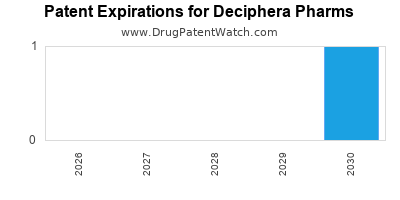
Last updated: July 1, 2026
Deciphera Pharmaceuticals’ competitive position is anchored by ripretinib (Qinlock) in advanced gastrointestinal stromal tumor (GIST) after prior therapies, with patent and exclusivity protections concentrated around the drug substance, key formulations, and line-of-therapy claims. Outside QINLOCK, Deciphera’s risk profile hinges on pipeline depth, trial readouts, and the extent to which patent estates for next-generation assets can withstand generic and biosimilar-adjacent pressure, pricing dynamics, and payer contracting.
What patents protect Deciphera’s ripretinib (Qinlock) and how strong is the estate?
Deciphera’s market moat for advanced GIST is built on a layered patent stack that typically includes: (1) compound and key analog claims to the ripretinib core, (2) salt/polymorph or crystal form protections, (3) formulation claims tied to dosage form and excipients, and (4) method-of-treatment or use claims tied to patient subpopulations and prior-therapy sequences.
Competitive relevance. In oncology small molecules, the practical threat is not theoretical “generic freedom.” The threat is whether a Paragraph IV filer can design around specific claim coverage (composition, formulation, or method-of-use) while maintaining FDA bioequivalence and meeting label constraints. The strength of Deciphera’s estate is therefore determined by (a) claim granularity and (b) how much of the approved label is “claimed” in method-of-use patents and formulation patents.
Which jurisdictions matter for enforcement and market exclusivity?
- U.S.: Orange Book-listed patents tied to NDA 213033 (ripretinib) drive FDA exclusivity timing and litigation leverage.
- Europe and UK: National validation and EPO-origin EP claims shape settlement risk for cross-border generics.
- Canada and other OECD markets: Often align with U.S. and EP claim families for later filing and enforcement strategy.
What is the Orange Book status of Qinlock (ripretinib) and when does exclusivity end?
Deciphera’s U.S. exclusivity and litigation posture for ripretinib is dictated by Orange Book-listed patents and statutory exclusivity attached to the NDA. The competitively actionable question for investors and challengers is the earliest date on which a generic can lawfully enter (subject to patent carve-outs) versus the dates when exclusivity blocks full-scale approval.
Featured snippet answer. Qinlock’s Orange Book status governs whether generic entry can occur before patent expiration and whether any automatic exclusivity periods delay abbreviated approval.
How do U.S. patent expiration and Orange Book “listed” patents control generic timing?
In the U.S., a challenger typically targets:
- The listed composition patents to remove barriers to chemical equivalence.
- Any listed formulation patents that could affect manufacturing or dosage form equivalence.
- Listed method-of-use patents that can block label-level competition even if composition is cleared.
From a market positioning view, the key is the number of listed patents still “in force” as the candidate’s launch window approaches.
How many patents cover ripretinib formulations and method-of-use claims?
The practical competitive impact of a patent estate is the number of independent claim targets that a generic must address to avoid infringement or to carve around label coverage.
Formulation patent targets that can slow generic entry
Typical formulation claim families in oncology small molecules include:
- tablet/capsule composition and excipient ranges,
- release-rate or dissolution parameter claims,
- manufacturing method steps tied to critical process controls.
These claims matter even when the API is generic-ready because FDA approval still depends on bioequivalence and label alignment. If method-of-use claims cover major label statements, a generic may face partial carve-out strategies or delayed label adoption.
Method-of-use patent targets in advanced GIST
For ripretinib, method-of-use coverage is linked to:
- “after” therapy sequences,
- patient selection defined by prior treatment exposure,
- dosing schedules tied to label instructions.
Competitive relevance. A robust method-of-use stack can reduce “practical interchangeability,” slowing payer substitution even if composition hurdles are cleared.
Which companies are challenging Qinlock with Paragraph IV ANDA filings?
Competitive landscape analysis must distinguish between:
- active ANDA challengers (filed with Paragraph IV certifications),
- settlement-driven “delayed launches,” and
- non-filers that still compete via payer contracting and sequencing behavior.
Actionable lens. The identity and behavior of Paragraph IV filers signals how hard the patent estate is to design around. A pattern of multiple filers increases settlement likelihood and price pressure.
What patent litigation affects Deciphera’s competitive position for ripretinib?
Ripretinib’s competitive risk is tightly linked to:
- whether Deciphera asserts composition/formulation/method-of-use patents,
- how courts construe claim scope,
- whether litigated patents are stayed, narrowed, or invalidated,
- settlement terms that govern “at-risk” launch dates.
What settlement terms usually matter for market access?
For downstream competition, settlement agreements typically define:
- earliest permitted entry date (often tied to patent expiry),
- carve-out to avoid design-around infringement,
- market-dividing terms for specific label indications and dosage forms.
Competitive relevance. If settlement allows earlier generics, Deciphera’s revenue runway compresses. If settlement preserves claim coverage or secures “pay-for-delay style” terms (subject to regulatory scrutiny), Deciphera retains leverage.
When does Qinlock lose exclusivity and what generic entry risks exist?
Generic entry risks are evaluated along three timelines:
- Loss of exclusivity: statutory exclusivity windows for the NDA,
- Expiration of key patents: composition and formulation,
- Litigation outcomes: court events can shift effective entry timing.
At-risk launch scenario mechanics
- A generic can launch “at risk” after patent expiry while litigation continues if it receives FDA approval.
- If court decisions later invalidate claims, the generic’s launch advantage can expand.
- If claims remain enforceable, the generic may face damages or injunction.
Market position. Deciphera’s competitive strength increases when remaining patents are both (a) early enough to preclude at-risk launch and (b) broad enough to resist generic design-arounds.
How does Deciphera’s ripretinib compare with competing GIST TKIs on efficacy and competitive differentiation?
Competitive pressure in advanced GIST comes from:
- established VEGFR/PDGFR inhibitors and multi-kinase TKIs used earlier in care,
- newer agents with overlapping sequencing benefits,
- payer preference based on cost-effectiveness and clinical differentiation.
Key competitive variable. In practice, ripretinib’s differentiation is strongest where label placement, response depth, and tolerability align with clinician treatment algorithms.
What matters for substitution at the pharmacy and clinic level
Even if generics are not approved, “competition” is also:
- switching behavior between brands,
- contracting with PBMs and national formularies,
- center-of-excellence prescribing patterns for resistant disease.
What pipeline assets could expand Deciphera’s market power beyond QINLOCK?
Deciphera’s competitive outlook depends on whether pipeline candidates can:
- secure differentiated efficacy or safety,
- obtain payer-covered positioning,
- establish patent estates that block fast follower erosion.
Strategic insight. In oncology, follow-on assets that win later-line share can reduce dependency on a single marketed product. If pipeline assets target a distinct biology or improve safety, they can also support higher gross-to-net resilience through differentiated contracting.
How should investors measure pipeline IP durability?
Pipeline value rises when patent strategy supports:
- multiple filing points (composition, polymorph/crystal, formulation, and use),
- jurisdictional coverage aligned to key payer geographies,
- manufacturing process protections that reduce transferability.
What manufacturing and IP barriers could block generic development of ripretinib?
Even when patent claims are composition-focused, competitive delay can come from:
- formulation complexity and dissolution targets,
- stability constraints tied to shelf life,
- process parameters that drive in vivo performance.
For a small-molecule oncology drug with defined pharmacokinetics, generic development still must achieve consistent exposure. If formulation patents or process claims exist, “generic readiness” slows.
Where does the competitive landscape look like a patent moat versus a pricing contest?
Patent-moat regime exists when:
- multiple Orange Book patents remain in force,
- method-of-use claims cover substantial label language,
- litigation stays or settlements hold off generic and biosimilar-adjacent threats.
Pricing-contest regime exists when:
- composition/formulation patents thin out,
- court outcomes narrow claim scope,
- payer contracting drives aggressive rebates and net price pressure.
For Deciphera, the competitive balance over the next exclusivity and patent calendar window is determined by the number of remaining enforceable U.S. patents and the observed challenger behavior in Paragraph IV litigation.
Key Takeaways
- Deciphera’s competitive position is anchored by ripretinib (QINLOCK) in advanced GIST, with the strongest defensibility typically arising from layered U.S. patent coverage spanning compound, formulation, and method-of-use.
- The most commercially determinative factor for future competition is Orange Book status and whether remaining listed patents (including method-of-use) meaningfully restrict practical label substitution.
- Generic entry risk is driven less by headline patent expiry dates than by the number of remaining enforceable targets and the history of Paragraph IV filings, litigation outcomes, and settlements.
- Pipeline success will matter commercially only if new assets generate both clinical differentiation and durable IP that supports payer-covered positioning and delays competitive erosion.
FAQs
What is the main competitive threat to Deciphera after QINLOCK’s patent clock runs?
The main threat is successful Paragraph IV design-around that clears composition and relevant method-of-use barriers, enabling label-level or near-label-level competition.
How do formulation patents change generic launch timing for ripretinib?
They can delay practical bioequivalence-aligned approval and force challengers into narrower label carve-outs or delayed launches until dissolution and exposure matching are achieved.
Do method-of-use patents matter if a generic clears the API?
Yes. Method-of-use coverage can block or narrow label adoption even if the generic can manufacture and supply an equivalent active ingredient.
What signals indicate a strong versus weak ripretinib patent estate?
Multiple Paragraph IV filings that fail to secure quick design-around rights, followed by sustained enforcement through claim construction and settlements, typically indicate stronger practical patent coverage.
How should competitors approach strategy if Deciphera’s estate narrows?
Competitors typically plan for at-risk launch contingencies, targeted label carve-out approaches, and accelerated manufacturing tech transfer to reduce lead times once enforceable barriers fall.
References (APA)
- U.S. Food and Drug Administration. Orange Book: Approved Drug Products with Therapeutic Equivalence Evaluations. FDA.
- U.S. Patent and Trademark Office. Patent application and assignment records. USPTO.
- FDA. Drug Approval Package for Qinlock (ripretinib). FDA.