You're using a free limited version of DrugPatentWatch: Upgrade for Complete Access

Last Updated: December 15, 2025

QINLOCK Drug Patent Profile


✉ Email this page to a colleague

« Back to Dashboard


Which patents cover Qinlock, and what generic alternatives are available?

Qinlock is a drug marketed by Deciphera Pharms and is included in one NDA. There are forty-one patents protecting this drug.

This drug has one hundred and fourteen patent family members in twenty-five countries.

The generic ingredient in QINLOCK is ripretinib. One supplier is listed for this compound. Additional details are available on the ripretinib profile page.

DrugPatentWatch® Generic Entry Outlook for Qinlock

Qinlock was eligible for patent challenges on May 15, 2024.

By analyzing the patents and regulatory protections it appears that the earliest date for generic entry will be December 30, 2040. This may change due to patent challenges or generic licensing.

There have been three patent litigation cases involving the patents protecting this drug, indicating strong interest in generic launch. Recent data indicate that 63% of patent challenges are decided in favor of the generic patent challenger and that 54% of successful patent challengers promptly launch generic drugs.

Indicators of Generic Entry

< Available with Subscription >

  Get Started Free

AI Deep Research
Questions you can ask:
  • What is the 5 year forecast for QINLOCK?
  • What are the global sales for QINLOCK?
  • What is Average Wholesale Price for QINLOCK?
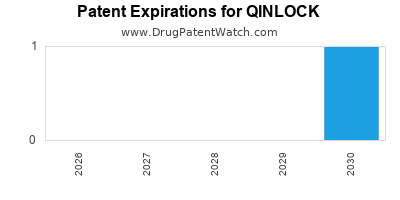
Drug patent expirations by year for QINLOCK
Drug Prices for QINLOCK

See drug prices for QINLOCK

DrugPatentWatch® Estimated Loss of Exclusivity (LOE) Date for QINLOCK
Generic Entry Date for QINLOCK*:
Constraining patent/regulatory exclusivity:
NDA:
Dosage:
TABLET;ORAL

*The generic entry opportunity date is the latter of the last compound-claiming patent and the last regulatory exclusivity protection. Many factors can influence early or later generic entry. This date is provided as a rough estimate of generic entry potential and should not be used as an independent source.

Recent Clinical Trials for QINLOCK

Identify potential brand extensions & 505(b)(2) entrants

SponsorPhase
Deciphera Pharmaceuticals LLCPhase 1

See all QINLOCK clinical trials

US Patents and Regulatory Information for QINLOCK

QINLOCK is protected by forty-one US patents and two FDA Regulatory Exclusivities.

Based on analysis by DrugPatentWatch, the earliest date for a generic version of QINLOCK is ⤷  Get Started Free.

This potential generic entry date is based on patent 11,185,535.

Generics may enter earlier, or later, based on new patent filings, patent extensions, patent invalidation, early generic licensing, generic entry preferences, and other factors.

Applicant Tradename Generic Name Dosage NDA Approval Date TE Type RLD RS Patent No. Patent Expiration Product Substance Delist Req. Exclusivity Expiration
Deciphera Pharms QINLOCK ripretinib TABLET;ORAL 213973-001 May 15, 2020 RX Yes Yes 11,911,370 ⤷  Get Started Free Y ⤷  Get Started Free
Deciphera Pharms QINLOCK ripretinib TABLET;ORAL 213973-001 May 15, 2020 RX Yes Yes 8,188,113 ⤷  Get Started Free Y Y ⤷  Get Started Free
Deciphera Pharms QINLOCK ripretinib TABLET;ORAL 213973-001 May 15, 2020 RX Yes Yes 11,576,903 ⤷  Get Started Free Y ⤷  Get Started Free
Deciphera Pharms QINLOCK ripretinib TABLET;ORAL 213973-001 May 15, 2020 RX Yes Yes 8,461,179 ⤷  Get Started Free Y Y ⤷  Get Started Free
>Applicant >Tradename >Generic Name >Dosage >NDA >Approval Date >TE >Type >RLD >RS >Patent No. >Patent Expiration >Product >Substance >Delist Req. >Exclusivity Expiration

EU/EMA Drug Approvals for QINLOCK

Company Drugname Inn Product Number / Indication Status Generic Biosimilar Orphan Marketing Authorisation Marketing Refusal
Deciphera Pharmaceuticals (Netherlands) B.V. Qinlock ripretinib EMEA/H/C/005614Qinlock is indicated for the treatment of adult patients with advanced gastrointestinal stromal tumour (GIST) who have received prior treatment with three or more kinase inhibitors, including imatinib. Authorised no no yes 2021-11-18
>Company >Drugname >Inn >Product Number / Indication >Status >Generic >Biosimilar >Orphan >Marketing Authorisation >Marketing Refusal

International Patents for QINLOCK

When does loss-of-exclusivity occur for QINLOCK?

Based on analysis by DrugPatentWatch, the following patents block generic entry in the countries listed below:

Argentina

Patent: 2354
Patent: FORMULACIONES DE INHIBIDORES DE LA CINASA AMORFA Y MÉTODOS DE ESTAS
Estimated Expiration: ⤷  Get Started Free

Patent: 2355
Patent: COMPOSICIONES DE 1-(4-BROMO-5-(1-ETIL-7-(METILAMINO)-2-OXO-1,2- DIHIDRO-1,6-NAFTIRIDIN-3-YL)-2-FLUOROFENIL)-3-FENILUREA
Estimated Expiration: ⤷  Get Started Free

Australia

Patent: 20417282
Patent: Compositions of 1-(4-bromo-5-(1-ethyl-7-(methylamino)-2-oxo-1,2-dihydro-1,6-naphthyridin-3-yl)-2-fluorophenyl)-3-phenylurea
Estimated Expiration: ⤷  Get Started Free

Patent: 20419197
Patent: Amorphous kinase inhibitor formulations and methods of use thereof
Estimated Expiration: ⤷  Get Started Free

Patent: 23241368
Patent: Compositions of 1-(4-bromo-5-(1-ethyl-7-(methylamino)-2-oxo-1,2-dihydro-1,6-naphthyridin-3-yl)-2-fluorophenyl)-3-phenylurea
Estimated Expiration: ⤷  Get Started Free

Patent: 23248048
Patent: Amorphous kinase inhibitor formulations and methods of use thereof
Estimated Expiration: ⤷  Get Started Free

Patent: 24227597
Patent: Amorphous kinase inhibitor formulations and methods of use thereof
Estimated Expiration: ⤷  Get Started Free

Patent: 24259742
Patent: Compositions of 1-(4-bromo-5-(1-ethyl-7-(methylamino)-2-oxo-1,2-dihydro-1,6-naphthyridin-3-yl)-2-fluorophenyl)-3-phenylurea
Estimated Expiration: ⤷  Get Started Free

Brazil

Patent: 2022013109
Patent: FORMULAÇÕES DE INIBIDOR DE QUINASE AMORFO E MÉTODOS DE USO DAS MESMAS
Estimated Expiration: ⤷  Get Started Free

Patent: 2022013169
Patent: COMPOSIÇÕES DE 1-(4-BROMO-5-(1-ETIL-7-(METILAMINO)-2-OXO-1,2-DIIDRO-1,6-NAFTIRIDIN-3-IL)-2-FLUOROFEIL)-3-FENILUREA
Estimated Expiration: ⤷  Get Started Free

Canada

Patent: 63051
Patent: COMPOSITIONS DE 1-(4-BROMO-5-(1-ETHYL-7-(METHYLAMINO)-2-OXO-1,2-DIHYDRO -1,6-NAPHTHYRIDINE-3-YL)-2-FLUOROPHENYL)-3-PHENYLUREE (COMPOSITIONS OF 1-(4-BROMO-5-(1-ETHYL-7-(METHYLAMINO)-2-OXO-1,2-DIHYDRO-1,6-NAPHTHYRIDIN-3-YL)-2-FLUOROPHENYL)-3-PHENYLUREA)
Estimated Expiration: ⤷  Get Started Free

Patent: 63053
Patent: FORMULATIONS D'INHIBITEUR DE KINASE AMORPHE ET LEURS PROCEDES D'UTILISATION (AMORPHOUS KINASE INHIBITOR FORMULATIONS AND METHODS OF USE THEREOF)
Estimated Expiration: ⤷  Get Started Free

China

Patent: 5135308
Patent: 非晶型激酶抑制剂制剂及其使用方法 (Amorphous kinase inhibitor formulations and methods of use thereof)
Estimated Expiration: ⤷  Get Started Free

Patent: 5243681
Patent: 1-(4-溴-5-(1-乙基-7-(甲氨基)-2-侧氧基-1,2-二氢-1,6-萘啶-3-基)-2-氟苯基)-3-苯基脲的组合物 (Compositions of 1-(4-bromo-5-(1-ethyl-7-(methylamino)-2-pendant oxy-1, 2-dihydro-1, 6-naphthyridin-3-yl)-2-fluorophenyl)-3-phenylurea)
Estimated Expiration: ⤷  Get Started Free

Patent: 8948772
Patent: 1-(4溴-5-(1乙基-7-(甲氨基)-2侧氧基-1,2-二氢-1,6-萘啶-3基)-2氟苯基)-3-苯基脲的组合物 (Compositions of 1-(4 bromo-5-(1 ethyl-7-(methylamino)-2-pendant oxy-1, 2-dihydro-1, 6-naphthyridin-3-yl)-2 fluorophenyl)-3-phenylurea)
Estimated Expiration: ⤷  Get Started Free

Patent: 8948773
Patent: 1-(4溴-5-(1乙基-7-(甲氨基)-2侧氧基-1,2-二氢-1,6-萘啶-3基)-2氟苯基)-3-苯基脲的组合物 (Compositions of 1-(4 bromo-5-(1 ethyl-7-(methylamino)-2-pendant oxy-1, 2-dihydro-1, 6-naphthyridin-3-yl)-2 fluorophenyl)-3-phenylurea)
Estimated Expiration: ⤷  Get Started Free

Patent: 8948774
Patent: 1-(4溴-5-(1乙基-7-(甲氨基)-2侧氧基-1,2-二氢-1,6-萘啶-3基)-2氟苯基)-3-苯基脲的组合物 (Compositions of 1-(4 bromo-5-(1 ethyl-7-(methylamino)-2-pendant oxy-1, 2-dihydro-1, 6-naphthyridin-3-yl)-2 fluorophenyl)-3-phenylurea)
Estimated Expiration: ⤷  Get Started Free

Patent: 9950433
Patent: 非晶型激酶抑制剂制剂及其使用方法 (Amorphous kinase inhibitor formulations and methods of use thereof)
Estimated Expiration: ⤷  Get Started Free

Patent: 9970649
Patent: 非晶型激酶抑制剂制剂及其使用方法 (Amorphous kinase inhibitor formulations and methods of use thereof)
Estimated Expiration: ⤷  Get Started Free

Croatia

Patent: 0231699
Estimated Expiration: ⤷  Get Started Free

Patent: 0241699
Estimated Expiration: ⤷  Get Started Free

Denmark

Patent: 84778
Estimated Expiration: ⤷  Get Started Free

Patent: 84779
Estimated Expiration: ⤷  Get Started Free

European Patent Office

Patent: 84778
Patent: FORMULATIONS D'INHIBITEUR DE KINASE AMORPHE ET LEURS PROCÉDÉS D'UTILISATION (AMORPHOUS KINASE INHIBITOR FORMULATIONS AND METHODS OF USE THEREOF)
Estimated Expiration: ⤷  Get Started Free

Patent: 84779
Patent: COMPOSITIONS DE 1-(4-BROMO-5-(1-ÉTHYL-7-(MÉTHYLAMINO)-2-OXO-1,2-DIHYDRO -1,6-NAPHTHYRIDINE-3-YL)-2-FLUOROPHÉNYL)-3-PHÉNYLUREE (COMPOSITIONS OF 1-(4-BROMO-5-(1-ETHYL-7-(METHYLAMINO)-2-OXO-1,2-DIHYDRO-1,6-NAPHTHYRIDIN-3-YL)-2-FLUOROPHENYL)-3-PHENYLUREA)
Estimated Expiration: ⤷  Get Started Free

Patent: 27827
Patent: FORMULATIONS D'INHIBITEURS DE KINASE AMORPHE ET LEURS PROCÉDÉS D'UTILISATION (AMORPHOUS KINASE INHIBITOR FORMULATIONS AND METHODS OF USE THEREOF)
Estimated Expiration: ⤷  Get Started Free

Patent: 01931
Patent: COMPOSITIONS DE 1-(4-BROMO-5-(1-ETHYL-7-(METHYLAMINO)-2-OXO-1,2-DIHYDRO-1,6-NAPHTHYRIDIN-3-YL)-2-FLUOROPHEYL)-3-PHENYLUREE (COMPOSITIONS OF 1-(4-BROMO-5-(1-ETHYL-7-(METHYLAMINO)-2-OXO-1,2-DIHYDRO-1,6-NAPHTHYRIDIN-3-YL)-2-FLUOROPHEYL)-3-PHENYLUREA)
Estimated Expiration: ⤷  Get Started Free

Finland

Patent: 84778
Estimated Expiration: ⤷  Get Started Free

Patent: 84779
Estimated Expiration: ⤷  Get Started Free

Hungary

Patent: 65493
Estimated Expiration: ⤷  Get Started Free

Patent: 70151
Estimated Expiration: ⤷  Get Started Free

Israel

Patent: 3864
Patent: תכשירים של 1-(4-bromo-5-(1-ethyl-7-(methylamino)-2-oxo-1,2-dihydro-1,6-naphthyridin-3-yl)-2-fluorophenyl)-3-phenylurea (Compositions of 1-(4-bromo-5-(1-ethyl-7-(methylamino)-2-oxo-1,2-dihydro-1,6-naphthyridin-3-yl)-2-fluorophenyl)-3-phenylurea)
Estimated Expiration: ⤷  Get Started Free

Patent: 3866
Patent: הרכבים של מעכבי קינאז אמורפיים ושיטות לשימוש בהם (Amorphous kinase inhibitor formulations and methods of use thereof)
Estimated Expiration: ⤷  Get Started Free

Japan

Patent: 34416
Estimated Expiration: ⤷  Get Started Free

Patent: 95672
Estimated Expiration: ⤷  Get Started Free

Patent: 23509628
Patent: 1-(4-ブロモ-5-(1-エチル-7-(メチルアミノ)-2-オキソ-1,2-ジヒドロ-1,6-ナフチリジン-3-イル)-2-フルオロフェニル)-3-フェニル尿素の組成物
Estimated Expiration: ⤷  Get Started Free

Patent: 23509629
Patent: 非晶質キナーゼ阻害剤の製剤およびその使用方法
Estimated Expiration: ⤷  Get Started Free

Patent: 24097009
Patent: 1-(4-ブロモ-5-(1-エチル-7-(メチルアミノ)-2-オキソ-1,2-ジヒドロ-1,6-ナフチリジン-3-イル)-2-フルオロフェニル)-3-フェニル尿素の組成物 (COMPOSITIONS OF 1-(4-BROMO-5-(1-ETHYL-7-(METHYLAMINO)-2-OXO-1,2-DIHYDRO-1,6-NAPHTHYRIDIN-3-YL)-2-FLUOROPHENYL)-3-PHENYLUREA)
Estimated Expiration: ⤷  Get Started Free

Patent: 25028954
Patent: 非晶質キナーゼ阻害剤の製剤およびその使用方法 (AMORPHOUS KINASE INHIBITOR FORMULATIONS AND METHODS OF USE THEREOF)
Estimated Expiration: ⤷  Get Started Free

Lithuania

Patent: 84778
Estimated Expiration: ⤷  Get Started Free

Patent: 84779
Estimated Expiration: ⤷  Get Started Free

Mexico

Patent: 22008097
Patent: COMPOSICIONES DE 1-(4-BROMO-5-(1-ETIL-7-(METILAMINO)-2-OXO-1,2-DIH IDRO-1,6-NAFTIRIDIN-3-YL)-2-FLUOROFEIL)-3-FENILUREA. (COMPOSITIONS OF 1-(4-BROMO-5-(1-ETHYL-7-(METHYLAMINO)-2-OXO-1,2-D IHYDRO-1,6-NAPHTHYRIDIN-3-YL)-2-FLUOROPHENYL)-3-PHENYLUREA.)
Estimated Expiration: ⤷  Get Started Free

Patent: 22008103
Patent: FORMULACIONES DE INHIBIDORES DE LA CINASA AMORFA Y METODOS DE ESTAS. (AMORPHOUS KINASE INHIBITOR FORMULATIONS AND METHODS OF USE THEREOF.)
Estimated Expiration: ⤷  Get Started Free

Poland

Patent: 84778
Estimated Expiration: ⤷  Get Started Free

Patent: 84779
Estimated Expiration: ⤷  Get Started Free

Portugal

Patent: 84778
Estimated Expiration: ⤷  Get Started Free

Patent: 84779
Estimated Expiration: ⤷  Get Started Free

San Marino

Patent: 02300467
Estimated Expiration: ⤷  Get Started Free

Patent: 02400484
Estimated Expiration: ⤷  Get Started Free

Serbia

Patent: 058
Patent: FORMULACIJE INHIBITORA AMORFNE KINAZE I POSTUPCI NJIHOVE PRIMENE (AMORPHOUS KINASE INHIBITOR FORMULATIONS AND METHODS OF USE THEREOF)
Estimated Expiration: ⤷  Get Started Free

Patent: 335
Patent: KOMPOZICIJE 1-(4-BROMO-5-(1-ETIL-7-(METILAMINO)-2-OKSO-1,2-DIHIDRO-1,6-NAFTIRIDIN-3-IL)-2-FLUOROFENIL)-3-FENILUREA (COMPOSITIONS OF 1-(4-BROMO-5-(1-ETHYL-7-(METHYLAMINO)-2-OXO-1,2-DIHYDRO-1,6-NAPHTHYRIDIN-3-YL)-2-FLUOROPHENYL)-3-PHENYLUREA)
Estimated Expiration: ⤷  Get Started Free

Slovenia

Patent: 84778
Estimated Expiration: ⤷  Get Started Free

Patent: 84779
Estimated Expiration: ⤷  Get Started Free

South Korea

Patent: 2800493
Estimated Expiration: ⤷  Get Started Free

Patent: 220123057
Patent: 비정질 키나아제 억제제 제형 및 이의 사용 방법
Estimated Expiration: ⤷  Get Started Free

Patent: 220123058
Patent: 1--3-페닐우레아의 조성물
Estimated Expiration: ⤷  Get Started Free

Patent: 250057151
Patent: 1--3-페닐우레아의조성물 (1-4--5-1--7--2--12--16--3--2--3- COMPOSITIONS OF 1-4-BROMO-5-1-ETHYL-7-METHYLAMINO-2-OXO-12-DIHYDRO-16-NAPHTHYRIDIN-3-YL-2-FLUOROPHENYL-3-PHENYLUREA)
Estimated Expiration: ⤷  Get Started Free

Patent: 250060322
Patent: 비정질 키나아제 억제제 제형 및 이의 사용 방법 (AMORPHOUS KINASE INHIBITOR FORMULATIONS AND METHODS OF USE THEREOF)
Estimated Expiration: ⤷  Get Started Free

Spain

Patent: 66336
Estimated Expiration: ⤷  Get Started Free

Patent: 91414
Estimated Expiration: ⤷  Get Started Free

Taiwan

Patent: 2136257
Patent: Amorphous kinase inhibitor formulations and methods of use thereof
Estimated Expiration: ⤷  Get Started Free

Patent: 2136258
Patent: Compositions of 1-(4-bromo-5-(1-ethyl-7-(methylamino)-2-oxo-1,2-dihydro-1,6-naphthyridin-3-yl)-2-fluoropheyl)-3-phenylurea
Estimated Expiration: ⤷  Get Started Free

Generics may enter earlier, or later, based on new patent filings, patent extensions, patent invalidation, early generic licensing, generic entry preferences, and other factors.

See the table below for additional patents covering QINLOCK around the world.

Country Patent Number Title Estimated Expiration
Finland 4084778 ⤷  Get Started Free
Mexico 2009002813 ⤷  Get Started Free
Brazil 112022013109 FORMULAÇÕES DE INIBIDOR DE QUINASE AMORFO E MÉTODOS DE USO DAS MESMAS ⤷  Get Started Free
Japan 2022544778 脊椎配向システム ⤷  Get Started Free
>Country >Patent Number >Title >Estimated Expiration

Market Dynamics and Financial Trajectory for the Pharmaceutical Drug: QINLOCK

Last updated: July 27, 2025


Introduction

QINLOCK (ripretinib) emerges as a targeted therapy for advanced gastrointestinal stromal tumors (GIST), a rare mesenchymal neoplasm primarily arising in the stomach or small intestine. Approved by the U.S. Food and Drug Administration (FDA) in 2020 for the treatment of adults with advanced GIST who have received prior systemic therapy, QINLOCK represents a significant advancement in the oncological landscape[1]. This analysis delineates the market dynamics influencing QINLOCK's trajectory and assesses its financial outlook within the broader pharmaceutical ecosystem.


Market Size and Unmet Need

GIST accounts for approximately 1-3% of all gastrointestinal tumors, with an estimated incidence of 10-15 cases per million annually[2]. Despite its rarity, the disease's targeted treatment regimen sustains a significant unmet medical need, especially for patients with advanced, refractory disease. The current standard of care primarily involves tyrosine kinase inhibitors (TKIs) such as imatinib, sunitinib, and regorafenib. However, resistance develops over time, rendering these therapies less effective and underscoring the necessity for novel agents like QINLOCK[3].

The initial market potential is constrained by the rarity of the condition, but the high therapeutic value and expansion into earlier lines of therapy bolster revenue prospects.


Market Dynamics Influencing QINLOCK

1. Competitive Landscape

QINLOCK's arrival introduced a new class of mutation-specific inhibitors aimed at overcoming resistance to first-line TKIs. While drugs like imatinib dominate early treatment, second- and third-line options such as ripretinib target resistant mutations, positioning QINLOCK favorably. Existing competitors include avapritinib (AYVAKYT) and ripretinib itself, among others in clinical development. The differentiation hinges on efficacy in resistant mutations and tolerability profiles.

2. Regulatory Environment

The accelerated approval pathways associated with orphan indications have expedited QINLOCK's market entry. Post-marketing commitments and continued data collection are critical, especially with potential label expansions, which could extend beyond GIST to other KIT or PDGFRA mutation-driven tumors[4].

3. Pricing and Reimbursement

Pricing strategies are aligned with the orphan drug premium, often reflecting high development costs and the limited patient pool. Reimbursement decisions by payers will significantly influence uptake, particularly in key markets such as the U.S. and Europe. Demonstrable clinical benefits are essential for favorable reimbursement status.

4. Clinical Adoption & Physician Preferences

Physician acceptance hinges on demonstrated superior efficacy and manageable safety profiles. Awareness campaigns and inclusion in clinical guidelines further drive adoption. Real-world evidence (RWE) will bolster credibility and facilitate wider utilization.

5. Market Penetration & Geographic Expansion

Initially focused on North America and Europe, expansion into emerging markets presents significant growth opportunities, albeit countered by challenges such as cost constraints and healthcare infrastructure differences.


Financial Trajectory

1. Revenue Projections

QINLOCK generated approximately $150 million in global sales in its first year post-approval (2021), with estimates projecting a compound annual growth rate (CAGR) of 20-25% over the next five years[5]. Sales are expected to be driven by increased adoption in second-line settings and potential authorization in first-line treatment, contingent upon ongoing trial results.

2. Cost Structure and Profitability

Initial R&D expenditure encompassed clinical trials, regulatory filings, and manufacturing scale-up, totaling hundreds of millions of dollars. As patent protection stabilizes, profit margins are anticipated to improve, particularly with increased market share and streamlined production costs.

3. Future Investment and Pipeline Development

Companies expect continued investment in expanding QINLOCK’s indications and developing next-generation inhibitors to combat resistance. Such pipeline advancements may sustain long-term revenues beyond current indications.

4. Market Risks Affecting Financial Performance

Key risks include competition from emerging therapies, regulatory setbacks, payer reimbursement barriers, and potential safety concerns. Market-facing strategies will need agility to adapt to evolving healthcare landscapes.


Strategic Opportunities and Challenges

Opportunities:

  • Label Expansion: Demonstrating efficacy in earlier lines of therapy or other KIT/PDGFRA mutation-driven conditions could significantly escalate revenues.
  • Combination Therapies: Synergistic regimens incorporating QINLOCK may improve outcomes, opening new treatment paradigms.
  • Biomarker-driven Precision Medicine: Tailoring therapy based on mutation profiles enhances clinical efficacy and could command premium pricing.

Challenges:

  • Market Penetration in Rarity: Limited patient population constrains overall sales but emphasizes the importance of high-value treatment.
  • Competitive Innovation: Rapid advancements in targeted oncology agents could dilute market share.
  • Reimbursement and Access Barriers: Cost considerations may delay adoption, especially in publicly funded healthcare systems.

Conclusion

QINLOCK presents a compelling case study of a targeted therapy navigating a niche yet high-value oncology market. Its financial trajectory promises steady growth fueled by unmet medical need, strategic market positioning, and ongoing clinical validation. Optimal success hinges on expansion into broader indications, strong payer and physician engagement, and vigilant management of competitive pressures.


Key Takeaways

  • Market potential for QINLOCK remains robust within the rare GIST segment, driven by its role in overcoming treatment resistance.
  • Strategic expansion into earlier lines and parallel indications could multiply revenues.
  • Pricing strategies and reimbursement policies are critical in maximizing market penetration.
  • Clinical outcomes and real-world data will shape adoption and influence future regulatory approvals.
  • Investment in pipeline development and combination therapies enhances sustainability and competitive edge.

FAQs

Q1: What is the primary mechanism of action of QINLOCK?
QINLOCK inhibits KIT and PDGFRA kinases, including mutant forms responsible for resistance in GIST, thereby stabilizing disease progression.

Q2: How does QINLOCK differentiate from other TKIs in GIST?
QINLOCK specifically targets resistant mutations, offering an effective option for patients who progress after standard TKIs like imatinib.

Q3: What are the main challenges in the commercial success of QINLOCK?
Challenges include market penetration limited by the rarity of GIST, high drug costs, payer reimbursement hurdles, and competition from emerging agents.

Q4: Are there ongoing clinical trials expanding QINLOCK’s indications?
Yes, trials are investigating QINLOCK in earlier lines of therapy and other tumor types driven by KIT or PDGFRA mutations.

Q5: What is the outlook for QINLOCK’s market share in the coming years?
With increasing adoption, label expansions, and successful pipeline development, QINLOCK’s market share is projected to grow steadily over the next five years.


References

[1] U.S. Food and Drug Administration. (2020). FDA Approves Ripretinib for Advanced GIST.
[2] Demetri, G. D., et al. (2019). Gastrointestinal stromal tumors: biology and treatment advances. Nature Reviews Clinical Oncology.
[3] Joensuu, H., et al. (2020). Recent advances in gastrointestinal stromal tumor management. Nature Reviews Clinical Oncology.
[4] FDA. (2021). Post-marketing commitments for ripretinib.
[5] EvaluatePharma. (2022). Market Intelligence Report: Oncology Drugs.

More… ↓

⤷  Get Started Free

Make Better Decisions: Try a trial or see plans & pricing

Drugs may be covered by multiple patents or regulatory protections. All trademarks and applicant names are the property of their respective owners or licensors. Although great care is taken in the proper and correct provision of this service, thinkBiotech LLC does not accept any responsibility for possible consequences of errors or omissions in the provided data. The data presented herein is for information purposes only. There is no warranty that the data contained herein is error free. We do not provide individual investment advice. This service is not registered with any financial regulatory agency. The information we publish is educational only and based on our opinions plus our models. By using DrugPatentWatch you acknowledge that we do not provide personalized recommendations or advice. thinkBiotech performs no independent verification of facts as provided by public sources nor are attempts made to provide legal or investing advice. Any reliance on data provided herein is done solely at the discretion of the user. Users of this service are advised to seek professional advice and independent confirmation before considering acting on any of the provided information. thinkBiotech LLC reserves the right to amend, extend or withdraw any part or all of the offered service without notice.