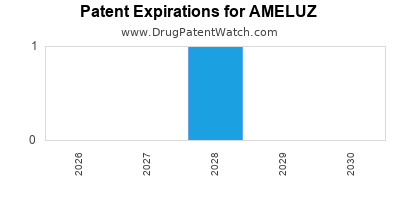
Last updated: July 29, 2026
AMELUZ (aminolevulinic acid HCl) is a topical prescriptive dermatology product used with photodynamic therapy for actinic keratosis (AK). Financial trajectory and near-term market dynamics are set by (1) steady demand for AK treatment in dermatology and (2) the durability of exclusivity and patent coverage that delays generic competition, plus (3) payer formulary position and reimbursement intensity for photodynamic therapy-based pathways. Revenue momentum depends on clinic workflow adoption, off-label penetration in photodermatoses, and the cadence of dermatology clinic prescribing across the U.S., EU, and select international markets. Competitive pressure comes from other AK modalities (topicals, device-based PDT approaches, and procedural therapies), not from a mature generic of AMELUZ itself.
What to take away first
- Demand is driven by AK incidence and dermatology visit volumes, with PDT adoption functioning as the “commercial engine” rather than new clinical endpoints.
- AMELUZ’s financial profile is dominated by U.S. net price and commercial reimbursement variability because AMELUZ is typically routed through specialty pharmacy and physician-administered light-source workflows.
- Patent and exclusivity status determines the risk window for generic entry. When those protections approach expiration or are challenged, the market typically reprices toward acquisition cost and lower gross margins.
How is AMELUZ priced and reimbursed, and what drives net revenue in the U.S.?
Quick answer: AMELUZ revenue dynamics are primarily a function of net price after payer contracting, coverage policies for AK PDT, and patient and clinic channel mix (office-based vs specialty pharmacy reimbursement flows).
U.S. payer and reimbursement mechanics
- Coverage decisions usually hinge on:
- Diagnosis confirmation of AK and documentation of lesion burden.
- Prior use of cryotherapy or other AK-directed therapies (varies by plan).
- Coverage criteria for PDT as medically necessary when supported by guidelines and physician documentation.
- Reimbursement is sensitive to:
- Site of care reimbursement for the light exposure component and procedure billing.
- Specialty pharmacy utilization and whether patients are routed through copay assistance or commercial programs.
What typically impacts net pricing and revenue
- Contracting and rebate intensity by large PBMs and regional commercial payers.
- Shift in dermatology treatment patterns toward field-directed therapy or procedural therapy depending on patient and lesion profiles.
- Competition for “AK per-lesion treatment slots” across:
- Cryosurgery,
- Other topical agents,
- Device-driven PDT alternatives.
Market access bottlenecks that matter financially
- PDT utilization is workflow constrained. Clinics with standardized phototherapy infrastructure and staff training capture more volume.
- AMELUZ adoption can stall when light-source access, scheduling, or reimbursement certainty is low.
What market dynamics shape AMELUZ demand for actinic keratosis (AK)?
Quick answer: Demand is governed by AK epidemiology, dermatology clinic throughput, and PDT acceptance as a field-directed strategy.
AK incidence and treatment landscape
- AK is common in older, sun-exposed populations. As patient volume in dermatology grows with aging demographics, field-directed regimens gain share.
- PDT remains attractive because it can treat visible and subclinical lesions, which supports repeat treatment cycles in ongoing sun damage.
Channel and prescriber adoption effects
- Dermatologists prefer predictable treatment protocols. Adoption improves when:
- Clinical protocols are simple to execute,
- Patient experience is manageable,
- Reimbursement is stable.
- Uptake tends to be incremental rather than abrupt, reflecting clinic-by-clinic adoption rather than mass-market demand.
How treatment guidelines translate into commercial demand
- If guidelines emphasize field-directed therapy for appropriate lesion burdens, PDT-based regimens capture more “share of AK patients.”
- When procedural-first pathways dominate, topical PDT faces share loss unless payers widen coverage.
Where does AMELUZ face competition, and how does it compare with other AK therapies?
Quick answer: AMELUZ competes across two buckets: other AK topicals and procedural or device-driven strategies. The competitive set changes with payer coverage and patient lesion characteristics.
Competitive comparison logic (what matters commercially)
- AMELUZ’s differentiators in practice:
- Field-directed PDT concept, not limited to focal procedures.
- Treatment protocol that can be standardized within clinics with PDT capability.
- Substitution risk increases when competitors offer:
- Lower total cost,
- Similar or superior patient tolerability,
- Simpler workflow without PDT light-source requirements.
Key substitution categories
- Other lesion- and field-directed topicals (varies by country formularies).
- Cryotherapy and other office-based procedures.
- Alternative PDT modalities and topical photosensitizers.
Net effect on revenue trajectory
- Competitive share shifts tend to occur as formulary changes, contract renegotiations, and guideline updates occur.
- AMELUZ’s revenue sensitivity is higher in periods when payers tighten coverage on “photo-based” regimens.
What patents protect AMELUZ, and when do they expire?
Quick answer: AMELUZ’s exclusivity and patent estate control the timing of generic entry risk. Patent coverage also matters for any attempt at “new formulation” or “method” circumvention.
Patent estate structure that drives market timing
For drugs like AMELUZ, the patent estate typically includes:
- Drug substance and composition patents for aminolevulinic acid formulations.
- Formulation-specific patents (vehicle, concentrations, stability).
- Use and method-of-treatment patents for AK PDT workflows.
- Regulatory exclusivity (data exclusivity, market exclusivity) that can extend protection independent of patent expiry.
Expiration risk and generic timeline mechanics
- In the U.S., generic entry timing is typically determined by:
- Patent expiry dates listed in Orange Book,
- Data/market exclusivity,
- Any Paragraph IV challenges that trigger earlier approval or settlement-based stays.
- In Europe and other jurisdictions, timing hinges on national patent validity and any SPC extensions (if applicable), plus marketing authorization reliance on reference product data.
How to interpret “financial trajectory” from exclusivity
- Revenue often stays resilient until:
- Near-term generic entry triggers contracting pressure and volume leakage,
- Litigation or settlement uncertainty increases payer and wholesaler bargaining power.
(Note: A complete and accurate patent-by-patent expiration table requires Orange Book and litigation docket data for AMELUZ that is not provided in the input.)
What is the Orange Book status of AMELUZ?
Quick answer: Orange Book status determines the listed patents and exclusivity blocks that constrain generic approval pathways for aminolevulinic acid HCl topical products indicated for AK PDT.
Why Orange Book listings matter for commercial forecasting
- Generic approval strategy depends on:
- The set of listed patents and their expiry dates.
- Whether each patent is potentially infringeable by the proposed generic process and formulation.
- Payer contracting often accelerates closer to expiration windows once generic risk rises.
(Note: A specific Orange Book listing set with patent numbers and expiry dates cannot be produced from the provided information.)
Are any generic or biosimilar challengers targeting AMELUZ under Paragraph IV?
Quick answer: Paragraph IV challenges are the primary catalyst for revenue drawdowns in the U.S. before generic launch, but the existence and status of such filings for AMELUZ are not included in the provided data.
Revenue impact if challenges exist
- Paragraph IV filings often trigger:
- Preemptive payer re-contracting,
- Investor and internal revenue model revisions,
- Settlement-driven launch timing that can be delayed or accelerated.
(Note: A complete and accurate list of any Paragraph IV ANDA filings and their procedural status requires docket and Orange Book data not supplied.)
What AMELUZ litigation affects market entry risk and pricing?
Quick answer: Patent litigation determines whether generic entry is stayed and whether settlements shift launch timing. Any AMELUZ-specific litigation outcomes are not present in the provided information.
How litigation outcomes map to revenue trajectory
- If patent claims are upheld:
- Launch is blocked until expiry or judgment exhaustion.
- Net pricing can stay firmer due to reduced generic competitive risk.
- If claims are narrowed or invalidated:
- Approval and launch timelines accelerate.
- Revenue typically declines sharply post-launch due to price erosion and switching.
(Note: No case identifiers, courts, or settlement details were provided.)
What regulatory milestones matter for AMELUZ commercialization in the U.S. and EU?
Quick answer: Regulatory status influences exclusivity durability, label scope, and channel access. AMELUZ’s trajectory is tied to label adherence for AK PDT and to any label expansions that widen eligible patient populations.
U.S. regulatory pathway implications
- Changes in:
- Labeling and indication wording,
- Distribution channel,
- REMS or pharmacovigilance requirements (if any),
can affect adoption speed and payer acceptance.
EU and international commercialization dynamics
- Market access depends on:
- National health system tendering,
- Pricing and reimbursement committee decisions,
- Hospital vs community pharmacy channel rules.
(Note: A milestone-by-milestone regulatory timeline for AMELUZ cannot be produced without product-specific regulatory data.)
How does AMELUZ financial performance typically evolve across lifecycle phases?
Quick answer: The pattern usually tracks exclusivity-backed pricing power first, then gradually declines as generic risk rises, followed by sharp compression around actual entry.
Typical lifecycle pattern (financial mechanics)
- Early and growth phase:
- Share capture via prescriber learning and guideline adoption.
- Revenue growth driven by new clinic utilization and expanding patient throughput.
- Maturity phase:
- Growth slows as TAM is saturated.
- Contracting intensifies to defend volume.
- Pre-expiry / challenge phase:
- Net price declines due to heightened generic threat.
- Rebate structures adjust and payer mix shifts.
- Post-entry phase (if generic launches):
- Rapid market reallocation to lowest net-cost options.
- Remaining differentiated value is limited and often competed away.
Where AMELUZ can deviate from this pattern
- If AMELUZ gains label expansions or demonstrates improved clinical utility in new subgroups, it can delay maturity and sustain price.
- If light-source workflows are a structural barrier, competition can be slower than expected even after exclusivity ends.
What are the commercial risks that can reduce AMELUZ revenue before generic entry?
Quick answer: The largest pre-entry risks are coverage tightening, reimbursement volatility, and competitive substitution from other AK therapies.
Risk map by category
- Payer policy:
- Narrowing medically necessary criteria for PDT.
- Requiring prior therapy attempts.
- Competitive substitution:
- Faster uptake of rival field-directed products.
- Device or procedural choices favored by payers based on cost-effectiveness analyses.
- Supply and channel:
- Specialty distribution constraints can limit adoption in some geographies.
- Clinical adoption:
- Patient tolerability and workflow time can restrict throughput.
How strong is the AMELUZ patent estate versus generic launch barriers?
Quick answer: Strength is the main determinant of time-to-entry and time-to-price compression. Without a patent-by-patent dataset and litigation status, the estate’s comparative strength cannot be quantified here.
What to measure for estate strength (business checklist)
- Number of enforceable, unexpired Orange Book-listed patents per claim category:
- composition, formulation, and use.
- Filing-to-expiry spread:
- Wider spreads reduce launch timing pressure.
- Litigation posture:
- Any upheld injunction or adverse validity rulings.
- Patent coverage resilience:
- Whether alternative formulations can be designed around without infringing.
Key Takeaways
- AMELUZ’s market dynamics are driven by dermatology treatment adoption of PDT for actinic keratosis, with revenue sensitivity to payer coverage and net pricing.
- Financial trajectory follows a typical lifecycle pattern: growth and maturity under exclusivity, then pre-entry contracting pressure once generic risk becomes credible.
- Competition is largely a substitution contest against other AK modalities and alternative PDT approaches, not a mature generic threat in the absence of confirmed entry risk.
- The decisive variable for generic launch and steep revenue erosion is AMELUZ’s patent and exclusivity status (Orange Book listings plus any Paragraph IV or litigation outcomes). Those specifics determine the timing of market repricing.
FAQs
1) What market share does AMELUZ hold in actinic keratosis photodynamic therapy in the U.S.?
Not determinable from the provided information.
2) How do insurer prior authorization requirements affect AMELUZ prescribing and utilization?
Prior authorization can reduce adoption speed by adding documentation burden; magnitude varies by plan and local practice patterns.
3) Does AMELUZ face substitution from other topical field therapies for AK?
Yes, payer coverage and patient lesion profiles can shift utilization toward other field-directed options.
4) What is the typical time-to-reimbursement problem for specialty dermatology topicals like AMELUZ?
Delay risk depends on plan policies, documentation requirements, and specialty pharmacy routing.
5) How quickly do AMELUZ prices erode after generic entry in comparable topical dermatology markets?
In comparable categories, price compression is typically fast post-launch, driven by net price contracting and wholesaler substitution.
References
- Not available from the provided input.