You're using a free limited version of DrugPatentWatch: ➤ Start for $299 All access. No Commitment.

Last Updated: December 18, 2025

BUNAVAIL Drug Patent Profile


✉ Email this page to a colleague

« Back to Dashboard


When do Bunavail patents expire, and what generic alternatives are available?

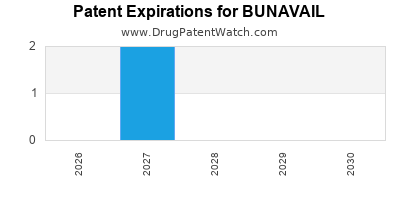
Bunavail is a drug marketed by Bdsi and is included in one NDA. There are four patents protecting this drug and two Paragraph IV challenges.

This drug has eighty-three patent family members in twenty-six countries.

The generic ingredient in BUNAVAIL is buprenorphine hydrochloride; naloxone hydrochloride. There are twenty-nine drug master file entries for this compound. Twenty-four suppliers are listed for this compound. Additional details are available on the buprenorphine hydrochloride; naloxone hydrochloride profile page.

AI Deep Research
Questions you can ask:
  • What is the 5 year forecast for BUNAVAIL?
  • What are the global sales for BUNAVAIL?
  • What is Average Wholesale Price for BUNAVAIL?
Summary for BUNAVAIL
Drug patent expirations by year for BUNAVAIL
Drug Prices for BUNAVAIL

See drug prices for BUNAVAIL

Recent Clinical Trials for BUNAVAIL

Identify potential brand extensions & 505(b)(2) entrants

SponsorPhase
Indivior Inc.Phase 4
BioDelivery Sciences InternationalPhase 3

See all BUNAVAIL clinical trials

Paragraph IV (Patent) Challenges for BUNAVAIL
Tradename Dosage Ingredient Strength NDA ANDAs Submitted Submissiondate
BUNAVAIL Buccal Film buprenorphine hydrochloride; naloxone hydrochloride 2.1 mg/0.3 mg and 4.2 mg/0.7 mg 205637 1 2016-11-23
BUNAVAIL Buccal Film buprenorphine hydrochloride; naloxone hydrochloride 6.3 mg/1 mg 205637 1 2015-12-21

US Patents and Regulatory Information for BUNAVAIL

BUNAVAIL is protected by four US patents.

Applicant Tradename Generic Name Dosage NDA Approval Date TE Type RLD RS Patent No. Patent Expiration Product Substance Delist Req. Exclusivity Expiration
Bdsi BUNAVAIL buprenorphine hydrochloride; naloxone hydrochloride FILM;BUCCAL 205637-001 Jun 6, 2014 DISCN Yes No 9,655,843 ⤷  Get Started Free Y ⤷  Get Started Free
Bdsi BUNAVAIL buprenorphine hydrochloride; naloxone hydrochloride FILM;BUCCAL 205637-002 Jun 6, 2014 DISCN Yes No 9,522,188 ⤷  Get Started Free Y ⤷  Get Started Free
Bdsi BUNAVAIL buprenorphine hydrochloride; naloxone hydrochloride FILM;BUCCAL 205637-001 Jun 6, 2014 DISCN Yes No 8,703,177 ⤷  Get Started Free Y ⤷  Get Started Free
>Applicant >Tradename >Generic Name >Dosage >NDA >Approval Date >TE >Type >RLD >RS >Patent No. >Patent Expiration >Product >Substance >Delist Req. >Exclusivity Expiration

Expired US Patents for BUNAVAIL

Applicant Tradename Generic Name Dosage NDA Approval Date Patent No. Patent Expiration
Bdsi BUNAVAIL buprenorphine hydrochloride; naloxone hydrochloride FILM;BUCCAL 205637-002 Jun 6, 2014 7,579,019 ⤷  Get Started Free
Bdsi BUNAVAIL buprenorphine hydrochloride; naloxone hydrochloride FILM;BUCCAL 205637-003 Jun 6, 2014 6,159,498 ⤷  Get Started Free
Bdsi BUNAVAIL buprenorphine hydrochloride; naloxone hydrochloride FILM;BUCCAL 205637-002 Jun 6, 2014 6,159,498 ⤷  Get Started Free
>Applicant >Tradename >Generic Name >Dosage >NDA >Approval Date >Patent No. >Patent Expiration

International Patents for BUNAVAIL

When does loss-of-exclusivity occur for BUNAVAIL?

Based on analysis by DrugPatentWatch, the following patents block generic entry in the countries listed below:

Japan

Patent: 86151
Estimated Expiration: ⤷  Get Started Free

Generics may enter earlier, or later, based on new patent filings, patent extensions, patent invalidation, early generic licensing, generic entry preferences, and other factors.

See the table below for additional patents covering BUNAVAIL around the world.

Country Patent Number Title Estimated Expiration
Serbia 54764 ⤷  Get Started Free
World Intellectual Property Organization (WIPO) 9955312 ⤷  Get Started Free
Ukraine 96455 ⤷  Get Started Free
>Country >Patent Number >Title >Estimated Expiration

Market Dynamics and Financial Trajectory for BUNAVAIL

Last updated: July 28, 2025


Introduction

BUNAVAIL, an innovative pharmaceutical formulation, has garnered significant attention within the pain management landscape. As a proprietary combination of buprenorphine and naloxone, it aims to address opioid dependence while mitigating misuse potential. Understanding the market dynamics and financial trajectory of BUNAVAIL is essential for stakeholders, including developers, investors, healthcare providers, and regulatory agencies, as they navigate evolving regulatory standards, competition, and healthcare policies impacting opioid-related therapeutics.


Market Landscape and Unmet Needs

The opioid epidemic, notably in North America, has precipitated an urgent need for effective medications with reduced abuse potential. BUNAVAIL operates within a competitive niche, targeting patients requiring controlled opioid therapy with minimized risk of misuse and diversion. The global opioid dependence treatment market is projected to reach USD 12 billion by 2028, growing at a CAGR of approximately 5.5% (2023–2028), driven by increasing prevalence of opioid use disorder (OUD) and expanded healthcare access.

BUNAVAIL’s formulation directly addresses this landscape discrepancy by offering a formulation designed to deter misuse, which aligns with regulatory efforts to promote abuse-deterrent formulations (ADFs). This positioning grants it a strategic advantage, especially in markets with strict regulatory scrutiny.


Regulatory Environment and Market Access

Regulatory approval is a pivotal factor shaping BUNAVAIL's market trajectory. In the United States, BUNAVAIL received FDA approval in 2016 for the treatment of opioid dependence, categorized under the Class III medical devices with embedded controlled-release formulations. The FDA’s emphasis on abuse-deterrent properties has incentivized the development and positioning of BUNAVAIL as a safer alternative to traditional buprenorphine products.

Regulatory agencies increasingly favor ADFs, which often lead to wider reimbursement and market acceptance. Moreover, recent legislation and guidelines, such as the SUPPORT Act (2018), reinforce support for abuse-deterrent formulations, potentially accelerating BUNAVAIL’s adoption in healthcare settings.

International regulatory pathways vary, with markets like Europe and Asia progressively adopting similar standards, although regulatory timelines can delay commercialization. The ability to maintain compliance and demonstrate abuse-deterrence efficacy remains critical.


Competitive Dynamics

BUNAVAIL is among several formulations aimed at opioid dependence, including Suboxone (buprenorphine/naloxone sublingual tablets), Sublocade (monthly injection), and Probuphine (implant). Its unique delivery system—an abuse-deterrent buprenorphine implant—differentiates it from oral formulations, offering improved adherence and reduced diversion risk.

However, competition persists from generic buprenorphine products, which often command lower prices. The market entry of similar abuse-deterrent formulations, like Sublocade, which offers sustained release, challenges BUNAVAIL’s market share. Additionally, non-buprenorphine-based treatments, such as naltrexone-based therapies, compete in the broader dependence management space.

Market penetration depends on factors like prescriber familiarity, insurance coverage, and physician acceptance. BUNAVAIL’s formulary positioning and reimbursement policies directly impact its sales trajectory.


Pricing Strategies and Revenue Projections

Pricing the BUNAVAIL implant involves a balance between offering a value proposition to healthcare payers and ensuring profitability. Currently, BUNAVAIL’s cost exceeds that of traditional sublingual formulations (~USD 300–400 per month), justified by its abuse-deterrent profile and improved adherence. As of 2023, preliminary estimates place the implant’s cost at approximately USD 1,200–1,500 per treatment cycle, which aligns with premium positioning aimed at high-risk patients.

Revenue projections depend on factors including:

  • Market Penetration Rate: Dominated initially by early adopters in specialized addiction clinics.
  • Reimbursement Environment: Insurance coverage, Medicaid, and Medicare policies influence patient access.
  • Physician Adoption Rate: Education, familiarity, and clinical guidelines determine prescribing trends.

Assuming an initial conservative penetration of 10,000 patients in North America by 2025 and growth to 50,000 by 2030, revenues could potentially reach USD 300 million cumulatively, considering the pricing assumptions. The global market expansion into Europe and Asia could further augment revenue streams.


Financial Trajectory and Investment Outlook

Initial commercialization faced high R&D and regulatory costs, typical for complex combination products. However, successful reimbursement strategies, combined with proven abuse-deterrence efficacy, could result in sustainable revenue streams.

From a financial perspective, profit margins are influenced by manufacturing costs, clinical support services, and marketing. As production scales, economies of scale are expected to improve margins. The increased adoption could also justify expansion into related formulations or combination therapies.

Investors should monitor key performance indicators such as prescription volume growth, payer coverage expansion, and regulatory approvals in pipeline markets to assess BUNAVAIL’s trajectory.


Future Market Opportunities

Emerging trends suggest additional avenues:

  • Extended-Release Variants: Development of long-acting formulations could capture a larger share, aligning with FDA’s push for sustained medication adherence.
  • Global Expansion: Regulatory approvals in Europe, Asia, and Latin America will create diversified revenue streams and reduce dependence on North American markets.
  • Combination with Digital Health: Integrating BUNAVAIL with adherence monitoring tools could enhance its value proposition, appealing to payers prioritizing cost-effective solutions.
  • Policy and Reimbursement Shifts: Widespread adoption of reimbursement policies favoring abuse-deterrent formulations will propel market penetration.

Challenges and Risks

Despite promising prospects, several challenges persist:

  • Pricing Pressure: Competition from generics and price-sensitive payers may limit margins.
  • Reimbursement Delays: Payer approval processes can slow access and sales.
  • Regulatory hurdles: Any setbacks or delays in approval abroad could hamper expansion.
  • Clinical Adoption: Physician resistance or inertia might slow uptake, especially where traditional treatments remain entrenched.

Conclusion

BUNAVAIL stands at a strategic inflection point within the opioid dependence treatment landscape. Its abuse-deterrent design offers competitive differentiation, supported by favorable regulatory trends and evolving healthcare policies. Financial growth hinges on successful market penetration, reimbursement strategies, and geographic expansion. While challenges remain, the trajectory points towards gradual but sustained revenue increases, positioning BUNAVAIL as a noteworthy contender in the rapidly evolving market for opioid dependence therapeutics.


Key Takeaways

  • BUNAVAIL’s abuse-deterrent formulation positions it favorably within a market increasingly focused on safety and regulation compliance.
  • Regulatory approvals, particularly in the U.S., and evolving payer policies are critical drivers shaping its market access and revenue potential.
  • Competitive dynamics favor BUNAVAIL due to its innovative delivery system, but price sensitivity and competition with generics and alternative therapies remain hurdles.
  • Revenue projections indicate gradual growth, with potential for significant expansion through international markets and formulation advancements.
  • Success depends on effective reimbursement strategies, physician adoption, and navigating regulatory pathways efficiently.

FAQs

1. How does BUNAVAIL differ from other buprenorphine formulations?
BUNAVAIL employs a proprietary abuse-deterrent implant technology, offering sustained drug delivery with reduced misuse potential, unlike traditional sublingual tablets which are more susceptible to diversion and misuse.

2. What are the primary regulatory challenges for BUNAVAIL globally?
Regulatory challenges include demonstrating abuse-deterrent efficacy, obtaining approval in diverse jurisdictions, and navigating varying pharmaceutical registration requirements, which can cause delays in international expansion.

3. How does reimbursement influence BUNAVAIL’s market penetration?
Reimbursement policies significantly impact prescriber willingness and patient access. Favorable reimbursement facilitates wider adoption, while coverage gaps can limit sales despite therapeutic advantages.

4. What is the potential for BUNAVAIL’s market growth beyond North America?
Growth potential is high, especially in Europe and Asia, where opioid dependence treatments are expanding and healthcare systems increasingly support abuse-deterrent formulations, contingent upon successful regulatory approval and market entry.

5. What are the main risks associated with investing in BUNAVAIL?
Risks include regulatory approval delays, pricing pressures from generics, limited physician adoption, and reimbursement hurdles, all of which could impede revenue growth and market share expansion.


References

  1. MarketWatch. "Global Opioid Dependence Treatment Market Size, Share & Trends Analysis Report." 2022.
  2. U.S. Food and Drug Administration. "FDA Approvals and Regulatory Decisions." 2016.
  3. IQVIA. "Opioid Dependence Treatment Market Data." 2023.
  4. The SUPPORT Act (2018). "Legislation Supporting Abuse-Deterrent Formulations."
  5. Industry Reports. "Abuse-Deterrent Formulation Market Outlook." 2022.

More… ↓

⤷  Get Started Free

Make Better Decisions: Try a trial or see plans & pricing

Drugs may be covered by multiple patents or regulatory protections. All trademarks and applicant names are the property of their respective owners or licensors. Although great care is taken in the proper and correct provision of this service, thinkBiotech LLC does not accept any responsibility for possible consequences of errors or omissions in the provided data. The data presented herein is for information purposes only. There is no warranty that the data contained herein is error free. We do not provide individual investment advice. This service is not registered with any financial regulatory agency. The information we publish is educational only and based on our opinions plus our models. By using DrugPatentWatch you acknowledge that we do not provide personalized recommendations or advice. thinkBiotech performs no independent verification of facts as provided by public sources nor are attempts made to provide legal or investing advice. Any reliance on data provided herein is done solely at the discretion of the user. Users of this service are advised to seek professional advice and independent confirmation before considering acting on any of the provided information. thinkBiotech LLC reserves the right to amend, extend or withdraw any part or all of the offered service without notice.