rinvoq Drug Patent Profile
✉ Email this page to a colleague
When do Rinvoq patents expire, and when can generic versions of Rinvoq launch?
Rinvoq is a drug marketed by Abbvie and is included in two NDAs. There are forty-five patents protecting this drug and one Paragraph IV challenge.
This drug has two hundred and thirty-one patent family members in forty-one countries.
The generic ingredient in RINVOQ is upadacitinib. One supplier is listed for this compound. Additional details are available on the upadacitinib profile page.
DrugPatentWatch® Generic Entry Outlook for Rinvoq
Rinvoq was eligible for patent challenges on August 16, 2023.
By analyzing the patents and regulatory protections it appears that the earliest date
for generic entry will be October 17, 2036. This may change due to patent challenges or generic licensing.
There have been four patent litigation cases involving the patents protecting this drug, indicating strong interest in generic launch. Recent data indicate that 63% of patent challenges are decided in favor of the generic patent challenger and that 54% of successful patent challengers promptly launch generic drugs.
There are two tentative approvals for the generic drug (upadacitinib), which indicates the potential for near-term generic launch.
Indicators of Generic Entry
AI Deep Research
Questions you can ask:
- What is the 5 year forecast for rinvoq?
- What are the global sales for rinvoq?
- What is Average Wholesale Price for rinvoq?
Summary for rinvoq
| International Patents: | 231 |
| US Patents: | 45 |
| Applicants: | 1 |
| NDAs: | 2 |
| Finished Product Suppliers / Packagers: | 1 |
| Raw Ingredient (Bulk) Api Vendors: | 46 |
| Clinical Trials: | 42 |
| Patent Applications: | 1,205 |
| Drug Prices: | Drug price information for rinvoq |
| Patent Litigation and PTAB cases: | See patent lawsuits and PTAB cases for rinvoq |
| What excipients (inactive ingredients) are in rinvoq? | rinvoq excipients list |
| DailyMed Link: | rinvoq at DailyMed |
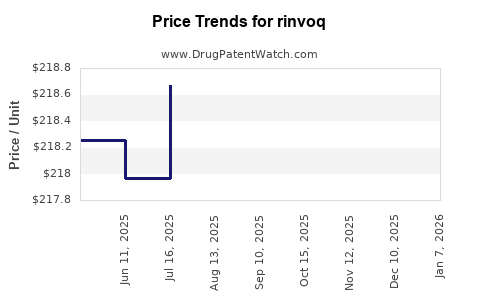
DrugPatentWatch® Estimated Loss of Exclusivity (LOE) Date for rinvoq
Generic Entry Date for rinvoq*:
Constraining patent/regulatory exclusivity:
NDA:
Dosage:
TABLET, EXTENDED RELEASE;ORAL |
*The generic entry opportunity date is the latter of the last compound-claiming patent and the last regulatory exclusivity protection. Many factors can influence early or later generic entry. This date is provided as a rough estimate of generic entry potential and should not be used as an independent source.
Recent Clinical Trials for rinvoq
Identify potential brand extensions & 505(b)(2) entrants
| Sponsor | Phase |
|---|---|
| Berinstein, Jeffrey | PHASE4 |
| AbbVie | PHASE4 |
| AbbVie | PHASE3 |
Pharmacology for rinvoq
| Drug Class | Janus Kinase Inhibitor |
| Mechanism of Action | Janus Kinase Inhibitors |
Paragraph IV (Patent) Challenges for RINVOQ
| Tradename | Dosage | Ingredient | Strength | NDA | ANDAs Submitted | Submissiondate |
|---|---|---|---|---|---|---|
| RINVOQ | Extended-release Tablets | upadacitinib | 45 mg | 211675 | 3 | 2023-08-16 |
US Patents and Regulatory Information for rinvoq
rinvoq is protected by sixty-one US patents and six FDA Regulatory Exclusivities.
Based on analysis by DrugPatentWatch, the earliest date for a generic version of rinvoq is ⤷ Start Trial.
This potential generic entry date is based on patent ⤷ Start Trial.
Generics may enter earlier, or later, based on new patent filings, patent extensions, patent invalidation, early generic licensing, generic entry preferences, and other factors.
| Applicant | Tradename | Generic Name | Dosage | NDA | Approval Date | TE | Type | RLD | RS | Patent No. | Patent Expiration | Product | Substance | Delist Req. | Exclusivity Expiration |
|---|---|---|---|---|---|---|---|---|---|---|---|---|---|---|---|
| Abbvie | RINVOQ | upadacitinib | TABLET, EXTENDED RELEASE;ORAL | 211675-002 | Jan 14, 2022 | RX | Yes | No | ⤷ Start Trial | ⤷ Start Trial | Y | Y | ⤷ Start Trial | ||
| Abbvie | RINVOQ | upadacitinib | TABLET, EXTENDED RELEASE;ORAL | 211675-003 | Mar 16, 2022 | RX | Yes | Yes | ⤷ Start Trial | ⤷ Start Trial | Y | ⤷ Start Trial | |||
| Abbvie | RINVOQ | upadacitinib | TABLET, EXTENDED RELEASE;ORAL | 211675-001 | Aug 16, 2019 | RX | Yes | No | ⤷ Start Trial | ⤷ Start Trial | Y | ⤷ Start Trial | |||
| Abbvie | RINVOQ | upadacitinib | TABLET, EXTENDED RELEASE;ORAL | 211675-002 | Jan 14, 2022 | RX | Yes | No | ⤷ Start Trial | ⤷ Start Trial | ⤷ Start Trial | ||||
| Abbvie | RINVOQ | upadacitinib | TABLET, EXTENDED RELEASE;ORAL | 211675-001 | Aug 16, 2019 | RX | Yes | No | ⤷ Start Trial | ⤷ Start Trial | Y | Y | ⤷ Start Trial | ||
| Abbvie | RINVOQ | upadacitinib | TABLET, EXTENDED RELEASE;ORAL | 211675-003 | Mar 16, 2022 | RX | Yes | Yes | ⤷ Start Trial | ⤷ Start Trial | ⤷ Start Trial | ||||
| >Applicant | >Tradename | >Generic Name | >Dosage | >NDA | >Approval Date | >TE | >Type | >RLD | >RS | >Patent No. | >Patent Expiration | >Product | >Substance | >Delist Req. | >Exclusivity Expiration |
EU/EMA Drug Approvals for rinvoq
| Company | Drugname | Inn | Product Number / Indication | Status | Generic | Biosimilar | Orphan | Marketing Authorisation | Marketing Refusal |
|---|---|---|---|---|---|---|---|---|---|
| AbbVie Deutschland GmbH & Co. KG | Rinvoq | upadacitinib | EMEA/H/C/004760Rheumatoid arthritisRINVOQ is indicated for the treatment of moderate to severe active rheumatoid arthritis in adult patients who have responded inadequately to, or who are intolerant to one or more disease-modifying anti-rheumatic drugs (DMARDs). RINVOQ may be used as monotherapy or in combination with methotrexate.Psoriatic arthritisRINVOQ is indicated for the treatment of active psoriatic arthritis in adult patients who have responded inadequately to, or who are intolerant to one or more DMARDs. RINVOQ may be used as monotherapy or in combination with methotrexate.Axial spondyloarthritisNon-radiographic axial spondyloarthritis (nr-axSpA)RINVOQ is indicated for the treatment of active non-radiographic axial spondyloarthritis in adult patients with objective signs of inflammation as indicated by elevated C-reactive protein (CRP) and/or magnetic resonance imaging (MRI), who have responded inadequately to nonsteroidal anti-inflammatory drugs (NSAIDs).Ankylosing spondylitis (AS, radiographic axial spondyloarthritis)RINVOQ is indicated for the treatment of active ankylosing spondylitis in adult patients who have responded inadequately to conventional therapy.Atopic dermatitisRINVOQ is indicated for the treatment of moderate to severe atopic dermatitis in adults and adolescents 12 years and older who are candidates for systemic therapy.Ulcerative colitisRINVOQ is indicated for the treatment of adult patients with moderately to severely active ulcerative colitis who have had an inadequate response, lost response or were intolerant to either conventional therapy or a biologic agent. Crohn’s diseaseRINVOQ is indicated for the treatment of adult patients with moderately to severely active Crohn’s disease who have had an inadequate response, lost response or were intolerant to either conventional therapy or a biologic agent. | Authorised | no | no | no | 2019-12-16 | |
| >Company | >Drugname | >Inn | >Product Number / Indication | >Status | >Generic | >Biosimilar | >Orphan | >Marketing Authorisation | >Marketing Refusal |
International Patents for rinvoq
When does loss-of-exclusivity occur for rinvoq?
Based on analysis by DrugPatentWatch, the following patents block generic entry in the countries listed below:
Australia
Patent: 16340167
Patent: Processes for the preparation of (3S,4R)-3-ethyl-4-(3H-imidazo[1,2-a]pyrrolo[2,3-e]-pyrazin-8-yl)-N-(2,2,2-trifluoroethyl)pyrrolidine-1-carboxamide and solid state forms thereof
Estimated Expiration: ⤷ Start Trial
Patent: 20359635
Patent: Treating spondyloarthritic and psoriatic conditions with upadacitinib
Estimated Expiration: ⤷ Start Trial
Patent: 21236570
Patent: Processes for the preparation of (3S,4R)-3-ethyl-4-(3H-imidazo[1,2-a]pyrrolo[2,3-e]-pyrazin-8-yl)-N-(2,2,2-trifluoroethyl)pyrrolidine-1-carboxamide and solid state forms thereof
Estimated Expiration: ⤷ Start Trial
Patent: 23251492
Patent: Processes for the preparation of (3S,4R)-3-ethyl-4-(3H-imidazo[1,2-a]pyrrolo[2,3-e]-pyrazin-8-yl)-N-(2,2,2-trifluoroethyl)pyrrolidine-1-carboxamide and solid state forms thereof
Estimated Expiration: ⤷ Start Trial
Brazil
Patent: 2018007677
Patent: processos para a preparação de (3s,4r)-3-etil-4-(3h-imidazo[1,2-a]pirrolo[2,3-e]-pirazin-8-il)-n-(2,2,2-trifluoroetil)pirrolidina-1-carboxamida e suas formas em estado sólido
Estimated Expiration: ⤷ Start Trial
Patent: 2022005765
Patent: Tratamento contra afecções espondiloartríticas e psoriáticas com upadacitinib
Estimated Expiration: ⤷ Start Trial
Patent: 2022024925
Patent: Composição farmacêutica de liberação prolongada compreendendo (3s,4r)-3-etil-4-(3h-imidazo[1,2-a]pirrolo[2,3-e]pirazin-8-il)-n-(2,2,2-trifluoroetil)pirroli-dina-1-carboxamida
Estimated Expiration: ⤷ Start Trial
Canada
Patent: 02220
Patent: PROCEDE DE PREPARATION DE (3S,4R)-3-ETHYL-4-(3H-IMIDAZO[1,2-A]PYRROLO[2,3-E]-PYRAZIN-8-YL)-N-(2,2,2-TRIFLUOROETHYL)PYRROLIDINE-1-CARBOXAMIDE ET DE SES FORMES A L'ETAT SOLIDE (PROCESSES FOR THE PREPARATION OF (3S,4R)-3-ETHYL-4-(3H-IMIDAZO[1,2-A]PYRROLO[2,3-E]-PYRAZIN-8-YL)-N-(2,2,2-TRIFLUOROETHYL)PYRROLIDINE-1-CARBOXAMIDE AND SOLID STATE FORMS THEREOF)
Estimated Expiration: ⤷ Start Trial
Patent: 23260
Patent: HEMIHYDRATE CRISTALLIN DE (3S,4R)-3-ETHYL-4-(3H-IMIDAZO[1,2-A]PYRROLO[2,3-E]PYRAZINE-8-YL)-N-(2,2,2-TRIFLUOROETHYL)PYRROLIDINE-1-CARBOXAMIDE ET FORME A L'ETAT SOLIDE (CRYSTALLINE HEMIHYDRATE OF (3S,4R)-3-ETHYL-4-(3H-IMIDAZO[1,2-A]PYRROLO[2,3-E]PYRAZIN-8-YL)-N-(2,2,2-TRIFLUOROETHYL)PYRROLIDINE-1-CARBOXAMIDE AND SOLID STATE FORM THEREOF)
Estimated Expiration: ⤷ Start Trial
Patent: 56170
Patent: TRAITEMENT DES SPONDYLOPATHIES ET DES AFFECTIONS PSORIASIQUES PAR UPADACITINIB (TREATING SPONDYLOARTHRITIC AND PSORIATIC CONDITIONS WITH UPADACITINIB)
Estimated Expiration: ⤷ Start Trial
China
Patent: 8368121
Patent: 制备(3S,4R)-3-乙基-4-(3H-咪唑并[1,2-a]吡咯并[2,3-e]吡嗪-8-基)-N-(2,2,2-三氟乙基)吡咯烷-1-甲酰胺及其固态形式的方法 (PROCESSES FOR THE PREPARATION OF (3S,4R)-3-ETHYL-4-(3H-IMIDAZO[1,2-a]PYRROLO[2,3-e]-PYRAZIN-8-YL)-N-(2,2,2-TRIFLUOROETHYL)PYRROLIDINE-1-CARBOXAMIDE AND SOLID STATE FORMS THEREOF)
Estimated Expiration: ⤷ Start Trial
Patent: 4929227
Patent: 用乌帕替尼治疗脊柱关节炎和银屑病 (Treatment of spinal arthritis and psoriasis with upatinib)
Estimated Expiration: ⤷ Start Trial
Patent: 6270645
Patent: 制备咪唑并[1,2-a]吡咯并[2,3-e]吡嗪类化合物及其固态形式的方法 (Method for preparing imidazo [1, 2-a] pyrrolo [2, 3-e] pyrazine compound and solid-state form thereof)
Estimated Expiration: ⤷ Start Trial
Patent: 6270646
Patent: 制备咪唑并[1,2-a]吡咯并[2,3-e]吡嗪类化合物及其固态形式的方法 (Method for preparing imidazo [1, 2-a] pyrrolo [2, 3-e] pyrazine compound and solid-state form thereof)
Estimated Expiration: ⤷ Start Trial
Patent: 6284011
Patent: 制备咪唑并[1,2-a]吡咯并[2,3-e]吡嗪类化合物及其固态形式的方法 (Method for preparing imidazo [1, 2-a] pyrrolo [2, 3-e] pyrazine compound and solid-state form thereof)
Estimated Expiration: ⤷ Start Trial
European Patent Office
Patent: 62455
Patent: PROCÉDÉ DE PRÉPARATION DE (3S,4R)-3-ÉTHYL-4-(3H-IMIDAZO[1,2-A]PYRROLO[2,3-E]-PYRAZIN-8-YL)-N-(2,2,2-TRIFLUOROÉTHYL)PYRROLIDINE-1-CARBOXAMIDE ET DE SES FORMES À L'ÉTAT SOLIDE (PROCESSES FOR THE PREPARATION OF (3S,4R)-3-ETHYL-4-(3H-IMIDAZO[1,2-a]PYRROLO[2,3-e]-PYRAZIN-8-YL)-N-(2,2,2-TRIFLUOROETHYL)PYRROLIDINE-1-CARBOXAMIDE AND SOLID STATE FORMS THEREOF)
Estimated Expiration: ⤷ Start Trial
Patent: 37686
Patent: TRAITEMENT DES SPONDYLOPATHIES ET DES AFFECTIONS PSORIASIQUES PAR UPADACITINIB (TREATING SPONDYLOARTHRITIC AND PSORIATIC CONDITIONS WITH UPADACITINIB)
Estimated Expiration: ⤷ Start Trial
Patent: 19503
Patent: L-MALEATE SOUS FORME CRYSTALLINE DE (3S,4R)-3-ÉTHYL-4-(3H-IMIDAZO[1,2-A!PYRROLO[2,3-E!PYRAZIN-8-YL)-N-(2,2,2-TRIFLUOROÉTHYL)PYRROLIDINE-1-CARBOXAMIDE (CRYTALLINE L-MALEATE OF (3S,4R)-3-ETHYL-4-(3H-IMIDAZO[1,2-A]PYRROLO[2,3-E]-PYRAZIN-8-YL)-N-(2,2,2-TRIFLUOROETHYL)PYRROLIDINE-1-CARBOXAMIDE)
Estimated Expiration: ⤷ Start Trial
Hong Kong
Patent: 63380
Patent: 製備(3S,4R)-3-乙基-4-(3H-咪唑並[1,2-A]吡咯並[2,3-E]吡嗪-8-基)-N-(2,2,2-三氟乙基)吡咯烷-1-甲醯胺及其固態形式的方法 (PROCESSES FOR THE PREPARATION OF (3S,4R)-3-ETHYL-4-(3H-IMIDAZO[1,2- A]PYRROLO[2,3-E]-PYRAZIN-8-YL)-N-(2,2,2-TRIFLUOROETHYL)PYRROLIDINE-1-CARBOXAMIDE AND SOLID STATE FORMS THEREOF)
Estimated Expiration: ⤷ Start Trial
Israel
Patent: 8654
Patent: תהליכים להכנת (3s,4r)–3–אתיל–4–(3h– אימידיאזו[1,2–a]פירולו[2, 3–e]–פיראזין–8–יל)–n–(2,2,2–טריפלורואתיל)פירולידין–1–קרבוקאמיד וצורות במצב מוצק שלהם (Processes for the preparation of (3s,4r)-3-ethyl-4-(3h-imidazo[1,2-a]pyrrolo[2,3-e]-pyrazin-8-yl)-n-(2,2,2-trifluoroethyl)pyrrolidine-1-carboxamide and solid state forms thereof)
Estimated Expiration: ⤷ Start Trial
Patent: 3531
Patent: תהליכים להכנת (3s,4r)-3-אתיל-4-(3h- אימידיאזו[1,2-a]פירולו[2, 3-e]-פיראזין-8-יל)-n-(2,2,2-טריפלורואתיל)פירולידין-1-קרבוקאמיד וצורות במצב מוצק שלהם (Processes for the preparation of (3s,4r)-3-ethyl-4-(3h-imidazo[1,2-a]pyrrolo[2,3-e]-pyrazin-8-yl)-n-(2,2,2-trifluoroethyl)pyrrolidine-1-carboxamide and solid state forms thereof)
Estimated Expiration: ⤷ Start Trial
Japan
Patent: 70775
Estimated Expiration: ⤷ Start Trial
Patent: 58317
Estimated Expiration: ⤷ Start Trial
Patent: 19501865
Patent: (3S,4R)−3−エチル−4−(3H−イミダゾ[1,2−a]ピロロ[2,3−e]−ピラジン−8−イル)−N−(2,2,2−トリフルオロエチル)ピロリジン−1−カルボキサミドおよびそれの固体型の製造方法
Estimated Expiration: ⤷ Start Trial
Patent: 21020902
Patent: (3S,4R)−3−エチル−4−(3H−イミダゾ[1,2−a]ピロロ[2,3−e]−ピラジン−8−イル)−N−(2,2,2−トリフルオロエチル)ピロリジン−1−カルボキサミドおよびそれの固体型の製造方法 (PROCESSES FOR PREPARATION OF (3S,4R)-3-ETHYL-4-(3H-IMIDAZO[1,2-a]PYRROLO[2,3-e]-PYRAZIN-8-YL)-N-(2,2,2-TRIFLUOROETHYL)PYRROLIDINE-1-CARBOXAMIDE AND SOLID STATE FORMS THEREOF)
Estimated Expiration: ⤷ Start Trial
Patent: 22107001
Patent: (3S,4R)-3-エチル-4-(3H-イミダゾ[1,2-a]ピロロ[2,3-e]-ピラジン-8-イル)-N-(2,2,2-トリフルオロエチル)ピロリジン-1-カルボキサミドおよびそれの固体型の製造方法
Estimated Expiration: ⤷ Start Trial
Patent: 22549379
Patent: ウパダシチニブによる脊椎関節炎及び乾癬状態の治療
Estimated Expiration: ⤷ Start Trial
Patent: 23113917
Patent: (3S,4R)-3-エチル-4-(3H-イミダゾ[1,2-a]ピロロ[2,3-e]-ピラジン-8-イル)-N-(2,2,2-トリフルオロエチル)ピロリジン-1-カルボキサミドおよびそれの固体型の製造方法 (METHODS FOR PREPARATION OF (3S,4R)-3-ETHYL-4-(3H-IMIDAZO[1,2-a]PYRROLO[2,3-e]-PYRAZIN-8-YL)-N-(2,2,2-TRIFLUOROETHYL)PYRROLIDINE-1-CARBOXAMIDE AND SOLID STATE FORMS THEREOF)
Estimated Expiration: ⤷ Start Trial
Mexico
Patent: 18004605
Estimated Expiration: ⤷ Start Trial
Patent: 21013812
Estimated Expiration: ⤷ Start Trial
Patent: 22003872
Estimated Expiration: ⤷ Start Trial
Russian Federation
Patent: 18117889
Estimated Expiration: ⤷ Start Trial
Singapore
Patent: 201913986Y
Estimated Expiration: ⤷ Start Trial
Patent: 201913987U
Estimated Expiration: ⤷ Start Trial
Patent: 201913989Q
Patent: PROCESSES FOR THE PREPARATION OF (3S,4R)-3-ETHYL-4-(3H-IMIDAZO[1,2-a]PYRROLO[2,3-e]-PYRAZIN-8-YL)-N-(2,2,2-TRIFLUOROETHYL)PYRROLIDINE-1-CARBOXAMIDE AND SOLID STATE FORMS THEREOF
Estimated Expiration: ⤷ Start Trial
Patent: 201913990R
Patent: PROCESSES FOR THE PREPARATION OF (3S,4R)-3-ETHYL-4-(3H-IMIDAZO[1,2-a]PYRROLO[2,3-e]-PYRAZIN-8-YL)-N-(2,2,2-TRIFLUOROETHYL)PYRROLIDINE-1-CARBOXAMIDE AND SOLID STATE FORMS THEREOF
Estimated Expiration: ⤷ Start Trial
Patent: 201913993Q
Patent: PROCESSES FOR THE PREPARATION OF (3S,4R)-3-ETHYL-4-(3H-IMIDAZO[1,2-a]PYRROLO[2,3-e]-PYRAZIN-8-YL)-N-(2,2,2-TRIFLUOROETHYL)PYRROLIDINE-1-CARBOXAMIDE AND SOLID STATE FORMS THEREOF
Estimated Expiration: ⤷ Start Trial
Patent: 201913997W
Patent: PROCESSES FOR THE PREPARATION OF (3S,4R)-3-ETHYL-4-(3H-IMIDAZO[1,2-a]PYRROLO[2,3-e]-PYRAZIN-8-YL)-N-(2,2,2-TRIFLUOROETHYL)PYRROLIDINE-1-CARBOXAMIDE AND SOLID STATE FORMS THEREOF
Estimated Expiration: ⤷ Start Trial
Patent: 201913999P
Patent: PROCESSES FOR THE PREPARATION OF (3S,4R)-3-ETHYL-4-(3H-IMIDAZO[1,2-a]PYRROLO[2,3-e]-PYRAZIN-8-YL)-N-(2,2,2-TRIFLUOROETHYL)PYRROLIDINE-1-CARBOXAMIDE AND SOLID STATE FORMS THEREOF
Estimated Expiration: ⤷ Start Trial
Patent: 201802990R
Patent: PROCESSES FOR THE PREPARATION OF (3S,4R)-3-ETHYL-4-(3H-IMIDAZO[1,2-a]PYRROLO[2,3-e]-PYRAZIN-8-YL)-N-(2,2,2-TRIFLUOROETHYL)PYRROLIDINE-1-CARBOXAMIDE AND SOLID STATE FORMS THEREOF
Estimated Expiration: ⤷ Start Trial
South Korea
Patent: 180081523
Estimated Expiration: ⤷ Start Trial
Generics may enter earlier, or later, based on new patent filings, patent extensions, patent invalidation, early generic licensing, generic entry preferences, and other factors.
See the table below for additional patents covering rinvoq around the world.
| Country | Patent Number | Title | Estimated Expiration |
|---|---|---|---|
| Australia | 2016340167 | ⤷ Start Trial | |
| Australia | 2020359635 | ⤷ Start Trial | |
| Australia | 2021236570 | ⤷ Start Trial | |
| Australia | 2023251492 | ⤷ Start Trial | |
| Australia | 2024240383 | ⤷ Start Trial | |
| Australia | 2025205010 | ⤷ Start Trial | |
| >Country | >Patent Number | >Title | >Estimated Expiration |
Supplementary Protection Certificates for rinvoq
| Patent Number | Supplementary Protection Certificate | SPC Country | SPC Expiration | SPC Description |
|---|---|---|---|---|
| 2506716 | CA 2020 00011 | Denmark | ⤷ Start Trial | PRODUCT NAME: UPADACITINIB; REG. NO/DATE: EU/1/19/1404 20191218 |
| 2506716 | 301035 | Netherlands | ⤷ Start Trial | PRODUCT NAME: UPADACITINIB OF EEN FARMACEUTISCH AANVAARDBAAR ZOUT DAARVAN; REGISTRATION NO/DATE: EU/1/19/1404 20191218 |
| 2506716 | 122020000011 | Germany | ⤷ Start Trial | PRODUCT NAME: UPADACITINIB ODER EIN PHARMAZEUTISCH VERTRAEGLICHES SALZ DAVON; REGISTRATION NO/DATE: EU/1/19/1404 20191216 |
| 2506716 | LUC00149 | Luxembourg | ⤷ Start Trial | PRODUCT NAME: UPADACITINIB OU UN SEL PHARMACEUTIQUEMENT ACCEPTABLE DE CELUI-CI; AUTHORISATION NUMBER AND DATE: EU/1/19/1404 20191218 |
| 2506716 | PA2020505 | Lithuania | ⤷ Start Trial | PRODUCT NAME: UPADACITINIBAS; REGISTRATION NO/DATE: EU/1/19/1404 20191216 |
| 2506716 | 2020C/505 | Belgium | ⤷ Start Trial | PRODUCT NAME: UPADACITINIB OF EEN FARMACEUTISCH AANVAARDBAAR ZOUT DAARVAN; AUTHORISATION NUMBER AND DATE: EU/1/19/1404 20191218 |
| >Patent Number | >Supplementary Protection Certificate | >SPC Country | >SPC Expiration | >SPC Description |
RINVOQ (Upadacitinib): Market Dynamics and Financial Trajectory
More… ↓
Make Better Decisions: Try a trial or see plans & pricing
Drugs may be covered by multiple patents or regulatory protections. All trademarks and applicant names are the property of their respective owners or licensors. Although great care is taken in the proper and correct provision of this service, thinkBiotech LLC does not accept any responsibility for possible consequences of errors or omissions in the provided data. The data presented herein is for information purposes only. There is no warranty that the data contained herein is error free. We do not provide individual investment advice. This service is not registered with any financial regulatory agency. The information we publish is educational only and based on our opinions plus our models. By using DrugPatentWatch you acknowledge that we do not provide personalized recommendations or advice. thinkBiotech performs no independent verification of facts as provided by public sources nor are attempts made to provide legal or investing advice. Any reliance on data provided herein is done solely at the discretion of the user. Users of this service are advised to seek professional advice and independent confirmation before considering acting on any of the provided information. thinkBiotech LLC reserves the right to amend, extend or withdraw any part or all of the offered service without notice.
ISSN: 2162-2639

Privacy and Cookies
Terms & Conditions
Site Map
DrugPatentWatch Alternatives
LOE / Major Patent Expirations 2026 - 2027
NCE-1 Patent Challenge Dates 2026 - 2027
Friedman, Yali. "DrugPatentWatch" DrugPatentWatch, thinkBiotech, 2026, www.DrugPatentWatch.com.
See Primary Research Papers Citing DrugPatentWatch