Last Updated: June 17, 2026

rexulti Drug Patent Profile


✉ Email this page to a colleague

« Back to Dashboard


When do Rexulti patents expire, and what generic alternatives are available?

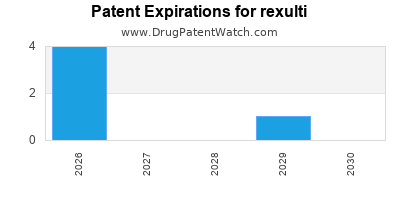
Rexulti is a drug marketed by Otsuka and is included in one NDA. There are six patents protecting this drug and one Paragraph IV challenge.

This drug has seventy-seven patent family members in thirty-nine countries.

The generic ingredient in REXULTI is brexpiprazole. There are eight drug master file entries for this compound. Four suppliers are listed for this compound. Additional details are available on the brexpiprazole profile page.

DrugPatentWatch® Litigation and Generic Entry Outlook for Rexulti

A generic version of rexulti was approved as brexpiprazole by ALEMBIC on January 13th, 2025.

  Start Trial

AI Deep Research
Questions you can ask:
  • What is the 5 year forecast for rexulti?
  • What are the global sales for rexulti?
  • What is Average Wholesale Price for rexulti?
Recent Clinical Trials for rexulti

Identify potential brand extensions & 505(b)(2) entrants

SponsorPhase
Unity Health TorontoPhase 4
McMaster UniversityPhase 4
University Health Network, TorontoPhase 4

See all rexulti clinical trials

Pharmacology for rexulti
Paragraph IV (Patent) Challenges for REXULTI
Tradename Dosage Ingredient Strength NDA ANDAs Submitted Submissiondate
REXULTI Tablets brexpiprazole 4 mg 205422 16 2019-07-10

US Patents and Regulatory Information for rexulti

rexulti is protected by six US patents and five FDA Regulatory Exclusivities.

Applicant Tradename Generic Name Dosage NDA Approval Date TE Type RLD RS Patent No. Patent Expiration Product Substance Delist Req. Exclusivity Expiration
Otsuka REXULTI brexpiprazole TABLET;ORAL 205422-004 Jul 10, 2015 AB RX Yes Yes ⤷  Start Trial ⤷  Start Trial ⤷  Start Trial
Otsuka REXULTI brexpiprazole TABLET;ORAL 205422-003 Jul 10, 2015 AB RX Yes No ⤷  Start Trial ⤷  Start Trial ⤷  Start Trial
Otsuka REXULTI brexpiprazole TABLET;ORAL 205422-005 Jul 10, 2015 AB RX Yes No RE48059*PED ⤷  Start Trial Y ⤷  Start Trial
Otsuka REXULTI brexpiprazole TABLET;ORAL 205422-006 Jul 10, 2015 AB RX Yes No RE48059*PED ⤷  Start Trial Y ⤷  Start Trial
Otsuka REXULTI brexpiprazole TABLET;ORAL 205422-005 Jul 10, 2015 AB RX Yes No 9,839,637*PED ⤷  Start Trial Y ⤷  Start Trial
Otsuka REXULTI brexpiprazole TABLET;ORAL 205422-005 Jul 10, 2015 AB RX Yes No 10,307,419*PED ⤷  Start Trial Y ⤷  Start Trial
>Applicant >Tradename >Generic Name >Dosage >NDA >Approval Date >TE >Type >RLD >RS >Patent No. >Patent Expiration >Product >Substance >Delist Req. >Exclusivity Expiration

EU/EMA Drug Approvals for rexulti

Company Drugname Inn Product Number / Indication Status Generic Biosimilar Orphan Marketing Authorisation Marketing Refusal
Otsuka Pharmaceutical Netherlands B.V. Rxulti brexpiprazole EMEA/H/C/003841Treatment of schizophrenia. Authorised no no no 2018-07-26
>Company >Drugname >Inn >Product Number / Indication >Status >Generic >Biosimilar >Orphan >Marketing Authorisation >Marketing Refusal

International Patents for rexulti

When does loss-of-exclusivity occur for rexulti?

Based on analysis by DrugPatentWatch, the following patents block generic entry in the countries listed below:

Argentina

Patent: 8319
Estimated Expiration: ⤷  Start Trial

Australia

Patent: 12321723
Estimated Expiration: ⤷  Start Trial

Brazil

Patent: 2014008603
Estimated Expiration: ⤷  Start Trial

Canada

Patent: 51588
Estimated Expiration: ⤷  Start Trial

Chile

Patent: 14000909
Estimated Expiration: ⤷  Start Trial

China

Patent: 3889425
Estimated Expiration: ⤷  Start Trial

Patent: 7397730
Estimated Expiration: ⤷  Start Trial

Colombia

Patent: 50480
Estimated Expiration: ⤷  Start Trial

Croatia

Patent: 0200037
Estimated Expiration: ⤷  Start Trial

Cyprus

Patent: 22460
Estimated Expiration: ⤷  Start Trial

Denmark

Patent: 67285
Estimated Expiration: ⤷  Start Trial

Eurasian Patent Organization

Patent: 2930
Estimated Expiration: ⤷  Start Trial

Patent: 1490783
Estimated Expiration: ⤷  Start Trial

European Patent Office

Patent: 67285
Estimated Expiration: ⤷  Start Trial

Finland

Patent: 67285
Estimated Expiration: ⤷  Start Trial

Hungary

Patent: 47493
Estimated Expiration: ⤷  Start Trial

India

Patent: 55DEN2014
Estimated Expiration: ⤷  Start Trial

Israel

Patent: 1513
Estimated Expiration: ⤷  Start Trial

Japan

Patent: 84161
Estimated Expiration: ⤷  Start Trial

Patent: 17088610
Estimated Expiration: ⤷  Start Trial

Patent: 2013054872
Estimated Expiration: ⤷  Start Trial

Jordan

Patent: 53
Estimated Expiration: ⤷  Start Trial

Lithuania

Patent: 67285
Estimated Expiration: ⤷  Start Trial

Malaysia

Patent: 3370
Estimated Expiration: ⤷  Start Trial

Mexico

Patent: 6092
Estimated Expiration: ⤷  Start Trial

Patent: 14004135
Estimated Expiration: ⤷  Start Trial

New Zealand

Patent: 2639
Estimated Expiration: ⤷  Start Trial

Philippines

Patent: 014500607
Estimated Expiration: ⤷  Start Trial

Poland

Patent: 67285
Estimated Expiration: ⤷  Start Trial

Portugal

Patent: 67285
Estimated Expiration: ⤷  Start Trial

Singapore

Patent: 201608412S
Estimated Expiration: ⤷  Start Trial

Patent: 14013783
Estimated Expiration: ⤷  Start Trial

Slovenia

Patent: 67285
Estimated Expiration: ⤷  Start Trial

South Africa

Patent: 1402333
Estimated Expiration: ⤷  Start Trial

South Korea

Patent: 2072371
Estimated Expiration: ⤷  Start Trial

Patent: 140075754
Estimated Expiration: ⤷  Start Trial

Spain

Patent: 62479
Estimated Expiration: ⤷  Start Trial

Taiwan

Patent: 1318651
Estimated Expiration: ⤷  Start Trial

Patent: 34908
Estimated Expiration: ⤷  Start Trial

Ukraine

Patent: 4411
Estimated Expiration: ⤷  Start Trial

Generics may enter earlier, or later, based on new patent filings, patent extensions, patent invalidation, early generic licensing, generic entry preferences, and other factors.

See the table below for additional patents covering rexulti around the world.

Country Patent Number Title Estimated Expiration
South Africa 201402333 ⤷  Start Trial
Canada 2851588 ⤷  Start Trial
Slovenia 2767285 ⤷  Start Trial
New Zealand 622639 ⤷  Start Trial
South Korea 20140075754 ⤷  Start Trial
Mexico 376092 ⤷  Start Trial
>Country >Patent Number >Title >Estimated Expiration

Supplementary Protection Certificates for rexulti

Patent Number Supplementary Protection Certificate SPC Country SPC Expiration SPC Description
1869025 32/2018 Austria ⤷  Start Trial PRODUCT NAME: BREXPIPRAZOL ODER EIN SALZ DAVON; REGISTRATION NO/DATE: EU/1/18/1294 (MITTEILUNG) 20180727
1869025 LUC00086 Luxembourg ⤷  Start Trial PRODUCT NAME: BREXPIPRAZOLE OU UN SEL DE CELUI-CI; AUTHORISATION NUMBER AND DATE: EU/1/18/1294 20180730
1869025 SPC/GB18/038 United Kingdom ⤷  Start Trial PRODUCT NAME: BREXPIPRAZOLE OR A SALT THEREOF; REGISTERED: UK EU/1/18/1294/001(NI) 20180730; UK PLGB 506970019 20180730; UK PLGB 506970020 20180730; UK PLGB 506970021 20180730; UK PLGB 506970022 20180730; UK PLGB 506970023 20180730; UK EU/1/18/1294/007(NI) 20180730; UK EU/1/18/1294/008(NI) 20180730; UK EU/1/18/1294/009(NI) 20180730; UK EU/1/18/1294/010(NI) 20180730; UK EU/1/18/1294/011(NI) 20180730; UK PLGB 506970024 20180730; UK EU/1/18/1294/002(NI) 20180730; UK EU/1/18/1294/003(NI) 20180730; UK EU/1/18/1294/004(NI) 20180730; UK EU/1/18/1294/005(NI) 20180730; UK EU/1/18/1294/006(NI) 20180730
1869025 C01869025/01 Switzerland ⤷  Start Trial PRODUCT NAME: BREXPIPRAZOL; REGISTRATION NO/DATE: SWISSMEDIC-ZULASSUNG 66475 17.07.2018
1869025 18C0004 France ⤷  Start Trial PRODUCT NAME: BREXPIPRAZOLE OU L'UN DE SES SELS; REGISTRATION NO/DATE: EU/1/18/1294 20180730
1869025 2018/034 Ireland ⤷  Start Trial PRODUCT NAME: BREXPIPRAZOLE OR A SALT THEREOF; NAT REGISTRATION NO/DATE: EU/1/18/1294 20180726; FIRST REGISTRATION NO/DATE: JOURNAL OF THE INTELLECTUAL PROPERTY OFFICE OF IRELAND (NO. 2402)
>Patent Number >Supplementary Protection Certificate >SPC Country >SPC Expiration >SPC Description

REXULTI (brexpiprazole) market dynamics and financial trajectory: sales trends, competitive pressure, and exclusivity risk

Last updated: June 3, 2026

REXULTI (brexpiprazole) revenue has been steady but pressured by slower growth, channel normalization, and intensified competition in schizophrenia and MDD adjunctive therapy. The drug’s commercial trajectory depends on (1) US payer access and formulary position versus aripiprazole and other atypical antipsychotics, (2) treatment persistence in schizophrenia and major depressive disorder (MDD) adjunct, and (3) patent and regulatory timelines governing US generics and potential “authorized” or non-authorized erosion. Near-term value risk sits in the combination of limited label expansion upside and rising generic/program-level substitution in branded CNS categories.

What is REXULTI (brexpiprazole) revenue trend and financial trajectory by geography?

Answer: REXULTI has functionally matured as a mid-size branded CNS asset. It does not show the explosive uptake profile of early blockbuster CNS launches, and the commercial curve is shaped more by retention and payer mix than by rapid market expansion.

US commercialization dynamics that typically drive REXULTI’s trajectory

REXULTI’s market performance in the US is driven by:

  • Class switching risk: Antipsychotic choice in schizophrenia frequently consolidates around cost and formulary tier placement, especially where payers prefer lower net-cost alternatives.
  • Adjunctive depression churn: For MDD adjunct, persistence is sensitive to efficacy response, side-effect tolerability, and prescriber comfort with alternative augmentation strategies.
  • Net pricing reality: Branded CNS sales reflect discounting, contracting, and rebating effects. Reported “gross-to-net” compression is a key driver of net sales trajectory in mature CNS portfolios.

International economics

International sales tend to track:

  • Local reimbursement categories for schizophrenia and depressive disorders,
  • Formulary penetration under national health systems and private pay tiers,
  • Competitor density within each country’s atypical antipsychotic lineup.

How do schizophrenia and MDD adjunct demand dynamics shape REXULTI sales?

Answer: Demand is split between chronic schizophrenia maintenance and time-limited MDD adjunct continuation, with different churn drivers.

Schizophrenia maintenance: stability with slow payer-driven substitution

  • Therapy intent: Long-term maintenance creates stickiness at the prescriber and patient level.
  • Erosion mechanics: The main erosion channel is payer formulary movement and net-cost dynamics rather than immediate loss of clinical adherence.
  • Switch triggers: Akathisia, weight gain, metabolic profile, tolerability, and long-term safety perceptions shape switching to other atypicals.

MDD adjunct: response-dependent utilization

  • Higher volatility: MDD adjunct utilization is more sensitive to individual response and early discontinuation.
  • Competitive overlap: Brexpiprazole competes against multiple augmentation options across payer preference frameworks, including other branded and generic CNS agents depending on local economics.

What market factors determine REXULTI’s competitive landscape versus aripiprazole and other atypicals?

Answer: Net cost, formulary status, and prescriber habit dominate. Clinical nuance matters but typically does not prevent substitution when payers tighten controls.

Direct competition themes

  • Aripiprazole-based replacement risk: Aripiprazole’s generic availability and entrenched clinical use create a low-cost benchmark for payers.
  • Alternative atypicals: Cariprazine, quetiapine, olanzapine, and risperidone form overlapping choice sets depending on dosing schedules, side-effect profile, and guideline preference patterns.
  • Managed care levers: Step therapy, prior authorization, and formulary tiers are the main commercial levers affecting branded atypical access.

Competitive positioning: what matters to buyers

For payers and pharmacy benefit managers, brexpiprazole competes as a:

  • Mid-to-lower net-cost branded option only if pricing contracts maintain payer acceptance,
  • Formulary alternative where a prescriber’s starting choice locks in for months via persistence.

When does REXULTI lose exclusivity in the US, and what does that mean for generic launch risk?

Answer: Exclusivity loss timing and patent cliffs determine the switch from branded retention to generic price competition. For CNS assets, generic erosion often starts with Paragraph IV or other patent-waiver pathways, then accelerates once multiple barriers fall.

Key exclusivity and patent risk mechanics

REXULTI’s generic-risk profile depends on:

  • Whether core composition-of-matter patents remain unexpired at the time of potential FDA ANDA acceptance,
  • Whether formulation or method-of-use patents create additional injunction leverage,
  • Whether data exclusivity or regulatory exclusivity delays generic approvals independently of patents.

Generic entry scenarios that typically impact sales

  • Single barrier fall scenario: One patent expires, but remaining patents continue to deter entry or delay launch.
  • Multi-patent cascade: Multiple expirations cluster, enabling faster erosion.
  • Settlement-driven launch: A patent settlement can set an agreed launch date even if litigation might have continued.

What patents protect REXULTI (brexpiprazole), and how strong is the patent estate?

Answer: The practical strength of the patent estate is defined by which patents remain enforceable in the US at the time of generic application and whether multiple independent barriers exist. For mid-size branded CNS drugs, the estate is often a patchwork of composition, formulation, and use claims that create a staggered defense path.

Patent estate evaluation framework used for commercial impact

A business-grade assessment should map:

  • Core composition patents (highest injunction leverage),
  • Formulation and polymorph patents (barrier to “same drug” substitution if claims are specific),
  • Method-of-use patents (barrier to label-scoped generic marketing or narrow carve-outs),
  • Manufacturing process patents (less common as a barrier in practical generic substitution unless strictly tied to scalable processes).

What this means for erosion velocity

A strong estate typically produces:

  • Slower price compression because launch is delayed,
  • Lower number of authorized/non-authorized entrants if settlements occur early,
  • More leverage for brand for life-cycle extensions, including controlled releases or line-extension formulations where applicable.

What is the Orange Book status of REXULTI, and how many drug listings matter for biosafety or ANDA?

Answer: Orange Book listings function as the map of patent barriers tied to each approved NDA strength and dosage form. For brexpiprazole, the number of active listings and their expiration dates determine practical timing for ANDA challenges.

How to interpret Orange Book listings for commercial risk

  • Number of listed patents tied to the NDA matters because each can independently support an injunction.
  • Earliest expiration date indicates the first potential generic entry window.
  • Patent scope breadth indicates whether a generic can route around by design choices.

Have there been Paragraph IV challenges to REXULTI patents, and what settlements changed launch timing?

Answer: The presence and outcomes of Paragraph IV filings determine the first credible generic launch risk and can shift launch dates via settlements. Paragraph IV litigation also determines whether multiple ANDAs proceed or get consolidated into a single commercial threat.

Why Paragraph IV outcomes drive revenue trajectories

  • If the brand wins: erosion is deferred, and PBM contracting may remain stable.
  • If the brand settles early: an agreed date creates a predictable erosion timeline.
  • If generics win: immediate launch compresses net sales and forces formulary reclassification.

Litigation implications for investors and licensors

  • Settlement terms (launch date, market carve-outs, exclusivity triggers) determine how quickly net sales fall.
  • Design-around feasibility affects whether a generic can enter without switching costs.

What FDA regulatory milestones apply to REXULTI, including label scope and new indications?

Answer: REXULTI’s financial sensitivity is tied to whether label expansion increases addressable population faster than competitive replacement. In CNS, label additions matter if they produce measurable incremental prescribing and if payers cover the expanded use.

How FDA label scope affects market sizing

  • Schizophrenia indications drive a stable base.
  • MDD adjunct creates overlap with multiple treatment lines where payer and prescriber decisions can shift quickly.

How does REXULTI compare with cariprazine, quetiapine, and other atypicals on market positioning?

Answer: REXULTI competes in an atypical antipsychotic ecosystem where differentiation is often expressed through tolerability and guideline alignment, but commercial outcomes hinge on net price and formulary adoption.

Competitive comparison dimensions that move sales

  • Formulary tier placement in schizophrenia and MDD adjunct,
  • Dosing convenience and switching friction,
  • Adverse event profile and patient-specific risk,
  • PBM contracting and rebates.

What manufacturing and formulation/IP barriers could slow generic substitution for REXULTI?

Answer: Barriers typically come from enforceable formulation patents or specific manufacturing methods tied to approved drug product. Where those exist and remain unexpired, they can delay launch even if core composition claims are weaker.

Practical substitution barriers in branded CNS

  • Bioequivalence feasibility: While generics generally clear BE requirements, formulation-specific claims can constrain “identical” approaches.
  • Process-specific claims: If process patents exist, generic development may face non-trivial design-around.

What are the commercial implications of patent expiry for REXULTI pricing and net sales?

Answer: Post-expiry, REXULTI net sales typically decline faster than gross retail visibility suggests, driven by PBM switching, rebate renegotiation, and increased dispensing of cheaper alternatives.

Typical post-cliff sales pathway in CNS

  • Pre-expiry months: PBMs may begin preemptive tiering.
  • Launch month: increased generic dispensing plus competitor promotion.
  • Following quarters: rebate compression and switching hardening across plans.

Key Takeaways

  • REXULTI’s financial trajectory reflects a mature CNS profile: incremental growth is constrained; persistence and payer mix dominate outcomes.
  • Competitive pressure is structural: generic aripiprazole and other atypicals set pricing anchors, increasing substitution incentives.
  • Exclusivity timelines drive the inflection: generic entry velocity hinges on Orange Book-listed patents, Paragraph IV outcomes, and any settlement-based launch dates.
  • Patent strength matters as a portfolio: composition, formulation, and method-of-use patents collectively determine how fast sales erosion accelerates after the first barrier falls.
  • Regulatory label scope affects addressable demand: MDD adjunct volatility changes utilization patterns, but competitive replacement can cap upside.

FAQs

  1. How does formulary placement for schizophrenia atypical antipsychotics change REXULTI net sales after generic launches?
  2. What Paragraph IV events typically trigger first credible generic entry for branded CNS drugs like REXULTI?
  3. How do patent settlements in CNS cases influence negotiated launch dates and market carve-outs?
  4. Which Orange Book listing types (composition, formulation, method-of-use) most often delay ANDA launches for brexpiprazole?
  5. How do MDD adjunct discontinuation and persistence rates affect branded antipsychotic revenue compared with schizophrenia maintenance?

References

  1. FDA Orange Book: Approved Drug Products with Therapeutic Equivalence Evaluations. Center for Drug Evaluation and Research (CDER).
  2. FDA Drug Approval Packages and labeling for REXULTI (brexpiprazole). CDER.
  3. FDA guidance on ANDA submissions and bioequivalence requirements (where applicable). CDER.

More… ↓

⤷  Start Trial

Make Better Decisions: Try a trial or see plans & pricing

Drugs may be covered by multiple patents or regulatory protections. All trademarks and applicant names are the property of their respective owners or licensors. Although great care is taken in the proper and correct provision of this service, thinkBiotech LLC does not accept any responsibility for possible consequences of errors or omissions in the provided data. The data presented herein is for information purposes only. There is no warranty that the data contained herein is error free. We do not provide individual investment advice. This service is not registered with any financial regulatory agency. The information we publish is educational only and based on our opinions plus our models. By using DrugPatentWatch you acknowledge that we do not provide personalized recommendations or advice. thinkBiotech performs no independent verification of facts as provided by public sources nor are attempts made to provide legal or investing advice. Any reliance on data provided herein is done solely at the discretion of the user. Users of this service are advised to seek professional advice and independent confirmation before considering acting on any of the provided information. thinkBiotech LLC reserves the right to amend, extend or withdraw any part or all of the offered service without notice.