Share This Page
PROMETHAZINE W/ CODEINE Drug Patent Profile
✉ Email this page to a colleague
Which patents cover Promethazine W/ Codeine, and what generic alternatives are available?
Promethazine W/ Codeine is a drug marketed by Cenci and is included in one NDA.
The generic ingredient in PROMETHAZINE W/ CODEINE is codeine phosphate; promethazine hydrochloride. There is one drug master file entry for this compound. Five suppliers are listed for this compound. Additional details are available on the codeine phosphate; promethazine hydrochloride profile page.
AI Deep Research
Questions you can ask:
- What is the 5 year forecast for PROMETHAZINE W/ CODEINE?
- What are the global sales for PROMETHAZINE W/ CODEINE?
- What is Average Wholesale Price for PROMETHAZINE W/ CODEINE?
Summary for PROMETHAZINE W/ CODEINE
| US Patents: | 0 |
| Applicants: | 1 |
| NDAs: | 1 |
| Patent Applications: | 227 |
| DailyMed Link: | PROMETHAZINE W/ CODEINE at DailyMed |
US Patents and Regulatory Information for PROMETHAZINE W/ CODEINE
| Applicant | Tradename | Generic Name | Dosage | NDA | Approval Date | TE | Type | RLD | RS | Patent No. | Patent Expiration | Product | Substance | Delist Req. | Exclusivity Expiration |
|---|---|---|---|---|---|---|---|---|---|---|---|---|---|---|---|
| Cenci | PROMETHAZINE W/ CODEINE | codeine phosphate; promethazine hydrochloride | SYRUP;ORAL | 088814-001 | Nov 22, 1985 | DISCN | No | No | ⤷ Start Trial | ⤷ Start Trial | ⤷ Start Trial | ||||
| >Applicant | >Tradename | >Generic Name | >Dosage | >NDA | >Approval Date | >TE | >Type | >RLD | >RS | >Patent No. | >Patent Expiration | >Product | >Substance | >Delist Req. | >Exclusivity Expiration |
Promethazine With Codeine Market Dynamics, Patent Position, and Financial Trajectory
Promethazine with codeine is a mature, largely generic prescription cough medicine with limited product-level financial disclosure, no meaningful biologic or biosimilar exposure, and weak residual patent protection. Its commercial trajectory is shaped more by opioid regulation, pediatric safety restrictions, state prescribing controls, abuse concerns, and manufacturer participation than by patent exclusivity.
The product has low strategic value as an innovative pharmaceutical asset. Revenue opportunities are concentrated in generic supply, contract manufacturing, pharmacy distribution, and selected international markets. Long-term demand is structurally pressured by declining use of opioid cough medicines and substitution toward non-opioid therapies.
What is promethazine with codeine and how is it used?
Promethazine with codeine combines promethazine hydrochloride, an antihistamine and antiemetic, with codeine phosphate, an opioid antitussive. It is marketed primarily as an oral solution for temporary relief of cough and upper-respiratory symptoms.
The product is distinct from promethazine with dextromethorphan. Dextromethorphan is a non-opioid cough suppressant, while codeine is an opioid subject to controlled-substance restrictions.
| Attribute | Promethazine with codeine |
|---|---|
| Active ingredients | Promethazine hydrochloride and codeine phosphate |
| Primary dosage form | Oral solution |
| Therapeutic category | Prescription cough and cold medicine |
| Regulatory pathway | Conventional small-molecule drug |
| U.S. controlled-substance status | Generally Schedule V at qualifying codeine concentrations under federal rules; state treatment can be stricter |
| Biosimilar exposure | None |
| Core commercial model | Generic prescription product |
| Main risk factors | Opioid misuse, pediatric safety, diversion, state restrictions, declining cough-product utilization |
The U.S. labeling contains strong warnings concerning respiratory depression, opioid misuse, neonatal opioid withdrawal, and potentially fatal pediatric exposure. The FDA contraindicates use in children under 12 and in patients under 18 following tonsillectomy or adenoidectomy. The FDA also recommends avoiding codeine-containing cough medicines in adolescents ages 12 to 18 with respiratory-risk factors such as obesity, obstructive sleep apnea, or severe lung disease. [1]
When does promethazine with codeine lose exclusivity?
Promethazine with codeine lost meaningful market exclusivity decades ago. The active ingredients are old, off-patent compounds, and the product competes primarily through abbreviated new drug applications, manufacturing scale, supply reliability, and wholesaler access.
No commercially material, enforceable composition-of-matter patent is associated with the combination today. Any historical formulation or use patents would generally have expired or provide limited protection against standard generic oral solutions.
The practical exclusivity position is:
| Exclusivity category | Current commercial impact |
|---|---|
| New chemical entity exclusivity | None |
| Orphan-drug exclusivity | None |
| Pediatric exclusivity | No current material effect |
| Data exclusivity | Expired |
| Composition-of-matter patents | Expired |
| Formulation patents | No publicly established blocking estate for the standard product |
| Method-of-use patents | No material barrier identified for ordinary cough treatment |
| Generic competition | Established |
The FDA Orange Book remains the authoritative source for current listed patents and regulatory exclusivity. Product-specific Orange Book entries can change as approvals are withdrawn, transferred, or updated. [2]
What is the FDA regulatory status of promethazine with codeine?
Promethazine with codeine is an FDA-approved prescription medicine available through multiple product approvals and generic equivalents. Its regulatory risk is driven by labeling and controlled-substance requirements rather than pending approval uncertainty.
The FDA took several actions that reduced the addressable market:
- In 2017, the FDA added its strongest warning against codeine use in children under 12 and restricted adolescent use in defined risk groups. [1]
- In 2018, the FDA required prescription cough-and-cold medicines containing codeine or hydrocodone to carry labeling limiting use to adults 18 and older. [3]
- Product labeling emphasizes respiratory depression, sedation, overdose, addiction, and accidental ingestion risks.
- State opioid laws can impose stricter age, quantity, monitoring, prescribing, or dispensing requirements than federal rules.
The regulatory profile reduces pediatric demand and increases prescriber friction. It also creates greater compliance costs for manufacturers, distributors, pharmacies, and prescribers.
What is the Orange Book status of promethazine with codeine?
The product’s Orange Book position is primarily relevant for identifying approved reference products, abbreviated approvals, and any residual listed patent claims. Because the combination is mature and genericized, Orange Book data does not indicate a conventional patent cliff comparable to a branded specialty drug.
A prospective entrant would focus on:
- Whether the relevant reference listed drug remains actively marketed.
- Whether the proposed product qualifies for an ANDA pathway.
- Whether the product has the same concentration, dosage form, route, and labeling.
- Whether any listed patents require a Paragraph IV certification.
- Whether state controlled-substance and manufacturing requirements can be satisfied.
For a standard oral solution, the main regulatory barriers are bioequivalence, chemistry-manufacturing-controls requirements, extractables and leachables, preservative performance, container-closure compatibility, and controlled-substance compliance.
Are there Paragraph IV challenges involving promethazine with codeine?
Paragraph IV litigation risk is low relative to newer branded medicines. A Paragraph IV certification is used when an ANDA applicant asserts that a listed patent is invalid, unenforceable, or would not be infringed. [4]
For promethazine with codeine, the commercial relevance of Paragraph IV litigation is limited because:
- Core ingredient patents are expired.
- Generic products have already entered the market.
- The combination does not depend on a current high-value branded patent estate.
- Any residual disputes would likely concern a narrow formulation, manufacturing process, or labeling issue.
The absence of a significant current patent dispute does not eliminate regulatory litigation risk. Manufacturers can still face product-liability claims, warning-label disputes, controlled-substance enforcement, manufacturing investigations, and recalls.
What formulations are protected by promethazine with codeine patents?
The commercially relevant formulation is an oral solution containing promethazine hydrochloride and codeine phosphate. The formulation is technically simple compared with extended-release opioids, inhaled products, injectables, or complex biologics.
Potential formulation-control points include:
- Active-ingredient concentration.
- Alcohol or sugar content.
- Preservative system.
- Flavoring and palatability.
- Syrup viscosity.
- Container-closure system.
- Dose-measuring device.
- Stability profile.
- Manufacturing controls for a Schedule V product.
These features can create regulatory and quality barriers without creating durable patent exclusivity. A generic manufacturer may differentiate through sugar-free formulations, improved packaging, tamper-evident closures, supply continuity, or private-label distribution.
How strong is the patent estate for promethazine with codeine?
The patent estate is weak from an innovator perspective and largely irrelevant to long-term market control.
| Patent-strength factor | Assessment |
|---|---|
| Composition patent | None of current commercial significance |
| Combination patent | Weak or expired |
| Formulation patent | Potentially narrow; no established blocking position |
| Method-of-use patent | Low commercial relevance |
| Manufacturing patent | Possible process protection, but unlikely to block standard entry |
| Patent-term extension | No meaningful current benefit |
| Generic entry barrier | Regulatory and supply-based rather than patent-based |
The product’s defensibility depends on operational execution. A manufacturer with reliable API sourcing, validated liquid manufacturing capacity, compliant controlled-substance systems, and strong wholesaler relationships may retain share even without patent protection.
Which companies compete in the promethazine with codeine market?
Competition has historically included branded and generic pharmaceutical manufacturers, contract manufacturers, and private-label suppliers. The market has included companies such as Actavis, Hi-Tech Pharmacal, Akorn, Perrigo, and other approved generic manufacturers, although individual product availability has changed over time.
The competitive landscape is difficult to measure because:
- Manufacturers may discontinue or temporarily stop products.
- FDA approval does not guarantee active commercial marketing.
- Wholesalers can source from multiple approved manufacturers.
- Public companies generally do not disclose revenue for this individual product.
- Some sales occur through private-label or distributor arrangements.
A company’s market position therefore depends less on patent ownership than on active supply, product listing status, manufacturing capacity, and channel access.
What is the financial trajectory for promethazine with codeine?
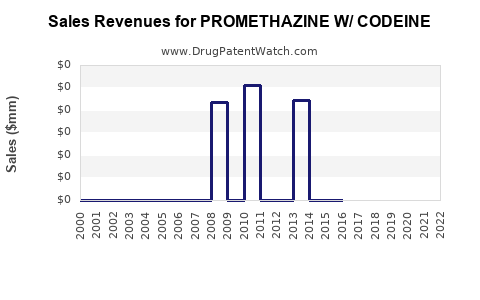
The financial trajectory is mature to declining in the United States. Product-level revenue is not generally disclosed by manufacturers, and publicly available company reports do not provide a reliable standalone market-size figure for promethazine with codeine.
The revenue model has four defining characteristics:
- Low innovation premium. Generic competition limits pricing power.
- Volume sensitivity. Revenue depends on prescription demand, seasonal respiratory illness, and pharmacy stocking.
- Regulatory drag. Opioid warnings and age restrictions reduce use.
- Supply volatility. Discontinuations, API availability, controlled-substance quotas, and quality events can shift share rapidly.
| Financial driver | Expected effect |
|---|---|
| Generic entry | Lower average selling price |
| Pediatric restrictions | Reduced prescription volume |
| Opioid stewardship | Lower chronic and discretionary use |
| Seasonal demand | Short-term volume spikes |
| Product shortages | Temporary pricing and share opportunities |
| Manufacturing consolidation | Potentially higher supply concentration |
| State restrictions | Geographic variation in demand |
| Private-label sales | Lower visibility but potential volume stability |
The product can remain profitable for a manufacturer with low-cost liquid manufacturing and efficient distribution. Gross margin is likely to be more sensitive to batch utilization, quality costs, packaging, freight, and API procurement than to intellectual-property royalties.
What generic entry risks exist?
Generic entry is already established, so the risk is not a future first generic launch. The relevant risks are incremental competition and market-share displacement.
A new entrant could compete through:
- Lower acquisition cost.
- Consistent supply during shortages.
- Sugar-free or alternative excipient formulations.
- Improved dosing devices.
- Retail-chain or wholesaler contracts.
- Private-label arrangements.
- International registrations.
The most likely U.S. launch scenario for a new manufacturer would be a low-price, limited-share entry followed by expansion if incumbent products experience shortages or discontinuations. A large price collapse is less likely than in high-volume tablets because liquid manufacturing is more operationally complex and the market is comparatively small.
Does promethazine with codeine face biosimilar risk?
No. Biosimilars apply to biological products, while promethazine with codeine is a conventional chemically synthesized small-molecule drug. Competition occurs through generic drug approvals under the ANDA pathway, not through the biosimilar pathway under the Public Health Service Act. [4]
This distinction matters commercially. The product has no biologic interchangeability strategy, no reference-biologic exclusivity period, and no biosimilar litigation framework.
What patent litigation affects promethazine with codeine?
No major current patent litigation materially controls U.S. market access for the standard combination oral solution based on the public regulatory and patent framework cited here. Litigation exposure is more likely to arise from product liability, controlled-substance compliance, manufacturing quality, labeling, or distribution practices.
Potential legal exposures include:
- Failure-to-warn claims.
- Pediatric respiratory-depression claims.
- Improper dispensing or diversion.
- Manufacturing deviations.
- Recall-related claims.
- False or misleading promotional claims.
- Distribution to illegitimate or noncompliant entities.
Settlement agreements are not a central market-access factor for this mature generic product. Unlike branded medicines facing Paragraph IV challenges, the commercial outcome is not dependent on a confidential launch settlement or licensed patent-entry date.
How does promethazine with codeine compare with competing cough medicines?
| Product category | Competitive position |
|---|---|
| Promethazine with codeine | Prescription opioid cough product; higher regulatory and abuse risk |
| Promethazine with dextromethorphan | Non-opioid alternative; generally lower controlled-substance burden |
| Benzonatate | Prescription non-opioid antitussive; separate safety and ingestion risks |
| Dextromethorphan products | Broad over-the-counter availability |
| Guaifenesin products | Expectorant market; generally lower regulatory friction |
| Hydrocodone-containing cough products | More restrictive opioid profile and higher enforcement exposure |
The main substitution threat is from non-opioid therapies and reduced treatment of uncomplicated cough. The product retains a niche where prescribers seek a sedating antihistamine-opioid combination, but that niche is constrained by safety policies and opioid stewardship.
What geographic markets remain commercially relevant?
The United States is the most important market for regulatory and commercial analysis because of FDA requirements, controlled-substance scheduling, and state-level opioid restrictions. International opportunities vary by country and may involve narcotics permits, import quotas, different prescribing rules, and separate registrations.
Geographic expansion is not straightforward. A manufacturer must address:
- Local controlled-drug scheduling.
- Import and export permits.
- Narcotics quota systems.
- Country-specific labeling.
- Serialization and track-and-trace rules.
- Local pharmacovigilance obligations.
- Restrictions on pediatric opioid use.
- Anti-diversion controls.
The same product can have materially different commercial viability across jurisdictions because codeine regulation varies widely.
Key Takeaways
- Promethazine with codeine is a mature generic prescription cough medicine.
- Its active ingredients and core combination are off-patent.
- No significant current patent estate appears to control standard U.S. generic entry.
- Paragraph IV litigation and settlement risk are low compared with branded drugs.
- The FDA’s pediatric restrictions and opioid warnings have reduced the addressable market.
- The product has no biosimilar exposure.
- Product-level revenue is not publicly disclosed with sufficient consistency for a reliable standalone market estimate.
- Financial performance depends on manufacturing cost, supply continuity, wholesaler access, and seasonal demand.
- Generic entry is already established; future competition will primarily affect share and pricing.
- The principal barriers are regulatory, quality, controlled-substance, and supply-chain barriers rather than intellectual property.
FAQs
Is promethazine with codeine still commercially available?
Availability varies by manufacturer, wholesaler inventory, product approval status, and local controlled-substance rules. FDA approval does not guarantee continuous commercial supply.
Is promethazine with codeine a Schedule II opioid?
The federal schedule depends on the codeine concentration and formulation. Qualifying low-concentration products are generally Schedule V federally, while states may impose stricter controls.
Can a generic manufacturer launch promethazine with codeine without licensing an innovator?
A manufacturer can generally pursue an ANDA-based generic strategy without an innovator license when applicable patents and exclusivities have expired. It must satisfy FDA requirements and make the required patent certifications.
Is promethazine with codeine subject to pediatric exclusivity?
No current pediatric exclusivity period creates a meaningful market barrier. Pediatric use is constrained by FDA contraindications and warnings.
What is the main investment risk for a promethazine with codeine manufacturer?
The principal risks are declining opioid-cough demand, low pricing power, regulatory enforcement, product liability, supply interruption, and the loss of pharmacy or wholesaler contracts.
References
-
U.S. Food and Drug Administration. (2017, April 20). FDA requires labeling changes regarding opioid-containing cough and cold medicines. https://www.fda.gov/
-
U.S. Food and Drug Administration. (n.d.). Orange Book: Approved drug products with therapeutic equivalence evaluations. https://www.accessdata.fda.gov/scripts/cder/ob/
-
U.S. Food and Drug Administration. (2018, January 11). FDA requires labeling changes for prescription opioid cough and cold medicines to limit their use to adults 18 years and older. https://www.fda.gov/
-
U.S. Food and Drug Administration. (n.d.). Abbreviated new drug application (ANDA) process for generic drugs. https://www.fda.gov/
-
U.S. Drug Enforcement Administration. (n.d.). Drug scheduling. https://www.dea.gov/drug-information/drug-scheduling
More… ↓
