Last updated: November 23, 2026
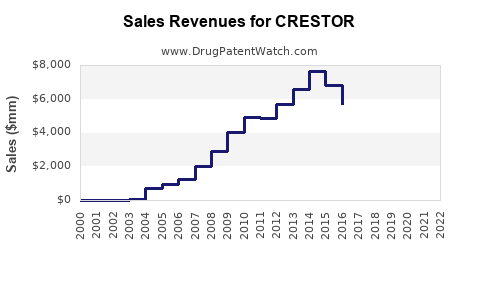
CRESTOR, the brand name for rosuvastatin calcium, has transitioned from a multibillion-dollar branded cardiovascular product to a mature generic statin. AstraZeneca’s reported CRESTOR revenue fell from approximately $5.3 billion in 2015 to less than $1 billion after broad generic entry. The drug remains commercially important through high global prescription volume, but its financial profile is now driven by generic-market pricing, regional brand retention, and residual royalty or licensing economics rather than U.S. exclusivity.
What is CRESTOR and how is it positioned in the statin market?
CRESTOR is an oral HMG-CoA reductase inhibitor approved to reduce low-density lipoprotein cholesterol, total cholesterol, triglycerides, and cardiovascular risk. Its active ingredient is rosuvastatin calcium.
The U.S. Food and Drug Administration approved CRESTOR under NDA 021366 in August 2003. Available strengths include 5 mg, 10 mg, 20 mg, and 40 mg tablets. The product is indicated for adults and, under specified conditions, pediatric patients with heterozygous familial hypercholesterolemia. [1]
Rosuvastatin competes primarily with:
- Generic atorvastatin, the largest statin competitor by prescription volume.
- Generic simvastatin and pravastatin.
- Ezetimibe and statin combinations.
- PCSK9 inhibitors such as Repatha and Praluent.
- Bempedoic acid products, including Nexletol and Nexlizet.
- Other branded or generic rosuvastatin products.
CRESTOR’s commercial differentiation historically came from its high potency, LDL-lowering performance, physician familiarity, and broad clinical-trial base. Those advantages support residual brand demand, but they do not prevent substitution by generic rosuvastatin.
How has CRESTOR revenue changed over time?
AstraZeneca’s CRESTOR revenue declined sharply after U.S. generic competition began. The following table presents rounded product-sales figures reported in AstraZeneca annual reports and financial disclosures.
| Year |
Approximate CRESTOR revenue |
Commercial condition |
| 2013 |
$5.6 billion |
Mature branded product |
| 2014 |
$5.3 billion |
Broad global brand sales |
| 2015 |
$5.3 billion |
Final full year before major U.S. generic erosion |
| 2016 |
$3.5 billion |
U.S. generic launches began |
| 2017 |
$1.4 billion |
Rapid generic substitution |
| 2018 |
$1.0 billion |
Mature erosion in the U.S. and other markets |
| 2019 |
$0.7 billion |
Residual branded and international sales |
| 2020 |
$0.5 billion |
Generic-dominated market |
| 2021 |
$0.4 billion |
Stable mature-product contribution |
| 2022 |
$0.4 billion |
Residual global sales |
| 2023 |
Approximately $0.3 billion to $0.4 billion |
Low-growth legacy product |
Sources: AstraZeneca annual reports and financial results. [2-7]
The decline from approximately $5.3 billion in 2015 to roughly $0.3 billion to $0.4 billion in 2023 represents a reduction of more than 90%. The fall was caused by U.S. generic entry, lower net prices, formulary substitution, and declining value of the brand’s patent estate.
CRESTOR remained a large product during the first half of the 2010s because statins treat a broad population and cardiovascular disease generates substantial prescription demand. The revenue base was less dependent on a narrow specialty indication than many newer medicines. That scale also made CRESTOR a major target for ANDA applicants.
When did CRESTOR lose U.S. market exclusivity?
CRESTOR lost effective U.S. commercial exclusivity in 2016, when generic rosuvastatin products entered the market under settlement arrangements and approved ANDAs.
The core compound patent, U.S. Patent No. 6,316,023, covered rosuvastatin and was listed in the FDA Orange Book. Its patent term, including applicable adjustments and pediatric exclusivity, extended into 2023. The practical commercial protection ended earlier because AstraZeneca settled Paragraph IV litigation and permitted generic launches before the nominal patent expiry date. [8-10]
CRESTOR exclusivity timeline
| Event |
Date |
| FDA approval of CRESTOR |
August 13, 2003 |
| U.S. compound patent protection |
Extended into 2023 |
| Paragraph IV litigation and settlements |
Primarily during the 2000s and early 2010s |
| First significant U.S. generic entry |
2016 |
| Nominal late-stage patent protection |
2023, subject to individual patent and exclusivity provisions |
| Current U.S. status |
Generic-dominated; no meaningful brand exclusivity |
The distinction between nominal patent expiration and actual market exclusivity is material. A patent can remain legally enforceable while a settlement gives generic manufacturers a contractual launch date before expiry.
What patents protected CRESTOR?
CRESTOR’s U.S. patent estate centered on the active pharmaceutical ingredient, pharmaceutical compositions, and selected use or formulation claims.
| Patent or protection category |
Relevance to CRESTOR |
| U.S. Patent No. 6,316,023 |
Core rosuvastatin compound patent |
| Rosuvastatin calcium claims |
Covered the marketed calcium salt form |
| Pharmaceutical composition claims |
Addressed tablet compositions and dosage forms |
| Method-of-use claims |
Addressed cholesterol treatment and cardiovascular-risk reduction |
| Pediatric exclusivity |
Extended applicable Orange Book patent protection |
Patent protection for CRESTOR was materially stronger than a narrow formulation-only estate because the core compound claims covered the active ingredient itself. Once that protection became vulnerable to Paragraph IV challenges, generic applicants had a direct route to commercial substitution.
The strength of the estate declined over time for three reasons:
- Compound claims approached expiry.
- Generic applicants challenged listed patents through Paragraph IV certifications.
- Product differentiation was limited after rosuvastatin calcium became available from multiple manufacturers.
Formulation and method-of-use patents offered additional litigation positions but did not preserve long-term exclusivity after generic manufacturers secured launch rights.
What was the Paragraph IV challenge history for CRESTOR?
Generic applicants challenged CRESTOR patents through Paragraph IV certifications under the Hatch-Waxman Act. AstraZeneca filed infringement actions against multiple ANDA applicants, including major generic manufacturers and suppliers seeking approval for rosuvastatin tablets.
The disputes generally concerned:
- Whether generic rosuvastatin infringed compound or composition claims.
- Whether the asserted patents were valid.
- Whether specific claims were obvious or anticipated.
- Whether generic products could launch before the listed patent dates.
- Whether settlements violated U.S. antitrust principles.
AstraZeneca entered settlement arrangements with generic companies that permitted launch before the latest nominal patent expiry. These agreements converted uncertain litigation outcomes into scheduled generic-entry dates. The commercial consequence was a controlled erosion pattern rather than a single abrupt loss of supply.
The CRESTOR litigation history also illustrates the strategic value of settlement timing. A brand company can preserve some revenue by delaying generic entry, while an ANDA applicant can obtain a defined launch date without bearing the full cost and risk of trial.
What is the FDA and Orange Book status of CRESTOR?
CRESTOR remains an FDA-approved prescription product. Its current commercial position is that of an approved legacy brand facing multiple generic rosuvastatin calcium products.
The FDA Orange Book historically listed CRESTOR patents and associated exclusivity information. The relevant patent protection is no longer a practical barrier to generic substitution in the United States. Multiple manufacturers market rosuvastatin calcium tablets through ANDA approvals.
The product has no biosimilar exposure because rosuvastatin is a chemically synthesized small molecule, not a biologic. The relevant regulatory pathway is ANDA approval, not the abbreviated pathway for biosimilars under the Public Health Service Act.
Current regulatory implications
- CRESTOR is not protected by active U.S. new chemical entity exclusivity.
- Generic rosuvastatin is approved through the ANDA pathway.
- Generic substitution is permitted under state pharmacy laws and payer policies.
- The brand can continue to be prescribed and dispensed, but it generally carries a price disadvantage.
- Label-based method-of-use protection does not prevent approval of broad generic rosuvastatin products when the applicant uses appropriate carve-outs.
What generic entry risks exist for CRESTOR?
The principal generic risk is already realized in the United States. The remaining commercial risks are price compression, payer substitution, and continued loss of branded prescriptions.
| Risk |
Impact on CRESTOR |
| Multiple ANDA approvals |
High |
| Price erosion |
High |
| Pharmacy substitution |
High |
| Formulary exclusion |
High |
| Supply competition among generics |
High |
| Biosimilar competition |
Not applicable |
| New branded cardiovascular entrants |
Moderate |
| International generic entry |
High |
Generic rosuvastatin benefits from straightforward tablet manufacturing, established clinical use, and large demand. Manufacturing barriers are limited relative to complex injectables, inhaled products, or biologics.
The principal technical barriers are API quality, impurity control, polymorph or salt-form consistency, dissolution performance, and regulatory compliance. These issues can affect individual manufacturers but do not create a durable market barrier for the class.
Which companies compete with CRESTOR and generic rosuvastatin?
Competition is segmented between molecule-level substitutes and broader lipid-lowering therapies.
Direct competitors
Direct competition includes generic rosuvastatin products from manufacturers such as Teva, Sandoz, Mylan or Viatris, Dr. Reddy’s Laboratories, Lupin, Apotex, Zydus, Sun Pharma, and other ANDA holders. The specific supplier mix changes by dosage strength, wholesaler contracts, shortages, and payer arrangements.
Therapeutic competitors
Atorvastatin remains the strongest therapeutic comparator because it is widely available as a low-cost generic and has extensive cardiovascular-outcomes data. Ezetimibe is used alone or with statins when additional LDL reduction is required. PCSK9 inhibitors compete in high-risk or familial hypercholesterolemia populations, but their prices and administration requirements limit direct substitution for routine statin therapy.
CRESTOR’s remaining advantage is not patent-based. It is based on clinician familiarity, patient persistence, regional branding, and perceived product reliability.
How does CRESTOR compare with Lipitor?
| Factor |
CRESTOR |
Lipitor |
| Active ingredient |
Rosuvastatin calcium |
Atorvastatin calcium |
| Brand owner |
AstraZeneca |
Pfizer |
| U.S. approval |
2003 |
1997 |
| Primary commercial phase |
2000s to mid-2010s |
1990s to early 2010s |
| Generic entry |
2011? broad CRESTOR entry in 2016 |
2011 |
| Current status |
Mature generic market |
Mature generic market |
| Main commercial strength |
Potent LDL reduction and brand recognition |
Scale, early market leadership, extensive outcomes data |
| Biosimilar risk |
None |
None |
Lipitor lost U.S. exclusivity earlier and experienced a faster initial decline in branded revenue. CRESTOR maintained higher branded revenue for longer, partly because its major U.S. generic-entry date was later. Both products now operate in generic-dominated markets.
What licensing deals affected CRESTOR economics?
CRESTOR originated from Shionogi, which licensed development and commercialization rights to AstraZeneca. The product was developed from rosuvastatin, also known in early development as ZD4522.
AstraZeneca’s economics included product revenue and payments associated with the licensed intellectual property. Shionogi retained economic interests in certain territories and received royalties or other contractual payments under the parties’ arrangements. The precise economics varied by jurisdiction and agreement period. [11]
The licensing structure reduced AstraZeneca’s ownership of the underlying discovery economics but gave it global development and commercial rights that supported large-scale launch and distribution. After generic entry, royalty economics became less valuable because the royalty base declined with branded sales.
What is the geographic coverage of CRESTOR patent protection?
CRESTOR patent protection was obtained across major pharmaceutical markets, including the United States, Europe, Japan, Canada, and other jurisdictions. Expiry dates varied because of national filing dates, patent-term rules, supplementary protection certificates, pediatric extensions, and local litigation.
The United States was the most commercially important jurisdiction because it produced a substantial share of CRESTOR revenue and had a well-developed Paragraph IV framework. Europe experienced country-specific generic entry following loss of applicable national protection. Japan remained strategically important because of Shionogi’s role and the product’s local commercial history.
Global protection did not create synchronized exclusivity. A company could face generic competition in one market while retaining patent protection or branded pricing in another.
How strong is the remaining CRESTOR patent estate?
The remaining estate has low commercial strength in the United States and limited ability to support premium pricing.
| Patent-estate factor |
Assessment |
| Core compound protection |
Expired or commercially exhausted |
| Formulation protection |
Limited residual leverage |
| Method-of-use protection |
Narrow practical effect |
| Generic design-around potential |
High |
| Manufacturing complexity |
Low to moderate |
| Litigation deterrence |
Low after generic entry |
| Brand pricing power |
Low |
| International variation |
Moderate |
A formulation patent can delay a particular product configuration, but it generally cannot prevent generic competition when the active ingredient is available and alternative formulations satisfy FDA requirements. CRESTOR therefore has no meaningful U.S. lifecycle-management platform comparable to an extended-release product, injectable formulation, or device-linked delivery system.
What is the financial outlook for CRESTOR?
CRESTOR is a declining or stable legacy revenue asset rather than a growth product. Its financial trajectory depends on three factors:
- Residual branded demand in markets where physicians or patients continue to prefer CRESTOR.
- International pricing and generic penetration.
- Any continuing royalty, co-promotion, or licensing income.
Revenue is unlikely to return to its pre-generic peak. The U.S. business is structurally constrained by generic substitution, low reimbursement, and limited clinical differentiation between brand and generic rosuvastatin.
AstraZeneca’s strategic value from CRESTOR now lies in cash generation from residual sales and the historical contribution the product made to funding newer oncology, respiratory, cardiovascular, and rare-disease assets. CRESTOR is no longer a major driver of corporate growth.
What generic launch scenarios apply to CRESTOR?
The relevant U.S. launch scenario has already occurred:
- First phase: limited or authorized generic entry under settlement arrangements.
- Second phase: additional ANDA approvals and broader pharmacy substitution.
- Third phase: price compression and loss of branded formulary position.
- Mature phase: generic rosuvastatin becomes the default product, while CRESTOR retains limited brand demand.
Future upside is limited to isolated markets, temporary supply disruptions, or branded prescriptions maintained for clinical or patient-preference reasons. A new U.S. exclusivity event is not expected from the original CRESTOR patent estate.
Key Takeaways
- CRESTOR is rosuvastatin calcium, an FDA-approved oral statin launched by AstraZeneca in 2003.
- AstraZeneca revenue peaked at approximately $5.3 billion in 2014-2015.
- Broad U.S. generic entry began in 2016 under Paragraph IV settlement arrangements.
- Revenue declined by more than 90% from the 2015 level by the early 2020s.
- The core U.S. patent estate, including U.S. Patent No. 6,316,023, no longer provides meaningful commercial exclusivity.
- Generic rosuvastatin, not biosimilar competition, is the principal market threat.
- Residual value comes from brand recognition, international sales, and limited royalty economics.
- CRESTOR is a mature, low-growth pharmaceutical asset with low remaining patent strength and high generic substitution risk.
FAQs
Is CRESTOR still protected by a U.S. patent?
No meaningful U.S. market exclusivity remains. Although certain patent terms extended into 2023, generic rosuvastatin entered the market in 2016 through settlement and ANDA pathways.
Is generic rosuvastatin therapeutically equivalent to CRESTOR?
FDA-approved generic rosuvastatin products are required to demonstrate bioequivalence to the reference listed drug. They contain rosuvastatin calcium in the approved strengths, subject to their individual labels and approvals.
Does CRESTOR have biosimilar competition?
No. CRESTOR is a small-molecule chemical drug. Its competitors are generic rosuvastatin products approved through the ANDA pathway, not biosimilars.
Can a new formulation restore CRESTOR exclusivity?
A new formulation could receive separate patent protection if it meets patentability requirements, but the original CRESTOR product does not have a known U.S. lifecycle-management formulation that restores broad market exclusivity.
Why do some patients continue to receive branded CRESTOR?
Brand prescriptions can persist because of physician preference, patient familiarity, regional reimbursement rules, pharmacy inventory, contractual arrangements, or a patient’s response to a particular manufacturer. These factors do not eliminate the underlying price and substitution pressure from generic rosuvastatin.
References
- U.S. Food and Drug Administration. (2003). Crestor prescribing information, NDA 021366.
- AstraZeneca. (2015). Annual report and Form 20-F 2015.
- AstraZeneca. (2016). Annual report and Form 20-F 2016.
- AstraZeneca. (2017). Annual report and Form 20-F 2017.
- AstraZeneca. (2018). Annual report and Form 20-F 2018.
- AstraZeneca. (2020). Annual report and Form 20-F 2020.
- AstraZeneca. (2023). Annual report and Form 20-F 2023.
- U.S. Patent No. 6,316,023. (2001). Rosuvastatin calcium and pharmaceutical compositions.
- U.S. Food and Drug Administration. (2024). Approved drug products with therapeutic equivalence evaluations: Orange Book.
- U.S. Code, 21 U.S.C. § 355(j). (2024). Abbreviated new drug applications and patent certifications.
- Shionogi & Co., Ltd. (Various years). Annual securities reports and corporate disclosures regarding rosuvastatin commercialization.