Last updated: August 15, 2026
Avelox, Bayer's brand for moxifloxacin hydrochloride, generated substantial global sales as a broad-spectrum fluoroquinolone before patent expiry and expanding antibiotic-safety restrictions sharply reduced its commercial value. U.S. exclusivity ended after the core patent expired in 2014, enabling generic moxifloxacin tablets and injection products. Bayer's branded Avelox revenue then entered a structural decline driven by generic substitution, reduced fluoroquinolone use, boxed safety warnings, antimicrobial-stewardship policies, and competition from levofloxacin, ciprofloxacin, respiratory cephalosporins, macrolides, and newer agents.
What is Avelox and how was it used?
Avelox contains moxifloxacin, a synthetic fluoroquinolone antibacterial. The U.S. Food and Drug Administration approved Avelox tablets in 1999 for adults with selected bacterial infections, including community-acquired pneumonia, acute bacterial sinusitis, acute bacterial exacerbations of chronic bronchitis, and uncomplicated skin and skin-structure infections. The product was later available as an intravenous formulation and as an oral tablet. [1]
Moxifloxacin inhibits bacterial DNA gyrase and topoisomerase IV. Its respiratory activity supported initial positioning against pathogens associated with community-acquired respiratory infections, including Streptococcus pneumoniae and atypical organisms.
The principal commercial dosage forms were:
| Dosage form |
Commercial role |
Main market risk |
| Oral tablets |
Primary outpatient product |
Generic substitution and antibiotic stewardship |
| Intravenous solution |
Hospital and step-down therapy |
Hospital formulary controls and generic injectable competition |
| Ophthalmic moxifloxacin products |
Separate product category |
Competes with other ophthalmic fluoroquinolones and is not equivalent to systemic Avelox |
Avelox ophthalmic products should not be confused with systemic Avelox. Ophthalmic moxifloxacin products, including branded and generic eye drops, have separate formulations, indications, manufacturers, and patent histories.
When did Avelox lose market exclusivity?
Avelox lost practical U.S. market exclusivity when generic manufacturers entered after expiration of the core moxifloxacin patent estate. The central U.S. patent historically associated with Avelox was U.S. Patent No. 5,607,942, covering moxifloxacin-related subject matter. Historical Orange Book records identified the patent with an expiration date in 2014, subject to patent-term adjustment and regulatory listing conventions. [2]
Avelox exclusivity timeline
| Event |
Date or period |
Commercial effect |
| FDA approval of Avelox tablets |
1999 |
U.S. branded launch |
| FDA approval of IV formulation |
Early 2000s |
Expanded hospital use |
| Peak commercial period |
Mid-to-late 2000s |
High-value branded respiratory-antibiotic franchise |
| Paragraph IV activity and Hatch-Waxman litigation |
Pre-expiry period |
Delayed or negotiated generic entry risk |
| Core U.S. patent expiry |
2014 |
Removal of the principal barrier to full generic competition |
| Post-expiry period |
2014 onward |
Rapid price erosion and loss of brand share |
The relevant commercial date was not only the nominal patent-expiration date. Generic entry depended on ANDA approval, litigation outcomes, settlement terms, manufacturing readiness, and state substitution practices. In practice, the end of exclusivity converted Avelox from a branded growth product into a mature genericized antibiotic.
What patents protected Avelox?
Avelox protection relied primarily on compound and related pharmaceutical patent rights rather than on a large portfolio of modern formulation or delivery patents.
Core compound protection
U.S. Patent No. 5,607,942 was the principal U.S. patent associated with moxifloxacin. The patent covered chemical subject matter relating to moxifloxacin and supported the branded product's initial market position. Its expiration removed the principal U.S. barrier to generic oral and injectable competition. [2]
Other patents and regulatory exclusivities could affect particular presentations, indications, or markets. Those rights did not create a durable second-generation franchise comparable to the patent estates surrounding complex biologics, long-acting injectables, or specialized delivery systems.
Formulation patents
Avelox's oral tablet and intravenous presentations were relatively conventional dosage forms. Their commercial protection was therefore less dependent on sophisticated formulation technology than products using controlled release, depot delivery, device integration, or complex active pharmaceutical ingredients.
Generic manufacturers could generally compete through standard pharmaceutical equivalence pathways. The absence of a commercially decisive, hard-to-replicate delivery system limited Bayer's ability to preserve premium pricing after compound-patent expiry.
Method-of-use patents
Avelox had label-based protection tied to approved bacterial indications. Method-of-use patents may have affected specific uses or dosing regimens, but the product's principal value was the broad systemic use of moxifloxacin rather than a narrow patented indication.
The FDA's safety restrictions also reduced the practical value of any remaining use-based protection. A patented indication has less commercial leverage when physicians and formularies increasingly avoid the drug class for risk-management reasons.
What was the Orange Book status of Avelox?
The FDA Orange Book historically listed Avelox as a prescription drug with approved tablet and injectable presentations and associated patent information. The core listed patent expired in the mid-2010s, after which ANDA-approved generic moxifloxacin products entered the U.S. market. [2]
Avelox is no longer a meaningful U.S. new-product exclusivity story. The brand may remain listed for regulatory and reference-product purposes, but its market position is defined by generic availability rather than by active patent protection.
The Orange Book does not itself establish commercial sales, market share, or the absence of every possible non-Orange-Book right. It primarily records FDA-approved products, therapeutic-equivalence evaluations, patents submitted for listing, and related exclusivity information.
Which companies challenged Avelox patents?
Generic pharmaceutical companies pursued moxifloxacin opportunities through the ANDA pathway, including major suppliers such as Teva, Sandoz, Mylan, Dr. Reddy's, and other U.S. and international manufacturers. The relevant competitive event was the filing and approval of abbreviated applications for pharmaceutically equivalent moxifloxacin products.
Paragraph IV certifications could trigger Hatch-Waxman litigation by asserting that listed patents were invalid, unenforceable, or not infringed. Avelox's generic-entry process therefore had the standard structure of branded small-molecule competition:
- An ANDA applicant filed a Paragraph IV certification.
- The patent owner could sue within the statutory period.
- The litigation could trigger a 30-month stay of FDA approval.
- The parties could litigate, settle, or allow approval after patent expiry.
- Generic launch could occur at risk or under a negotiated entry date.
Publicly reported Avelox litigation was commercially important during the pre-expiry period, but the market ultimately moved to broad generic availability after the core patent barrier ended. No remaining litigation has preserved Avelox as a protected high-revenue franchise.
How did Avelox revenue change over time?
Avelox followed the standard lifecycle of a successful small-molecule antibiotic:
| Lifecycle phase |
Financial trajectory |
Main drivers |
| Launch and adoption |
Rapid growth |
Respiratory efficacy, broad physician uptake, Bayer promotion |
| Mature branded phase |
High but slowing sales |
Formulary penetration and established prescribing |
| Pre-expiry phase |
Decline begins |
Patent-risk discounting, safety concerns, generic preparation |
| Post-expiry phase |
Sharp erosion |
Multiple generic suppliers and substitution |
| Mature generic phase |
Low branded relevance |
Commodity pricing and restricted use |
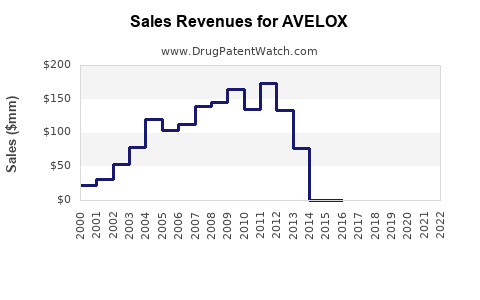
Bayer's public reporting treated Avelox within its pharmaceutical product portfolio and reported material sales during the product's mature branded period. The franchise was one of Bayer's important anti-infective products before patent expiry, but it did not remain a major growth driver after genericization. Bayer's later pharmaceutical strategy shifted toward oncology, cardiovascular disease, ophthalmology, women's health, and other specialty areas rather than rebuilding Avelox through lifecycle management. [3]
Exact Avelox revenue comparisons across years require harmonizing Bayer's reporting currency, segment definitions, discontinued-product treatment, and regional reporting. The directional conclusion is clear: sales peaked before generic entry and declined materially after 2014.
What caused the decline in Avelox demand?
Patent expiry was the largest discrete financial event, but several market forces reduced demand before and after generic entry.
Fluoroquinolone safety restrictions
The FDA required strengthened warnings for systemic fluoroquinolones, including risks involving tendinitis and tendon rupture, peripheral neuropathy, central nervous system effects, and other potentially serious adverse reactions. In 2016, the FDA stated that the risks of systemic fluoroquinolones generally outweighed the benefits for patients with acute bacterial sinusitis, acute bacterial exacerbation of chronic bronchitis, and uncomplicated urinary tract infections when alternative treatments were available. [4]
That regulatory position affected Avelox prescribing even before full generic erosion. Physicians and payers increasingly reserved systemic fluoroquinolones for cases in which alternatives were unsuitable.
Antimicrobial stewardship
Hospitals and health systems expanded stewardship programs designed to reduce unnecessary broad-spectrum antibiotic use, shorten treatment duration, and select narrower agents when clinically appropriate. These policies reduced volume and weakened the commercial value of broad outpatient antibiotic promotion.
Therapeutic competition
Avelox competed with:
- Levofloxacin, including branded Levaquin before genericization.
- Ciprofloxacin, particularly for gram-negative infections.
- Macrolides such as azithromycin.
- Beta-lactam and beta-lactamase-inhibitor combinations.
- Third-generation cephalosporins.
- Newer agents reserved for resistant infections.
For community-acquired pneumonia, clinical selection depended on local resistance patterns, patient comorbidities, safety considerations, route of administration, and hospital protocol. Moxifloxacin's broad activity did not guarantee preference when a narrower or safer alternative was available.
How strong was the Avelox patent estate?
Avelox had a strong initial compound position but a limited long-term moat after patent expiry.
Strengths
- Established small-molecule composition patent.
- FDA-approved oral and intravenous presentations.
- Broad clinical familiarity.
- Established manufacturing and distribution infrastructure.
- High pre-expiry prescription volume.
Weaknesses
- Conventional dosage forms were relatively easy to reproduce.
- The active ingredient was chemically defined and suitable for ANDA competition.
- No biologic-comparability barrier applied.
- Safety warnings reduced the value of broad method-of-use protection.
- Generic substitution rapidly transferred volume away from the brand.
Avelox's patent estate was therefore strong for the protected period but not durable after expiry. Its commercial profile was closer to a conventional chemical antibiotic than to a complex product with long-lived formulation or manufacturing barriers.
Does Avelox face biosimilar risk?
No. Avelox is a conventional small-molecule drug, not a biologic. Biosimilars do not apply. Competition occurs through generic drug applications, primarily ANDAs in the United States and equivalent generic pathways in other jurisdictions.
The relevant risks are generic entry, therapeutic substitution, tender pricing, hospital formulary exclusion, and reduced fluoroquinolone use. These risks are more direct and economically severe than biosimilar competition because multiple suppliers can enter once the relevant patents and regulatory exclusivities have expired.
What generic entry risks exist for Avelox?
The main generic-entry risks are already realized in the United States and other developed markets.
Oral tablets
Generic moxifloxacin tablets face low technical barriers. Price competition is intense because multiple manufacturers can supply bioequivalent products and pharmacists may substitute generic products under state law and payer policy.
Intravenous products
Generic injectable moxifloxacin has somewhat higher manufacturing, quality, and supply-chain requirements than tablets. Those requirements do not recreate meaningful branded exclusivity. Hospital purchasing organizations generally negotiate on price, supply reliability, and formulary status.
International markets
Patent expiry and generic penetration occurred on different schedules across jurisdictions because of national patent terms, supplementary protection certificates, regulatory approval timing, and local reimbursement systems. Europe, Canada, Japan, and emerging markets each had distinct launch and pricing dynamics. Bayer's global Avelox revenue therefore declined in stages rather than on a single worldwide date.
What is the current FDA and commercial status of Avelox?
Avelox remains a historically approved reference product, but it is no longer a protected U.S. growth asset. Generic moxifloxacin is available in oral and injectable forms, and systemic fluoroquinolone prescribing is constrained by FDA warnings and stewardship practices. [1, 4]
The brand's remaining economic value is limited by:
- Generic substitution.
- Low branded pricing power.
- Restricted use in several common indications.
- Hospital and payer procurement pressure.
- Mature-product marketing economics.
- Potential discontinuation or reduced commercial support in some regions.
Avelox's continuing relevance is primarily clinical and regulatory, not as a patent-protected revenue platform.
How does Avelox compare with Levaquin and Cipro?
| Factor |
Avelox |
Levaquin |
Cipro |
| Active ingredient |
Moxifloxacin |
Levofloxacin |
Ciprofloxacin |
| Drug class |
Fluoroquinolone |
Fluoroquinolone |
Fluoroquinolone |
| Main historical positioning |
Respiratory infections |
Respiratory and broad systemic use |
Gram-negative and urinary indications |
| U.S. brand status |
Genericized |
Genericized |
Genericized |
| Biosimilar exposure |
None |
None |
None |
| Current commercial model |
Generic commodity |
Generic commodity |
Generic commodity |
| Major constraint |
Safety warnings and stewardship |
Safety warnings and stewardship |
Resistance, safety warnings, and stewardship |
Avelox achieved commercial differentiation through respiratory positioning, but that differentiation weakened as physicians limited fluoroquinolone use and generic products became interchangeable on price.
What licensing deals affected Avelox?
Avelox was primarily a Bayer-developed and Bayer-commercialized product. It did not generate the type of major external licensing economics associated with many modern specialty pharmaceuticals. Regional distribution and commercialization arrangements may have existed, but the central value capture remained with Bayer and its affiliated commercial organizations.
The lack of a major external licensing structure reduced complexity in analyzing the product's financial trajectory. Revenue decline was mainly a function of product lifecycle, regulatory restrictions, and generic competition rather than royalty restructuring or a transfer of global rights.
Key Takeaways
- Avelox is Bayer's brand for moxifloxacin hydrochloride, a systemic fluoroquinolone.
- FDA approval began in 1999, with oral and intravenous products forming the core franchise.
- The principal U.S. patent protection expired in the mid-2010s, with historical Orange Book records identifying U.S. Patent No. 5,607,942.
- Generic moxifloxacin entry eliminated meaningful U.S. branded exclusivity.
- Avelox revenue declined after patent expiry and was further pressured by FDA safety warnings and antimicrobial stewardship.
- The product has no biosimilar risk because it is a conventional small molecule.
- Tablet and injectable generic competition created low long-term barriers to substitution.
- Avelox's patent estate was commercially strong during its protected period but lacked a durable formulation or manufacturing moat.
- The brand is no longer a significant growth or patent-value asset for Bayer.
FAQs About Avelox Patents, Revenue, and Competition
Is Avelox still sold as a brand?
Avelox may remain present in regulatory and market records, but generic moxifloxacin has replaced it as the principal U.S. supply source. Brand availability varies by country and commercial channel.
What is the generic name for Avelox?
The generic name is moxifloxacin hydrochloride. Generic products are supplied primarily as oral tablets and intravenous formulations.
Did Avelox have pediatric exclusivity?
Avelox's principal commercial protection came from patent and regulatory rights associated with the approved product. Any pediatric exclusivity or supplemental regulatory periods must be assessed against the specific historical FDA listing and product presentation.
Can a generic manufacturer launch Avelox without Bayer's permission?
A generic manufacturer can market moxifloxacin under the applicable ANDA or national generic-drug pathway after satisfying regulatory requirements and resolving relevant patent barriers. It cannot market the Bayer Avelox trademark without authorization.
Is moxifloxacin still used for pneumonia?
Yes. Moxifloxacin remains an option for selected adult respiratory infections, including some community-acquired pneumonia cases. Clinical use is constrained by resistance, patient-specific safety risks, FDA warnings, and availability of alternative antibiotics.
References
- U.S. Food and Drug Administration. (2023). Avelox (moxifloxacin hydrochloride) prescribing information. FDA.
- U.S. Food and Drug Administration. (n.d.). Approved drug products with therapeutic equivalence evaluations, Orange Book: Avelox and moxifloxacin patent listings. FDA.
- Bayer AG. (2005-2015). Annual reports and financial statements. Bayer AG.
- U.S. Food and Drug Administration. (2016, July 26). FDA updates warnings for fluoroquinolone antibiotics on risks of disabling side effects. FDA.