Share This Page
Drug Sales Trends for AVELOX
✉ Email this page to a colleague
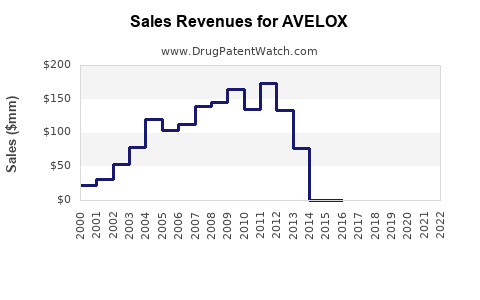
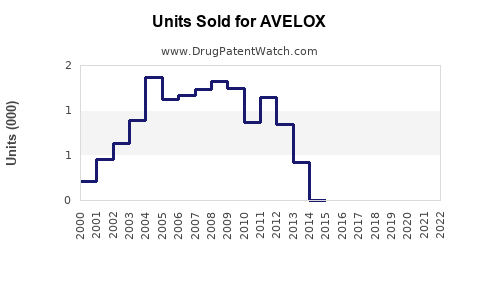
Annual Sales Revenues and Units Sold for AVELOX
| Drug Name | Revenues (USD) | Units | Year |
|---|---|---|---|
| AVELOX | ⤷ Start Trial | ⤷ Start Trial | 2022 |
| AVELOX | ⤷ Start Trial | ⤷ Start Trial | 2021 |
| AVELOX | ⤷ Start Trial | ⤷ Start Trial | 2020 |
| AVELOX | ⤷ Start Trial | ⤷ Start Trial | 2019 |
| AVELOX | ⤷ Start Trial | ⤷ Start Trial | 2018 |
| AVELOX | ⤷ Start Trial | ⤷ Start Trial | 2017 |
| AVELOX | ⤷ Start Trial | ⤷ Start Trial | 2016 |
| >Drug Name | >Revenues (USD) | >Units | >Year |
Avelox Market Analysis and Sales Projections: Moxifloxacin Commercial Outlook
Avelox, Bayer’s brand of moxifloxacin, is a mature fluoroquinolone antibiotic with no meaningful remaining U.S. brand franchise. The product lost market exclusivity years ago, generic moxifloxacin is widely available, and current revenue is concentrated in low-priced generic tablets and intravenous formulations. Avelox-branded sales are expected to remain negligible, while the broader moxifloxacin market should decline gradually as clinicians limit fluoroquinolone use because of safety warnings and antimicrobial-stewardship policies.
What is Avelox and what is its current FDA status?
Avelox is the former brand name for moxifloxacin hydrochloride, a fluoroquinolone antibacterial approved for selected bacterial infections. U.S. dosage forms included 400 mg oral tablets and an intravenous injection. The drug was approved by the FDA in 1999 under Bayer’s NDA 21-085.[1]
Moxifloxacin has been used for:
- Community-acquired bacterial pneumonia
- Acute bacterial sinusitis
- Acute bacterial exacerbations of chronic bronchitis
- Complicated and uncomplicated skin and skin-structure infections
- Intra-abdominal infections
- Certain other susceptible bacterial infections
The original Avelox label has been narrowed over time by safety warnings and changes in prescribing practice. Fluoroquinolones carry FDA warnings regarding tendinitis and tendon rupture, peripheral neuropathy, central nervous system effects, hypoglycemia, aortic aneurysm and dissection risk, and potentially disabling adverse reactions.[2][3]
The U.S. commercial market now consists mainly of generic moxifloxacin tablets and injections. Avelox is not a growth product for Bayer.
When did Avelox lose exclusivity?
Avelox lost practical market exclusivity after the expiration of its primary patent and the entry of generic moxifloxacin products. Generic versions are approved under the FDA’s Abbreviated New Drug Application pathway and are therapeutically equivalent to the reference product when assigned an “AB” rating in the Orange Book.[4]
| Milestone | Approximate timing | Commercial effect |
|---|---|---|
| FDA approval of Avelox | 1999 | U.S. brand launch |
| Core small-molecule patent protection | Expired before broad generic entry | End of durable brand exclusivity |
| Generic moxifloxacin entry | Mid-to-late 2000s | Rapid price and share erosion |
| Current U.S. market | Mature generic market | Minimal brand economics |
The exact patent history includes compound, formulation and method-of-use claims. Those rights no longer prevent routine generic supply. Current generic availability is the commercially relevant indicator that Avelox no longer has enforceable market exclusivity capable of supporting branded pricing.
What patents protect Avelox and moxifloxacin?
Avelox was protected primarily through patents covering moxifloxacin, pharmaceutical compositions and selected uses. The original product was a conventional small-molecule antibiotic rather than a biologic, so it did not have a biologics exclusivity period or biosimilar pathway.
Patent estate status
The commercially important patent categories were:
- Moxifloxacin compound claims.
- Pharmaceutical composition claims.
- Oral and injectable dosage-form claims.
- Method-of-treatment claims.
- Manufacturing and crystallization claims.
These categories have limited current value because the product has been genericized for many years. Later formulation or process patents, where enforceable, would not recreate the original Avelox franchise unless they covered a clinically differentiated product with a separate regulatory approval.
Formulation patents and manufacturing barriers
Moxifloxacin is available in conventional oral and intravenous forms. Those dosage forms use established pharmaceutical technology and do not create the technical barriers associated with sustained-release injectables, long-acting implants, complex biologics or device-linked delivery systems.
Potential manufacturing barriers include:
- Active pharmaceutical ingredient qualification
- Impurity control
- Sterile manufacturing for intravenous products
- Bioequivalence testing for oral tablets
- Supply-chain compliance and batch release
- Contract manufacturing capacity
These are operational hurdles rather than durable exclusion rights. Multiple generic manufacturers can address them, and the product does not require a proprietary delivery device.
What is the Orange Book status of Avelox?
The FDA Orange Book identifies approved drug products, patent information and therapeutic-equivalence ratings. Generic moxifloxacin products are listed against the relevant reference product and are generally eligible for substitution when the applicable product has an AB rating.[4]
Avelox’s current Orange Book importance is limited because:
- The brand no longer controls the commercial market.
- Generic moxifloxacin products are available.
- No current Avelox patent listing provides meaningful market protection comparable with a new product.
- The principal commercial issue is generic price competition, not patent enforcement.
The intravenous formulation may have different approved product listings and manufacturers from the tablet formulation, but both are mature generic segments.
How large is the Avelox market?
The market should be divided into two segments:
- Avelox-branded sales.
- Total moxifloxacin sales across generic oral and intravenous products.
Avelox-branded market
Avelox-branded sales are expected to be immaterial in the United States. Brand retention in mature antibiotics is generally limited to hospitals, legacy formularies, or markets where generic penetration is incomplete. Bayer’s current pharmaceutical reporting does not identify Avelox as a major separately reported growth brand.[5]
A practical base-case estimate for current U.S. Avelox-branded revenue is below $5 million annually, with a high probability that actual revenue is substantially lower or effectively zero. This is an analytical estimate, not a reported Bayer sales figure.
Total moxifloxacin market
The total market remains larger than branded Avelox sales because it includes:
- Generic 400 mg tablets
- Generic intravenous moxifloxacin
- Hospital and institutional purchases
- International sales
- Government and public-health procurement
- Limited specialty use in resistant or complicated infections
Revenue is constrained by generic competition and low unit prices. Hospital purchasing can produce volume, but it also imposes aggressive tender discounts.
What are Avelox sales projections through 2030?
Avelox does not have a credible branded growth trajectory. The relevant forecast is a mature-market projection for branded Avelox and total moxifloxacin.
Base-case sales projection
| Year | Avelox branded sales estimate | Total moxifloxacin market estimate | Market view |
|---|---|---|---|
| 2024 | Less than $5 million | $150 million-$250 million globally | Mature generic demand |
| 2025 | Less than $4 million | $145 million-$240 million | Continued price pressure |
| 2026 | Less than $3 million | $138 million-$230 million | Modest volume decline |
| 2027 | Less than $2 million | $130 million-$220 million | More tender competition |
| 2028 | Less than $2 million | $122 million-$210 million | Brand becomes commercially negligible |
| 2029 | Less than $1 million | $114 million-$200 million | Generic consolidation |
| 2030 | Less than $1 million | $105 million-$190 million | Mature, declining category |
The total-market figures are scenario estimates based on the product’s age, generic penetration, declining brand relevance, antibiotic-stewardship restrictions and expected price erosion. They are not company-reported forecasts.
Scenario analysis
| Scenario | 2030 total moxifloxacin market | Main assumptions |
|---|---|---|
| Upside | $190 million-$230 million | Stable hospital use, slower price erosion, continued international demand |
| Base case | $105 million-$190 million | Low-single-digit volume decline and ongoing generic price compression |
| Downside | $60 million-$105 million | Faster fluoroquinolone restrictions, fewer hospital uses and aggressive tender pricing |
The upside case does not imply recovery of Avelox-branded revenue. Any upside would accrue mainly to low-cost generic manufacturers with efficient API sourcing and hospital distribution.
What drives demand for moxifloxacin?
Moxifloxacin demand is supported by its broad antibacterial spectrum and once-daily 400 mg dosing. Its intravenous formulation also provides a hospital option for patients unable to take oral medicines.
Demand is limited by several factors:
- FDA safety warnings for systemic fluoroquinolones
- Availability of lower-cost antibiotics
- Antimicrobial-resistance concerns
- Hospital stewardship protocols
- Avoidance in patients with elevated tendon, nerve, cardiovascular or glucose-related risks
- Generic price competition
- Narrower use in uncomplicated infections
Moxifloxacin retains clinical relevance in selected respiratory, intra-abdominal and hospital settings, but it is unlikely to regain the broad outpatient role it held during the branded period.
Which companies compete with Avelox?
Avelox competes with generic moxifloxacin manufacturers and alternative antibiotics rather than with a single branded rival.
Generic competitors
The U.S. market has included products from manufacturers such as:
- Hikma Pharmaceuticals
- Sandoz
- Teva Pharmaceuticals
- Dr. Reddy’s Laboratories
- Lupin
- Zydus Pharmaceuticals
- Rising Pharmaceuticals
- Mylan, now part of Viatris
- Other regional and contract manufacturers
The specific active supplier set changes as companies enter, discontinue or consolidate product lines.
Therapeutic competitors
Moxifloxacin competes clinically with:
- Levofloxacin
- Ciprofloxacin
- Doxycycline
- Amoxicillin-clavulanate
- Ceftriaxone
- Azithromycin
- Other guideline-directed antibiotics
Levofloxacin is the closest large-market fluoroquinolone comparator in many respiratory and hospital applications. Ciprofloxacin has stronger positioning in certain gram-negative and urinary indications, while doxycycline and beta-lactam combinations often benefit from stewardship preferences.
How does Avelox compare with levofloxacin?
| Factor | Moxifloxacin/Avelox | Levofloxacin |
|---|---|---|
| Brand status | Avelox is commercially obsolete in the U.S. | Levaquin also lost exclusivity |
| Main dosage forms | Oral and intravenous | Oral and intravenous |
| Generic competition | High | High |
| Respiratory use | Strong historical position | Broad respiratory and hospital use |
| Urinary positioning | Limited by pharmacology | More established |
| Commercial outlook | Mature and declining | Larger, more diversified generic market |
| Patent value | No material current brand protection | No material current brand protection |
Levofloxacin generally has a broader commercial footprint because of its respiratory, urinary and hospital uses. Moxifloxacin’s limited urinary role and greater stewardship scrutiny constrain its market size.
Are companies challenging Avelox with Paragraph IV filings?
Paragraph IV litigation was relevant during the original generic-entry period, when generic applicants challenged listed patents or asserted that patents were invalid or not infringed. That phase is commercially complete.
There is no current strategic value in a new Paragraph IV challenge to Avelox because:
- The product is already genericized.
- The core exclusivity period has ended.
- Generic products are already approved.
- A new challenger would face low prices and entrenched suppliers rather than a protected branded market.
The present risk is reverse: manufacturers can lose profitability through price erosion, supply disruption or withdrawal from low-margin contracts.
What patent litigation affects Avelox today?
Current Avelox economics are not driven by active patent litigation. Any residual disputes would more likely involve:
- Generic product quality
- Manufacturing compliance
- Contract disputes
- Supply obligations
- Antitrust or procurement issues
- Product liability claims
Product liability exposure can remain after patent expiry. Fluoroquinolone litigation has historically focused on tendon injury, neuropathy, aortic complications and other alleged adverse effects. Such claims can affect manufacturers’ legal reserves and insurance costs even when patent protection no longer exists.
Does Avelox have biosimilar risk?
No. Avelox is a small-molecule drug, not a biologic. Biosimilar competition under the Public Health Service Act does not apply. The relevant competitors are abbreviated new drug applications, generic tablets and generic injectable products.
What licensing deals affect Avelox?
No current licensing transaction is known to create a meaningful commercial catalyst for Avelox. The product is too mature for a conventional branded licensing deal to support significant value unless a license involves:
- A new delivery system
- A reformulated product
- A fixed-dose combination
- A differentiated hospital formulation
- A non-U.S. commercialization territory
- A new indication with regulatory exclusivity
Without a new formulation or indication, licensing Avelox would transfer a low-margin generic asset rather than a protected franchise.
How strong is the Avelox patent estate?
The current patent estate is weak from an investment and partnering perspective.
| Patent-estate factor | Assessment |
|---|---|
| Core compound protection | Expired |
| Generic blocking power | None of material significance |
| Formulation differentiation | Limited |
| Manufacturing protection | Possible process know-how, but weak exclusion |
| Regulatory exclusivity | Expired |
| Biosimilar protection | Not applicable |
| Litigation leverage | Low |
| Commercial durability | Low |
The strongest remaining asset is not intellectual property. It is operational capability in API sourcing, sterile manufacturing, regulatory compliance and institutional distribution.
What generic launch scenarios exist for Avelox?
Three scenarios are commercially plausible:
- Continued generic supply. Several manufacturers remain active, prices decline gradually and the market contracts slowly.
- Supplier consolidation. Low margins cause one or more manufacturers to exit, creating intermittent shortages or temporary price increases.
- Hospital-only persistence. Oral use declines faster, while injectable moxifloxacin remains in selected institutional settings.
A full branded relaunch is unlikely. A differentiated reformulation could change the outlook, but it would be a new commercial proposition rather than a recovery of legacy Avelox sales.
Key Takeaways
- Avelox is a mature moxifloxacin brand with no meaningful remaining U.S. exclusivity.
- Generic moxifloxacin, not branded Avelox, controls the current market.
- Avelox-branded annual revenue is likely below $5 million and may be negligible.
- Global moxifloxacin revenue is estimated at roughly $150 million-$250 million in 2024, with a base-case decline to $105 million-$190 million by 2030.
- The main risks are generic price erosion, antimicrobial stewardship, safety warnings and hospital formulary restrictions.
- There is no meaningful current Paragraph IV, biosimilar or patent-litigation catalyst.
- Commercial value resides in manufacturing efficiency and distribution, not in the legacy Avelox patent estate.
FAQs
Is Avelox still prescribed?
Moxifloxacin is still prescribed in selected bacterial infections, but prescriptions are generally for generic moxifloxacin rather than branded Avelox.
Is Avelox the same as Vigamox?
No. Avelox is systemic moxifloxacin, historically available as oral and intravenous therapy. Vigamox is an ophthalmic moxifloxacin product with a separate formulation and commercial history.
Can generic manufacturers still launch moxifloxacin?
Yes. Moxifloxacin is an established generic product. Launch economics depend on FDA approval, manufacturing capacity, API cost, supply reliability and contracting terms.
Does Avelox have pediatric market potential?
Systemic moxifloxacin has limited pediatric use because fluoroquinolone risk-benefit considerations are more restrictive in children. Pediatric expansion is not a credible base-case sales driver.
What would be required to revive Avelox sales?
A commercial revival would require a new clinically differentiated formulation, a new approved indication, a delivery-system advantage or a protected combination product. Rebranding the existing tablet or injection would not overcome generic competition.
References
-
U.S. Food and Drug Administration. (1999). Avelox prescribing information, NDA 21-085. FDA Drugs@FDA database.
-
U.S. Food and Drug Administration. (2016). FDA updates warnings for oral and injectable fluoroquinolone antibiotics due to disabling side effects. FDA Drug Safety Communication.
-
U.S. Food and Drug Administration. (2018). Fluoroquinolone antibiotics: FDA requires label changes due to risk of aortic aneurysm and dissection. FDA Drug Safety Communication.
-
U.S. Food and Drug Administration. (2024). Approved drug products with therapeutic equivalence evaluations. FDA Orange Book.
-
Bayer AG. (2024). Annual report 2023. Bayer Investor Relations.
More… ↓
