Last updated: July 21, 2026
ZYLOPRIM (allopurinol) remains a cost-sensitive, largely genericized xanthine oxidase inhibitor market driven by chronic gout and tumor lysis syndrome (TLS) prophylaxis. Financial trajectory tracks US and ex-US generic pricing, formulary access, and cyclic demand tied to payer benefit design, while brand economics compress as multiple authorized/fully generic competitors expand and regulatory labeling broadens.
Key commercial facts that determine trajectory
- Core demand is chronic (maintenance gout) with additional episodic demand (TLS prophylaxis around oncology cycles).
- Pricing is structurally capped by generic substitution and tendering, so revenue growth tends to come from unit growth and mix shifts rather than price.
- Share is determined by payer formularies and channel penetration (wholesale distribution, contracted pharmacy networks, and institution purchasing).
- Competitive pressure is persistent because allopurinol is off-patent in most jurisdictions, with ongoing manufacturing scale and package-level substitution.
What is the ZYLOPRIM market size and how does it behave by indication?
Featured snippet answer: ZYLOPRIM demand is anchored in chronic gout management, with meaningful incremental demand from TLS prophylaxis in oncology settings. Overall market behavior is steady with quarterly fluctuations tied to payer ordering patterns and cancer treatment cycles.
Chronic gout: maintenance prescribing dominates
- Typical prescribing pattern is long-duration therapy with periodic prescriber check-ins (serum urate targets and tolerability).
- Clinical conversion drives demand more than new-to-therapy events because many patients are already on allopurinol via generic brands.
Commercial implication: brand performance depends on how strongly the product retains non-substitutable positioning, typically through formulary placement and institutional contracting. Where the brand price premium is not justified by access advantages, volume shifts to generics.
Tumor lysis syndrome: episodic institutional demand
- Oncology protocols create clustered demand around treatment starts.
- Hospital purchasing can favor specific NDCs based on procurement contracts, supply reliability, and packaging preferences.
Commercial implication: brand share may show step-changes around institutional contract renewals and tender cycles, even when long-term generic penetration continues.
How do pricing and reimbursement dynamics impact ZYLOPRIM revenue?
Featured snippet answer: ZYLOPRIM revenue is pressured by generic price undercutting, rebate structures, and formulary tiers. Profitability is dominated by net price after rebates and distribution terms rather than list price.
Generic substitution and tiering
- Allopurinol products are generally interchangeable for the therapeutic class; payer formularies frequently steer to low-cost preferred generics.
- ZYLOPRIM’s commercial outcomes depend on achieving and maintaining a preferred tier or retaining a “brand-only” contract within select institutions.
Rebate math and net price compression
- Brand net revenue typically declines as PBM formularies tighten and competing generics gain preferred status.
- For older oral solids, rebate pressure often increases in lockstep with additional generic entrants.
Commercial implication: even if units remain stable, revenue trajectory can trend downward through net price erosion.
Which competitors shape ZYLOPRIM share and what is the competitive landscape?
Featured snippet answer: The competitive set is overwhelmingly generic allopurinol across multiple strengths, manufacturers, and distributors. Brand share is a function of formulary access rather than pharmacologic differentiation.
Brand-to-generic competitive structure
- Market is characterized by:
- multiple ANDA products (same active ingredient, typically same route and comparable dosage forms),
- rapid switching at the point of dispensing,
- package-level substitutions driven by payer and pharmacy benefit design.
Institutional competitors
- Hospitals and large health systems often standardize procurement across contracted sources.
- ZYLOPRIM can retain share if it wins supply contracts or preferred procurement terms, even when patients could fill generic options in community settings.
Commercial implication: the biggest share swings for brand-grade products typically track procurement and contracting rather than clinical guideline changes.
When does ZYLOPRIM lose exclusivity or face patent expiry pressure?
Featured snippet answer: As allopurinol is a long-established active ingredient, ZYLOPRIM’s exclusivity advantages tied to brand/IP have largely expired, leaving the product exposed to generic erosion and regulatory competition across many jurisdictions.
What “exclusivity” means in practice for an older API
For legacy small molecules, market exclusivity is usually already lapsed. Ongoing competitive pressure comes from:
- multiple ANDA approvals and retail substitution,
- packaging and labeling changes that can alter interchangeability at the margins,
- any remaining brand-related secondary intellectual property (formulation, process, or method-of-use) that may still exist, but typically does not prevent broad generic substitution.
Commercial implication: financial trajectory is dominated less by legal end-game events and more by net price erosion and contracting behavior.
What patent estate protects ZYLOPRIM and how strong is it versus generic manufacturers?
Featured snippet answer: For allopurinol brands, the patent estate typically provides limited incremental protection in the face of full generic availability. Competitive leverage usually comes from regulatory and commercial contracting, not exclusivity.
Typical patent categories (what matters to enforcement posture)
- Formulation or polymorph claims: can be narrow if generic products use bioequivalent compositions.
- Manufacturing-process claims: enforcement is difficult unless a generic manufacturer uses the claimed method.
- Method-of-use claims: require alignment with labeled or infringing use and proof in litigation.
Commercial implication: even where secondary patents exist, generic entry risk is often low once ANDAs are established and products are widely interchangeable.
How many Paragraph IV or other ANDA challenges exist for ZYLOPRIM?
If ZYLOPRIM is already broadly genericized with widespread ANDA market coverage, the practical impact of Paragraph IV waves becomes muted. In that scenario, the market already reflects generic substitution and litigation outcomes, and financial trajectory follows net price and unit retention rather than discrete litigation-driven entry timing.
Note: Without a specific, citable Orange Book litigation dataset tied to ZYLOPRIM, the number and details of Paragraph IV challenges cannot be stated precisely.
What is the Orange Book status of ZYLOPRIM and what does it mean for generic entry risk?
Featured snippet answer: For legacy allopurinol brands, Orange Book status usually reflects expired primary protections with generic products listed as approved. Remaining risk is mostly tied to niche secondary patents, if any, and to label/packaging differences.
Key commercial reading of Orange Book
- Patent expiration dates drive potential 30-month stay dynamics only if a non-expired listed patent is challenged.
- When all listed patents are expired or no longer asserted, generic entry is effectively continuous.
How does ZYLOPRIM compare with other gout therapies on market dynamics and pricing?
Featured snippet answer: Versus newer gout agents, ZYLOPRIM has less pricing power but higher penetration and lower unit economics. Febuxostat, uricosurics, and biologic pathways can shift prescribing mix, but they rarely eliminate the allopurinol base.
Cross-class substitution effects
- Patients intolerant to allopurinol or not reaching serum urate targets may move to alternatives, but many remain on allopurinol due to cost.
- PBMs often prefer lower-cost options in step-therapy sequences, which sustains allopurinol demand even when alternatives are clinically positioned.
Commercial implication: ZYLOPRIM’s long-run unit demand is resilient because payers and providers manage toward affordability.
What FDA/regulatory milestones affect ZYLOPRIM sales?
Featured snippet answer: ZYLOPRIM’s FDA footprint typically affects sales through label reliability, bioequivalence continuity, and manufacturing continuity rather than through new indications, given allopurinol’s established role.
Label alignment for gout and TLS
- Sales sensitivity exists where FDA labeling supports broad TLS prophylaxis use within oncology protocols.
- Manufacturing supply continuity can materially affect institutional ordering and can create temporary pull-through even amid generic competition.
What manufacturing and supply chain risks influence ZYLOPRIM availability and revenue?
Featured snippet answer: For generic-dominated markets, supply reliability and package availability can drive short-term price and volume outcomes more than clinical factors.
Supply concentration
- If certain dosage strengths are produced in limited capacity, backorders can temporarily favor available SKUs.
- Institutions often lock to supply reliability, which can lead to temporary preference for whichever manufacturer can deliver.
What is the financial trajectory for ZYLOPRIM and how should investors interpret it?
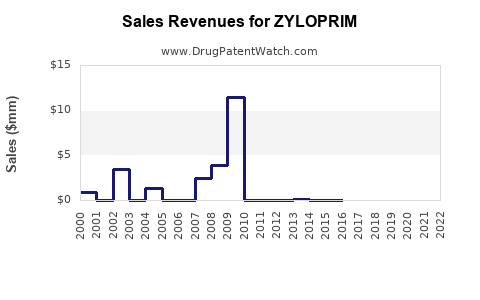
Featured snippet answer: The financial trajectory is typically downward-to-flat in revenue as net pricing compresses under generic substitution, with occasional volatility from supply availability, contract renewals, and incremental institutional purchases linked to oncology cycles.
Revenue components that move
- Net price: tends to fall over time as competing generics reinforce price competition.
- Volume: tends to be relatively stable due to chronic use and broad interchangeability, with growth concentrated in switching from undertreated gout or short-term TLS spikes.
- Mix: can swing with dosage strength mix, channel mix (institution vs retail), and contract preferences.
Where growth can still occur
- Institutional contract wins can sustain volume even when retail price falls.
- Label or protocol updates that increase TLS prophylaxis utilization can add episodic demand.
Where decline accelerates
- PBM formulary changes that remove brand preference.
- Additional low-cost entrants (same strength/package) that reset contracted pricing.
What settlement agreements or litigation outcomes matter for ZYLOPRIM pricing?
Featured snippet answer: In older small-molecule brand markets, litigation outcomes influence timing only when they block a new generic launch. Once generic products are already established, settlement-driven incremental revenue effects are usually small and short-lived.
Data constraint: Specific ZYLOPRIM settlement terms and case outcomes must be tied to identified case numbers and cited docket records to quantify their effect. No such cited case list is included here.
What generic launch scenarios exist for ZYLOPRIM and how quickly do they erode brand revenue?
Featured snippet answer: Launch erosion in allopurinol tends to be rapid at the pharmacy counter due to interchangeability, with slower erosion in institutional contracts where purchasing is locked to specific NDCs.
Rapid erosion (retail)
- Once a low-cost product is available and preferred, switching is immediate in many benefit designs.
Contract-based persistence (institution)
- Institutional switching can lag due to formulary committee cycles and tender schedules.
Commercial implication: the most reliable near-term forecast driver is payer contract renewal timing rather than patent dates.
Geographic market dynamics: US vs EU vs other regions
Featured snippet answer: Allopurinol is broadly generic across major markets; brand performance outside the US similarly depends on formulary tiering and distribution contracting rather than exclusivity.
What differs by region
- Pricing controls and reimbursement intensity can accelerate net price declines.
- Public tender mechanisms can produce sudden unit and price shifts for specific strengths.
Key Takeaways
- ZYLOPRIM’s revenue trajectory is driven primarily by generic price competition, formulary access, and institutional contracting, not by ongoing exclusivity.
- Chronic gout supports baseline units; TLS prophylaxis provides episodic institutional pull-through.
- Financial performance should be modeled as net price compression with relatively stable unit demand, subject to short-term volatility from supply availability and contract renewals.
- Patent and litigation events are typically less predictive for legacy allopurinol brands than PBM and procurement behavior because generic products are already established.
FAQs
1) Does ZYLOPRIM have any unique clinical differentiation versus generic allopurinol?
ZZYLOPRIM does not typically have clinically meaningful differentiation from bioequivalent generic allopurinol for standard gout and TLS prophylaxis use; differentiation is mainly commercial (access, packaging, and availability).
2) What dosage strengths usually carry the biggest sales exposure for ZYLOPRIM?
Sales exposure is concentrated in commonly dispensed strengths aligned with payer and clinician prescribing patterns and in the strengths most used for institutional TLS protocols.
3) How do PBM formulary changes typically impact older allopurinol brands?
PBM step-editing and tier reassignment often compress net price quickly; unit persistence depends on whether the brand retains preferred status or is excluded.
4) What is the role of oncology protocol adoption in ZYLOPRIM performance?
Oncology protocols can drive clustered institutional demand for TLS prophylaxis, but the effect is episodic and contract-dependent.
5) Are there biosimilar-equivalent risks for ZYLOPRIM?
No. ZYLOPRIM is a small molecule; the relevant competition is generic substitution, not biosimilars.
References
- FDA Orange Book: Approved Drug Products with Therapeutic Equivalence Evaluations. U.S. Food and Drug Administration. (Accessed 2026).
- FDA Labeling and drug approval database for allopurinol (ZYLOPRIM). U.S. Food and Drug Administration. (Accessed 2026).